

Corporate Bonds Or Gold: Choosing Between Fixed Income And Wealth Creation


Investing is not just saving; it entails an opportunity to achieve capital appreciation. While the financial goals of individuals vary according to their distinct needs, at the heart of any fiscal goal is the need for portfolio growth with stability. It is these fiscal goals and objectives that determine the actual strategy of investing and set the tone of investment philosophy.
As 2026 begins, it is important to take a closer look at our investments and align them with our financial goals. Amid the rising geopolitical instability and ongoing volatility, it is important to understand the significance of stable growth.
Therefore, this blog explores Corporate Bonds VS Gold India to comparatively analyse the incorporation of fixed-income capital growth and hedge in the 2026 portfolio.
Importance Of Defining Investment Objectives
The first step to building an optimal 2026 portfolio is to determine the investment objective because the investment philosophy and strategy would be based on the objectives of the investor. Exploring the detailed breakdown of its importance is key to choosing a suitable investment objective:
- Goal Clarity
Setting an investment objective gives investors clarity and enables them to choose suitable assets. Without goal clarity, investors can go on to choose assets beyond their risk tolerance or that don’t meet return needs. - Risk Management
Establishing investment goals reveals an accurate assessment of your risk tolerance. It guarantees that the chosen investment fits your tolerance capacity to withstand market volatility and headwinds - Decision-Making Framework
In times of uncertainty or market turbulence, investment objectives assist you in staying on the chosen path and making relevant portfolio modifications.
Choosing Between Stable, Fixed-Income And Wealth Creation
Every portfolio requires a proportion of fixed-income securities to ensure portfolio stability, irrespective of risk tolerance. However, the proportion of these assets can vary with risk tolerance and financial objectives. Discussed below are different factors that can help create a balance between potential appreciation and stability.
- Financial Goals
Investors must consider whether they are looking for long-term wealth creation, capital preservation, or portfolio diversification. The goal can help determine the proportion of assets. For instance, an investor who faces a heightened market volatility can increase the proportion of safe-haven assets. - Returns Expectations
The amount or nature of returns anticipated by an investor plays a key role in choosing assets. For instance, investors who aim to create passive income can prioritise fixed-income sources like high-yielding FDs, corporate bonds, etc. - Risk Tolerance
Determine your readiness to withstand drops in your investment value. For example, stability investments have lower risk, whilst potential appreciation alternatives have a higher risk exposure.
With these basics in mind, let us understand the outlook and projected patterns for the new year 2026, before getting into investments like Gold VS Bonds Investment 2026.
2026 Market Outlook And Market Projections
Sensex and Nifty 50 began 2025 at 77,500 and 23637.65, respectively. Although both delivered a muted performance in 2025, compared to global indices, 2025 saw some key rallies. The chart below comparatively illustrates the performance of Sensex and Nifty with major global counterparts.
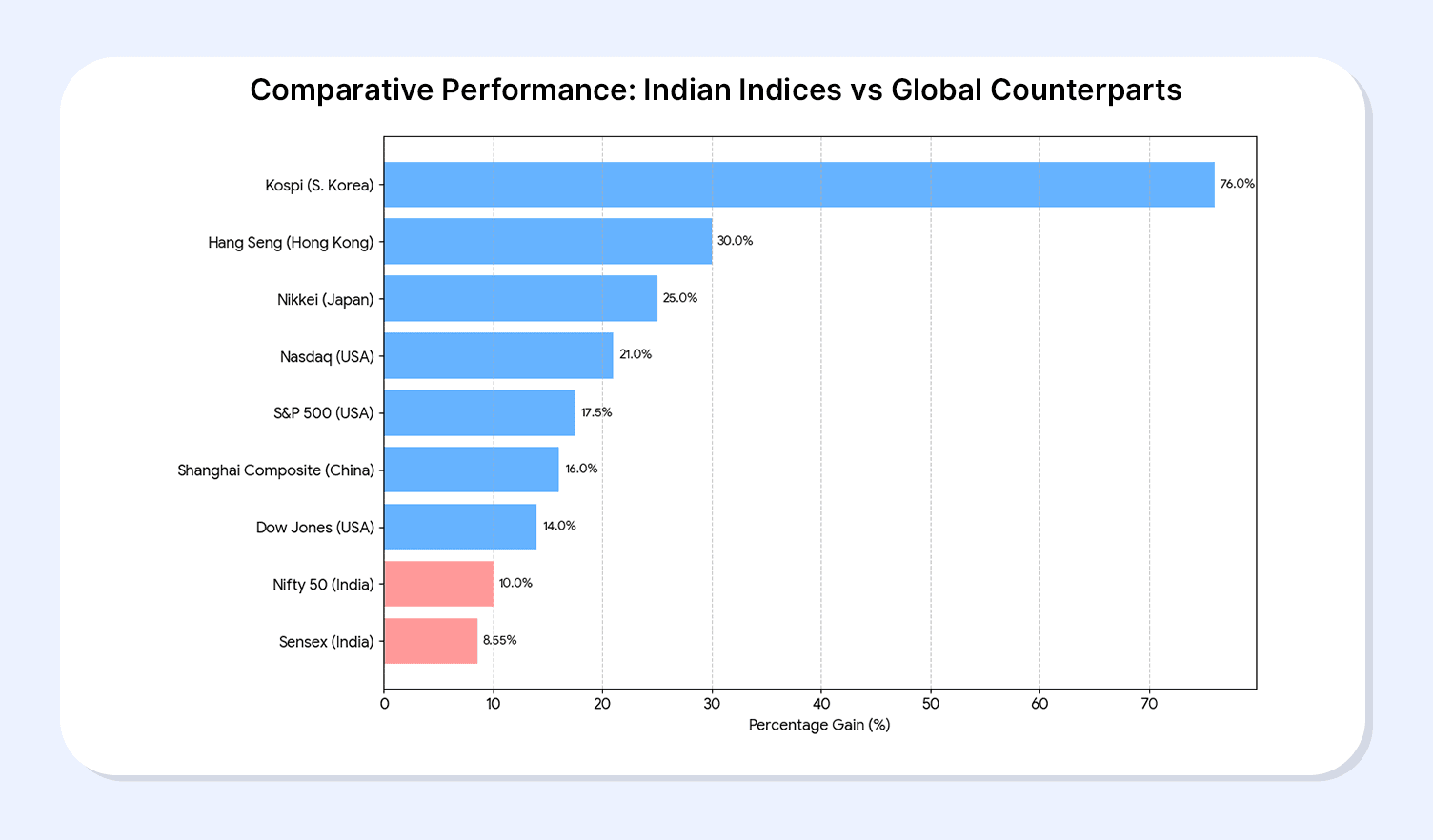
Experts anticipate Sensex might reach the 98,000 level in 2026, while Nifty 50 can hit anywhere between 28,500 and 29,800 in the case of the expected bull run. Sectors like Banking, Consumer, Defence, Metal, Oil, Energy and Power remain in the Can-Watch list of analysts. While the outlook remains positive, experts also give cautions. Discussed below are some reasons why.
- Fed Cuts: In December 2025, the US Federal Reserve cut the federal fund rate by 25 basis points. It implies that inter-bank borrowing in the US will be cheaper. This liquidity rise in the biggest economy implies greater global liquidity. It can be beneficial to the Indian markets, as it can boost the FIIs and FDIs in India, which were declining before.
- Overvaluation: Stretched company valuations diminish investor confidence. Certain overvalued stocks in the Indian markets have increased market volatility in 2025 and can have an impact on the 2026 markets as well.
- Global Uncertainties: Global variables like rising conflicts, hostilities, tariff pressure from the US, etc., can impose a detrimental impact on the Indian markets.
Given this mixed bag of positive and cautionary market expectations, let us discuss and comparatively analyse two key assets that can instil portfolio stability. Let us explore which is better between the Best Investment Bonds or Gold India1.
Corporate Bonds VS Gold India: Meaning And Features
Corporate bonds and gold are popular investment assets. Nevertheless, deciding which one to choose is totally dependent on the financial objectives of an investor. Let us go into the features they have so you can make an informed selection or asset mix.
1. Corporate Bonds
To raise money from investors, businesses issue corporate bonds as debt instruments. These bonds usually have a set maturity time and a fixed interest rate. Corporate bonds, particularly high-yield bonds, can provide capital preservation and steady, consistent income for investors who are risk-averse. Discussed below are some of its features.
- Regular Payments: With coupon payments and a consistent cash flow at periodic intervals, corporate bonds provide a reliable source of income.
- Lower Volatility: The volatility of corporate bonds is comparatively lower. When looking for steady returns and avoiding risk, they can be helpful.
- Diversification: Along with stocks and other riskier assets, corporate bonds are a useful tool for portfolio diversification.
2. Gold
Being a tangible asset, gold has high intrinsic value, cementing its position as a safe-haven instrument that can preserve capital during volatility. It is advantageous for people looking to diversify and gain from capital growth in order to create the necessary wealth. There are several ways to invest in gold. You may invest in real gold, such as jewellery, coins, and bars, as well as digital gold, gold ETFs, gold mutual funds, and gold savings plans. Discussed below are the key characteristics of gold.
- Safe-Haven Asset: Globally, gold is a valued commodity. It serves as a buffer against inflation and currency swings. In times of conflict and similar circumstances, it is a recommended investment choice.
- Diversification: Since gold's price fluctuations often do not directly coincide with those of other asset classes, making investments in gold diversifies risk.
- Long-term Store Of Value: In contrast to a number of other asset types, gold is a traditional store of value. It maintains its purchasing power and does not lose value as a result of economic unrest.
After exploring the meaning and features of Corporate Bonds VS Gold India, let us break down and take a closer look at its key differentiators.
Corporate Bonds VS Gold: Which Is Better?
This section compares the return, risk, volatility, and tax implications, along with other parameters, of the two key assets, corporate bonds and gold.
1. Corporate Bonds VS Gold Returns
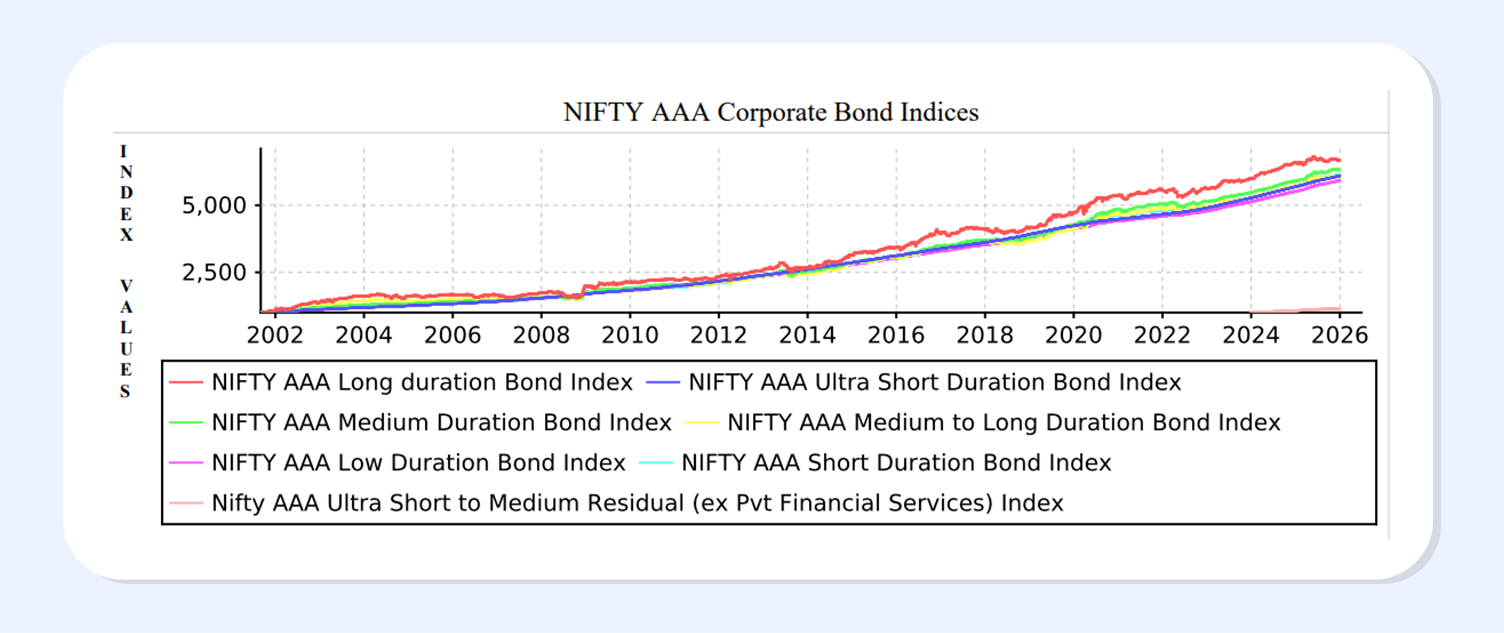
Apart from particular corporate bonds, different indices can help us analyse the performance of the corporate bond market in general. Let us take the Nifty AAA Corporate bond benchmark. This highly rated bond index includes bonds of different ranges, from ultra-short-term to long-term. As of 31 December 2025, the highest return since inception is recorded by NIFTY AAA Long Duration Bond Index at 8.11%. The chart below shows the returns of different bond indices from 2002 to 2026.
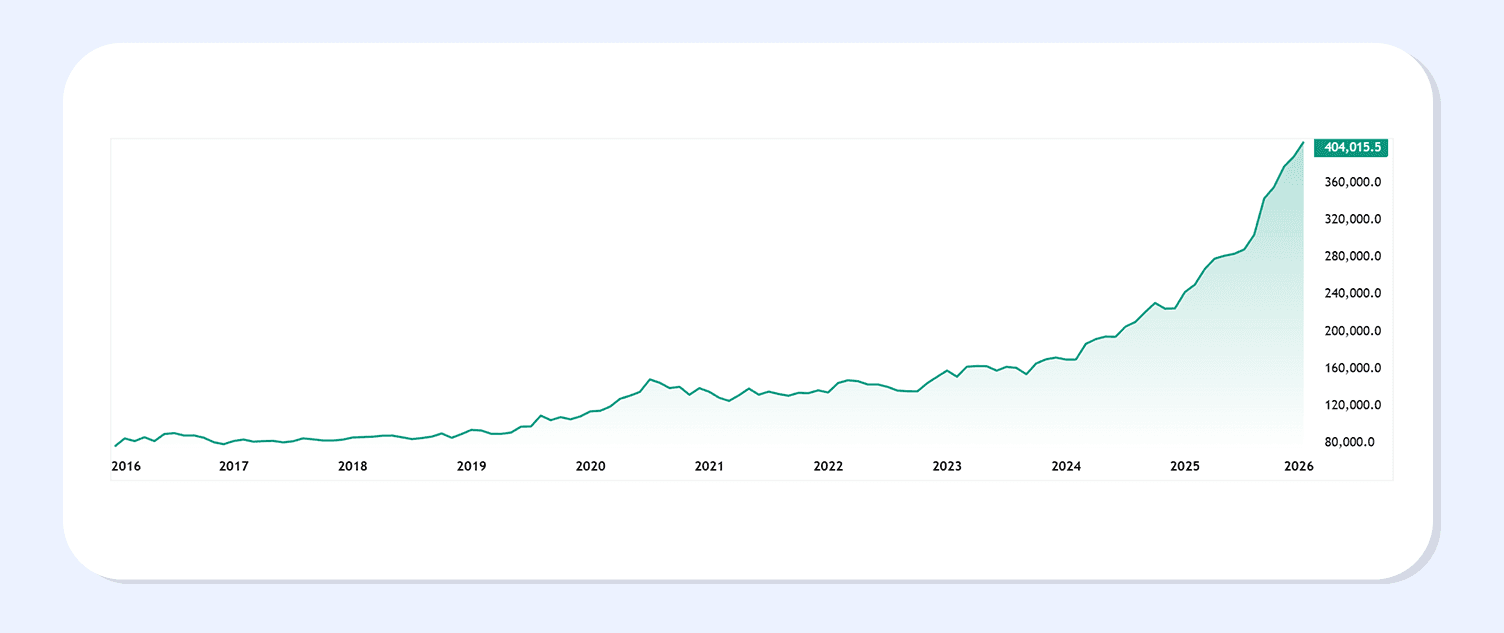
On the other hand, gold has emerged as the best-performing asset in 25 years, beating investments like silver, NSE Nifty, and Sensex. At 14.3% average yearly returns over 25 years, this cements the position of this asset as a key instrument not only for hedging during market volatility but also for growth. The graph below highlights its performance over 10 years, from 2016 to 2026.
2. Corporate Bonds VS Gold India: Risk and Volatility
Both bonds and gold are low-risk assets when compared to market investments like equity. However, if we consider liquidity, which is a key determinant of risk, a minute difference appears.
In the case of gold, liquidity depends on the nature of holding. For instance, while gold ETFs are highly liquid, physical gold can be harder to sell. Moreover, the making charges and lowered purity of physical gold often result in diminished post-sale returns. Corporate bonds, on the other hand, have optimal liquidity. Moreover, the upcoming NSDL Bond Selling Platform is expected to improve bond liquidity further.
Finally, gold rates incur a direct impact of global trends. Historically, events like the pandemic can cause sharp volatility and market headwinds. On the other hand, while corporate bonds face interest rate or credit risk, the fixed returns of the coupon rate can reduce the risk.
3. Corporate Bonds VS Gold India: Tax Implications
The applicable tax rate diminishes the return expected. Therefore, it must be considered when comparing asset classes. The table below shows the taxability of corporate bonds and gold.
| Parameters | Corporate Bond | Gold |
| LTCG | 12.5% (transfer on or after 23 July 2024) | 12.5% |
| STCG | Applicable Tax Slab | Applicable Tax Slab |
| GST | NA | Physical gold has GST Gold = 3% Making Charge = 5% |
4. Gold VS Bonds Investment 2026: Comprehensive Comparison Table
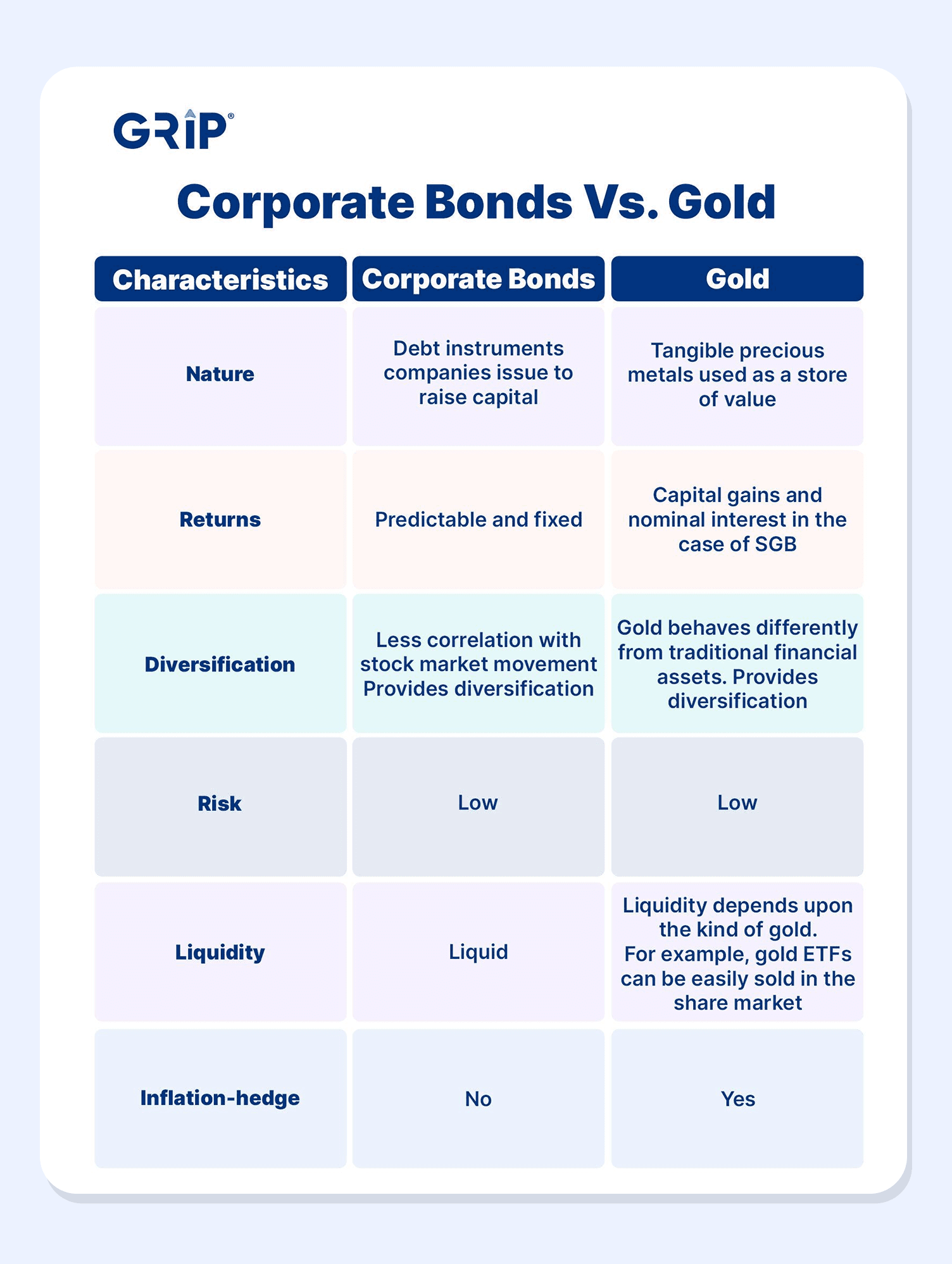
Gold and corporate bonds both have unique characteristics and are used for various investing objectives. Who claims a spot in your future financial journey depends on your risk tolerance and investing objectives. To assist you in selecting one to meet your investing goals, below is a summary of both:
The first-of-its-kind alternative investment product, BondX, offers investors access to investment-grade rated bonds from a carefully chosen group of issuers at a fractionalised investment size. Curated for individual investors, BondX is a credit-rated, diversified, and SEBI-compliant product.
Given the substantial growth prospects and regulatory support meted out to corporate bonds, they might be a great option for steady returns with less volatility.
Corporate Bond Surge: A New Alternative To Gold
Given the muted performance and volatility of equity investments during certain periods in India, the corporate bond is emerging as a popular investment medium. Moreover, according to a SEBI mandate, NSDL is gearing up to soon launch a bond-selling platform that will boost liquidity. Moreover, reports suggest that corporate bond issuances can reach INR 11 trillion in 2026.
Corporate Bond Surge: A New Alternative To Gold
Corporate bond issuances in India are set to exceed INR 11 trillion in FY26, driven by faster transmission of rate cuts in the bond market relative to banks. With benchmark yields falling more than 35 basis points since January and strong institutional demand, bonds are becoming a cost-efficient and liquid option, making them an even more compelling portfolio alternative alongside gold.
Conclusion
Before the discontinuation of SGBs, a debate over corporate bonds vs sovereign gold bonds was trending. For financial planning, gold is still a significant asset class for Indians. Nonetheless, patience and a long-term outlook are essential for profitable gold investing.
Additionally, an unfavourable market might result in static market returns for years, while gold prices rise sharply under erratic market conditions.
Corporate bonds, on the other hand, have shorter maturities and offer appealing risk-adjusted, fixed-periodic yields.
Grip Invest offers bonds with up to 12.5% YTM, inflation-protection and security cover. Visit Grip Today!
FAQs
References:
1. TOI, accessed from: https://timesofindia.indiatimes.com/business/india-business/stock-market-outlook-2026-why-did-sensex-nifty-underperform-in-2025-where-are-indices-headed-next-year-top-things-to-know/articleshow/126273827.cms
2. Live mint, accessed from: https://www.livemint.com/market/stock-market-news/indian-stock-market-outlook-2026-banking-auto-to-it-20-stocks-to-buy-11767250407724.html
3. NIFTY, accessed from: https://www.niftyindices.com/Factsheet/Factsheet_NIFTY_AAA_Corporate_Bond_Indices.pdf
4. TOI, accessed from: https://timesofindia.indiatimes.com/business/india-business/gold-silver-have-given-best-returns-over-25-years/articleshow/126222578.cms
5. Trading view, accessed from: https://www.tradingview.com/symbols/XAUINR/?timeframe=120M
6. Income tax india, accessed from: https://tinyurl.com/mwymd252
7. Axis max life, accessed from: https://www.axismaxlife.com/blog/tax-savings/short-term-capital-gains-tax
8. Tribune India, accessed from: https://www.tribuneindia.com/partner-exclusives/foreign-investment-in-indian-corporate-bonds-key-trends-and-the-outlook-ahead/
9. PnG jeweller, accessed from: https://www.pngjewellers.com/blogs/png-blogs/gst-rates-on-gold-jewellery-in-india?srsltid=AfmBOopHsnJdyEXHTHNDjxEVuq0z1W35grApisfHm0pUU9c02h70ueMJ
Want to stay at the top of your finances?
Join the community of 4 lakh+ investors and learn more about Grip Invest, the latest financial knick-knacks and shenanigans that take place in the world of investing.
Happy Investing!
Disclaimer - Investments in debt securities are subject to risks. Read all the offer-related documents carefully. The investor is requested to take into consideration all the risk factors before the commencement of trading. This communication is prepared by Grip Broking Private Limited (bearing SEBI Registration No. INZ000312836 and NSE ID 90319) and/or its affiliate/ group company(ies) (together referred to as “Grip Invest”) and the contents of this disclaimer are applicable to this document and any and all written or oral communication(s) made by Grip Invest or its directors, employees, associates, representatives and agents. This communication does not constitute advice relating to investing or otherwise dealing in securities and is not an offer or solicitation for the purchase or sale of any securities. Grip Invest does not guarantee or assure any return on investments and accepts no liability for the consequences of any actions taken based on the information provided. For more details, please visit https://www.gripinvest.in/.
Registered Address - 106, II F, New Asiatic Building, H Block, Connaught Place, New Delhi 110001.


