

Secondary Bond Market: Meaning, How It Works and Benefits For Investors


Bonds are securities that are used by the government and corporations to raise debt from investors. Bonds provide investors with regular interest payments, and they are regularly traded on the exchanges.
Although bonds can potentially provide a regular and stable income, investors can face liquidity problems when selling the bonds. Here are some common liquidity issues that investors face in the bond secondary market, and how you can use Grip Invest’s platform to sell bonds with ease
The Liquidity Problem In Bonds
The corporate bonds in India witnessed a daily traded value of INR 21,560 crores on 19th March 20251. But there are possible corporate bond liquidity constraints which can make it challenging for retail investors to sell their bond holdings.
Why Selling Bonds Before Maturity Is Challenging?
Bonds are typically issued for long durations, with maturity periods reaching decades. Selling bonds before maturity can have liquidity challenges because:
1. Over-the-Counter Markets: Bonds are heavily traded through direct negotiation through over-the-counter markets and stock exchanges. This can lead to low transparency and the unavailability of buyers and sellers.
2. External Factors: Liquidity in bonds can be impacted by factors such as limited market depth, interest rate fluctuations, and credit rating changes.
3. Transaction Costs: The challenge of selling bonds before maturity can be exacerbated by higher transaction costs and bid-ask spreads.
For example, an investor investing in a corporate bond with 4 years left until maturity can find it difficult to sell their holdings because of a lack of buyers for that bond. And the investor might have to settle for a lower price.
Differences In Liquidity Between Corporate Bonds And Other Assets
Corporate bonds have different liquidity structures as compared to other assets like cash equivalents, stocks, or real estate. Here’s how corporate bonds liquidity is different:
1. Held till Maturity
Bonds are often held till their maturity period is over, which makes them less liquid and limits their trading frequency. Thus, bonds are considered long-term investments, as they are designed for stability and income. However, other assets like stocks and real estate can be traded easily in a secondary market and turned into cash.
2. High Denominations
Corporate bonds require high minimum investments, which makes them inaccessible for beginners and small investors. High denomination can result in an entry barrier by limiting accessibility and trading activity. However, other assets like stocks, ETFs, or mutual funds allow smaller investments and can be traded easily.
3. Market Dynamics
Factors like central bank policies, investor behaviour, and market conditions can significantly affect corporate bonds' liquidity. However, other assets like stocks have high market demand due to the frequency of trading and can be sold easily.
How Liquidity Affects Bond Prices And Returns
Liquidity refers to the availability of buyers and sellers for securities. If there is low liquidity for a bond, then the seller might not find the buyer at their desired price and have to settle at a lower price.
Whereas in a highly liquid fixed-income secondary market, the bonds can be traded near their fair value. So, lacking liquidity can lead to settling for a discounted price and lowering your potential returns.
Factors That Impact Bond Liquidity
Here are some factors that impact the government and corporate bond liquidity:

1. Issuer: Bonds issued by the government are safer than bonds issued by corporations. Hence, government bonds have a higher number of traders.
2. Credit Rating: Bonds with higher credit ratings are preferred by investors as long-term investments. So, highly rated bonds have higher liquidity.
3. Interest Rate: When interest rates rise, bonds become attractive since they offer higher returns.
Why Selling Bonds Before Maturity Can Be Difficult?
There are several reasons that makes it difficult to sell bonds before their maturity in the bonds secondary market, such as:
A. Limited Buyers
Some bonds with lower credit ratings or with low interest rates might not have enough buyers, as they can be very risky to hold as long-term investments. Some bonds that offer high returns and are stable, such as some government securities or high-yield corporate bonds (junk bonds), can also have liquidity issues, as investors might not be willing to sell bonds before maturity.
B. Price Volatility
Interest rates of bonds and the price of bonds are related inversely. It means that when the interest rates increase, the price of bonds falls, and when interest rates fall, the price of bonds rises. This leads to a movement in the price of bonds. Other factors, like a change in the credit rating of the bond or a change in economic factors, can also lead to bond price movement.
A falling bond price can make sellers unwilling to sell at lower prices, thus draining the liquidity.
C. Hidden Costs
Intermediaries like brokers often charge high trading fees for bonds. This adds to the cost of trading the bonds for investors.
Bid-Ask spread can also add to the trading cost of the investors. Spread refers to the price mismatch between what buyers are willing to pay and what the sellers are willing to take.
For example, while selling corporate bonds, you might quote a price of INR 200, whereas the buyer quotes a price of INR 195, leading to a spread of INR 5.
Low liquidity can widen the spread and the costs for investors.
How Grip Invest’s Platform Provides Liquidity For Investors
Grip Invest offers investors the option to exit their bond investments early by placing a sell order after a 2-month holding period. This flexibility eliminates the need to wait until the bond is mature, providing a practical solution for those needing urgent access to funds.
1. Seamless Bond Selling: Instant Access to Buyers
Once a sell order is placed, the platform connects investors with multiple potential buyers. Grip helps bond sellers get good prices by lining up competitive offers. Everything is done online which makes selling very easy.
2. Transparent Pricing And Lower Transaction Costs
Grip Invest's selling experience is enhanced by transparent pricing and minimal transaction costs. Settlements are done within a single business day, ensuring a fast and efficient process. This helps in building investor confidence and gives investors greater control over their bond investments.
Want to estimate how much your bond investment could grow? Calculate your growth before making your investment decision.
Introducing Grip Marketplace: India’s Peer-to-Peer Bond Selling Platform
Grip Marketplace is a digital bond trading space that connects investors looking to exit their bond positions with others seeking quality fixed-income investments. It eliminates traditional friction points like low buyer interest, hidden costs, and lack of pricing transparency, making bond selling simple and efficient. By enabling real-time listing and discovery, Grip Marketplace plays a crucial role in improving bond liquidity for retail investors.
How To Sell Your Bonds Anytime On Grip Invest?
With the Sell Bonds Anytime feature, exiting your bond investment is now faster and more convenient. Here is how it works:
Looking to exit your bond investment before maturity? Grip offers a simple and streamlined process to help you do that with ease. Here’s how it works:
1. Access Your Portfolio
Log in to the Grip app and head to the Portfolio section to view all your bond and SDI investments.
2. Select the Investment
Choose the specific bond or SDI you wish to sell and open its details page.
3. Review the Sell Price
Click on the Sell option to check the current price available for your investment before proceeding.
4. Confirm the Sale
Complete the process by eSigning the DDPI within the app to place your sell request.
5. Track and Receive Funds
After placing the order, you can monitor its status in the app, with settlement typically completed within one working day.
Who Benefits Most From Liquid Bonds?
A liquid bond market in India can be very beneficial in the following ways:
1. Retail Investors Seeking Flexibility
Individual investors who might have to sell their bond holdings unexpectedly before maturity or small investors who want to diversify in bonds can benefit from a liquid bond market. A liquid bond market can witness an inflow of funds from new retail investors who might otherwise have been reluctant to trade corporate bonds.
2. Short-Term Fixed-Income Investors
Liquid bonds are ideal for investors who are looking for short-term, low-risk investment options to park their surplus funds and earn steady returns.
Anyone Wanting To Sell Bonds Before Maturity Without Loss
Some unexpected changes in market or economic conditions can lead investors to exit bond investments before maturity. A liquid bond market can be beneficial in such a case. For example, an expected election result, a sudden policy change, unexpected economic data, and geopolitical events are some events that can trigger bond selling.
How The Secondary Bond Market Works?
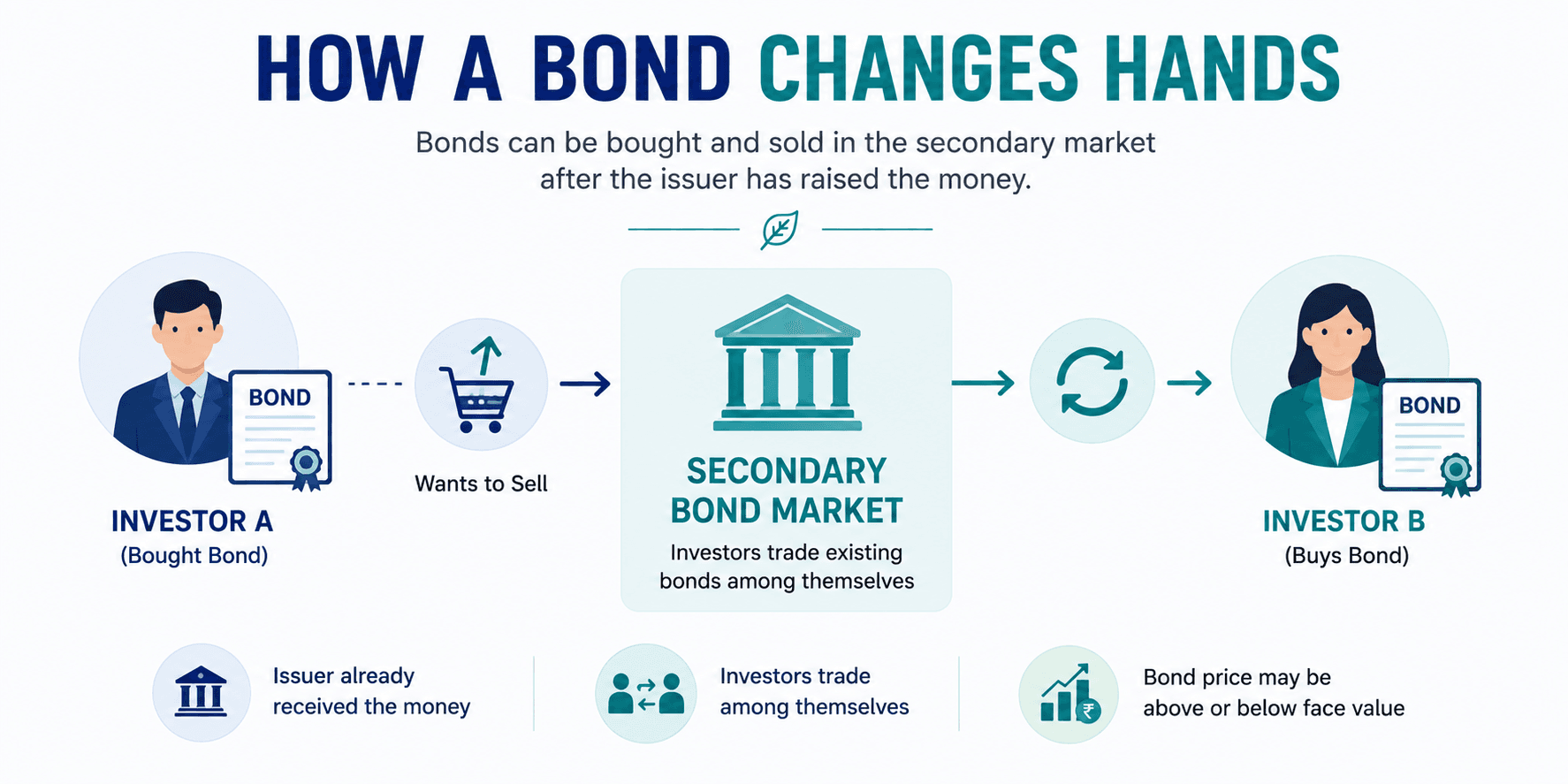
The secondary bond market allows investors to trade bonds after they have been issued. Here is how the process works in steps.
Step 1. Issuer Raises Funds
A government, PSU, municipality or company issues bonds to raise funds for any projects, expansion, or operational needs.
Step 2. Primary Market
Later, those bonds are offered to investors for the first time through the primary market at a predetermined issue price. The money raised goes directly to the issuer.
Step 3. Investors
Retail and institutional investors purchase the bonds and become the initial bondholders. They will earn regular coupon payments until they decide to hold or sell those bonds.
Step 4. Exchange/OTC (Secondary Bond Market)
Investors can sell the bond before maturity on a recognised stock exchange or through the OTC market. The transaction takes place between investors, and the issuer is not involved in this.
Step 5. New Investors
Another investor who buys the bond at the prevailing market price becomes the new bondholder (Investor 2). They will receive future interest payments and the principal at maturity unless they sell the bond again.
What Determines Bond Prices In The Secondary Market?
Bond prices in the secondary market fluctuate continuously based on the following factors.
1. Interest Rate Change
The rise in interest rates makes the existing bond less attractive, causing its price to fall. When interest rates decline, older bonds with higher coupon rates become more valuable.
2. Credit Rating Changes
Credit ratings reflect the issuer's ability to repay debt. An upgraded rating generally increases investor confidence and raise bonds price. However, a downgrade can reduce demand and lead to lower prices in the bond market.
3. Remaining Time to Maturity
Longer-duration bonds are usually more sensitive to interest rate changes. Short-term bonds have smaller price fluctuations than long-term bonds in the secondary bond market.
4. Bond Liquidity
Higher bond liquidity means buyers and sellers are available, which makes it easier to execute a trade at a fair price. Less bond liquidity may mean trading at a discount because finding buyers can take longer.
5. Demand and Supply
Bond prices are also affected by market demand and supply. Higher demand will increase the price, while excess supply can lower them.
6. Inflation Expectation
Investors expecting inflation to rise may demand high yields, causing existing bond prices to decline. Whereas lower inflation often supports higher bond valuation.
Key Benefits Of Investing In Secondary Bonds
Discussed below are the various advantages of investing in secondary market bonds in India.
1. Liquidity And Ease Of Trading
In the absence of a secondary market for bonds, the liquidity of bond investments might have diminished. Investors can sell their bonds in the secondary market whenever they deem fit. This improves the autonomy of individual investors and gives them more control over their portfolios.
2. Real-Time Price Discovery And Transparency
The marketplace by Grip offers real-time bond trading in India. Investors can now compare the real-time prices of various bonds and make an informed investment decision.
Real-time analysis not only improves the quality of investment by keeping investors updated with the current trends but it also improves transparency between the different stakeholders of the transaction.
3. Portfolio Diversification With Bonds
Optimum portfolio diversification allows investors to maximise their returns whilst minimising the risk. Bonds are fixed-income generating securities that can help control risk. Moreover, being a debt security, they get priority in capital repayment during dissolution.
For instance, if XYZ aims to shut down its company, bonds have to be redeemed before equity because they represent debt capital.
4. Access To A Wide Range Of Bonds
Marketplace by Grip offers the ultimate bond trading platform that allows investors to perform a real-time analysis of different bonds. Investors can base their decisions on credit ratings, maturity periods, yields and much more.
The table below shows the list of different high-yield bonds in India that are currently trading in the Grip Marketplace.
| Bond | Yield (%) | Credit Rating | Maturity (Months) |
| Navi Finserv | 9.75 | Crisil A | 5 |
| Muthoot | 10.5 | Crisil A+ | 17 |
| Oxyzo | 10 | Crisil A+ | 9 |
Primary Market vs Secondary Market
Understanding the primary vs secondary bond market will help investors choose the right investment strategy depending on whether they want to invest in a new bond issue or trade existing securities.
Features | Primary Bond Market | Secondary Bond Market |
Purpose | Raise fresh capital for issuers | Trading existing bond |
Buyer | Investors buy directly from the issuer | Investors trade with other investors |
Price | Fixed issue price | Market-driven prices |
Participant | Issuer and Investor | Buyer, seller, broker, dealer |
Trading | During issuance only | Anytime after issuance |
Liquidity | Limited until listing | Provide bond liquidity |
Objective | Capital raising | Investment, portfolio, management and liquidity |
Bonds Vs Stocks vs Mutual Funds
The table below compares bonds with two other popular investment avenues, namely stocks and mutual funds.
| Particulars | Bonds | Stocks | Mutual Fund |
| Meaning | A type of debt instrument issued by corporations, governments and other entities. | It represents ownership of the issuing company. | It pools the funds of a group of investors and invests it in a basket of securities. |
| Nature of investment | Bonds are a debt investment. | Stocks are an equity investment. | It can have both debt and equity investments. |
| Status of investor | Creditor of the issuer. | Part-owner of the issuing company. | Unitholders of the fund |
| Returns | Fixed returns are provided in the form of interest. Investors can sell their bonds and generate capital gains. They are fixed-income generating securities. | Capital gains derived through trading depend on the prevailing market price. Dividend payment is at the discretion of the company. | It may or may not generate fixed returns based on the nature of the mutual fund. |
Risk and Return Profile
Like any investment medium, bond investment strategies depend upon the risk and return profiles of the investment medium. The risk and return profiles of many bond investing options are contrasted in the table below.
| Security | Risk | Return |
| Investment-grade bonds | Medium to low | High to medium |
| High-yield bonds | High to medium | Very high |
| Fixed deposits | low | low |
| Equity | High to medium | High to low |
Common Mistakes While Trading Bonds
You should avoid these common mistakes while participating in the secondary bond market.
- Ignoring the impact of interest rate movement.
- Focusing only on the coupon rates instead of total return.
- Not checking issuer credit rating before investing.
- Overlooking bond liquidity before making a decision.
- Selling bonds without considering the transaction cost.
- Not comparing yields with similar bonds available in the bond market.
- Buying illiquid bonds simply because they offer higher yields.
Conclusion
Bond market liquidity plays an important role in determining how easily investors can buy or sell bonds at a fair price. Factors such as market demand, interest rate movements, credit quality, and the availability of buyers influence how liquid a bond is in the secondary market. Understanding these factors can help investors make informed decisions before investing and when planning an early exit.
For investors who may need to sell their holdings before maturity, access to a transparent and efficient secondary market can make the process significantly easier. Platforms such as Grip Invest provide eligible investors with the option to place sell orders, connect with potential buyers, and complete transactions through a streamlined digital process. While liquidity can never be guaranteed and depends on market conditions, having access to an organised marketplace can improve the overall selling experience and offer greater flexibility in managing bond investments.
FAQs On Secondary Market Bonds
References
1. National Stock Exchange India, accessed from: https://www.nseindia.com/report-detail/cbm-trades-archives
 |
Author: Grip Invest Editorial Team The Grip Invest Editorial Team is a group of Chartered Accountants, MBA (Finance) graduates, and Qualified Research Analysts dedicated to helping you invest smarter. We dive deep into India's fixed income landscape to deliver content that is accurate, up-to-date, and easy to understand. Whether you're exploring bonds, fixed deposits, or other fixed income opportunities, our guides cut through the noise and give you the clarity to make better financial decisions. |
Want to stay at the top of your finances?
Join the community of 4 lakh+ investors and learn more about Grip Invest, the latest financial knick-knacks, and shenanigans in the world of investing.
Happy Investing!
Disclaimer - Investments in debt securities/municipal debt securities/securitised debt instruments are subject to risks including delay and/ or default in payment. Read all the offer related documents carefully. The investor is requested to take into consideration all the risk factors before the commencement of trading.
This communication is prepared by Grip Broking Private Limited (bearing SEBI Registration No. INZ000312836 and NSE ID 90319) and/or its affiliate/ group company(ies) (together referred to as “Grip”) and the contents of this disclaimer are applicable to this document and any and all written or oral communication(s) made by Grip or its directors, employees, associates, representatives and agents. This communication does not constitute advice relating to investing or otherwise dealing in securities and is not an offer or solicitation for the purchase or sale of any securities. Grip does not guarantee or assure any return on investments and accepts no liability for consequences of any actions taken based on the information provided. For more details, please visit www.gripinvest.in
Registered Address - 106, II F, New Asiatic Building, H Block, Connaught Place, New Delhi 110001


