

Secured vs Unsecured Bonds: Differences, Risks And Which Is Better


Corporate bonds have long been a go-to investment choice for individuals and institutions looking to diversify their portfolios while earning fixed income. Unfortunately, not all corporate bonds offer equal protection or potential returns. Secured and unsecured corporate debt investments provide various levels of security and possible return, thus necessitating investors to understand these in detail before making investment decisions.
As part of your investment process in corporate bonds, you must know the difference between secured and unsecured bonds. Are you aware of their respective risks and benefits? Assessing corporate debt investments will enable you to make informed decisions and maximise returns.
Here, we will deeply dive into the key differences between secured and unsecured corporate bonds and factors investors must consider when assessing such investments. By developing an in-depth knowledge of both types of bonds, you can make better decisions and increase your chances of financial success and wealth creation.
Secured Corporate Bonds
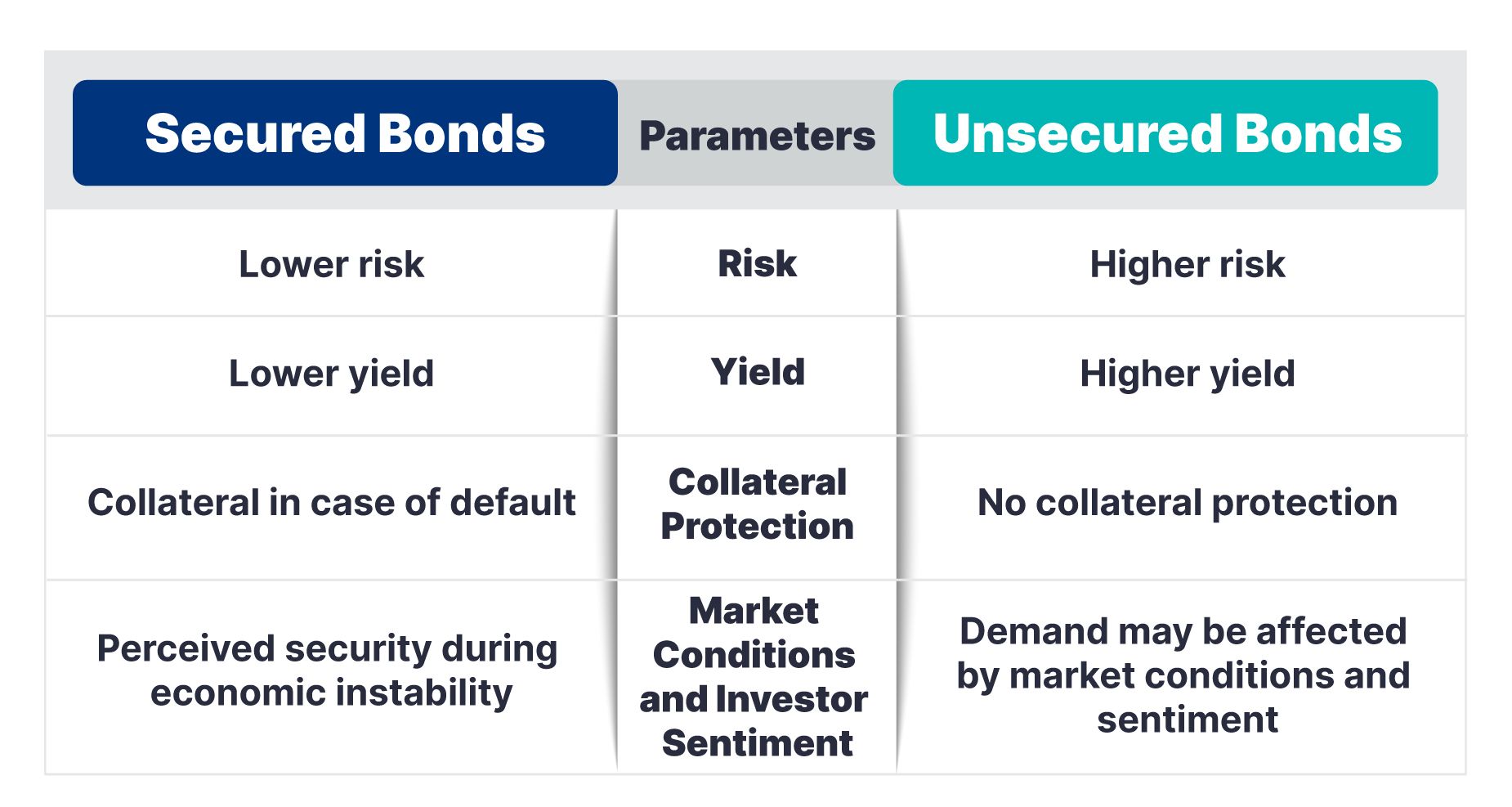
Secured corporate bonds provide investors with additional protection through collateral backing. When companies issue these bonds, they pledge specific assets such as real estate, inventory or receivables as security against default or non-payment. In case of default, bondholders are entitled to sell these secured assets (through a legally mandated process) to recover principal and interest payments.
Below are the characteristics of secured bonds:
- Collateral Backing: These bonds are guaranteed with specific assets or collateral. In case of any default, the bondholders have the right to recourse.
- Higher Priority: Secured bondholders enjoy priority in terms of repayment compared to unsecured ones in a liquidation scenario.
- Lower Risk: Secured corporate bonds are considered less risky than unsecured bonds due to the availability of collateral. This safety net (in the form of collateral backing) can reduce losses and ensure that the bondholders' interests are preserved in case of default.
- Lower Yield: Due to the higher security offered by secured bonds than unsecured bonds, their yields tend to be lower than unsecured bonds. Investors are willing to compensate for the lower risk with lesser returns.
Unsecured Corporate Bonds
Unsecured corporate bonds (or debentures) are issued without collateral being pledged. It relies solely on an issuer's creditworthiness and ability to meet its debt obligations in case of default. This means bondholders face a higher risk in recovering their investments.
Below are the characteristics of unsecured bonds:
- No Collateral: Unsecured corporate bonds do not rely on specific assets as collateral backing them. Instead, they rely solely on income generated from the respective business operations of the issuers for meeting the interest and principal repayment.
- Higher Risk: Unsecured bonds pose higher risks than secured ones due to the lack of collateral protection. The chances of recovery could be limited or non-existent in the case of default.
- Higher Yield: Unsecured bonds often offer higher yields in exchange for taking on additional risk. These investors demand compensation through higher returns as part of investing in the riskier alternative of the two.
- Creditworthiness: The issuing company's financial health and creditworthiness are relevant in determining yield and demand for unsecured bonds.
How Security Works in Bond Investing?
In investing in secured corporate bonds, you may be able to understand how bond security works to measure the level of security available in case of issuer default.
- Collateral: Collateral refers to assets that have been pledged by the issuer in order to secure the bond, such as real property, equipment, or accounts receivable. Pledged bond collateral offers an extra layer of security for the bond holder.
- Security Cover: It refers to the ratio of the value of the asset pledged to the outstanding amount of the bond. The greater the security cover, the greater the extent to which the pledged bond collateral exceeds the repayment obligation of the issuer.
- Bond Trustee: A bond trustee refers to an independent party that acts as a security trustee for the benefit of the bond holder. The bond trustee oversees the security agreement of the bond.
- Recovery Right: In case of issuer default, bond holders are allowed to exercise their rights to collect the dues from the assets pledged as the bond security. It generally ensures that they are prioritized over unsecured bond holders.
Key Differences Between Secured And Unsecured Bonds
What Happens if the Issuer Defaults?
In case a company fails to repay its bond obligations, the recovery procedure is dependent on whether investors possess secured bonds or unsecured bonds.
- Recovery order: Secured bondholders are usually paid off first before unsecured bondholders since they have a legal right over the pledged collateral.
- Pledged bond collateral liquidation: In case necessary, the pledged bond collateral can be liquidated to pay off the outstanding amount owed by investors.
- Bond trustees' role: Bond trustees act on behalf of investors, ensure that the bond conditions are followed by the issuer, and enforce security in case the issuer is in default.
- Recovery time period: Recovery is not instantaneous. It will take several months to years depending on the legal procedure and the asset liquidation process.
Should You Always Choose Secured Bonds?
This is not always the case, although the feature of bond security is certainly advantageous about secured bonds.
Credit rating: Sometimes the unsecured corporate bonds of an issuer that is highly rated may be safer compared to the secured bonds of a less financially stable issuer.
Financial stability: A financially healthy company with steady cash flows would easily manage its unsecured debt obligations without collateralization.
Coupon rate: The coupon of an unsecured bond is usually higher because of the extra risk factor.
Investment strategy: When safety of capital is a top priority, secured bonds would be preferable. Otherwise, unsecured bonds may prove more attractive.
In conclusion, it makes sense to choose secured vs unsecured bonds based not only on the collateral but also the financial position of the issuer and the credit rating and investment goals of the investors.
Looking To Invest In High-Quality Corporate Bonds?
Whether you prefer secured bonds for stability or unsecured bonds for higher returns, corporate bonds offer an excellent opportunity to diversify your portfolio and earn predictable income.
1. Choose from AAA & AA-rated bonds
2. Enjoy fixed interest payouts & capital preservation
3. Invest in bonds carefully vetted for creditworthiness
Key Considerations When Investing In Unsecured Bonds
- Assessing Issuer Creditworthiness: As unsecured bonds do not offer collateral backing, investors must carefully examine their financial health, credit ratings, and track record to gauge whether the interest and principal payments can be paid promptly by the Issuer.
- Industry And Market Conditions: Traders should carefully examine overall economic trends and industry dynamics when investing in unsecured bonds.
- Investor Risk Tolerance: Investors must analyse their risk appetite and take calculated risks while investing in unsecured corporate bonds. Knowing the risk appetite helps investors in balancing the overall portfolio.
Investor Checklist
When choosing between secured and unsecured bonds, consider the following important issues:
Credit Rating: Obtain credit ratings issued by credible credit rating firms to determine the ability of the issuing organization to repay the debt.
Security Cover: In case of secured bonds, make sure that the value of bond security is enough to cover the total amount of outstanding debt.
Financial Position of Issuer: Consider the revenue, profits, debts, and cash flows of the issuer company to determine its financial position.
Liquidity: Make sure that the bond will be easy to buy or sell in the secondary market.
Maturity: Select the duration of the bond which corresponds to your financial plans.
Considering all these issues will help you to choose suitable bonds.
Final Thoughts
Comparing secured and unsecured corporate bonds requires careful analysis. Secured bonds provide some protection through pledged assets, while uncollateralised debt investments carry higher risks but could trade at potentially higher yields.
Explore Grip Invest to learn about favourable risk-reward investment opportunities in secured and rated corporate bonds. Grip Invest allows you to explore carefully curated alternative investment opportunities offering diversification and predictable returns.
FAQs On Secured vs Unsecured Bonds
 |
Author: Grip Invest Editorial Team The Grip Invest Editorial Team is a group of Chartered Accountants, MBA (Finance) graduates, and Qualified Research Analysts dedicated to helping you invest smarter. We dive deep into India's fixed income landscape to deliver content that is accurate, up-to-date, and easy to understand. Whether you're exploring bonds, fixed deposits, or other fixed income opportunities, our guides cut through the noise and give you the clarity to make better financial decisions. |
Want to stay at the top of your finances?
Join the community of 2.5 lakh+ investors and learn more about Grip Invest, the latest financial knick-knacks and shenanigans that take place in the world of investing.
Happy Investing!
Disclaimer - Investments in debt securities are subject to risks. Read all the offer-related documents carefully. The investor is requested to take into consideration all the risk factors before the commencement of trading. This communication is prepared by Grip Broking Private Limited (bearing SEBI Registration No. INZ000312836 and NSE ID 90319) and/or its affiliate/ group company(ies) (together referred to as “Grip”) and the contents of this disclaimer are applicable to this document and any and all written or oral communication(s) made by Grip or its directors, employees, associates, representatives and agents. This communication does not constitute advice relating to investing or otherwise dealing in securities and is not an offer or solicitation for the purchase or sale of any securities. Grip does not guarantee or assure any return on investments and accepts no liability for the consequences of any actions taken based on the information provided. For more details, please visit https://www.gripinvest.in/.
Registered Address - 106, II F, New Asiatic Building, H Block, Connaught Place, New Delhi 110001.


