

Bond Yield Vs Coupon Rate: Meaning, Key Differences And How To Calculate Them



Bond yield Vs Coupon rate is simple to separate. The coupon rate tells you the interest a bond pays on its face value. Yield tells you what that bond may return based on the price you actually pay.
An 8% coupon does not always mean an 8% return. If the bond trades above or below face value, the yield changes. Current yield and yield to maturity (YTM) help measure that difference in different ways.
What Is A Bond Coupon Rate?
The coupon rate is the interest rate a bond issuer applies to its face value. For a conventional fixed-rate bond, this rate generally remains unchanged until maturity.
Suppose a bond has a face value of INR 1000 and an 8% bond coupon rate. The annual coupon payment will be:
Annual coupon= INR 1000 × 8%= INR 80
The investor receives INR 80 annually in this example, irrespective of whether the bond later trades at INR 900, INR 1,000 or INR 1,100.
This is why the coupon rate should not be treated as the investor’s actual return. It primarily determines the scheduled interest payment. Different types of bonds in India may also have different coupon structures and payment frequencies.
What Is Bond Yield?
The bond yield meaning is broader than the stated coupon. Yield shows the return on a bond relative to the amount an investor pays for it.
Current yield is one of the simplest measures:
Current Yield= Annual Coupon / Market Price x 100
Take the same bond paying INR 80 annually. If an investor purchases it for INR 900, its current yield becomes:
INR 80 / INR 900 x 100= 8.89%
If the price instead rises to INR 1100:
INR 80 / INR 1100 x 100= 7.27%
The bond interest rate, or coupon rate, remains 8% in both cases. What changes is the yield relative to the purchase price.
Bond Yield Vs Coupon Rate: Key Differences
The difference between bond yield vs coupon rate becomes clearer when three measures are separated. Coupon rate shows the interest promised on the bond’s face value. Current yield measures that coupon income against the price paid. This is the key distinction in a current yield vs coupon rate comparison.
Yield to maturity, or YTM, goes a step further. It is the annualised return measure that equates the bond’s current price with the present value of its remaining coupon payments and maturity value. It assumes the bond is held until maturity and scheduled payments are received. So, a yield to maturity vs coupon rate comparison also captures the effect of buying the bond above or below face value.
| Factor | Coupon Rate | Current Yield | YTM |
| What it measures | Interest paid on the bond’s face value | Annual coupon income relative to the current market price | Potential annualised return if the bond is held to maturity |
| Calculation basis | Annual coupon/ face value | Annual coupon/ market price | Current price, coupon payments, face value and time to maturity |
| Changes when market price changes | No, for a fixed-rate bond | Yes | Yes |
| Includes gain or loss at maturity | No | No | Yes |
| Considers time to maturity | No | No | Yes |
| At discount, par and premium | Remains unchanged | Above coupon at a discount, equal at par and below coupon at a premium | Generally above current yield at a discount, equal to coupon at par and below current yield at a premium |
| Best used for | Understanding scheduled interest income | Comparing coupon income with the price paid | Comparing potential overall returns across bonds held to maturity |
| Key limitation or assumption | Does not reflect the market price paid | Ignores capital gain or loss at maturity | Assumes the bond is held to maturity and scheduled payments are received; standard YTM also assumes coupon reinvestment at the YTM rate |
How Do Bond Price Changes Affect Yield And Coupon Rate?
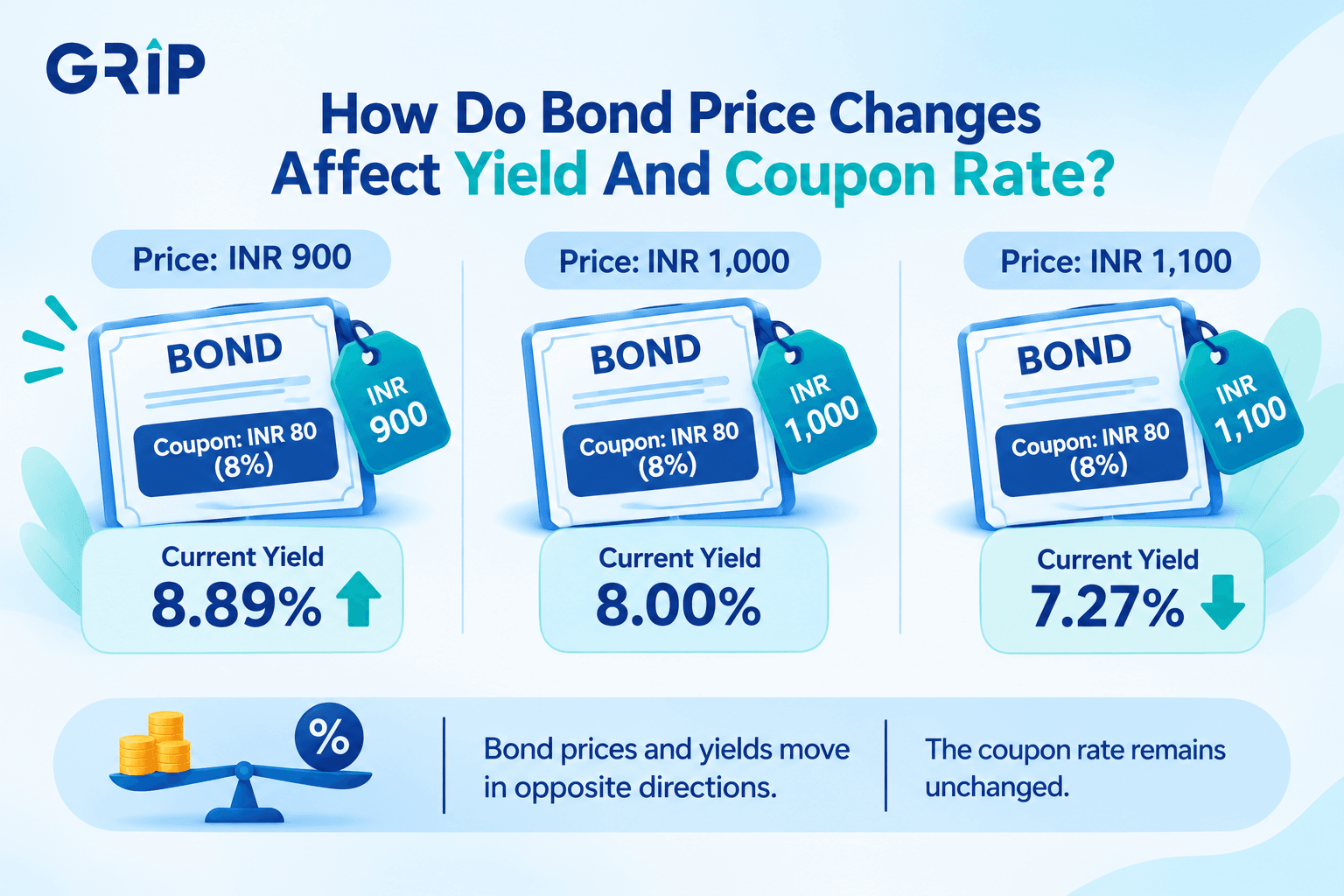
Bond prices and yields generally move in opposite directions. The coupon rate on an existing fixed-rate bond does not move with its market price.
Consider our INR 1,000 bond again:
Purchase Price | Annual Coupon | Coupon Rate | Current Yield |
INR 900 | INR 80 | 8% | 8.89% |
INR 1,000 | INR 80 | 8% | 8.00% |
INR 1,100 | INR 80 | 8% | 7.27% |
At INR 900, the investor pays less to receive the same INR 80 annual coupon. Current yield therefore rises. At INR 1,100, the same cash payment represents a smaller percentage of the investment.
Market interest rates, credit conditions and demand for a bond can all influence its price.
How To Calculate Bond Yield And Coupon Rate
Coupon rate and current yield use different price bases. The coupon rate uses face value, while current yield uses the bond’s market price.
Coupon Rate
Coupon Rate = Annual Coupon / Face Value x 100
Take the 6.20% GS 2029 from the RBI auction on 30 October 2026. For every INR 100 of face value, the bond pays an annual coupon of INR 6.20.1
INR 6.20 / INR 100 x 100 = 6.20%
Current Yield
Current Yield = Annual Coupon / Market Price x 100
The same bond had a cut-off price of INR 97.69. Its current yield at that price was:
INR 6.20 / INR 97.69 x 100 = 6.35%
Now, see what happens if only the market price changes.
| Market Price | Price Level | Current Yield |
INR 97.69 | Below face value | 6.35% |
INR 100 | At face value | 6.20% |
INR 105* | Above face value | 5.90% |
*INR 105 is a hypothetical market price used for illustration.
At INR 97.69, the bond trades below face value, so its current yield is higher than its 6.20% coupon rate. At INR 100, both are equal. At INR 105, the investor pays more for the same INR 6.20 annual coupon, bringing current yield down to 5.90%.
The bond’s implicit YTM at the actual INR 97.69 auction price was 7.1218%. YTM goes beyond current yield by also considering the remaining coupon payments, the amount received at maturity and the time left until maturity.
When Should Investors Consider Coupon Rate Vs Yield?
The right metric depends on what the investor wants to assess.
Investor Question | Metric To Consider | Investor Question |
How much scheduled interest will I receive? | Coupon payment and coupon rate | How much scheduled interest will I receive? |
How much coupon income will I receive relative to today’s price? | Current yield | How much coupon income will I receive relative to today’s price? |
What is the potential annualised return until maturity? | YTM | What is the potential annualised return until maturity? |
Am I buying above or below face value? | Price and YTM | Am I buying above or below face value? |
How do bonds with different prices compare? | YTM and other risk factors | How do bonds with different prices compare? |
For investors focused mainly on regular income, coupon payments are useful. However, investors comparing potential bond returns across securities may find YTM more informative.
Yield should not be considered alone. Credit quality, maturity, liquidity, repayment terms and the structure of the bond also affect the risk-return trade-off. A broader understanding of bond investment in India can therefore help when comparing different securities.
FAQs

Want to stay at the top of your finances?
Join the community of 22 lakh+ investors and learn more about Grip Invest, the latest financial knick-knacks, and shenanigans in the world of investing.
Happy Investing!
Disclaimer - Investments in debt securities/municipal debt securities/securitised debt instruments are subject to risks including delay and/ or default in payment. Read all the offer related documents carefully. The investor is requested to take into consideration all the risk factors before the commencement of trading.
This communication is prepared by Grip Broking Private Limited (bearing SEBI Registration No. INZ000312836 and NSE ID 90319) and/or its affiliate/ group company(ies) (together referred to as “Grip”) and the contents of this disclaimer are applicable to this document and any and all written or oral communication(s) made by Grip or its directors, employees, associates, representatives and agents. This communication does not constitute advice relating to investing or otherwise dealing in securities and is not an offer or solicitation for the purchase or sale of any securities. Grip does not guarantee or assure any return on investments and accepts no liability for consequences of any actions taken based on the information provided. For more details, please visit www.gripinvest.in
Registered Address - 106, II F, New Asiatic Building, H Block, Connaught Place, New Delhi 110001


