

Corporate Bond Credit Rating: How To Read And Evaluate Bond Ratings



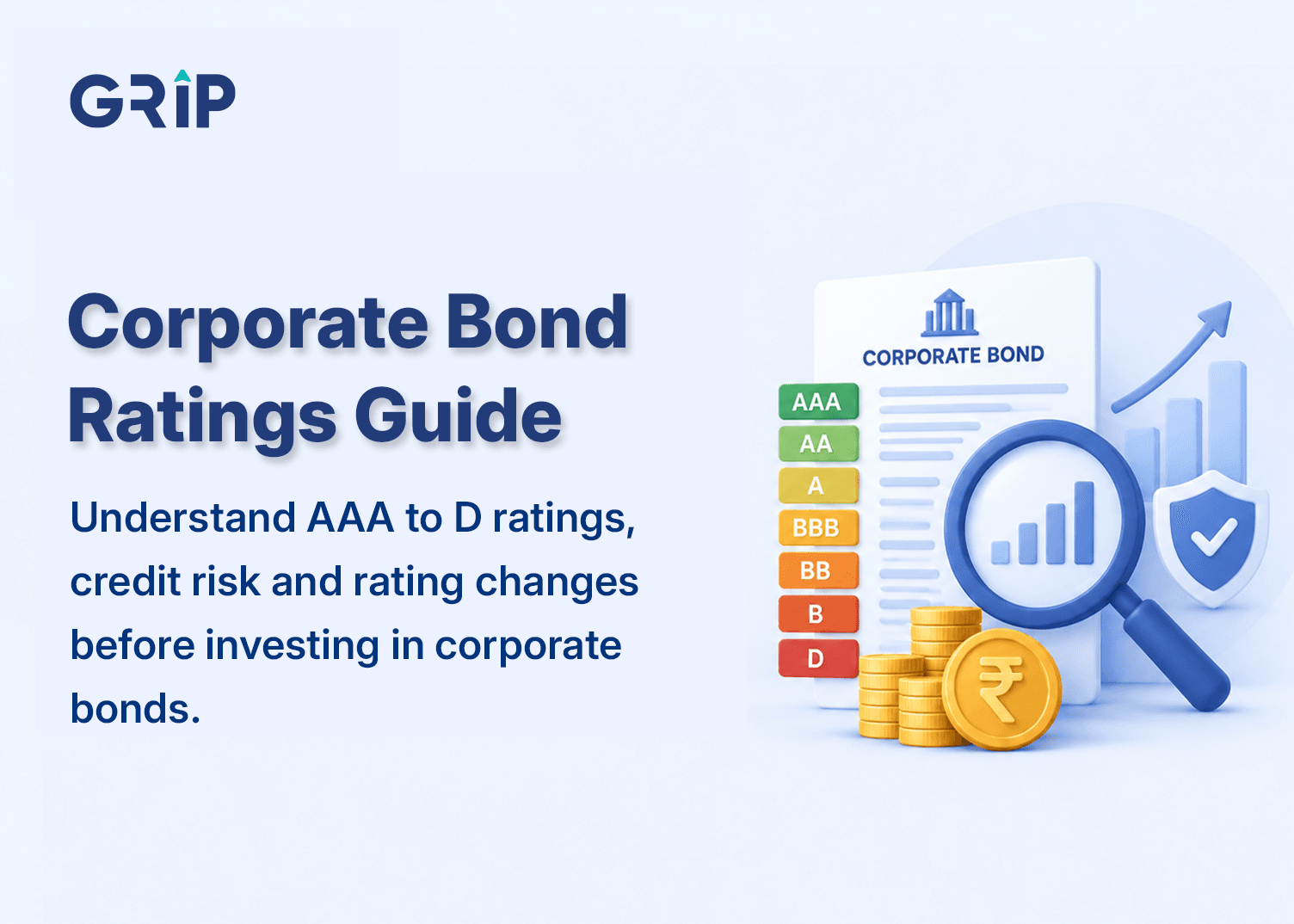
Corporate bond credit rating shows how a credit rating agency views the creditworthiness of a corporate bond. This rating reflects factors such as the financial position, debt level and the ability to pay off the borrowing of the issuer or company.
Further, the rating can differ across debt instruments issued by the same company based on the seniority, security, guarantees and repayment structure. For instance, the secured bonds of a company may have an AA rating, while its unsecured bonds hold a low rating, say BBB.
Understanding The Corporate Bond Credit Rating Scale
The bond credit rating meaning further takes shape when it is viewed as a measure of the ability of an issuer to service debt on time.
The credit rating agencies in India assign ratings ranging from AAA to D on the long-term credit rating scale. Bonds with AAA to BBB ratings are considered investment-grade bonds, as they offer a high degree of safety1. Ratings below BBB fall outside the investment-grade category.
Rating | Meaning | Risk category |
AAA | Highest degree of safety | Lowest credit risk |
AA | High degree of safety | Very low credit risk |
A | Adequate degree of safety | Low credit risk |
BBB | Moderate degree of safety | Moderate credit risk |
BB | Moderate risk of default | Higher credit risk |
B | High risk of default | High credit risk |
C | Very high risk of default | Very high credit risk |
D | Default or expected default | Default |
Source: Crisil Ratings2
Note: Ratings may also use ‘+’ or ‘?’ modifiers from AA to C to show the comparative standing within a rating category.
Who Assigns Corporate Bond Credit Ratings In India?
Corporate bond credit ratings in India are assigned by SEBI-registered credit rating agencies.
In India as of September 2026, there are 9 registered credit rating agencies under SEBI.3 The major agencies include:
- CRISIL Ratings: It is one of the oldest credit rating agencies in India and a subsidiary of S&P Global.4
- ICRA: The agency provides credit ratings across debt instruments and sectors.5
- CARE Ratings: It is a major domestic ratings firm operating under the CareEdge brand.6
- India Ratings and Research: This is a wholly-owned subsidiary of the Fitch Group.7
Other SEBI-registered CRAs include Acuité Ratings & Research, Brickwork Ratings, Infomerics Valuation and Rating, Acer Credit Rating and CredStone Ratings.
Rating Agency vs Credit Bureau
- Credit Rating Agency (CRA): The CRAs provide a forward-looking opinion on the future debt repayment capacity and creditworthiness of an issuer or their debt instruments.
- Credit Bureau: A credit bureau, on the other hand, records the past borrowing and repayment history of an individual or entity, which the lenders use to assess credit behaviour and generate credit scores.
How Do Credit Rating Agencies Evaluate A Corporate Bond?
The CRAs assess several factors before assigning a rating. Their evaluation typically covers:
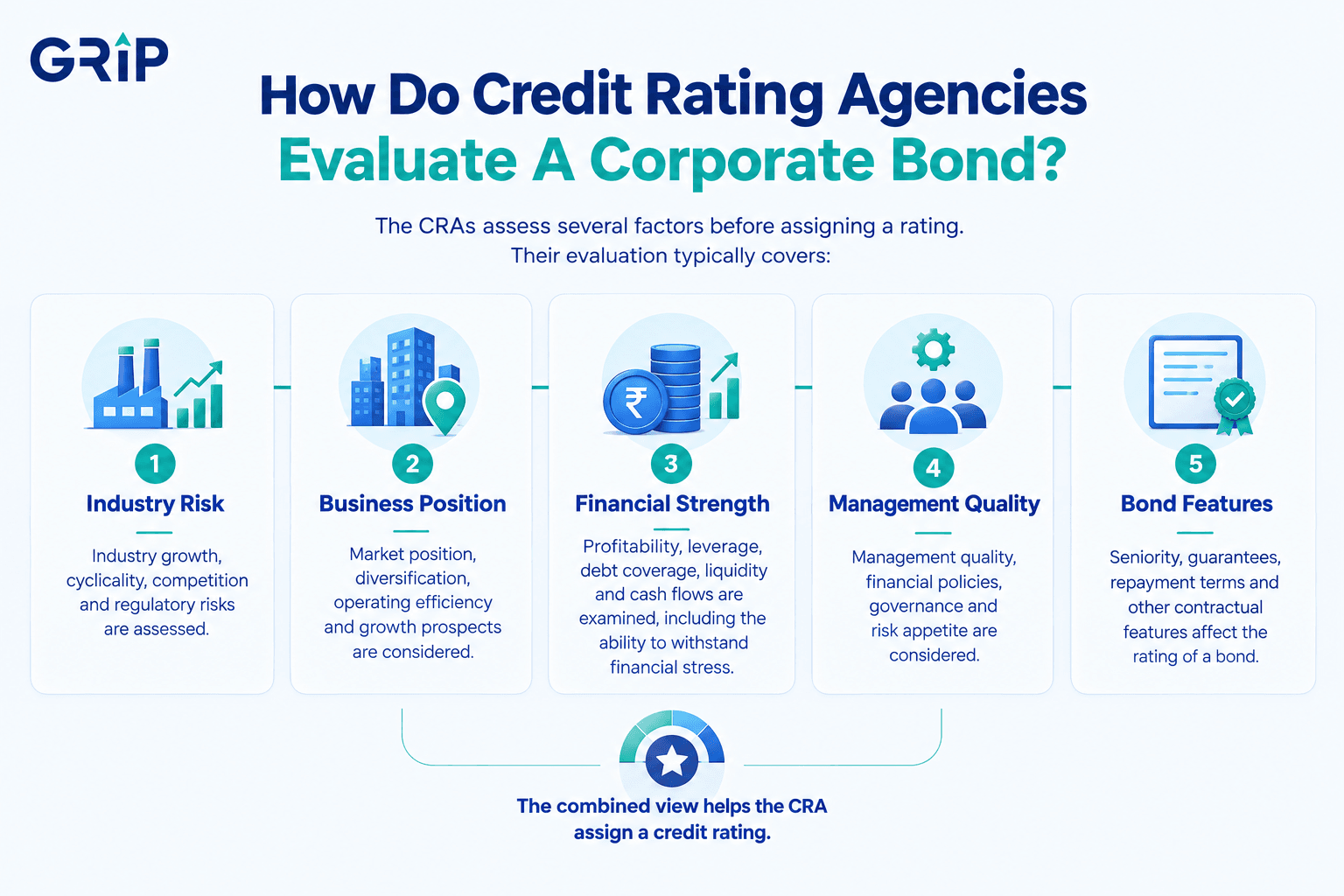
- Industry Risk: They assess industry growth, cyclicality, competition and regulatory risks.
- Business Position: The market position, diversification, operating efficiency and growth prospects are considered.
- Financial Strength: Profitability, leverage, debt coverage, liquidity and cash flows are examined by the agency, including the ability of the company to withstand financial stress.
- Management Quality: Management quality, financial policies, governance and risk appetite also hold a place in the assessment.
- Bond Features: The features, including seniority, guarantees, repayment terms and other contractual features, affect the rating of a bond.
Let us say Bond A and Bond B provide an 8% coupon rate. If Bond A is AAA-rated and Bond B is BBB-rated, Bond B may trade at a higher yield. This is because investors demand higher compensation for high corporate bond risk.
A bond rating downgrade can further affect its market yield. To learn how to check bond ratings, investors can refer to the rating agency websites, bond offer documents and issuer disclosures.
How Should Investors Use A Corporate Bond Credit Rating?
Investors should use the corporate bond rating as a basic measure for default risk, while also considering yield, maturity, liquidity, security and personal risk tolerance.
Here is a 5-minute bond rating checklist:
Check | What to look for? |
| Rating | Check whether the bond has AAA, AA, BBB bond ratings or lower and identify its risk category. |
| Rating trend | Observe the latest rating, outlook and any recent upgrade or bond rating downgrade. |
| Rationale | Read the latest CRA rationale to understand the key credit strengths and risks. |
| Yield | Compare the yield with similar investment-grade bonds and consider whether it compensates for the credit risk. |
| Bond terms | Assess the maturity, security, seniority, guarantees and liquidity before investing. |
What Does A Credit Rating Upgrade Or Downgrade Mean?
A credit rating upgrade means improvement in the creditworthiness of an issuer or debt instrument. The factors, including improved profitability, lower debt levels, better liquidity or a stronger business profile, support rating upgrades.
A credit rating downgrade, on the contrary, means deterioration in the creditworthiness and indicates higher credit risk. It may result from weaker financial performance, rising debt, reduced liquidity or a weaker business position. A downgrade, however, does not mean that the company is about to default.
What Are The Limitations Of Corporate Bond Credit Ratings?
While corporate bond credit ratings are a useful indicator, they do not capture every risk an investor may face while investing in corporate bonds. The key limitations include:
- No Guarantee of Returns: These ratings are opinions on the default probability of a bond and do not guarantee repayment or returns.
- Does Not Cover All Risks: The ratings are based primarily on credit risk. They do not factor in risks such as changes in interest rates, secondary market liquidity or losses from movements in the secondary-market price.
- Can Change Over Time: They are dynamic in nature and reflect the information and expectations available when the assessment is made. The shifts in corporate fundamentals and macroeconomic conditions can lead to an upgrade or downgrade in ratings.
- Delayed Rating Updates: Since the ratings rely on available information and go through review cycles, they may lag behind real-time market developments or sudden corporate distress.
Disclaimer: Corporate bond credit ratings are opinions on creditworthiness, not guarantees of repayment or returns. Investors should consider ratings alongside yield, maturity, liquidity, security and their own risk tolerance before investing.
FAQs

Want to stay at the top of your finances?
Join the community of 22 lakh+ investors and learn more about Grip Invest, the latest financial knick-knacks, and shenanigans in the world of investing.
Happy Investing!
Disclaimer - Investments in debt securities/municipal debt securities/securitised debt instruments are subject to risks including delay and/ or default in payment. Read all the offer related documents carefully. The investor is requested to take into consideration all the risk factors before the commencement of trading.
This communication is prepared by Grip Broking Private Limited (bearing SEBI Registration No. INZ000312836 and NSE ID 90319) and/or its affiliate/ group company(ies) (together referred to as “Grip”) and the contents of this disclaimer are applicable to this document and any and all written or oral communication(s) made by Grip or its directors, employees, associates, representatives and agents. This communication does not constitute advice relating to investing or otherwise dealing in securities and is not an offer or solicitation for the purchase or sale of any securities. Grip does not guarantee or assure any return on investments and accepts no liability for consequences of any actions taken based on the information provided. For more details, please visit www.gripinvest.in
Registered Address - 106, II F, New Asiatic Building, H Block, Connaught Place, New Delhi 110001


