

India’s Current Account Deficit: Causes, Impact And 2026 Outlook


While carrying out fundamental analysis of a market or economy, one of the key indicators often used by analysts is the level of Current Account Deficit (CAD). The timing of discussing this concept cannot be better as we are facing an unprecedented era where the economic superpowers are in loggerheads with each other.
There is an ongoing tussle between the Trump-led United States, which has recently imposed high tariffs against major economies, including India. India’s CAD, which was approximately 0.2% of the GDP in the first quarter of the current financial year, is all set to widen due to the geopolitical issues.
Let us understand the concept of CAD, its uses for policymakers and investors, and how it influences market sentiment, particularly in the current situation.
What Is The Current Account Deficit (CAD)?
Current Account refers to the proportion (or relationship) between the total exports and imports of a country. If the total exports exceed total imports, it is known as CAS (Current Account Surplus). On the other hand, CAD refers to a situation where a country’s total imports of goods, services, and investment income exceed its total exports. In simple terms, it reflects how much more India buys from the world than it sells.
The concept differs from fiscal deficit, which is a measure of the gap between government spending and revenue. The current account includes four major components: the trade balance (driven largely by India's merchandise trade deficit), services exports (where India maintains a strong surplus), primary income (such as interest and dividend payments), and secondary income, like remittances from overseas Indians.
When these four components collectively show a shortfall, India’s current account deficit widens. There are several reasons why analysts, investors, and the general public should understand this: it helps highlight the strength of Indian companies (exporters), the external health of the country, the overall global competitiveness, and the country's geopolitical strength.
Why Does CAD Matter For The Economy?
While evaluating the economic performance of a country or to predict the performance of a sector, it is critical to evaluate whether the nation is a net importer or exporter of goods and services. Here are the most critical reasons why CAD matter for the economy:
1. The current account deficit reflects the gap between India’s foreign exchange earnings and outflows. A wider deficit puts pressure on the rupee, often leading to depreciation and tighter financial conditions.
2. A rising current account balance can make imports costlier, increasing inflation across fuel, commodities, and manufactured goods.
3. One of the major causes of the current account deficit is India’s heavy dependence on crude oil. When global oil prices rise, the India current account deficit typically widens due to a higher import bill.
4. Strong services export India and steady remittance flows help offset the merchandise trade deficit, offering some stability during global slowdowns.
Eventually, it influences the monetary policy stance, the use of forex reserves, and market liquidity. Investors and market analysts follow these movements to assess risks related to currency volatility and bond yields.
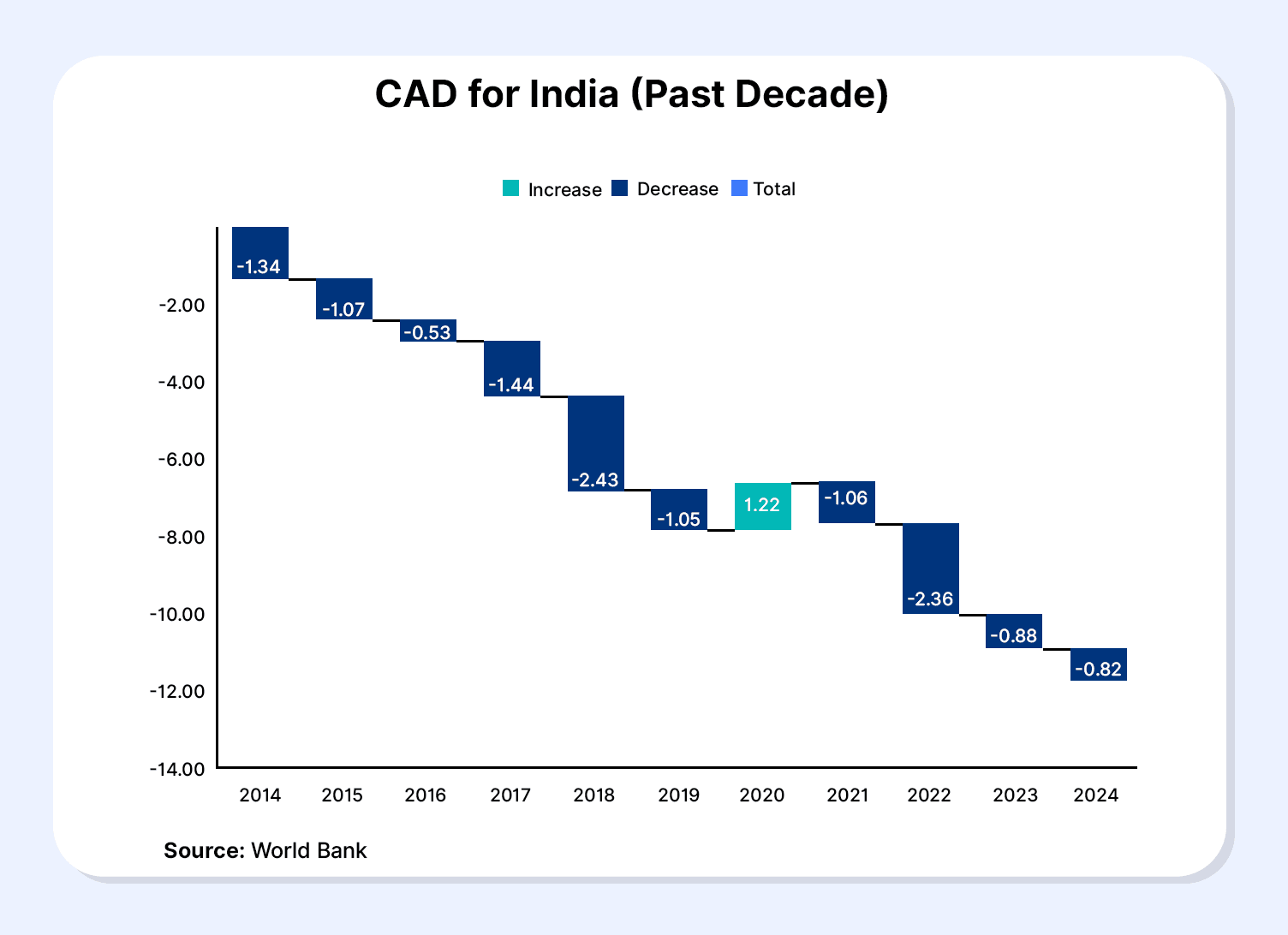
Here is a chart depicting the CAD (as a percentage of GDP) in the past ten years:
Recent Trends And Data (2025-26)
If we consider the most recent data and numbers related to the CAD (in percentage of the GDP), there are some very interesting findings. For FY2024–25, CAD stood at 0.6% of GDP, supported by a record surplus in services and resilient remittance inflows.
In Q4 FY25, the current account balance India 2025 even turned positive, recording a surplus of USD 13.5 billion, equivalent to around 1.3% of GDP. Entering the new financial year, the India current account deficit q1 2025 remained extremely comfortable at just 0.2% of GDP (approximately USD 2.4 billion).
Entering FY2026, Q1 saw a comfortable CAD of 0.2% of GDP ($2.4 billion), supported by an 18% YoY surge in remittances despite reverting from the Q4 surplus. However, US tariffs under President Trump are pressuring exports (India's US goods share approx 2% of GDP), with analysts projecting CAD to widen modestly to around 0.9-1% of GDP for FY2026 amid trade tensions.
Impact On Investors And Inflation
With the recent intervention by the RBI and with the initiatives by the Central Government (such as the recent GST reforms), the stock market has been in a bullish mode in the past few months. There is a barrage of new IPOs hitting the market, and the total market size (capitalisation) has expanded to an unprecedented $5.5 trillion.
With CAD at just 0.2% of GDP in Q1 2025, pressure on the rupee remained limited, reducing imported inflation. This aligns with the latest CPI trend, where inflation eased to 2.1% in June 2025, with a quarterly average of 2.7%, well within the RBI’s comfort band. A contained current account deficit impact generally supports steadier bond yields and lowers the risk premium foreign investors assign to India.
With such valuations, many investors feel the need to hedge and invest a part of their portfolio in safer alternatives such as bonds. Diversification, irrespective of any prevailing market conditions, is critical for attaining long-term investment goals.
Platforms like Grip Invest enable access to asset-backed bonds and predictable cash-flow products that are less sensitive to currency swings. These instruments provide stability, making them effective tools for navigating periods of uncertainty while the current account balance India 2025 evolves.
Conclusion
Understanding the Current Account Deficit is a critical aspect of fundamental analysis and is essential for your investment decisions. India, for many reasons, has been a net importer of goods and services, and even though it has managed to reduce the CAD levels, it is still higher than some of its Western and more developed counterparts.
With CAD narrowing to 0.6% of GDP for FY24–25 and just 0.2% in Q1 2025, the country has entered the year with one of its most favourable external balances in a decade. This strength, combined with easing inflation and high forex reserves, positions India well to withstand global volatility. However, the outlook will continue to depend on global oil prices, geopolitical shifts, and the trajectory of demand in key export markets.
For investors, understanding the current account balance India 2026 is crucial, as it shapes currency trends, bond yields, and overall market sentiment. Do not forget the importance of diversification, and including fixed income securities that not only hedge your portfolio against market volatility but also contribute heavily to attaining personal financial goals.
Visit Grip Invest today!
FAQs On Current Account Deficit
1. What causes a current account deficit in India?
A current account deficit arises when India’s imports exceed exports. Key drivers include high crude oil imports, electronics and gold demand, a large merchandise trade deficit, and periods when services exports or remittances grow more slowly than expected.
2. Is a high CAD bad for the economy?
A high CAD can put pressure on the rupee, raise external borrowing needs, and increase vulnerability to global shocks. However, a moderate CAD is manageable if financed through stable capital inflows and supported by strong services export India and remittances.
3. How does CAD affect inflation and investments?
A widening CAD can weaken the rupee, making imports costlier and pushing up inflation. For investors, it may lead to higher bond yields and short-term volatility. When CAD is low, as in the current account balance of India 2025, currency stability supports lower inflation and more predictable investment conditions
Want to stay at the top of your finances?
Join the community of 4 lakh+ investors and learn more about Grip Invest, the latest financial knick-knacks, and shenanigans in the world of investing.
Happy Investing!
Disclaimer - Investments in debt securities/municipal debt securities/securitised debt instruments are subject to risks including delay and/ or default in payment. Read all the offer related documents carefully. The investor is requested to take into consideration all the risk factors before the commencement of trading.
This communication is prepared by Grip Broking Private Limited (bearing SEBI Registration No. INZ000312836 and NSE ID 90319) and/or its affiliate/ group company(ies) (together referred to as “Grip”) and the contents of this disclaimer are applicable to this document and any and all written or oral communication(s) made by Grip or its directors, employees, associates, representatives and agents. This communication does not constitute advice relating to investing or otherwise dealing in securities and is not an offer or solicitation for the purchase or sale of any securities. Grip does not guarantee or assure any return on investments and accepts no liability for consequences of any actions taken based on the information provided. For more details, please visit www.gripinvest.in
Registered Address - 106, II F, New Asiatic Building, H Block, Connaught Place, New Delhi 110001


