

How To Buy Gold Bonds In India: Online And Offline Process Explained


Gold remains a classic investment opportunity when looking for a steady return with no fluctuations caused by the market. Lots of people look for ways to store their gold securely with no fear of theft or damage. In addition, some people want to invest in gold without the need for physical storage.
Sovereign gold bonds provide a way to invest in Gold using a government-backed investment vehicle. This guide explains how to purchase Gold Bonds through different methods, both online and offline.
Types Of Gold Bonds In India
There are different gold investment options India has, including various types of gold bonds, each of which is designed for investors’ unique needs.
The two main types, Sovereign Gold Bonds and Exchange Traded Gold Bonds, provide different investors with ways to invest in gold. The former is an investment instrument issued on behalf of the Government of India, with an inherent link between the price of the bond and a measure of the market price of gold.
Holding the sovereign bond does not provide the investor with the right to possess the physical gold or to receive an actual quantity of the metal. Exchange-traded gold bonds also traverse the reality of possessing actual gold, but instead provide a method to invest in gold through an exchange-traded equity security.
1. Sovereign Gold Bonds: Sovereign Gold Bonds are a government-issued electronic security backed by the Reserve Bank of India. It provides the investor with a promise from the Indian government to return either one unit of gold worth a prescribed amount at maturity, or two times the value of the price of a gold bond plus half (25%) of that amount in fixed interest.
2. Exchange Traded Gold Bonds: Exchange-traded gold bonds are securities that trade on stock exchanges. It provides the investor with the right to receive a unit of gold or U.S. dollars for a unit of exchange-traded securities issued by those companies that maintain reserve amounts of physical gold. There is no specified maturity date associated with an investor's unit of exchange-traded securities. Exchange-traded gold bonds are ideal for an investor who is actively buying and selling stock in response to the periodic changes in the price of gold on a daily basis.
What Is A Sovereign Gold Bond?
SGB is a government security denominated in grams of gold. The Reserve Bank of India issues these bonds on behalf of the Government of India.
The investor does not receive physical gold. Instead, the value of the bond moves with gold prices, and the redemption amount is calculated using the scheme’s prescribed pricing method.
These RBI gold bonds also pay fixed interest. Most outstanding series carry annual interest of 2.5% on the original issue price, paid half-yearly.1
SGBs have a maturity period of 8 years. Investors can request premature redemption after the fifth year on specified interest payment dates.
The Government of India backs both the interest payments and redemption amount.
Are Sovereign Gold Bonds Discontinued?
SGBs have not been formally cancelled. However, fresh issuance remains paused.
The last primary issue was Sovereign Gold Bond 2023-24 Series IV. It opened between 12 and 16 February 2024 and was issued on 21 February 2024 at INR 6,263 per gram before the online discount. No fresh tranche was issued during FY 2024-25.4
The Sovereign Gold Bond Scheme began in 2015 to move part of India’s investment demand away from physical gold.5 The government estimated that around 300 tonnes of gold bars and coins were being purchased each year for investment. Since much of India’s gold demand depends on imports, shifting this demand towards financial gold was expected to reduce pressure on the current account deficit.
However, the scheme also created a growing financial liability for the government. SGBs are redeemed according to the value of gold at that time, rather than at their original issue price. The government also pays fixed interest throughout the bond’s tenure.6
As gold prices increased due to geopolitical developments, the amount required to redeem maturing bonds also rose. This made SGBs a more expensive way for the government to borrow compared with regular Government Securities and Treasury Bills.
The government, therefore, paused fresh issuances. The Union Budget 2026-27 also shows no expected receipts from fresh SGB issuance, while it continues to account for payments relating to existing bonds. Moreover, the future tranches depend on the relative cost of SGBs, Government Securities and Treasury Bills.
Therefore, the answer to “Are SGBs discontinued?” requires some distinction:
- Fresh primary issuance has remained paused since February 2024.
- The government has not announced the next subscription window.
- Existing bonds remain valid.
- They continue earning interest and reaching premature or final redemption.
- Eligible listed series can still be bought and sold through NSE and BSE.
How Union Budget 2026 Changed SGB Taxation Rules
The Union Budget 2026 changed one of the main tax benefits associated with SGBs.
Earlier, the law broadly provided a capital gains exemption when an individual redeemed a Sovereign Gold Bond. The statutory wording did not expressly require the investor to have purchased it during the original issue.
From 1 April 2026, the exemption applies only when an individual:
- Subscribed to the bond during its original issue
- Held the same bond continuously
- Redeemed it on final maturity7
These Budget 2026 SGB changes mean that secondary-market buyers and investors choosing premature redemption can no longer claim this exemption.
Here are the SGB Tax Rules before and after Budget 2026. The redemption exemption discussed below applies only to individual investors.
| Tax area | Position before 1 April 2026 | Position from 1 April 2026 |
| Interest income | Taxable at the investor’s applicable slab rate | No change; taxable at the applicable slab rate |
| Original subscriber holding until maturity | Capital gains exempt | Capital gains exempt |
| Secondary-market buyer holding until maturity | Capital gains exempt | Capital gains exemption not available |
| Premature redemption after five years | Capital gains exempt | Capital gains exemption not available |
| Sale through NSE or BSE | Capital gains tax applied | Capital gains tax continues to apply |
For example, assume Meera subscribed to an SGB during its original issue for INR 60,000. She holds it continuously until its 8-year maturity, when its redemption value reaches INR 90,000.
Her capital gain is:
INR 90,000 - 60,000 = INR 30,000
Since Meera subscribed during the original issue and held the bond until maturity, the INR 30,000 capital gain qualifies for exemption.
Now consider Arun. He buys the same series from the secondary market for INR 70,000 and receives INR 90,000 when it matures.
His capital gain is:
INR 90,000 - 70,000 = INR 20,000
Arun does not qualify for the maturity exemption because he was not the original subscriber. The INR 20,000 gain will face tax under the applicable capital gains provisions.
For listed SGBs sold or otherwise transferred:
- A holding period of more than 12 months makes the gain long-term. Such gains are generally taxed at 12.5% without indexation.
- A holding period of 12 months or less makes the gain short-term. These gains are generally taxed at the investor’s applicable slab rate.8
- Interest earned on SGBs remains taxable at the applicable slab rate.
Tax treatment can depend on the transaction, investor category and applicable law. Investors should obtain professional tax advice before selling or redeeming a bond.
Step-By-Step Process To Buy SGB
The way you buy Sovereign Gold Bonds depends on whether the government has opened a fresh subscription window. As noted earlier, as of July 2026, no new tranche is available for direct subscription.
However, this does not mean investors have no access to SGBs.
Can You Still Buy SGBs in 2026?
Yes. Investors researching how to buy SGBs in 2026 can purchase listed bonds through NSE or BSE using a demat and trading account.
Several SGB series may be available, each with a different price, maturity date and trading volume. Investors looking to buy RBI bonds in 2026 for gold exposure should compare these factors before selecting a series.
For example, NSE provides details such as the trading symbol, original issue price, current market price, volume and 52-week price range.9
How To Buy SGBs Through NSE or BSE?
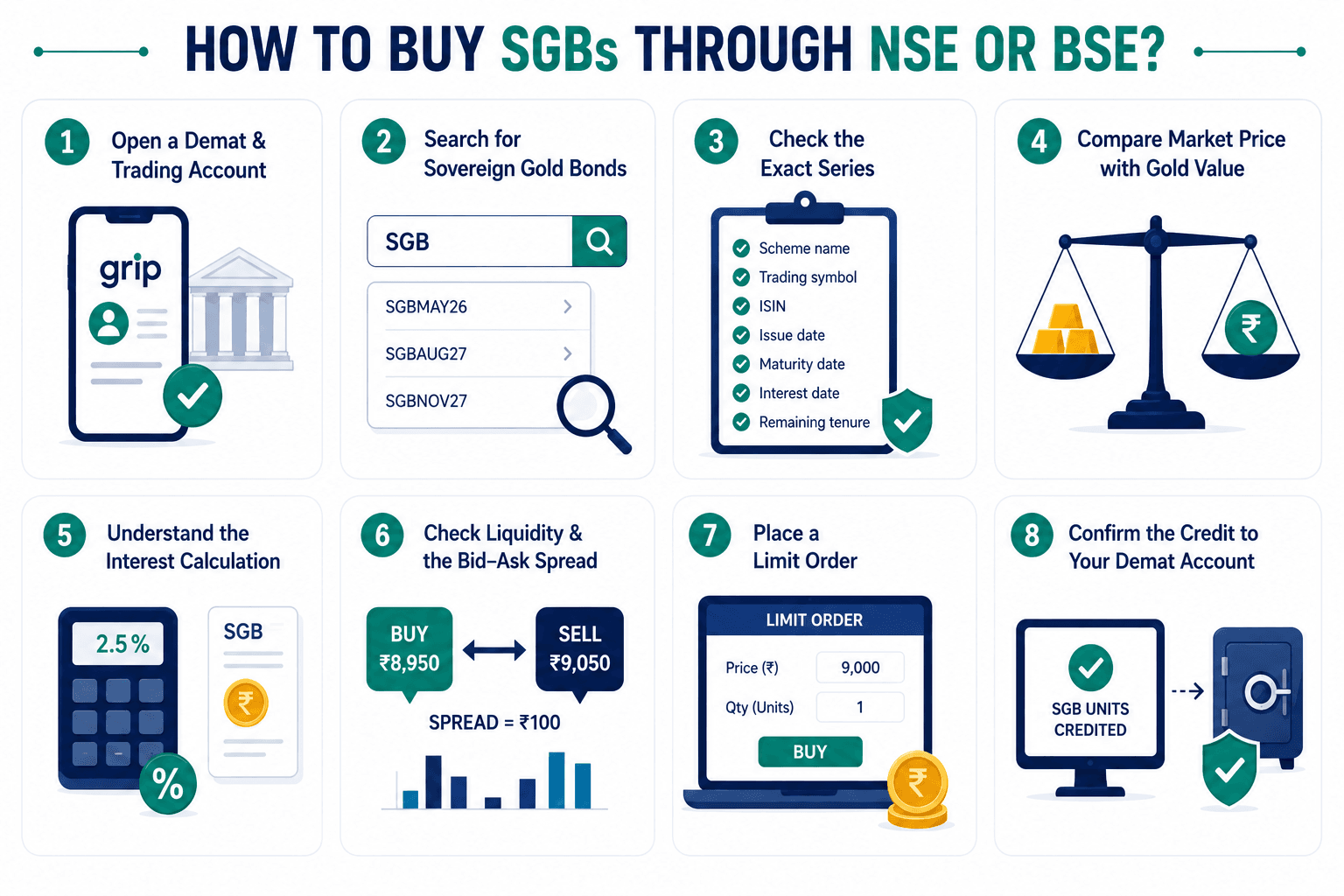
Step 1: Open a Demat and Trading Account
Use an existing account with a SEBI-registered broker or complete the account-opening process. Ensure that your PAN, bank account and KYC information are current.
Step 2: Search for Sovereign Gold Bonds
Enter “SGB” in the broker’s search bar. Several series may appear, each with a different symbol, issue date and maturity date.
For example, a symbol may include an abbreviation of its maturity month and year. Do not select a series based only on its current price.
Step 3: Check the Exact Series
Verify the following details:
Full scheme name
Trading symbol
ISIN
Original issue date
Final maturity date
Next interest payment date
Remaining tenure
The maturity date matters because bonds with a shorter remaining period may behave differently from newer series.
Step 4: Compare the Market Price With Gold Value
An SGB can trade above or below the value of one gram of gold. Demand, supply, liquidity, remaining tenure and tax expectations can affect its exchange price.
A discount does not always mean the bond is undervalued. Low trading activity or a wide bid-ask spread may explain the lower price.
Step 5: Understand the Interest Calculation
The annual interest remains 2.5% of the bond’s original issue price. It is not calculated on your secondary-market purchase price.
Suppose an SGB was originally issued at INR 5,000 per gram. Its annual interest remains INR 125 per unit, even when you buy it later for INR 9,000.
Your effective interest yield would therefore be lower than 2.5%, although you would still receive exposure to changes in gold prices.
Step 6: Check Liquidity and the Bid-Ask Spread
Some SGB series trade infrequently. A limited number of buyers and sellers can create a wide difference between the available buying and selling prices.
Review the daily volume before ordering. A bond may appear attractive but become difficult to sell quickly at a suitable price.
Step 7: Place a Limit Order
A market order accepts the best available price, which may change quickly in an illiquid series. A limit order allows you to set the maximum price you will pay.
Enter the required number of units. One SGB unit generally represents one gram of gold.
Step 8: Confirm the Credit to Your Demat Account
After exchange settlement, the purchased units should appear in your demat account. Check the quantity, ISIN and transaction price.
Interest payments and redemption proceeds will use the bank details linked to the holding records.
What Is HDFC Sovereign Gold Bond ?
Sovereign Gold Bonds (SGBs) are government securities denominated in grams of gold. They are issued by the Reserve Bank of India (RBI) on behalf of the Government of India. These bonds were introduced in November 2015 to reduce the demand for physical gold while offering investors a secure, gold-linked investment option.
1. HDFC Bank's Role in SGB Distribution
HDFC Bank is one of the RBI-authorised commercial banks that facilitates the subscription process for SGBs. Existing HDFC customers can purchase SGBs seamlessly through HDFC net banking, mobile banking applications,, or by visiting the bank branch. HDFC Bank acts as a collection agent, it receives your application and payment, and the bonds are credited to your Demat account or held in RBI Bond Ledger Account2
2. How the Investment Works ?
You invest in units equivalent to grams of gold. The issue price is fixed by the RBI based on the simple average of the closing price of 999-purity gold which is published by the India Bullion and Jewellers Association (IBJA) for the three business days preceding the subscription period.
For Example: Imagine the issue price is INR 6,200 per gram. You invest INR 62,000, which gives you 10 grams of SGB. After 8 years, if gold appreciates to INR 9,000 per gram, your redemption value would be INR 90,000, a capital gain of INR 28,000, plus the interest earned over the tenure. And if you hold to maturity, the INR 28,000 gain is entirely tax-free.
Key Features Of Sovereign Gold Bond Via HDFC
Here is a snapshot of the core features of HDFC SGB:
| Feature | Details |
| Issuer | Reserve Bank of India (RBI) on behalf of Govt. of India |
| Distribution Channel | HDFC Bank (net banking, mobile app, branch) |
| Denomination | 1 gram of gold (minimum 1 gram, max 4 kg per individual per year) |
| Tenure | 8 years (with exit option after 5th year on coupon payment dates) |
| Interest Rate | 2.50% per annum on initial investment, paid semi-annually |
| Issue Price | Based on IBJA gold rate (3-day average of 999 purity gold) |
| Online Discount | INR 50 per gram discount for online applications |
| Tax on Interest | Taxable as per investor's income tax slab |
| Capital Gains Tax at Maturity | Completely exempt (zero tax) |
| Tradability | Listed on stock exchanges after 2 weeks; can be sold early |
| Collateral | Eligible as collateral for loans |
| Eligibility | Resident Indians, HUFs, Trusts, Universities, Charitable Institutions |
Source: Bank Bazaar3
Risks And Considerations Before You Invest
Like any investment, SGBs come with risks that every investor should understand upfront.
a) Gold Price Volatility
The redemption value is directly tied to the prevailing gold price at maturity. If gold prices decline over your 8-year holding period, your capital may not grow as expected. However, you still earn the 2.5% annual interest regardless of price movement, providing a partial cushion.
b) Lock-in Period
SGBs have an 8-year tenure. While early exit is permitted from the 5th year onwards (on coupon payment dates), you cannot redeem early in the first five years. This makes SGBs unsuitable for investors who may need liquidity within 1–4 years4
c) Liquidity in Secondary Market
SGBs are listed on the NSE and BSE, so you can sell before maturity on the stock exchange. However, trading volumes for SGBs can be thin, meaning you may not always get the best price quickly. The bid-ask spread can sometimes work against retail sellers. This risk is mitigated significantly if you hold to the full 8-year term.
d) Interest Rate Risk
The 2.50% fixed interest rate may look modest compared to other fixed-income instruments, especially if market interest rates rise sharply in the future. However, investors are compensated by gold's long-term price appreciation potential.
Who Should Consider HDFC Sovereign Gold Bond?
SGBs are not a one-size-fits-all product. Here is who benefits the most:
1. Long-term investors (8+ year horizon) who want exposure to gold without managing physical storage.
2. Tax-conscious investors who want to avoid capital gains tax — the 8-year maturity exemption is a significant advantage over gold ETFs and physical gold.
3. Portfolio diversifiers who want to reduce overall portfolio risk by adding an uncorrelated asset class (gold) alongside equities and debt5
4. First-time gold investors who prefer a government-backed, transparent, and regulated product over unorganised jewellery purchases.
5. HDFC Bank customers who can conveniently subscribe through net banking and link the bond to their existing Demat accounts.
Gold Bonds Vs Physical Gold
When comparing gold bonds with gold ETFs or physical gold, the gold bond's benefits of convenience outweigh the disadvantages. Physical gold must be stored in a secure location, locker rental fee paid, risk of theft of jewellery, and only provides price appreciation.
With gold bonds, the disadvantages above are the advantages of holding the bond digitally, the interest income, and the gold purity certificate provided for the price you originally paid for the bond. Physical gold may be a good way to purchase jewellery for cultural purposes; however, gold bonds are better as pure investments.
| Aspect | Gold Bonds | Physical Gold |
| Storage | None needed | Locker costs yearly |
| Returns | Interest + price gain | Price gain only |
| Liquidity | After lock-in or trade | Sell anytime |
| Tax | Maturity exempt long-term | Gains taxed after years |
| Safety | Government backed | Theft risk high |
Beyond Basics: Eligibility And Tips
- Using annual limits to track and encourage each other's gold purchase after moving to bowls.
- Record gold purchase electronically as a record keeping method.
- Eligible to incur penalties when selling below min. return.
- Must track return at both level time.
- Cash flow statements not filed quarterly.
- Diversify and invest 5-10% of portfolios typically.
- Create price alerts.
Common Mistakes To Avoid
- Buy gold at too high a price or do research.
- Forget to account for premiums charged during resale periods.
- Failure to track trade activity through depositories.
- Forget to complete taxes on interest income.
- Verify authenticity of agents before engaging in transactions.
- Locating new methods of making purchases incurs considerably lower costs.
Conclusion
Sovereign Gold Bonds offer a structured and government-backed way to invest in gold without worrying about lockers, purity, or theft. You earn fixed interest along with potential price appreciation, and if held till maturity, the capital gains benefit makes them even more attractive. Whether you buy during primary issuance through your bank or pick them up later from the secondary market, SGBs provide flexibility along with discipline.
That said, gold should usually form only a portion of a diversified portfolio. If you are looking to balance gold exposure with other fixed-income options like corporate bonds, platforms such as Grip Invest can help you explore curated debt opportunities alongside traditional assets. Combining gold bonds with other income-generating instruments can create a more stable and diversified long-term strategy.
FAQs
1. How do I buy gold bonds?
Online through primary distribution at banks or offline at branches using personal identification numbers. By electronic distribution through the stock exchange at any time.
2. Are gold bonds safe?
Yes, all gold sovereign bonds come with full backing from the Indian Government, so both investment and coupon payments are completely safe. There are no physical storage or purity concerns.
3. Can I resell gold bonds prior to their maturity date?
Yes, through market channels 5+ years after you year-end through redemption in the Reserve Bank of India or through the market.
Want to stay at the top of your finances?
Join the community of 4 lakh+ investors and learn more about Grip Invest, the latest financial knick-knacks, and shenanigans in the world of investing.
Happy Investing!
Disclaimer - Investments in debt securities/municipal debt securities/securitised debt instruments are subject to risks including delay and/ or default in payment. Read all the offer related documents carefully. The investor is requested to take into consideration all the risk factors before the commencement of trading.
This communication is prepared by Grip Broking Private Limited (bearing SEBI Registration No. INZ000312836 and NSE ID 90319) and/or its affiliate/ group company(ies) (together referred to as “Grip”) and the contents of this disclaimer are applicable to this document and any and all written or oral communication(s) made by Grip or its directors, employees, associates, representatives and agents. This communication does not constitute advice relating to investing or otherwise dealing in securities and is not an offer or solicitation for the purchase or sale of any securities. Grip does not guarantee or assure any return on investments and accepts no liability for consequences of any actions taken based on the information provided. For more details, please visit www.gripinvest.in
Registered Address - 106, II F, New Asiatic Building, H Block, Connaught Place, New Delhi 110001


