

India–US Trade Deal Explained: Impact on Economy, Markets, And Investors


The much-anticipated India-US trade deal was announced a few hours ago by the Indian Prime Minister and the US President through social networks. Ever since the announcement was made official, the stock market has gone into a frenzy, with both the Nifty 50 and the Sensex inching towards record highs1. The Nifty IT Index jumped more than 6%, as IT services account for a major share of Indian exports to the US2.
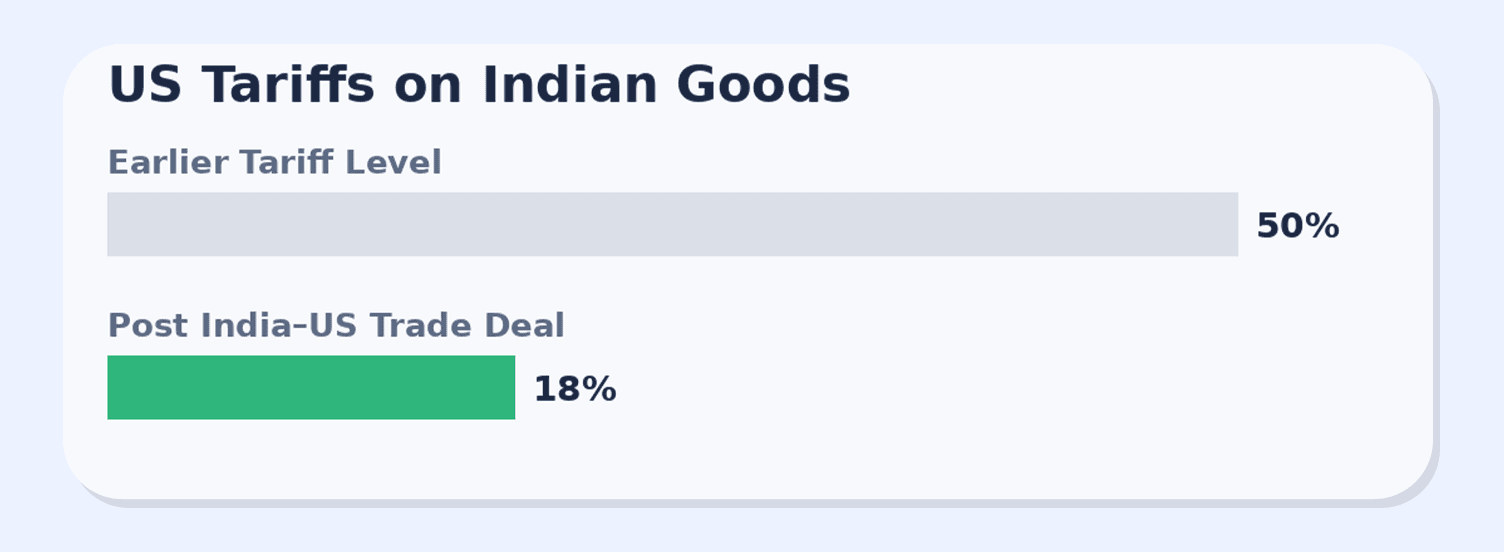
Even though the details of the deal are still pending, one of the most significant statistics is the reduction in tariffs on Indian goods from 50% to 18%, which provides an excellent opportunity for Indian manufacturers to expand in the US market.
The trade deal between two of the world's largest and most democratic economies is set to have major short-term and significant long-term implications for the economy and markets.
The Announcement: Stability In Global Trade And Reduction Of Tariffs
As part of the deal, the US has agreed to cut tariffs on Indian goods to 18% from earlier levels of up to 50%, with the changes taking effect immediately3. This marks a significant easing of trade restrictions that had earlier raised concerns for Indian exporters, particularly in manufacturing-heavy segments.
It will be interesting to note the product-wise tariff schedules, sector-specific exemptions, and implementation guidelines, which are expected to be released through subsequent notifications.
The US President stated that India will reduce tariffs and non-tariff barriers for American products to zero. However, aside from the tariff announcement, one of the most critical aspects of the deal, some clarifications are still awaited.
The Reason For The Markets’ Rally
The stock market reacted positively to the update, and the short-term impact of the trade deal was witnessed in broader and sectoral indices surging as soon as the opening bell rang.
The tariff reduction directly improves earnings visibility for companies dependent on US demand. Lower trade barriers reduce the risk of margin compression, enable better pricing power, and support order pipeline stability.
The currency market also showed similar optimism, with the INR appreciating by 1.20% and reaching a recent high of INR 90.36 versus the US Dollar reflecting expectations of improved dollar inflows and reduced pressure on India’s external accounts4.
Macro Impact: Economy, Trade, And Inflation
1. Short-Term Impact
The deal will provide much-needed relief to Indian exporters, whose sales were hit hard after President Trump's reciprocal and punitive tariff announcements a few months ago. With high tariffs and uncertain demand patterns, Indian exporters will gain significant clarity once the deal is finalised. The strengthening rupee may also ease imported inflation pressures by lowering the cost of dollar-priced commodities and intermediate goods.
With clearer trade policies between the two nations, there will be a significant impact on the capital and revenue expenditure decisions of medium- and large-sized businesses based in both the US and India.
2. Medium-Term Implications
One of the critical outcomes of the deal would be an edge for Indian businesses over their Asian counterparts. India now has one of the lowest tariffs on goods (18%), significantly lower than those in other Asian nations, including China, Pakistan, Indonesia, Bangladesh, and Vietnam.
The agreement may also strengthen India’s position in global supply chains, particularly for manufacturers looking to diversify sourcing amid geopolitical realignments.
However, actual predictions about the medium- to long-term implications of the deal can only be made once the detailed implementation, terms, and conditions are known.
Impact On Sectors And Themes
The biggest immediate beneficiaries of the deal are the exporters, as strong gains in the stocks of core sectors such as auto components, engineering goods, and other manufacturing-focused exporters were witnessed.
Large-cap stocks also contributed significantly to the rally, indicating broad-based participation rather than a narrow trade.
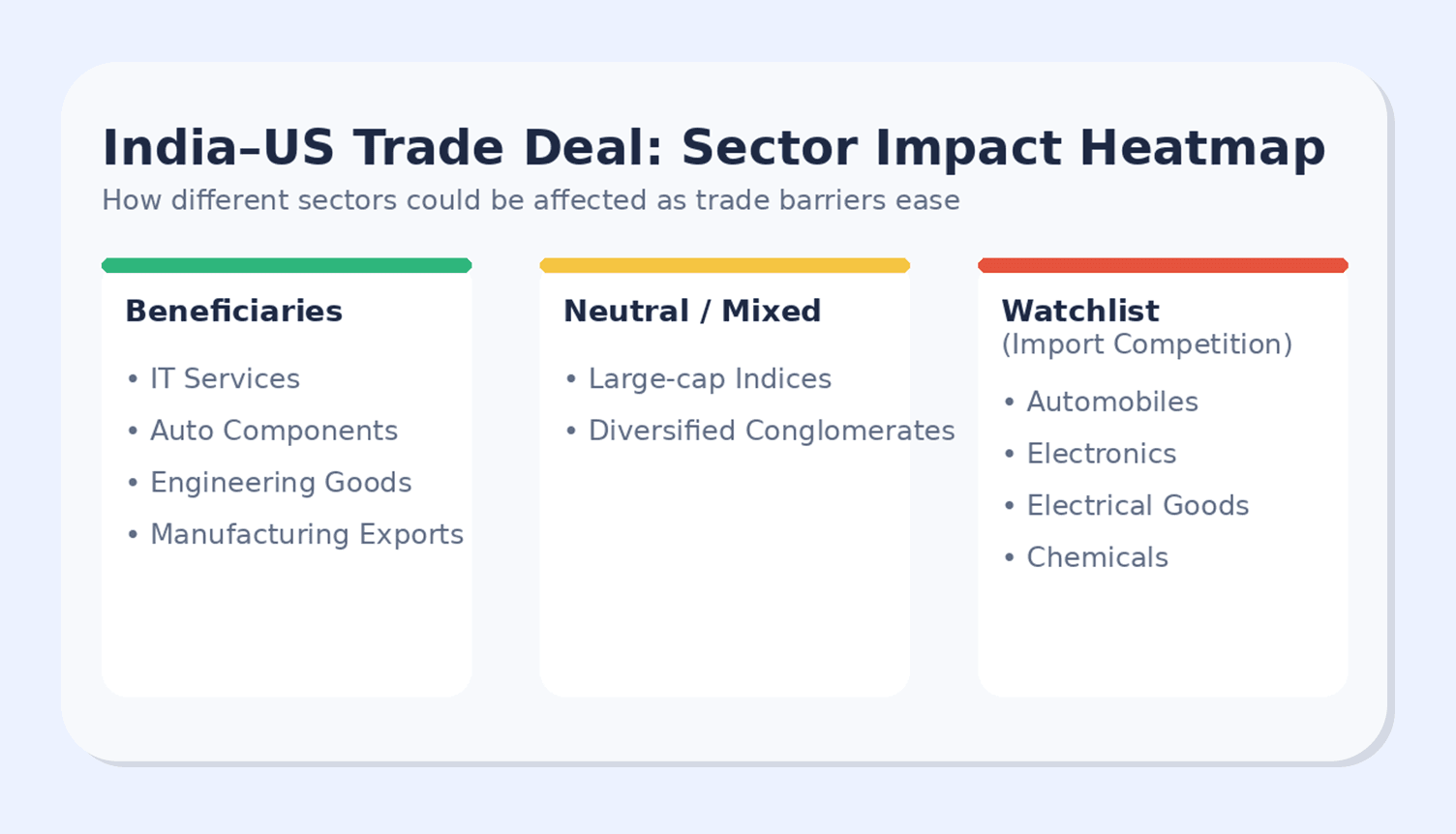
However, if the Indian government reduces tariff barriers on US goods to zero (as President Trump has stated), the market will see an influx of US products, including automobiles, electronics, electrical goods, and chemicals.
It will increase overall competitiveness in Indian markets and put some pressure on Indian players in these sectors. These effects are likely to become clearer once product-level details are released.
What Should Investors Do Now?
Even though the market is currently in euphoria, long-term investors should closely monitor official notifications detailing product-wise tariff changes, management commentary from export-oriented companies, and trends in foreign portfolio flows and rupee stability.
The market reaction after the announcement has been extremely positive, but it only adds to the overall volatility associated with the stock market.
In such phases, fixed-income instruments can play a stabilising role, offering diversification and predictable returns. Platforms like Grip Invest which provide access to curated fixed-income opportunities, can help investors balance growth exposure with income stability.
Conclusion
The India–US trade deal marks an important step toward improving trade certainty, export competitiveness, and earnings visibility for Indian businesses, particularly those reliant on the US market. While the initial market reaction has been positive, the real impact will depend on product-wise tariff structures, implementation timelines, and reciprocal trade commitments. As details emerge, investors will need to assess how the agreement shapes sectoral growth, capital flows, and India’s long-term position in global supply chains.
In such evolving market conditions, balancing growth opportunities with stable income becomes crucial—platforms like Grip Invest enable investors to access curated fixed-income options that can help manage volatility while staying invested for the long term.
FAQs On India US Trade Deal
1. What is the India–US trade deal?
The India–US trade deal involves a significant reduction in US tariffs on Indian goods, aimed at improving trade flows, export growth, and economic cooperation between the two countries.
2. How does the India–US trade deal impact Indian markets?
The deal has boosted market sentiment, with export-oriented sectors and indices like Nifty IT rallying on expectations of higher earnings and improved demand visibility.
3. Which sectors benefit the most from the trade deal?
Manufacturing exporters, auto components, engineering goods, and IT services are expected to be the key beneficiaries due to lower trade barriers.
4. Will the India–US trade deal affect inflation in India?
A stronger rupee and improved trade balance could help ease imported inflation by reducing the cost of dollar-denominated imports.
5. What should investors watch after the trade deal announcement?
Investors should track product-wise tariff details, company management commentary, rupee movement, and foreign portfolio investment trends for clearer direction.
References:
1. LiveMint, accessed from: https://www.livemint.com/market/stock-market-news/stock-market-today-live-sensex-today-nifty-50-india-us-trade-deal-donald-trump-tariffs-gold-rate-silver-price-usd-vs-inr-11770085249570.html
2. The Business Standard, accessed from: https://www.business-standard.com/markets/news/nifty-it-index-soars-6-intra-day-techm-hits-record-high-here-s-why-126020300487_1.html
3. Reuters, accessed from: https://www.reuters.com/world/india/india-us-trade-deal-slashes-tariffs-lifts-exports-markets-2026-02-03/
4. Live Mint, accessed from: https://www.livemint.com/market/stock-market-news/indiaus-trade-deal-impact-rupee-jumps-1-2-to-90-40-against-us-dollar-can-it-appreciate-further-11770089966543.html
Want to stay at the top of your finances?
Join the community of 4 lakh+ investors and learn more about Grip Invest, the latest financial knick-knacks, and shenanigans in the world of investing.
Happy Investing!
Disclaimer - Investments in debt securities/municipal debt securities/securitised debt instruments are subject to risks including delay and/ or default in payment. Read all the offer related documents carefully. The investor is requested to take into consideration all the risk factors before the commencement of trading.
This communication is prepared by Grip Broking Private Limited (bearing SEBI Registration No. INZ000312836 and NSE ID 90319) and/or its affiliate/ group company(ies) (together referred to as “Grip”) and the contents of this disclaimer are applicable to this document and any and all written or oral communication(s) made by Grip or its directors, employees, associates, representatives and agents. This communication does not constitute advice relating to investing or otherwise dealing in securities and is not an offer or solicitation for the purchase or sale of any securities. Grip does not guarantee or assure any return on investments and accepts no liability for consequences of any actions taken based on the information provided. For more details, please visit www.gripinvest.in
Registered Address - 106, II F, New Asiatic Building, H Block, Connaught Place, New Delhi 110001


