

RBI Bulk Deposit Disclosure Rules 2026: Rate Disclosure, Thresholds And Bank Requirements



What Are RBI Bulk Deposit Disclosure Rules?
The Reserve Bank of India (RBI) bulk FD disclosure rules require banks to disclose the interest rates offered on large-value term deposits. The framework is intended to make the rates offered on bulk deposits more transparent and allow depositors to compare the applicable rates before placing their funds.
Under the rules, banks must publish the applicable bulk-deposit interest rates on their websites. The rates offered for deposits of the same amount category and tenor are also subject to RBI’s requirements on consistency and differential pricing.
These RBI rules for bulk deposits bring higher visibility to the pricing of high-value deposits, where rates may differ from those available on regular retail fixed deposits.
What Changed Under RBI’s July 2026 Amendment?
The July 2026 RBI amendment introduced specific changes to RBI bulk deposit disclosure rules, which are to take effect from 1 October 2026.1
- Fixed Disclosure Time: Under the revised bulk FD disclosure rules, banks must publish applicable deposit rates on their websites by 10:00 am on every business day, with a maximum grace period of 10 minutes, until 10:10 am.
- Uniform Rates: The revised RBI rules for bulk deposits require disclosed rates to be uniform across branches and customers, without discrimination between deposits of similar amounts accepted on the same date.
- LCR-Based Pricing: Banks may offer differential bulk deposit interest rates RBI sets based on the applicable Liquidity Coverage Ratio (LCR) run-off rates for deposits or unsecured wholesale funding.
- Advance Rate Disclosure: Under the revised RBI deposit rate disclosure framework, the interest payable on deposits must follow the rate schedule disclosed by the bank in advance on its website.
What Is Considered A Bulk Deposit Under RBI Rules?
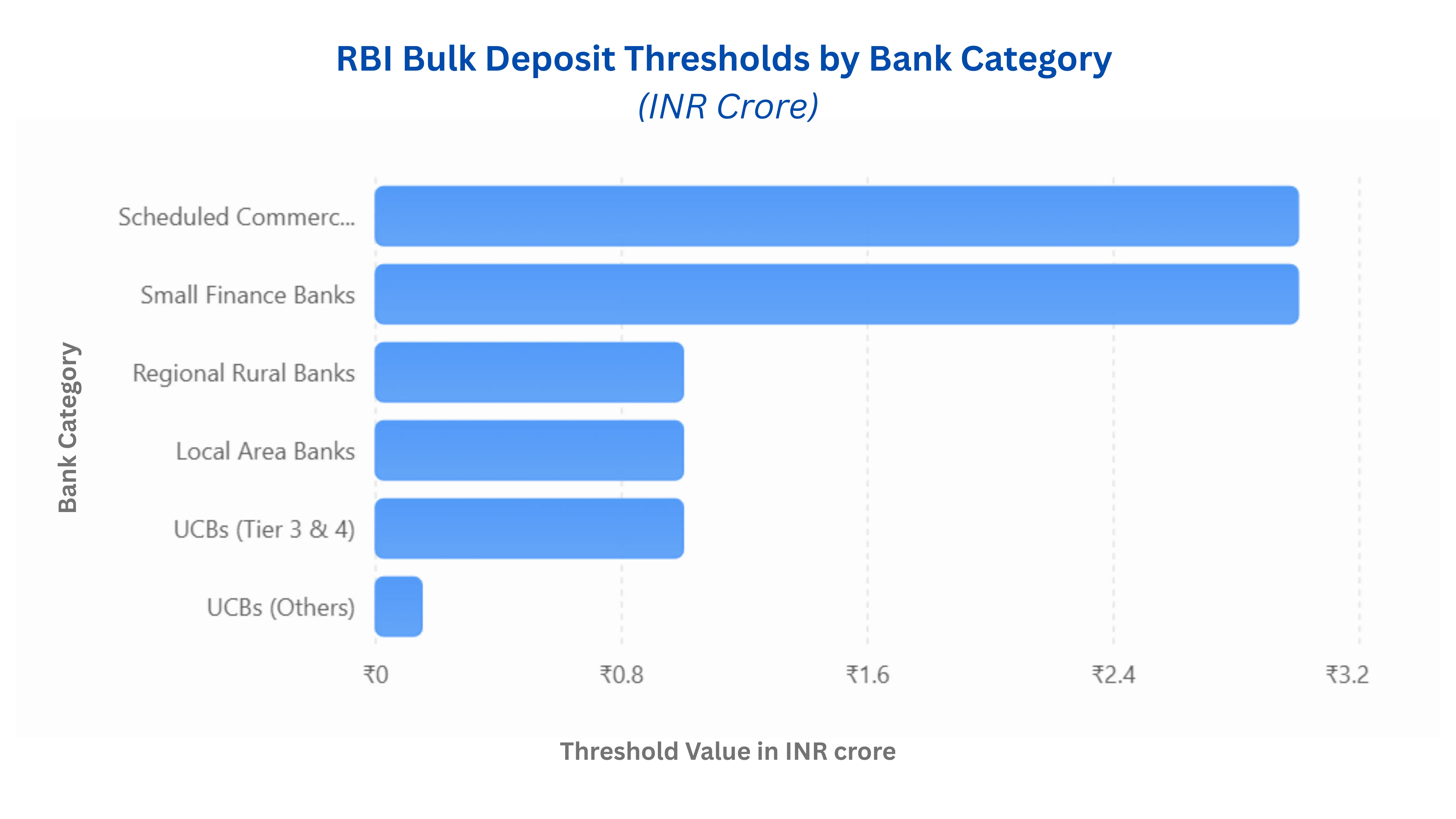
Under RBI bulk deposit disclosure rules, a bulk deposit refers to a single rupee term deposit that meets or exceeds a specified regulatory threshold. The RBI rules for bulk deposits vary across the categories of financial institutions. The thresholds revised by the RBI in June 2024 remain unchanged under the latest revision of the RBI rules for bulk deposits.
- Scheduled Commercial Banks (SCBs) and Small Finance Banks (SFBs): A single rupee term deposit of INR 3 crore and above.
- Regional Rural Banks (RRBs) and Local Area Banks (LABs): A single rupee term deposit of INR 1 crore and above.
- Urban Co-operative Banks (UCBs): A single rupee term deposit of INR 1 crore and above for Tier 3 and Tier 4 UCBs, and INR 15 lakh and above for all other UCBs.
Source: RBI, Money Control2,3
How Can Banks Set Interest Rates On Bulk Deposits?
Banks set interest rates on bulk deposits based on their internal asset-liability requirements and specific regulatory guidelines.
Unlike retail rate cards, which offer fixed, non-negotiable interest rates to the general public for smaller deposit buckets, bulk deposit pricing allows for more flexibility. Banks can further structure differential rates depending on funding needs and the specific liquidity risk profile under the bulk deposit rules RBI LCR framework.
However, banks are not allowed to price arbitrarily. Under RBI deposit rate disclosure guidelines, the rates must be determined and disclosed in accordance with the applicable RBI requirements.
Additionally, banks must transparently publish their applicable bulk deposit schedules on their websites every business day by 10:00 AM, effective from 1 October 2026.
Bulk Deposit Disclosure Vs Regular FD Rate Disclosure
The RBI bulk FD rules and bank FD rate disclosure create a distinct framework for managing liquidity risk and enhance market transparency.
Features | Bulk Deposit Disclosure | FD Rate Disclosure |
| Threshold Limit | Single deposits of INR 3 crore and above | Retail deposits under INR 3 crore |
| Update Frequency | Daily publication every business day | Periodic and only during policy revisions |
| Timeline Mandate | Must be live by 10:00 AM, with a 10-minute grace period | Disclosed in advance without daily deadlines |
| Pricing Basis | Linked to Liquidity Coverage Ratio (LCR) risks | Standard maturity tenures and investor type |
Why Do RBI’s Disclosure Rules Matter To Depositors?
RBI bulk deposit disclosure rules improve transparency around deposit rates and help investors assess the terms available for their specific deposit size.
- Easier Comparison: The published rates allow depositors to compare rates offered by different banks for similar deposit categories.
- Greater Pricing Transparency: Regular disclosure gives depositors visibility into the rates banks offer on bulk deposits.
- Better Rate Understanding: Disclosed rates help depositors identify the rate applicable to their deposit size and tenure.
- Rate Eligibility: Depositors can verify whether a quoted bulk deposit rate is actually available for their intended deposit amount.
- Less Rate Confusion: The disclosures help to distinguish retail FD rates from bulk deposit rates. Checking the actual rate and terms is important when evaluating fixed-income investment opportunities.
How Should Investors Check A Bank’s Bulk FD Rate?
Investors should check the latest published bulk deposit rate of the bank before committing funds, rather than relying on a quoted or previously advertised rate.
1. Check the Bank Website: Visit the official website and locate the daily bulk deposit rate schedule.
2. Verify the Deposit Size: Check the specific bank category threshold rules and whether the amount meets the bulk limit.
3. Check the Publication Date: The rate should be from the latest business-day disclosure and not superseded by a newer rate.
4. Compare the Tenure: Check the rate against the exact deposit tenure, as the applicable rate can vary across maturity periods.
5. Confirm Applicable Terms: Review the rate schedule and other deposit terms before investing to confirm that the quoted rate applies to the proposed deposit.
Conclusion
The revised RBI bulk deposit disclosure rules bring greater transparency to how banks disclose and price large-value term deposits. For depositors, the key consideration is not only the quoted interest rate but also whether it applies to their deposit size, tenure and category. Checking the latest bank disclosure and applicable terms can help investors assess fixed-income opportunities more accurately.
FAQs

Want to stay at the top of your finances?
Join the community of 22 lakh+ investors and learn more about Grip Invest, the latest financial knick-knacks, and shenanigans in the world of investing.
Happy Investing!
Disclaimer - Investments in debt securities/municipal debt securities/securitised debt instruments are subject to risks including delay and/ or default in payment. Read all the offer related documents carefully. The investor is requested to take into consideration all the risk factors before the commencement of trading.
This communication is prepared by Grip Broking Private Limited (bearing SEBI Registration No. INZ000312836 and NSE ID 90319) and/or its affiliate/ group company(ies) (together referred to as “Grip”) and the contents of this disclaimer are applicable to this document and any and all written or oral communication(s) made by Grip or its directors, employees, associates, representatives and agents. This communication does not constitute advice relating to investing or otherwise dealing in securities and is not an offer or solicitation for the purchase or sale of any securities. Grip does not guarantee or assure any return on investments and accepts no liability for consequences of any actions taken based on the information provided. For more details, please visit www.gripinvest.in
Registered Address - 106, II F, New Asiatic Building, H Block, Connaught Place, New Delhi 110001


