

Union Budget 2026 Infrastructure Announcements: Roads, Railways, Housing And Capex Push Explained


Increased demand for improved infrastructure is seen across India. Additional roadways, railways and residences have become the need of the hour.
Union budget 2026 infrastructure announcements have highlighted how these areas need to change in order to support continued economic development. The budget was all about providing financial support to improve these infrastructure requirements.
Finance Minister Nirmala Sitharaman has increased capital expenditures, which will encourage Indians to create jobs and increase interconnectivity. Overall, this could greatly enhance India's economy if implemented properly.
Why Infrastructure Matters
Infrastructure supports India's development story, as we know how poor Infrastructure causes long delays in the free movement of people and halts trading as well.
Slow trains cause delays in the transportation of products. The Union Budget infra projects in 2026 will remove all these problems.
Hypothetical Example:
INR 12.2 trillion of investment in this domain will provide employment for millions and improve the overall economy. The creation of better infrastructure will make the daily activities of all citizens a lot easier.
Improved infrastructure networks will improve access to cities from rural areas. The ease of movement of people and products will certainly generate growth.
Overall Allocation
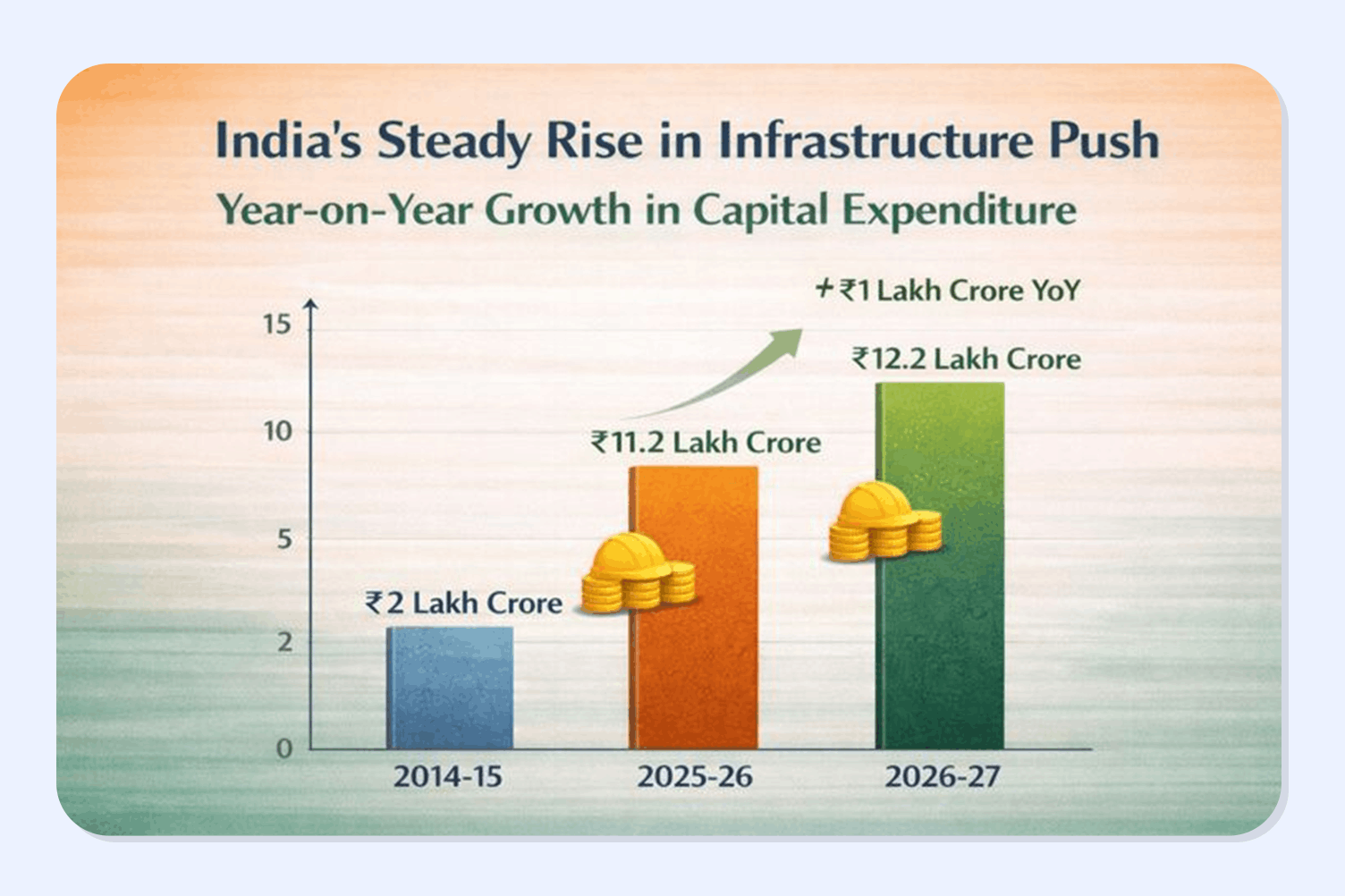
The capital expenditure budget for the central government in 2026 is INR 12.2 trillion. The current amount is an increase of 9% from last year's original budget amount to the Capital Expenditure of INR 11 trillion.
Building assets such as roads and railways with this funding will also encourage private sector investment. Capital expenditure (capex) by the federal government has been steadily increasing from a low (in 2014) of 2 trillion, which will now provide ongoing long-term growth.
Overall Capex
Capex for the current year is INR 12.2 trillion. Public Capex India provides the funding for the creation of entirely new capital projects, along with the upgrade of existing capital projects across many sectors. The focus will remain on the creation of quality assets.
YoY Growth in Capital Expenditure
There is a YoY increase of INR 11.2 trillion in the capital expenditure budget from 2025/26 to 2026/27. The steady increases in the capital expenditure budget 2026 are indicative of a long-term commitment to creating economic growth in India, and create a basis for future growth in all economic sectors.
Key Announcements
The focus of the union budget infrastructure projects highlighted is centred on the Budget of 2026. The major focus of this budget 2026 infrastructure spending is on tier 2 and 3 cities and will facilitate urban growth at a faster pace than before.
1. Roads and Highways
When it comes to roads highways budget India 2026, it is receiving INR. 2.94 lakh crores of the funding. Major cities would now be connected with new expressways, which would reduce congestion and ultimately increase trade. In addition, projects will also target upgrade projects in all border communities, which will make travel quicker and safer.
2. Railways and Metro Projects
The railway budget allocation 2026 supports seven new high-speed trains. There is an increase in safety equipment through modern signalling technology. Expansion of the Metro rail into smaller cities is planned, and freight corridors will speed up the movement of goods. Trains will operate at much higher speeds than before.
3. Ports and Logistics
Upgrades to ports will lead to much faster shipping. Additional freight corridors are planned to link the eastern and western coasts of India. The number of national waterways will increase, providing another cheaper form of transportation. The improved links between transport modes will reduce logistics costs. Goods will get to the market much faster due to the improved transport links.
4. Affordable Housing and Urban Infra
Affordable housing is being targeted for all Tier-2 cities with populations over 5 lakh, including urban infrastructure financing requirements for smart cities. There will be an increase in real estate investment trusts (REITs) that recycle real estate assets. Housing will become affordable for the majority of people in the middle class.
Sector-Wise Impact
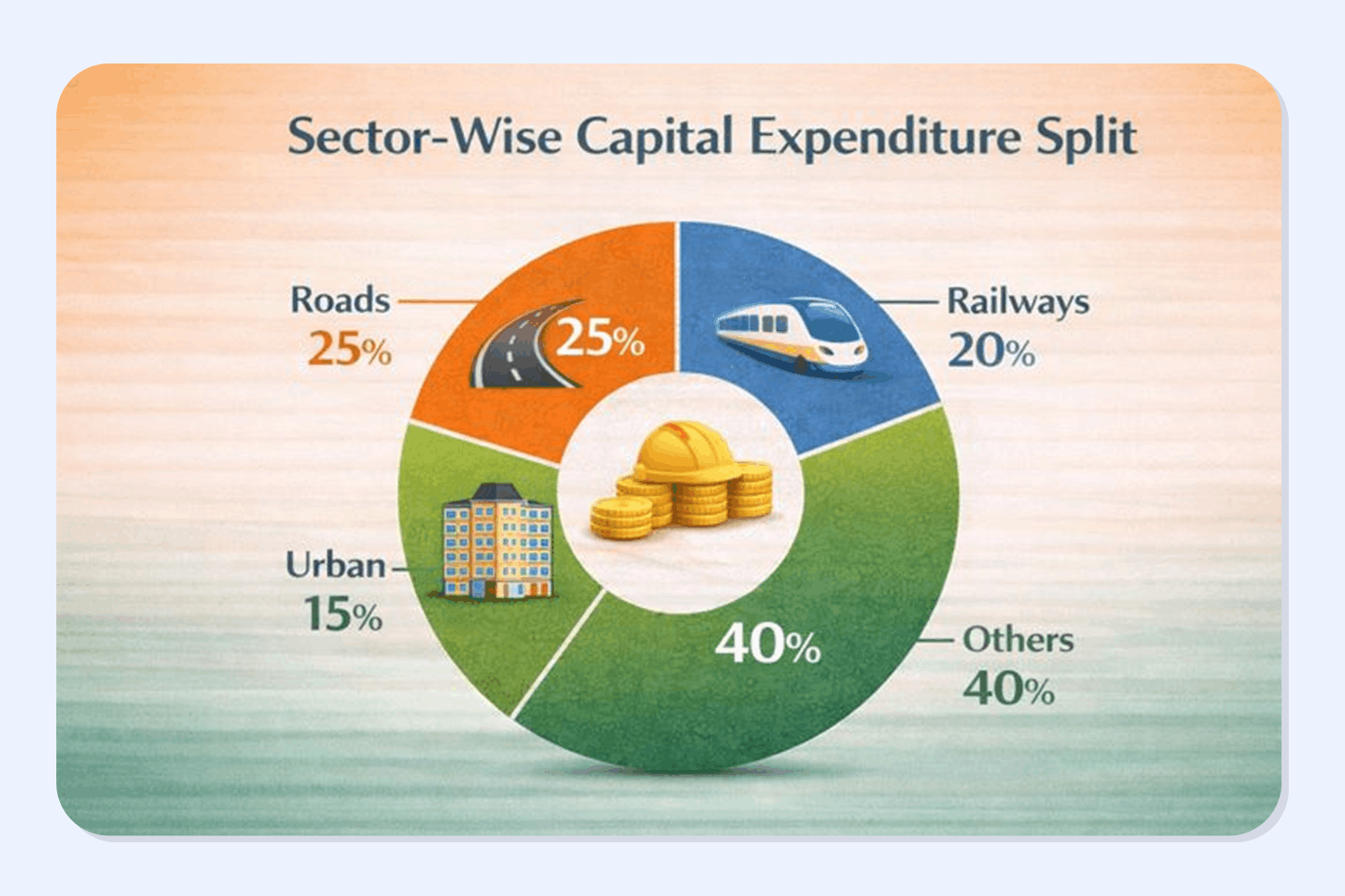
Significant new federal government infrastructure budgets will produce downstream economic effects. As construction companies receive new major contracts, they will require substantial amounts of steel and cement to fulfil those contracts, thus creating additional jobs.
- Construction: Many projects have an ongoing supply of work for construction companies to fulfil. Consequently, companies like L & T are seeing their order books grow steadily. For instance, a road project contract for approximately INR 5,000 crores is equivalent to creating 20,000 jobs.
- Steel and Cement: The demand for these products will only continue to be strong over the next two years. The capacity utilisation at the existing plants producing these materials will continue to be approximately 15% over their current rate of production. For instance, Tata Steel has been supplying a new line of Rails, generating record quarterly sales for the company.
- Logistics: The reduction in the costs of providing transportation service will significantly reduce expenses for companies utilising trucks to transport goods and for those companies utilising water to transport goods.
- Real Estate: The federal government is encouraging the construction of new housing units, making it easier for developers to obtain financing. The developers are also benefiting from Investment in the Real Estates Trust, providing funding. For example, a developer in Pune recently sold 2000 affordable housing units in a short period of time.
Investor Participation
For retail Investors, joining the infrastructure story is simple. The infrastructure investment sector is easily accessible through two main avenues - equities and bonds. WE can leverage the Union Budget's infra project allocation. There are also several listed capex-focused stocks that can be used to track capex-related growth. Subtle solutions like Grip can facilitate purchasing bonds.
Equity Exposure
Invest in publicly traded infrastructure companies like L&T, IRB, etc. - Their stock price will go up when they win new projects, creating long-term capital gains over time.
Example: INR 1 lakh invested in a road builder will yield a 25% return in a year's time.
Fixed-Income Opportunities
Infrastructure expansion also creates attractive opportunities in government-backed infrastructure bonds, which are designed to offer predictable income and relatively lower risk compared to many market-linked investments. Bonds issued by entities such as NHAI (National Highways Authority of India) and IRFC (Indian Railway Finance Corporation) are commonly considered by investors seeking stable returns while participating in India’s long-term infrastructure growth.
Why infrastructure bonds can be attractive:
- Stable interest income: Regular coupon payments provide predictable cash flows.
- Relatively lower credit risk: Many infrastructure issuers are government-backed or government-linked entities.
- Portfolio diversification: Fixed-income instruments help balance equity market volatility.
- Participation in infrastructure growth: Investments indirectly support large-scale national projects.
Example:
An investment of INR 50,000 in an NHAI bond offering 7.5% annual interest can generate steady yearly income while preserving capital over the investment tenure.
Today, investors can access curated corporate and infrastructure bond opportunities through platforms like Grip Invest, making it easier to explore diversified fixed-income investments aligned with India’s infrastructure expansion.
Conclusion
The Union Budget 2026 infrastructure announcements reinforce the government’s long-term commitment to building roads, railways, logistics networks, housing, and urban infrastructure that can sustain India’s economic expansion. Higher capital expenditure, targeted investments in Tier 2 and Tier 3 cities, and a strong focus on connectivity are expected to boost job creation, stimulate private sector participation, and improve productivity across industries such as construction, steel, cement, logistics, and real estate. Over time, these investments can strengthen supply chains, reduce transportation costs, and support faster economic growth.
For investors, the infrastructure push opens opportunities across both equity and fixed-income markets, as companies involved in construction, logistics, and materials benefit from increased project pipelines, while government-backed infrastructure bonds provide relatively stable income avenues. Platforms like Grip Invest enable investors to access curated bond opportunities linked to India’s infrastructure growth, helping diversify portfolios while participating in the country’s long-term development story.
FAQs
1. What are the Major Infrastructure Announcements in the 2026 Union Budget?
Major infrastructure investment highlights in the budget include:
- The 2026 Union budget allocated a total of INR 12.2 lakh Crore ($150 Billion) to capital expenditures across all sectors, including INR 2.94 lakh crore ($39.0 Billion) for roads/highways.
- INR 3.90 lakh crore ($48.4 Billion) to develop seven high-speed rail corridors as part of the Indian railway system, as well as ports and INR 1.10 lakh crore ($13.4 Billion) for providing economical housing and townships in 2nd-level cities.
The intent behind these infrastructure projects is to develop adequate transport links and generate additional employment across all levels of the economy.
2. How Much Was Capital Expenditure Allocated in the 2026 Union Budget?
The Union Budget for capital expenditures for 2026 is INR 1,24,000 Crore, which is a 9% increase from the 2025 fiscal year budget of INR 1,12,000 Crore. The capital works programme for the Indian infrastructure spending.
3. What Sectors Will Benefit From the 2026 Union Budget Infrastructure Investment?
Sectors that experience the greatest benefit from the infrastructure investment made by the government in the Union Budget for 2026 are: Construction, Steel, Cement, Logistics and Real Estate.
Want to stay at the top of your finances?
Join the community of 4 lakh+ investors and learn more about Grip Invest, the latest financial knick-knacks, and shenanigans in the world of investing.
Happy Investing!
Disclaimer - Investments in debt securities/municipal debt securities/securitised debt instruments are subject to risks including delay and/ or default in payment. Read all the offer related documents carefully. The investor is requested to take into consideration all the risk factors before the commencement of trading.
This communication is prepared by Grip Broking Private Limited (bearing SEBI Registration No. INZ000312836 and NSE ID 90319) and/or its affiliate/ group company(ies) (together referred to as “Grip”) and the contents of this disclaimer are applicable to this document and any and all written or oral communication(s) made by Grip or its directors, employees, associates, representatives and agents. This communication does not constitute advice relating to investing or otherwise dealing in securities and is not an offer or solicitation for the purchase or sale of any securities. Grip does not guarantee or assure any return on investments and accepts no liability for consequences of any actions taken based on the information provided. For more details, please visit www.gripinvest.in
Registered Address - 106, II F, New Asiatic Building, H Block, Connaught Place, New Delhi 110001


