

Covered Bonds
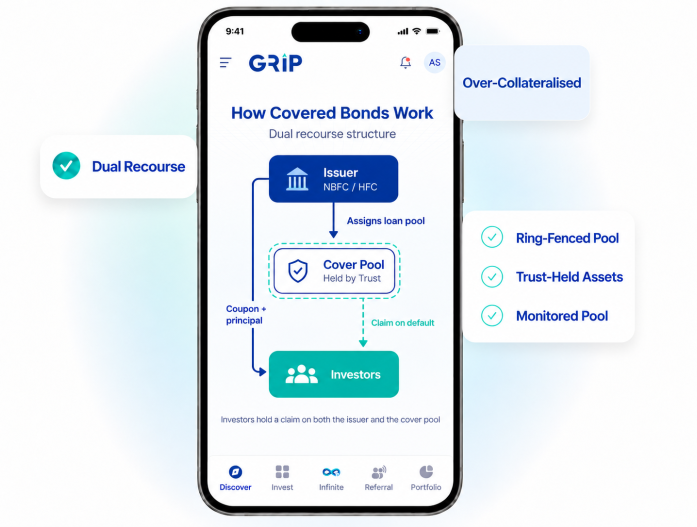
Cover Pool: Issuances are backed by a segregated pool of receivables, typically mortgage loans, vehicle loans, gold loans, or MSME advances originated by the issuing entity.
Dual Recourse: In the event of default, investors hold a claim on the issuer and, separately, on the cover pool securing the bonds.
Ring-Fencing: India has no dedicated covered bond legislation, so the cover pool is generally transferred to a trust or special purpose vehicle to keep it separate from the issuer's insolvency estate.
Over-Collateralisation: The value of the cover pool is maintained above the value of bonds outstanding, and underperforming assets are typically replaced through the life of the issuance.
Credit Rating: Rating agencies assess the issuer's standalone credit profile, the quality and seasoning of the cover pool, the level of over-collateralisation, and the enforceability of the ring-fencing structure. This can result in a rating above the issuer's own rating.
Retail Availability: Most Indian covered bond issuances are privately placed, leaving listed corporate and government bonds as the accessible retail option.


Plan Your Investments In Bonds
Estimate your returns from investment in bonds in India
Use our bond calculator to estimate the returns you will get from investments in bonds in India. This calculator is designed to estimate returns from different types of bonds, such as covered bonds, corporate bonds, etc.
- Add your investment amount
- Add the tenure of the bond
- Provide expected YTM and coupon frequency
- See instant returns
Disclaimer: This calculator is for illustration purposes only and does not guarantee or represent actual returns.

REASON AND BENEFITS

Structural Credit Protection
Dual recourse, over-collateralisation and a ring-fenced pool are designed to reduce investor losses if the issuer defaults.

Rating Uplift
Since the cover pool is assessed alongside the issuer, covered bonds may be rated above the issuer's own rating.

Return Positioning
Covered bond returns typically sit above comparable government securities and below the same issuer's unsecured debt.

Ongoing Pool Monitoring
The issuer monitors the cover pool through the bond's life and replaces assets falling below agreed criteria.

Predictable Coupon Income
Covered bonds usually pay a fixed coupon at defined intervals, supporting investors who need scheduled cash flows.

How to Invest?


- Legislative Covered Bonds: Governed by dedicated statute that defines investor claims, cover pool eligibility and issuer obligations. India has no such legislation.
- Contractual Covered Bonds: Governed by the transaction documents rather than statute. All Indian covered bond issuances currently fall in this category.
- Static Pool: The cover pool is fixed at issuance and its assets are not substituted, even if their performance deteriorates.
- Dynamic Pool: Here, the constituents of the cover pool are closely monitored and changed based on their performance.
- Hard Bullet: Principal is repaid on a fixed maturity date with no provision for extension.
- Soft Bullet: Here, the maturity date of a covered bond can be shifted or postponed up to a specific tenure.
- Conditional Pass-Through: If principal is unpaid at maturity, the bond converts to pass-through, repaying investors as pool cash flows arrive.

OTHER OFFERINGS
Other Secured Fixed-Income Products By Grip Invest

Corporate Bonds
- Securities issued by corporates & NBFCs
- Up to 12.5% pre-tax YTM
- Start investing with Rs 1,000
- Exchange listed and credit rated

InvoiceX
- Loans backed by Invoice Discounting
- Up to 14% pre-tax YTM
- Start investing with Rs 1,00,000
- SEBI/RBI compliant and credit rated

LoanX
- Diverse pool of loans from top NBFCs
- Up to 14% pre-tax
- Start investing with Rs 1,00,000
- SEBI/RBI compliant and credit rated

Baskets
- Theme based investing
- Up to 14% pre-tax YTM
- Start investing with Rs 5,000
- SEBI/RBI compliant and credit rated

Corporate FDs
- High Yield Fixed Deposit Investments
- Up to 10% pre-tax
- Start investing with Rs 1,000
- SEBI/RBI compliant and credit rated
For your knowledge
Some of our partners






Insightful Videos
Watch & Learn More About Investing In Bonds
How to Claim TDS on Bonds: Step-by-Step Guide
Current Yield vs YTM: What Smart Investors Should Know
What is Yield in Bonds? Bond Yields Explained Simply
To help you
Frequently Asked Questions
Why do investors consider covered bonds?
Are covered bonds considered low-risk investments?
Can covered bonds survive even if there is a default?
Which two layers of security do covered bonds offer?


