Top

Debentures

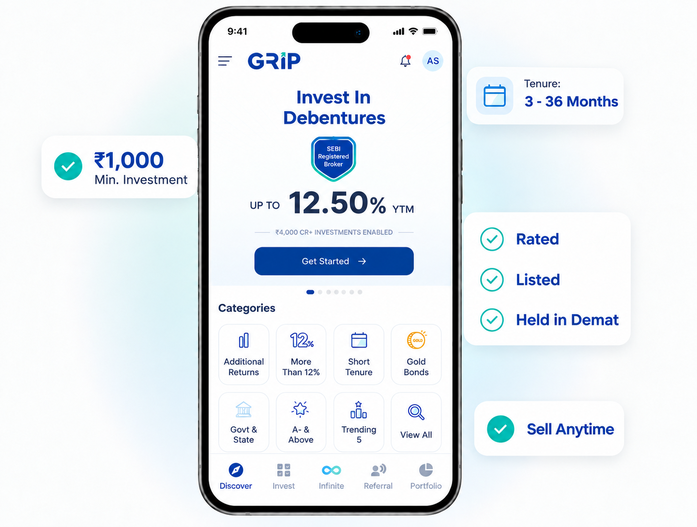
Invest in credit-rated debentures from established Indian issuers, with YTM of up to 12.5%. Start investing with just INR 1,000.

invest_in_debentures
  • Credit Rated Options
  • SEBI Registered Platforms
  • Invest & Sell Anytime
AT A GLANCE
Investing With Grip
₹ 4,000 Cr+
Investments Enabled
₹ 1,000
Min. Investment in Debentures
51,000+
Investors
ABOUT DEBENTURES

What Are Debentures?

  • Debentures are debt instruments issued by companies to raise funds, where investors receive interest and repayment of principal as per the terms and conditions.

  • Debentures can be secured or unsecured and convertible or non-convertible debentures (NCDs). NCDs are a common form of debentures in India and are widely used by NBFCs across infrastructure, housing and vehicle finance.

  • The key features of debentures include defined tenures, interest payout schedules, credit ratings and security arrangements that vary by issuer.

  • Debenture holders are lenders to the company, not owners, so they earn interest without voting rights or a share in profits.

  • Debenture investments carry issuer and market risks, so investors should consider credit rating, security and repayment terms.

gripFDworks
Debentures
fdWorks
Bank FDs
YTM (%)
Up to 12.5%
6% - 7%
Principal Repayment
At maturity or in instalments
At maturity
Risk
Varies with credit rating and security
Low
Liquidity
Listed debentures can be sold before maturity
Premature withdrawal, usually with a penalty
Tenure
Varies (3-36 Months)
7 days to 10 years
Security cover
Yes, if secured
DICGC insurance up to INR 5 lakhs

Make Plan For Your Investment

Estimate returns from your debenture investments

Use our bond calculator to find out the expected returns from investments in debentures in India. Provide the inputs to see the final amount.

  • Add investment amount
  • Provide tenure and coupon frequency
  • Set the expected YTM
  • See instant results
Bond Return Calculator
₹
24 mo
%
Total returns₹1,20,963
Interest₹20,963

Disclaimer: This calculator is for illustration purposes only and does not guarantee or represent actual returns.

LIVE DEBENTURES ON GRIP INVEST
Invest In Debentures Starting From Just INR 1,000

REASON AND BENEFITS

Why Invest In Debentures?

grip

Regular Interest Income

Debentures pay interest at set intervals as per issue terms, helping investors plan a steady income stream.

grip

Repayment Priority

Debenture holders have priority over shareholders for repayment, in case the issuing company gets liquidated or winds up.

grip

Higher Yield Potential

Secured and unsecured debentures both may offer higher yields than FDs, but the return varies, depending on issuer risk and market conditions.

grip

Portfolio Diversification

Debentures add a fixed-income component to equity-heavy portfolios and are generally less affected by daily stock market movements.

grip

Liquidity Before Maturity

Listed debentures can be sold before maturity at market prices. Investments made through Grip Invest can be sold anytime.

grip

Investor Protection

For listed issues, a SEBI-registered debenture trustee monitors the issuer's compliance and protects debenture holders' interests.

How to Invest?

It’s really simple with Grip

Find Your Deal
Investment Process
Visualize Returns
01.

Explore curated investment opportunities process

Find
your deal

Unique investment opportunities qualified through rigorous due diligence

02.

Complete KYC and investment process

Complete
KYC &
Investment

Seamless digital KYC, e-sign and payment experience

03.

Earn fixed returns with Grip

Returns per
pre-decided
schedule

Track your portfolio seamlessly while earning fixed returns

How To Evaluate A Debenture Before Investing?
  • Credit Rating: While figuring out how to invest in debentures in India, check the credit ratings assigned by agencies such as CRISIL, ICRA, CARE and India Ratings. They can range from AAA to D, wherein ratings of BBB- and above are generally considered investment-grade, indicating lower default risk.
  • Issuer Financials: The financial performance of the issuer, debt levels and repayment track record indicate its ability to pay interest and return principal on time.
  • Security Cover: Secured and unsecured debentures differ in their collateral arrangements. Secured debentures have specified assets attached as collateral, while unsecured debentures lack that, which can impact recovery prospects upon default.
  • Yield To Maturity (YTM): YTM is the expected return upon maturity. Comparing it with similar assets and market rates can help in assessing whether the yield matches risk.
  • Tenure And Liquidity: The tenure and the financial goals of an investor should align when choosing a debenture to invest in. Listed and actively traded debentures may offer easier liquidity, while low-volume issues can be harder to sell.
  • Payout Structure: Check the interest frequency, whether the coupon is fixed or floating, and whether the principal is repaid in instalments.
logo

OTHER OFFERINGS

Other Secured Fixed-Income Products By Grip Invest

Corporate Bonds

Corporate Bonds

  • Securities issued by corporates & NBFCs
  • Up to 14% pre-tax YTM
  • Start investing with Rs 1,000
  • Exchange listed and credit rated
InvoiceX

InvoiceX

  • Loans backed by Invoice Discounting
  • Up to 14% pre-tax YTM
  • Start investing with Rs 1,00,000
  • SEBI/RBI complaint and credit rated
LoanX

LoanX

  • Diverse pool of loans from top NBFCs
  • Up to 14% pre-tax
  • Start investing with Rs 1,00,000
  • SEBI/RBI complaint and credit rated
Baskets

Baskets

  • Theme based investing
  • Up to 14% pre-tax YTM
  • Start investing with Rs 5,000
  • SEBI/RBI complaint and credit rated
Corporate FDs

Corporate FDs

  • High Yield Fixed Deposit Investments
  • Up to 10% pre-tax
  • Start investing with Rs 1,000
  • SEBI/RBI compliant and credit rated

For your knowledge

How Are Debentures Taxed in India?

  • Interest Income: The interest earned on debentures is added to the investor’s taxable income and taxed at the applicable income tax slab rate of the holder.
  • Long-Term Capital Gains (LTCG): Gains on listed debentures held for over 12 months are taxed at 12.5%, without indexation, plus applicable surcharge and cess.
  • Unlisted Debentures: Gains on unlisted debentures are treated as short-term and taxed at the slab rate, regardless of the holding period.
  • Market-Linked Debentures (MLDs): Gains on MLDs are always treated as short-term and taxed at the slab rate, regardless of the holding period.
  • TDS On Interest: 10% TDS is deducted on debenture interest above ?10,000 per issuer in a financial year, or 20% without a valid PAN.
  • Note: Tax on debentures is based on rules applicable for FY 2026-27 under the Income-tax Act, 2025. Eligible investors can submit Form 121 (formerly Form 15G/15H) to avoid TDS. Rules may differ for NRIs; please consult a tax advisor.

Some of our partners

ashika_group
HSBC
Insurance dheko
mobikwik
paisa bazaar
stashfin
tata neu
bajaj_logo.webp
shriram_logo
suryoday_deallogos
Uniti_logo

Market Insights

Latest Update on Debentures Market in India
Mahindra_Financial_NCD_ Market_Update
4 Oct 2026

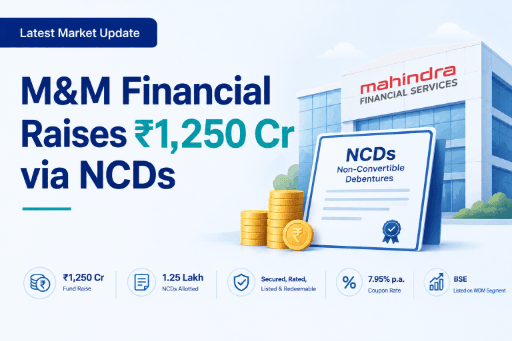
Mahindra & Mahindra Financial Services raises INR 1,250 cr via NCDs

Mahindra & Mahindra Financial Services, which is one of India’s leading NBFCs, has raised INR 1,250 crore through the allotment of 1.25 lakh secured, rated, listed and redeemable NCDs (non-convertible debentures), having a face value of INR 1 lakh per debenture, issued at par. This was done on a private placement basis, with a fixed coupon rate of 7.95% p.a., and the debentures are proposed to be listed on the Wholesale Debt Market Segment of BSE.

Read More

Insightful Blogs

Following Blogs Provide Detailed Insights On Fixed Income Investment

Insightful Videos

Learn more about debentures investments in India

What is Yield in Bonds? Bond Yields Explained Simply

YTM vs Coupon Rate | What Every Investor Needs To Know

How to Claim TDS on Bonds: Step-by-Step Guide

To help you

Frequently Asked Questions

What is the meaning of debentures in simple words?

A debenture is a debt instrument that a company issues to borrow money from investors. When you invest in a debenture, you lend to the company and receive interest at set intervals, with the principal repaid at maturity or as per the issue terms.
In India, the Companies Act, 2013 defines debentures to include bonds issued by companies, so the two terms are often used interchangeably. Corporate bonds are debentures and may be secured or unsecured. However, government securities such as G-Secs, SDLs and T-Bills are not debentures, as they are not issued by companies. In some countries, such as the US, "debenture" refers only to unsecured bonds.
Shares give you ownership in a company, while debentures make you a lender to it. Shareholders may earn dividends and usually have voting rights, whereas debenture holders earn interest as per the issue terms and are repaid before shareholders if the company is wound up.
Debentures are mainly classified by security and convertibility. Secured debentures are backed by collateral, while unsecured ones are not. Convertible debentures can be converted into equity shares as per the issue terms, while non-convertible debentures (NCDs) cannot. Other types include fully and partly convertible, floating-rate and market-linked debentures.


Not exactly. NCDs (non-convertible debentures) are a type of debenture that cannot be converted into equity shares. The broader category of debentures also includes convertible debentures. Both NCDs and convertible debentures can be secured or unsecured.
Companies issue debentures to raise funds without issuing additional equity. The funds may be used for business expansion, working capital, repaying existing debt or other purposes, as stated in the issue documents.
Debentures in India are issued through a public issue or a private placement. Listed NCDs must comply with the SEBI (Issue and Listing of Non-Convertible Securities) Regulations, 2021, which cover disclosures, credit rating, debenture trustee appointment and listing.
Debentures are not risk-free investments. The level of risk varies with the credit quality of the issuer, security backing, repayment record, tenure and market liquidity. While high-rated debentures may still carry lower credit risk, investors can still face losses if the issuer fails to meet its obligations and defaults.
Key risks include credit risk (issuer default or delayed payments), interest rate risk (prices fall when rates rise), liquidity risk (difficulty selling before maturity) and reinvestment risk. Unsecured debentures also carry higher recovery risk, as no specific assets back them.
The minimum investment depends on the issue's face value and lot size, as stated in the offer document. Public NCD issues commonly require at least INR 10,000. On Grip Invest, you can start investing in debentures with just INR 1,000.
Yes. Listed debentures can be sold before maturity on stock exchanges at the prevailing market price, which may be higher or lower than your purchase price. Debentures bought on Grip Invest can also be sold anytime on the platform.
Sign up on Grip Invest, complete your KYC and browse the available debentures. Compare details such as the issuer, credit rating, YTM, tenure and payout frequency, then invest online starting at INR 1,000.
A debenture trustee is a SEBI-registered entity appointed to protect debenture holders' interests. It monitors the issuer's compliance with the issue terms, oversees the security cover for secured debentures and can act on behalf of investors if the issuer defaults.
You can buy listed debentures through public issues, on stock exchanges through a broker, or on SEBI-registered Online Bond Platform Providers (OBPPs) such as Grip Invest. On Grip Invest, you can compare credit-rated debentures and start investing with INR 1,000.

TESTIMONIALS

Wall of Love @ Grip