

High Yield Bonds
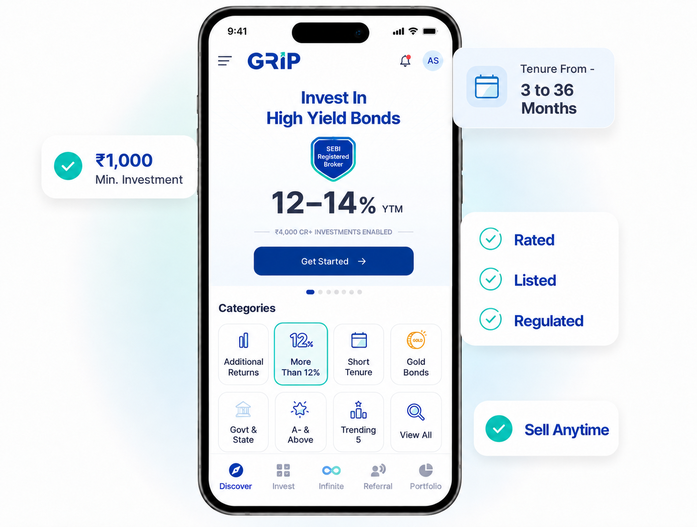
High yield bonds are BBB-rated corporate bonds offering higher yields than government bonds and AAA, AA or A-rated bonds.
They offer 12–14% pre-tax YTM with fixed tenures and monthly or quarterly interest payouts.
These bonds are commonly issued by growing NBFCs and mid-sized companies that pay higher borrowing costs to raise capital.
Ratings come from SEBI-registered agencies such as CRISIL, ICRA, CARE and India Ratings; BBB indicates a moderate degree of safety.
High yield bonds are issued under SEBI’s NCS Regulations, listed on NSE or BSE and held in investors’ Demat accounts.


Make Plan For Your Investment
Calculate your returns from high yield bonds
Use our bond calculator to estimate the returns you will receive by investing in a high yield corporate bond in India
- Add your investment amount
- Set the tenure, YTM and coupon frequency
- See the instant results
Disclaimer: This calculator is for illustration purposes only and does not guarantee or represent actual returns.

BENEFITS OF INVESTING IN HIGH YIELD BONDS

Higher Yield Potential
Offers 12–14% pre-tax YTM, typically above bank FD rates and AAA/AA-rated bonds, in exchange for higher credit risk

Regular Income
Monthly or quarterly interest payouts provide a predictable income schedule throughout the bond’s tenure

Investment-Grade Ratings
BBB+, BBB and BBB- ratings sit within the investment-grade band, offering higher yields without moving into sub-investment-grade debt (BB or lower)

Diversification
High yield corporate bonds add a fixed-income component to a portfolio, reducing reliance on equity returns across market cycles

Easy Liquidity
If purchased from Grip, investors can sell the high yield bonds on Grip anytime, offering them exit before maturity.

How to Invest?


- Credit Rating and Outlook: Check the rating, the issuing agency, the outlook and any recent rating actions. A Negative outlook or rating watch signals a possible downgrade. BBB- is the lowest investment-grade rating, so a single downgrade from BBB- would move the bond to sub-investment grade.
- Issuer Financials: Look at the financial health of the issuer, including capital adequacy, asset quality (GNPA), profitability and repayment history, together to judge whether the issuer has enough financial cushion and cash flow to service debt comfortably.
- Security Cover: Check what assets back the bond and how much security cover is available. Stronger collateral coverage gives investors an extra layer of protection if repayment problems arise.
- Yield vs Risk: Compare YTM with similarly rated bonds. A yield well above peers can signal higher risk than the rating suggests.

OTHER OFFERINGS
Other Secured Fixed-Income Products By Grip Invest

Corporate Bonds
- Securities issued by corporates & NBFCs
- Up to 12.5% pre-tax YTM
- Start investing with Rs 1,000
- Exchange listed and credit rated

InvoiceX
- Loans backed by Invoice Discounting
- Up to 14% pre-tax YTM
- Start investing with Rs 1,00,000
- SEBI/RBI compliant and credit rated

LoanX
- Diverse pool of loans from top NBFCs
- Up to 14% pre-tax
- Start investing with Rs 1,00,000
- SEBI/RBI compliant and credit rated

Baskets
- Theme based investing
- Up to 14% pre-tax YTM
- Start investing with Rs 5,000
- SEBI/RBI compliant and credit rated

Corporate FDs
- High Yield Fixed Deposit Investments
- Up to 10% pre-tax
- Start investing with Rs 1,000
- SEBI/RBI compliant and credit rated
FOR YOUR KNOWLEDGE
Some of our partners






Insightful Blogs
Read Our Blogs For Detailed Insights On High Yield Bonds
Insightful Videos
Learn More About Investing In High Yield Bonds Through Our Videos
To help you
Frequently Asked Questions
Are high yield bonds the same as junk bonds?
No. Globally, “high yield” often refers to sub-investment-grade or junk bonds. High yield bonds on Grip are rated BBB+, BBB or BBB- which is within India’s investment-grade band. They still carry more credit risk than AAA, AA or A-rated bonds.
What credit rating do high yield bonds on Grip carry?
High yield bonds on Grip carry BBB+/BBB/BBB- investment-grade ratings from SEBI- registered agencies such as CRISIL, ICRA, CARE and India Ratings. Agencies define BBB as a moderate degree of safety regarding timely payment of interest and principal.
Are high yield bonds safe to invest in?
High yield bonds are not risk free, they carry moderate credit risk. They are investment grade and repayment depends on the issuer’s financial health. Security cover varies by bond, hence check the rating, outlook, financials, security cover and repayment structure before investing.
What happens if a high yield bond is downgraded?
A downgrade can lower the bond’s market price and make it harder to sell, even if interest payments continue. A BBB bond would need a two-notch downgrade to fall below investment grade. Holding to maturity is unaffected as long as the issuer repays on time.
What returns can I earn from high yield corporate bonds?
High yield corporate bonds on Grip offer 12-14% pre-tax YTM. Actual YTM depends on the purchase price, coupon, repayment schedule and remaining tenure, so it can differ from the coupon rate.
Why do high yield bonds offer higher returns than bank FDs?
Growing NBFCs and mid-sized companies pay higher borrowing costs to raise capital, so their bonds offer higher yields. These yields compensate investors for higher credit risk: high yield bonds typically offer 12–14% pre-tax YTM, compared with 6–7% on bank FDs, which carry DICGC cover.
Who should invest in high yield bonds?
Investors who are willing to diversify their portfolio with fixed returns can invest in high-yield bonds. However, they must consider that these bonds also come with moderate risk. Hence, they should add a variety of bonds to their portfolio, from top-rated to high-yield bonds. High yield bonds should not be considered as a replacement for low-risk savings.
What is the minimum amount to invest in high yield bonds?
You can start investing in high-yield bonds with a minimum investment of INR 1,000 on Grip Invest.
Can I sell high yield bonds before maturity?
Yes. High yield bonds are listed and can be sold before maturity, subject to buyer demand. Bonds bought through Grip Invest held in Grip’s demat account of investor, can be sold anytime on Grip.
Are high yield bonds suitable for short-term investment?
High yield bonds suit short- to medium-term goals, with tenures typically between 3 and 36 months. Choose a bond whose maturity matches your investment horizon
How are high yield bonds taxed in India?
As per tax rules for FY 2026-27, interest from high yield bonds is taxed at your income tax slab rate, and TDS may be deducted on interest payouts. If you sell a listed bond within 12 months, the gain is taxed at your slab rate; after 12 months, it is taxed at 12.5% without indexation. Surcharge and cess apply as applicable.
Do I need a Demat account to buy high yield bonds?
Yes. A Demat account is required to hold listed corporate bonds electronically. Grip allows investors to open a Demat account during onboarding, and purchased bonds are credited to that account.
How can I invest in high yield bonds online through Grip?
Sign up on Grip, complete your KYC and explore the high yield bonds listed. Review each bond’s issuer, rating, YTM, tenure and security cover, then invest online. The bonds are credited to your Demat account.


