

Perpetual Bonds
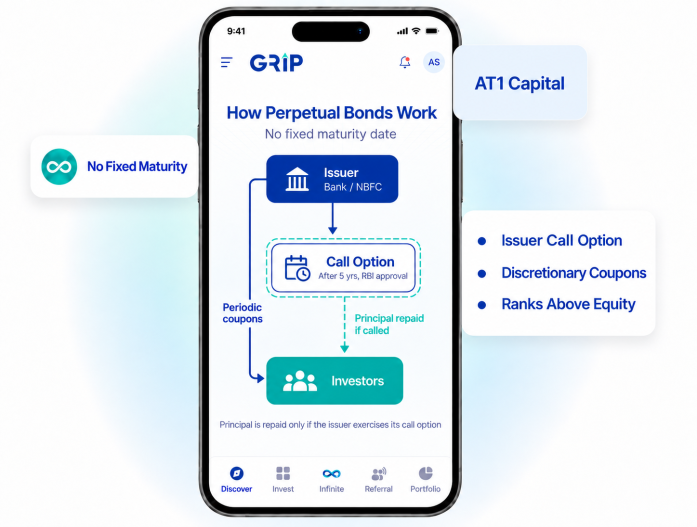
Call Option: There are perpetual bonds that come with a call option, which means the issuer can redeem the bonds after a specified period. With a call option, the issuer gets the flexibility to manage the debt.
No Maturity Date: Perpetual bonds do not mature; hence, they do not have a maturity date. This makes them a unique debt instrument.
Coupon Payment: Coupons are paid periodically, but AT1 issuers can cancel them at their discretion, and missed coupons are not paid later.
Loss Absorption: Bank AT1 bonds can be written down or converted into equity if the bank's capital falls below a set trigger.
Retail Availability: Fresh AT1 issues are open only to institutional investors in INR 1 crore lots, making listed government and corporate bonds the accessible retail option.


Make Plan For Your Bond Investment
Estimate the returns you will get from your bond investments
This bond calculator is designed to help you estimate the returns from your investments in different types of bonds, including corporate bonds, government bonds, etc.
- Add desired investment amount
- Set the right tenure and coupon frequency
- Put the expected YTM
- See instant returns
Disclaimer: This calculator is for illustration purposes only and does not guarantee or represent actual returns.
REASON AND BENEFITS

Periodic Income
Perpetual bonds pay coupons at regular intervals for as long as they remain outstanding, subject to the issuer's payment terms.

Higher Coupon Rates
Issuers typically pay higher coupons than on their regular bonds, to compensate for subordination, call risk, and loss absorption.

Diversification
Their hybrid features, sitting between debt and equity, give them a risk-return profile distinct from regular bonds and shares.

Price Gains When Rates Fall
Their long duration means prices can rise sharply when interest rates decline, though they fall equally sharply when rates rise.

How to Invest?


- For Long-Term Horizon: Since perpetual bonds do not have a maturity period, it is suitable for investors who have a long-term investment horizon so that their principal amount is compensated in the form of interest received.
- Portfolio Diversifiers: Perpetual bonds provide fixed income and hence can be helpful for investors who are looking to diversify and add stable income to their portfolio.
- For Regular Income: Investors who are looking for regular income from investments can consider perpetual bonds as they offer a stable income stream.
- Informed Investors: Best suited to investors who understand call options, subordination, and AT1 write-down triggers before committing capital.
- Institutional And HNI Investors: With INR 1 crore trading lots for AT1 bonds, these instruments largely suit institutions and investors with large investable surplus.
- Investors should assess their financial goals, risk appetite, and liquidity needs before investing. Those seeking a defined maturity and lower risk can consider corporate bonds and government bonds instead.

OTHER OFFERINGS
Other Secured Fixed-Income Products By Grip Invest

Corporate Bonds
- Securities issued by corporates & NBFCs
- Up to 14% pre-tax YTM
- Start investing with Rs 1,000
- Exchange listed and credit rated

InvoiceX
- Loans backed by Invoice Discounting
- Up to 14% pre-tax YTM
- Start investing with Rs 1,00,000
- SEBI/RBI complaint and credit rated

LoanX
- Diverse pool of loans from top NBFCs
- Up to 14% pre-tax
- Start investing with Rs 1,00,000
- SEBI/RBI complaint and credit rated

Baskets
- Theme based investing
- Up to 14% pre-tax YTM
- Start investing with Rs 5,000
- SEBI/RBI complaint and credit rated

Corporate FDs
- High Yield Fixed Deposit Investments
- Up to 10% pre-tax
- Start investing with Rs 1,000
- SEBI/RBI compliant and credit rated
For your knowledge
Some of our partners


Insightful Videos
Watch & Learn More About Fixed Income Investing
When Stocks Lost 24%, Bonds Made 12% — The Truth About Bonds
What Is Accrued Interest in Bonds: Simple Explanation
What is Yield in Bonds? Bond Yields Explained Simply
To help you
Frequently Asked Questions
Are perpetual bonds and AT1 bonds the same?
Can investors redeem perpetual bonds?
Can perpetual bonds be sold in the secondary market?
How to buy perpetual bonds in India?


