

US Treasury Yields Move: What Could It Mean For Indian Bonds?


US Treasury yields have risen in early September 2026, with the benchmark 10-year yield reaching around 4.8% as bond markets sold off globally1. Indian government bonds felt some of that pressure too, and the 10-year yield briefly moved above 7% on September 2.
US Treasury yields show the return investors can earn from US government debt at prevailing market prices. The 10-year yield receives particular attention because it captures longer-term expectations around interest rates, inflation and economic growth. It also functions as a key benchmark across global bond markets.
Bond prices generally move in the opposite direction to yields. Therefore, when 10-year yields rise, existing bonds tend to trade at lower prices because newer bonds may offer better returns.
That global repricing can reach India, although the pass-through is not one-for-one. Research finds that a 100-basis-point rise in the one-year US Treasury yield was associated with a roughly 25-30 basis-point increase in Indian G-sec yields3. The recent movement in 10-year US Treasury yields show how that relationship has played out in practice.
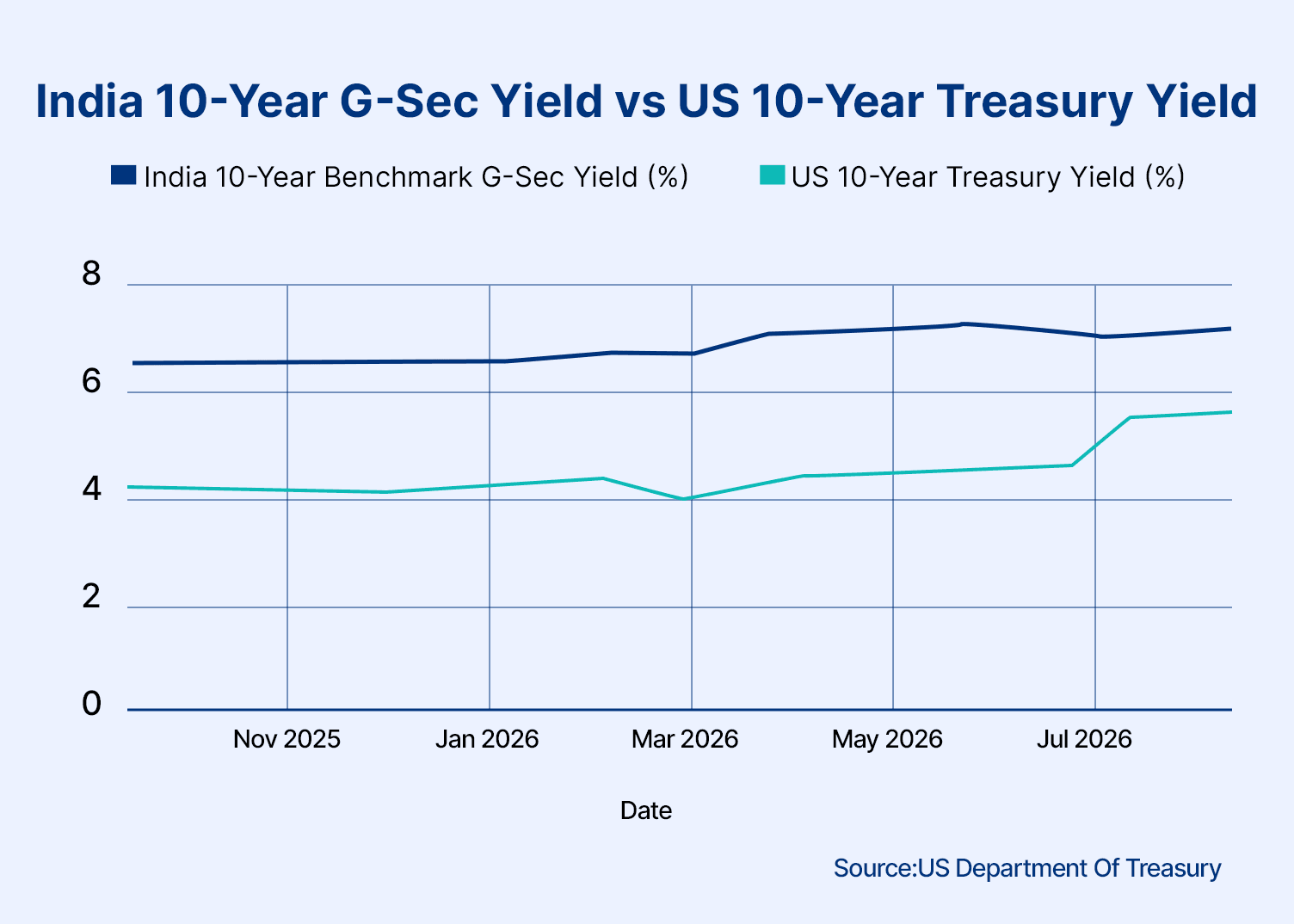
Source: US Department Of Treasury4
From September 2025 to February 2026, the US 10-year yield fell by 19 basis points, while India 10-year bond yield rose by around 9 basis points. At other points in the period, both yields moved in the same direction. So, while US yields can influence Indian bonds, domestic factors can change both the direction and extent of that impact.
Why US Treasury Yields Influence Indian Bonds?
A change in US Treasury yields does not stay confined to the US bond market. Its influence on Indian bonds can show up in several ways.
- Higher US yields can weaken demand for Indian debt: If the US 10-year Treasury yield rises from 4% to 5%, investors can earn more from US government debt without taking INR exposure. That can make dollar assets relatively more attractive and reduce fresh FPI flows into Indian bonds. If buying weakens, Indian bond prices may come under pressure and yields can rise.
- A weaker rupee can raise inflation concerns: Higher US yields can support the dollar and make INR assets less attractive to foreign investors. If the rupee weakens, imports become more expensive in INR terms. It is estimated that a 5% INR depreciation from its baseline could raise inflation by around 35 basis points. Higher inflation expectations can, in turn, push Indian government bond yields higher.5
- A wider India-US bond yield spread can attract investors: The spread is the difference between Indian and US government bond yields of comparable maturity. For example, if India's 10-year yield is 6.5% and the US yield is 5%, the spread is 1.5 percentage points. That extra return can attract foreign investors, but it must be large enough to compensate for possible INR depreciation and country risk.
These are the main ways US Treasury yields can influence Indian bonds. But the link becomes easier to point out during a Treasury sell-off, when investors sell Treasuries, bond prices fall, and yields rise. At that point, the pressure can pass through several channels before it reaches Indian bond yields.
How A US Treasury Sell-Off Reaches India
A rise in US Treasury yields can put pressure on Indian bonds, but the Treasury move alone does not decide where Indian yields go. The effect becomes stronger when other forces move in the same direction. The April-June 2022 quarter is a useful example because higher US yields coincided with dollar strength, foreign outflows, a weaker rupee, expensive crude and tighter domestic policy.6
1. Global risk repricing: When US government debt starts offering a higher return, investors may demand a higher return from emerging-market bonds as well. Indian bond prices may then need to fall for yields to move higher. In June 2022, India’s 10-year G-sec yield touched 7.62% while global yields were rising and domestic inflation remained elevated.
2. Foreign flows: Higher US yields can also change where global investors choose to hold their money. If FPIs reduce their exposure to India, demand for Indian securities weakens. During April-June 2022, FPIs withdrew around USD 14 billion from India, adding to the broader pressure already coming from global markets.
3. Rupee movement: The effect can deepen when rising US yields are accompanied by a stronger dollar. A weaker INR reduces USD returns for unhedged foreign investors and can also make imports more expensive for India. During the quarter, the US Dollar Index rose 6.5%, while the INR weakened by 4%.
4. Oil prices: Rupee weakness becomes more important when crude is expensive because India imports much of the oil it consumes. A weaker currency means the same barrel of crude costs more in INR terms, adding to inflation concerns. Brent crude averaged around USD 112 per barrel during the quarter, while India’s crude import dependence was about 85.6% in FY2022.
5. RBI expectations: If those currency and inflation pressures build, the domestic policy outlook can change as well. Markets may begin to price in tighter liquidity or higher policy rates, which can place further upward pressure on bond yields. In May 2022, the RBI raised the repo rate by 40 basis points and increased the CRR to 4.5%.
The 2022 episode therefore was not simply a case of US Treasury sell-off and Indian bonds following. The Treasury sell-off was one part of a broader setting. When several of these forces move together, their combined effect on Indian bonds can be much stronger than the US Treasury move alone.
What Higher Indian Bond Yields Mean For Investors?
For someone already holding bonds, higher yields usually mean lower market prices. For fresh investment, though, the same move can open up better yields on newly issued bonds.
- Existing long-duration bonds can fall more in price: When market yields rise, investors can get a higher return from bonds available at the new rates. An older fixed-rate bond therefore has to trade at a lower price to remain competitive. The effect is usually larger for long-duration bonds because investors are receiving those older fixed payments for more years. Their prices are therefore more sensitive to a change in market yields.
- Fresh investments may offer higher yields: The same rise in market yields can work differently for someone investing now. Newly issued government securities and high-quality bonds may offer yields closer to the higher prevailing rates. So while existing bond prices may be falling, investors making a fresh allocation can get access to better yields.
- Long-duration debt funds can see larger NAV movements: Debt fund interest rate risk becomes more visible when market yields rise because the prices of bonds held by the fund can fall. Funds with longer-duration bonds usually see a larger impact, while short-duration funds tend to react less.
- Mark-to-market changes are different from holding a bond to maturity: A directly held government bond may show a lower market price after yields rise. That matters if the investor sells it at that price. If the bond is held until maturity, the agreed coupon and principal repayment remain the same, assuming the issuer pays as promised. The fall in market value is therefore not automatically the same as a realised loss.
The impact also varies across fixed-income products:
Investment | When yields rise | Impact |
Direct bonds | Existing prices may fall | Selling before maturity can lock in the lower market price |
Gilt funds | NAV may fall more sharply | Longer-duration holdings can make them more sensitive |
Short-duration debt funds | Usually see a smaller impact | Shorter maturity reduces sensitivity to yield changes |
Corporate bond funds | NAV may decline | Both interest-rate moves and credit spreads can affect prices |
Fixed deposits | Existing FD rates stay unchanged | New FD rates depend more on banks' funding needs and domestic rate conditions |
The same rise in yields can therefore hurt an existing bond price while making fresh fixed-income investments more attractive. How far Indian yields move, though, also depends on domestic policy. The RBI does not simply follow the US Fed.
Why The RBI May Not Mirror The US Fed ?
The Fed can influence global borrowing conditions, but the RBI still has to respond to what is happening inside India. That gives Indian bond yields some room to move differently from US Treasuries.
- Domestic conditions come first: RBI policy is shaped mainly by India’s inflation and growth outlook, while banking-system liquidity, the rupee and financial-market conditions also matter. So even if the Fed is tightening, the RBI may not need to make the same move if domestic conditions point elsewhere.
- Domestic investors can absorb part of the shock: Indian government bonds are held largely by institutions such as banks, insurers, provident and pension funds and mutual funds. For example, banks and insurance companies together held about 64% of Central Government securities at the end of December 2024, while FPIs held 2.8%. Strong domestic demand can therefore soften the impact when overseas investors pull back.7
- The RBI can manage liquidity when markets become tight: Through repo operations, open market purchases and other liquidity tools, the RBI can add funds to the banking system or support demand for government securities. These measures do not cancel a global yield shock, but they can reduce the pressure it creates in the domestic market.
- Forex intervention can limit disorderly rupee moves: A sharp rise in US yields can strengthen the dollar and add pressure on the INR. The RBI can buy or sell foreign currency to contain excessive volatility and keep the forex market orderly, without targeting a fixed exchange rate.
The Fed can change the global backdrop, but the RBI still responds to conditions at home. So, tracking Indian bonds means watching both sides of that equation.
What To Watch Next ?
A single movement in the US 10-year yield will not tell the whole story. These indicators can give a clearer sense of whether pressure on Indian bonds is building or easing.
1. US inflation and Federal Reserve commentary: Higher-than-expected US inflation or signals that rates may stay high for longer can keep Treasury yields elevated. Softer inflation or a more accommodative Fed outlook can work in the opposite direction.
2. US 10-year Treasury yield: Watch whether the yield is rising steadily or reversing after a short-term move. A sustained rise can keep the global return benchmark high and maintain pressure on emerging-market bonds.
3. India's CPI inflation, crude oil and the rupee: These three indicators help show whether a global shock is becoming a domestic inflation concern. Higher crude alongside a weaker INR is particularly important because both can raise India's import costs.
4. FPI flows into Indian bonds: Foreign buying can support demand for Indian bonds even when US yields are high. Persistent selling, on the other hand, can add pressure on bond prices and yields.
5. RBI policy, auction demand and the India 10-year G-sec yield: RBI statements indicate how policymakers see inflation, growth and liquidity. Government bond auctions show whether investors are willing to absorb fresh supply, while the 10-year G-sec yield gives a direct view of how these expectations are being priced into the market.
FAQs On US Treasury Yield Rise On Indian Bonds
Want to stay at the top of your finances?
Join the community of 4 lakh+ investors and learn more about Grip Invest, the latest financial knick-knacks, and shenanigans in the world of investing.
Happy Investing!
Disclaimer - Investments in debt securities/municipal debt securities/securitised debt instruments are subject to risks, including delay and/ or default in payment. Read all the offer-related documents carefully. The investor is requested to take into consideration all the risk factors before the commencement of trading.
This communication is prepared by Grip Broking Private Limited (bearing SEBI Registration No. INZ000312836 and NSE ID 90319) and/or its affiliate/ group company(ies) (together referred to as “Grip”) and the contents of this disclaimer are applicable to this document and any and all written or oral communication(s) made by Grip or its directors, employees, associates, representatives and agents. This communication does not constitute advice relating to investing or otherwise dealing in securities and is not an offer or solicitation for the purchase or sale of any securities. Grip does not guarantee or assure any return on investments and accepts no liability for the consequences of any actions taken based on the information provided. For more details, please visit www.gripinvest.in
Registered Address - 106, II F, New Asiatic Building, H Block, Connaught Place, New Delhi 110001
Want to stay at the top of your finances?
Join the community of 22 lakh+ investors and learn more about Grip Invest, the latest financial knick-knacks, and shenanigans in the world of investing.
Happy Investing!
Disclaimer - Investments in debt securities/municipal debt securities/securitised debt instruments are subject to risks including delay and/ or default in payment. Read all the offer related documents carefully. The investor is requested to take into consideration all the risk factors before the commencement of trading.
This communication is prepared by Grip Broking Private Limited (bearing SEBI Registration No. INZ000312836 and NSE ID 90319) and/or its affiliate/ group company(ies) (together referred to as “Grip”) and the contents of this disclaimer are applicable to this document and any and all written or oral communication(s) made by Grip or its directors, employees, associates, representatives and agents. This communication does not constitute advice relating to investing or otherwise dealing in securities and is not an offer or solicitation for the purchase or sale of any securities. Grip does not guarantee or assure any return on investments and accepts no liability for consequences of any actions taken based on the information provided. For more details, please visit www.gripinvest.in
Registered Address - 106, II F, New Asiatic Building, H Block, Connaught Place, New Delhi 110001


