

Corporate FD Vs NCD: Returns, Risks And Key Differences



Corporate FD vs NCD compares two ways in which companies borrow from individual investors at a fixed rate of interest.
A corporate FD is a deposit accepted by a company under deposit rules, while an NCD is a debt security issued under SEBI regulations and is usually listed on a stock exchange. The return, the exit route and the tax deducted can differ even when the same company issues both.
What Is A Corporate Fixed Deposit?
A corporate fixed deposit refers to a term deposit placed with an NBFC, a housing finance company or another company for a fixed period at a pre-agreed rate of interest. Deposits taken by NBFCs and housing finance companies are governed by the RBI directions on acceptance of public deposits issued in November 2025, while deposits taken by other companies fall under the Companies (Acceptance of Deposits) Rules, 2014. As per RBI, only NBFCs holding a deposit-taking certificate and a minimum rating of BBB- can accept public deposits, and such a deposit has to be repayable after 12 months but not later than 60 months.
However, a corporate FD is not the same as a bank FD, and this is the first point to settle in any corporate FD vs NCD comparison. Bank deposits are insured by DICGC up to INR 5 lakh per depositor per bank including interest, whereas deposits with NBFCs are not covered by this insurance. Repayment of a corporate FD therefore depends only on the company that accepted it, and RBI does not take responsibility for repayment of such deposits.
Such a deposit should also be kept apart from other forms of corporate borrowing like NCDs, commercial paper or inter-corporate deposits. Only a deposit accepted under the applicable deposit rules carries the conditions set by those rules, such as the tenure limit and the rating requirement. Investors can check the corporate FDs available on Grip along with the rating of each issuer.
What Is A Non-Convertible Debenture (NCD)?
A non-convertible debenture refers to a debt security through which a company borrows for a fixed term and pays interest, called the coupon, on its face value. Unlike a convertible debenture, it cannot be converted into shares. Non-convertible debentures are issued under the SEBI (Issue and Listing of Non-Convertible Securities) Regulations, 2021 through a public issue or a private placement, and listed NCDs are held in demat form. The market is large, with outstanding corporate bonds at around INR 61 lakh crore as per SEBI in September 2026.
An NCD investment can be secured or unsecured, and the two have different security structures. A secured NCD is backed by a charge on specified assets of the issuer, such as its loan receivables, and SEBI rules require the issuer to maintain security cover of at least 100% of principal and interest, or higher if the offer document says so. An unsecured NCD has no such charge, and some unsecured issues are subordinated debt that ranks below other lenders at the time of repayment. Security may improve the position of investors in a default but it does not ensure full or timely recovery, since recovery depends on the value of the assets and the legal process.
Corporate FD Vs NCD: Key Differences
The Corporate FD Vs NCD differences come mainly from the legal form of each instrument. A corporate FD is a deposit contract between the investor and the company, whereas an NCD is a security that can be transferred to another investor through the stock exchange. Hence the corporate fixed deposit vs NCD choice affects how interest is paid, how an investor can exit and which tax provision applies to the interest.
A similar point arises in an NCD vs bank FD comparison. The NCD carries the issuer's credit risk without any deposit insurance, whereas a bank FD is insured within the DICGC limit, so a higher coupon on an NCD is partly a payment for that extra risk. The below table helps to distinguish a corporate FD and an NCD on the main parameters:
Parameter | Corporate FD | NCD |
| Governing rules | RBI deposit directions for NBFCs and housing finance companies; Companies (Acceptance of Deposits) Rules, 2014 for other companies | SEBI NCS Regulations, 2021 and the Companies Act, 2013 |
| Form of holding | Deposit receipt or account statement with the company | Security held in demat form, usually listed |
| Tenure | 12 to 60 months for NBFC deposits | As per the issue terms, from short to long tenures |
| Security | Unsecured deposit of the company | Secured or unsecured, as stated in the offer document |
| Interest | Fixed rate; monthly, quarterly, half-yearly, annual or at maturity | Fixed coupon on face value; price paid can differ from face value |
| Exit before maturity | Premature withdrawal under deposit rules and company terms, usually at a lower rate | Sale on the stock exchange at market price, subject to a buyer |
| Credit rating | Rating of the deposit programme | Rating of each NCD issue |
| TDS provision | Section 393(1) [Table: Sl. 5(iii)], Income-tax Act, 2025 | Section 393(1) [Table: Sl. 5(i)], Income-tax Act, 2025 |
Corporate FD Vs NCD: Returns And Interest Payments
Corporate FD returns depend on the deposit rate for the chosen tenure and payout option, whereas the return on an NCD depends on its coupon and the price paid for it. Corporate FD interest rates are usually a little lower under the monthly payout option than under the cumulative option, as interest paid earlier earns less compounding. An NCD pays its coupon on face value on fixed dates, so its yield to maturity falls below the coupon when it is bought above face value and rises when it is bought below.
A company FD vs NCD comparison is clearer when both come from the same issuer, as the difference in credit quality is then removed.
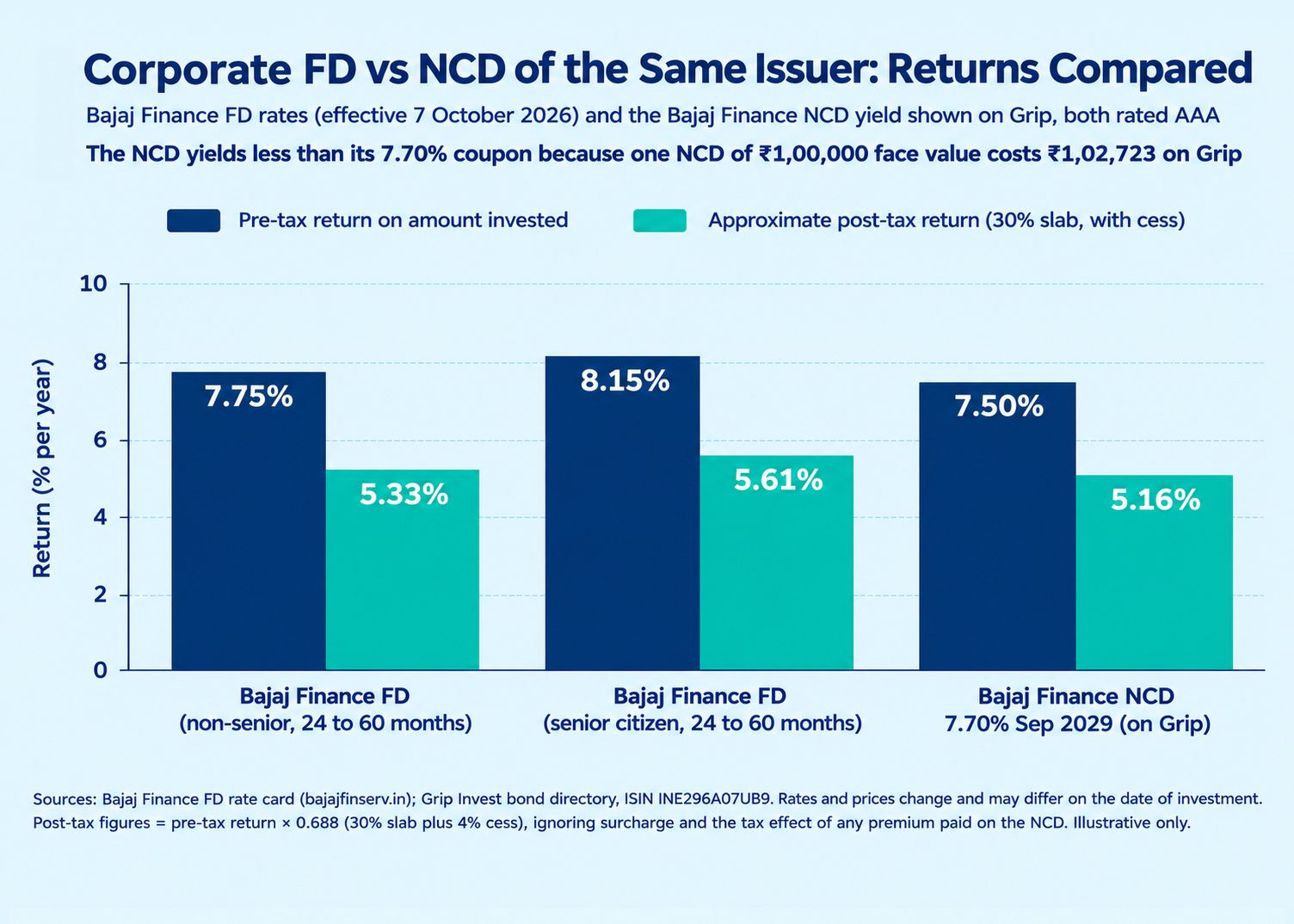
The example below uses a Bajaj Finance FD and a Bajaj Finance 7.70% NCD maturing on 20 September 2029 listed on Grip, both rated AAA by CRISIL. Bajaj Finance offers 7.75% on FDs of 24 to 60 months for non-senior citizens and 8.15% for senior citizens, with rates effective from 7 October 2026. The NCD is secured by a first pari passu charge on the company's book debts and loan receivables and shows a yield of 7.50% on Grip, with one NCD of INR 1,00,000 face value costing INR 1,02,723.
Suppose an investor puts INR 1,00,000 in the FD with annual payout then the yearly interest would be INR 7,750 (INR 1,00,000 × 7.75%). One NCD would pay INR 7,700 a year (INR 1,00,000 × 7.70%), but the investor pays INR 1,02,723 for it and gets back INR 1,00,000 at maturity. Part of the extra amount may be interest accrued since the last coupon, which comes back with the next coupon, while the rest is a premium that is not repaid.
Hence in this case the FD gives a slightly higher return on the amount invested, which shows that an NCD does not always pay more than an FD of the same company.
Particulars | Bajaj Finance FD | Bajaj Finance NCD (ISIN INE296A07UB9) |
| Credit rating | CRISIL AAA/Stable, ICRA AAA (Stable) | CRISIL AAA/Stable |
| Rate | 7.75%, or 8.15% for senior citizens | 7.70% coupon on face value |
| Return on amount invested | 7.75% (8.15% for senior citizens) | 7.50% yield to maturity |
| Amount invested in example | INR 1,00,000 | INR 1,02,723 for one NCD |
| Yearly interest | INR 7,750 | INR 7,700 |
| Payout | Annual payout chosen; other options available | Annual coupon |
| Maturity | Chosen tenure between 24 and 60 months | 20 September 2029 |
| Security | Unsecured deposit | Secured, first pari passu charge on receivables |
| Exit before maturity | Premature withdrawal as per company terms | Sale on the exchange at market price |
FD rates as published by Bajaj Finance, effective 7 October 2026. NCD yield and price as shown on the Grip bond directory. Rates and prices change and may differ on the date of investment.
Risks Of Investing In Corporate FDs And NCDs
Both instruments carry the credit risk of the company that issues them, and neither becomes risk-free because of a high interest rate or a high credit rating. Corporate deposit risk and NCD risk can be understood as per the points given below:
- Credit Risk: The company may delay or fail to pay interest or principal, and neither instrument has deposit insurance to fall back on.
- Rating Changes: A rating is an agency's opinion at a point in time and it can be cut within weeks when the company's finances weaken.
- Exit Before Maturity: An NBFC deposit can generally not be withdrawn in the first three months except in limited cases, and an NCD can be sold only if a buyer is available at an acceptable price.
- Price Movement in NCDs: The market price of a listed NCD may fall when interest rates rise, which affects the investor only if it is sold before maturity.
- Reinvestment: Periodic interest may have to be reinvested at lower rates if rates fall during the tenure.
- Concentration: Placing a large share of savings with one company increases the loss if that company runs into trouble.
The DHFL case of 2019 shows how quickly these risks can come together. Its public NCDs carried AAA ratings from CARE and Brickwork until early 2019, yet by May 2019 the company had stopped fresh deposits and premature withdrawals, and in June 2019 CARE moved its public NCDs of INR 29,000 crore and FDs of INR 8,940 crore to default. Security on the NCDs and the earlier top rating did not prevent delays and losses for investors.
Taxation Of Corporate FDs Vs NCDs
Interest earned on a corporate FD is generally taxable as income from other sources at the slab rate applicable to the investor. This applies whether the interest is paid out periodically or added to the deposit under the cumulative option, in which case the company generally deducts TDS on the interest credited each year.
Interest on NCDs is taxed in the same manner at slab rate, but the sale of an NCD before maturity brings in capital gains rules that do not apply to a deposit. The relevant provisions can be understood as per the points given below:
1. TDS on Corporate FD Interest: The company deducts TDS at 10% under Section 393(1) of the Income-tax Act, 2025, when interest paid to the investor exceeds INR 10,000 in a tax year.
2. TDS on NCD Interest: The issuer deducts TDS at 10% under Section 393(1), when the coupon paid to the investor exceeds INR 10,000 in a tax year.
3. Sale of Listed NCDs Before Maturity: A listed NCD held for more than 12 months gives a long-term capital gain taxed at 12.5% without indexation under Section 197 (earlier Section 112), while a gain on one held for 12 months or less is taxed at slab rate.
4. Unlisted NCDs: Gains on transfer, redemption or maturity of unlisted debentures are treated as short-term capital gains irrespective of the holding period under Section 76 (earlier Section 50AA), for transfers on or after 23 July 2024.
5. Acquisition Date and Holding Period: The holding period runs from the date of purchase to the date of sale, so NCDs of the same series bought on different dates can fall into different categories. The rates above apply to transfers on or after 23 July 2024 and older transactions were taxed under the rules in force at that time.
Suppose an investor buys a listed NCD at INR 1,00,000 and sells it after 15 months at INR 1,02,000 then the gain of INR 2,000 would be taxed at 12.5%, which comes to INR 260 including 4% cess (INR 2,000 × 13%). TDS and the final tax liability are separate. If an investor in the 30% slab earns INR 40,000 of FD interest in a year then TDS would be INR 4,000 (INR 40,000 × 10%), while the actual tax would be INR 12,480 (INR 40,000 × 31.2%), so INR 8,480 would still be payable through advance tax or at the time of filing the return.
In contrast, an investor whose total income is below the taxable limit may claim a refund of the TDS or, where eligible, give the prescribed self-declaration to avoid deduction.
Disclaimer: Calculations are illustrative and ignore surcharge. Tax rules may change and investors may consult a tax adviser for their own case.
FAQs

Want to stay at the top of your finances?
Join the community of 22 lakh+ investors and learn more about Grip Invest, the latest financial knick-knacks, and shenanigans in the world of investing.
Happy Investing!
Disclaimer - Investments in debt securities/municipal debt securities/securitised debt instruments are subject to risks including delay and/ or default in payment. Read all the offer related documents carefully. The investor is requested to take into consideration all the risk factors before the commencement of trading.
This communication is prepared by Grip Broking Private Limited (bearing SEBI Registration No. INZ000312836 and NSE ID 90319) and/or its affiliate/ group company(ies) (together referred to as “Grip”) and the contents of this disclaimer are applicable to this document and any and all written or oral communication(s) made by Grip or its directors, employees, associates, representatives and agents. This communication does not constitute advice relating to investing or otherwise dealing in securities and is not an offer or solicitation for the purchase or sale of any securities. Grip does not guarantee or assure any return on investments and accepts no liability for consequences of any actions taken based on the information provided. For more details, please visit www.gripinvest.in
Registered Address - 106, II F, New Asiatic Building, H Block, Connaught Place, New Delhi 110001


