

Limited Period FD Scheme: How It Works And What To Check Before Investing



Fixed Deposits are popular because of their simplicity, relative safety, and the trust people place in the banking system. Although risks are not completely absent, they are generally lower, especially when compared with market-linked investments. The interest rates offered on FDs often vary based on the tenure and the age of the depositor (in the case of an individual depositor).
Banks and certain eligible financial institutions may also offer special deposit schemes for particular tenures or for a limited booking period.
One example is a limited-period FD scheme: a special deposit scheme available for booking only during a specified period that may offer a special interest rate for a particular tenure. The limited period typically refers to the FD booking window, not its maturity period. Let's look at how such a scheme works and what you need to check before making an investment decision.
What Is A Limited Period FD Scheme?
As explained earlier, it is a category of fixed deposit that is available for booking only for a specified period. During this pre-decided period, you might be offered a higher interest rate, so it often comes as an additional offering alongside regular FD options.
Once the offer period ends, investors can generally no longer invest in the scheme under the same terms. It is important here to understand the difference between two terms: the limited period and the FD tenure.
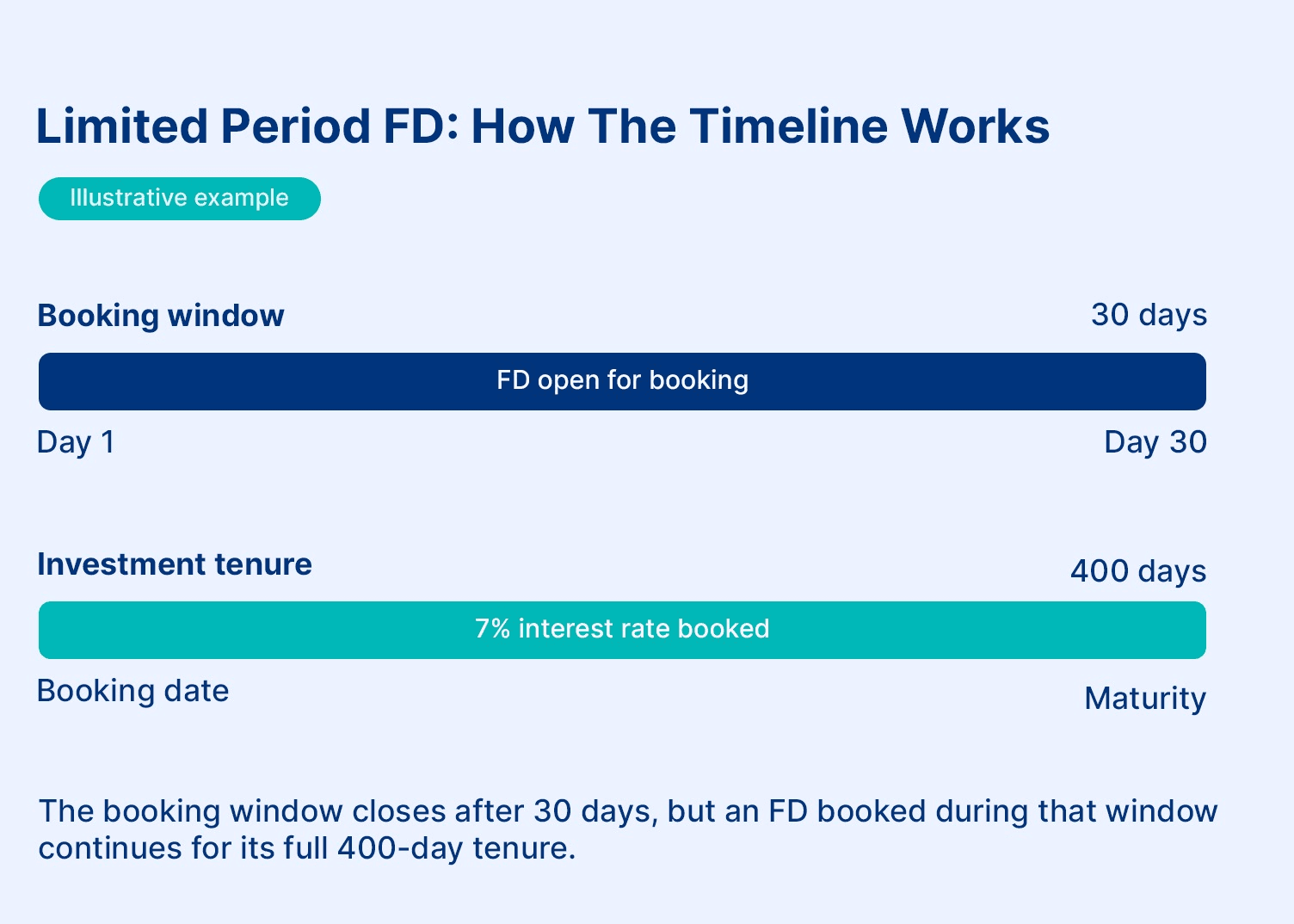
For example, suppose a bank offers a limited-period FD with an interest rate of 7% for a tenure of 400 days, but keeps the scheme open for booking for only one month.
An investor who books the FD within this 30-day window will continue to earn the applicable interest rate for the stipulated 400-day tenure. Thus, the limited period refers to the booking window, not the FD's maturity period.
How Does A Limited Period FD Scheme Work?
Conceptually and practically, there is no difference between a conventional FD and a limited period FD scheme except that the investment has to be made in a specified booking window. The applicable interest rate is booked, and the deposit continues for the given tenure. Depending on the terms and conditions, interest can accumulate or be paid periodically.
In addition, specific conditions may apply to premature withdrawal, minimum investment, auto-renewal, online booking, and other applicable terms. At the time of maturity, the principal and applicable interest are paid according to the chosen payout option, after considering any applicable tax provisions.
Why Do Banks Offer Limited Period FD Schemes?
Fixed deposits make up an important part of a bank’s sources of funds. These funds can then be deployed for lending and other activities. Sometimes, a bank may want to mobilise more deposits for a particular tenure instead of raising interest rates across its entire FD portfolio. With a limited-period FD scheme, banks can attract deposits selectively for a particular tenure.
It also helps banks in managing their funding requirements. From the investor perspective, it can create an opportunity to lock in a comparatively attractive interest rate without the bank revising its regular FD rates across tenures in response to broader market conditions or changes in the interest-rate environment.
Limited Period FD Scheme Vs Regular FD
Here are the most important points of difference between the two FD types:
Parameter | Limited Period FD Scheme | Regular FD |
Availability | Available for booking during a specified window | Generally available throughout the year |
Tenure | Usually offered for a specific tenure or a limited set of tenures | Generally provides multiple tenure options |
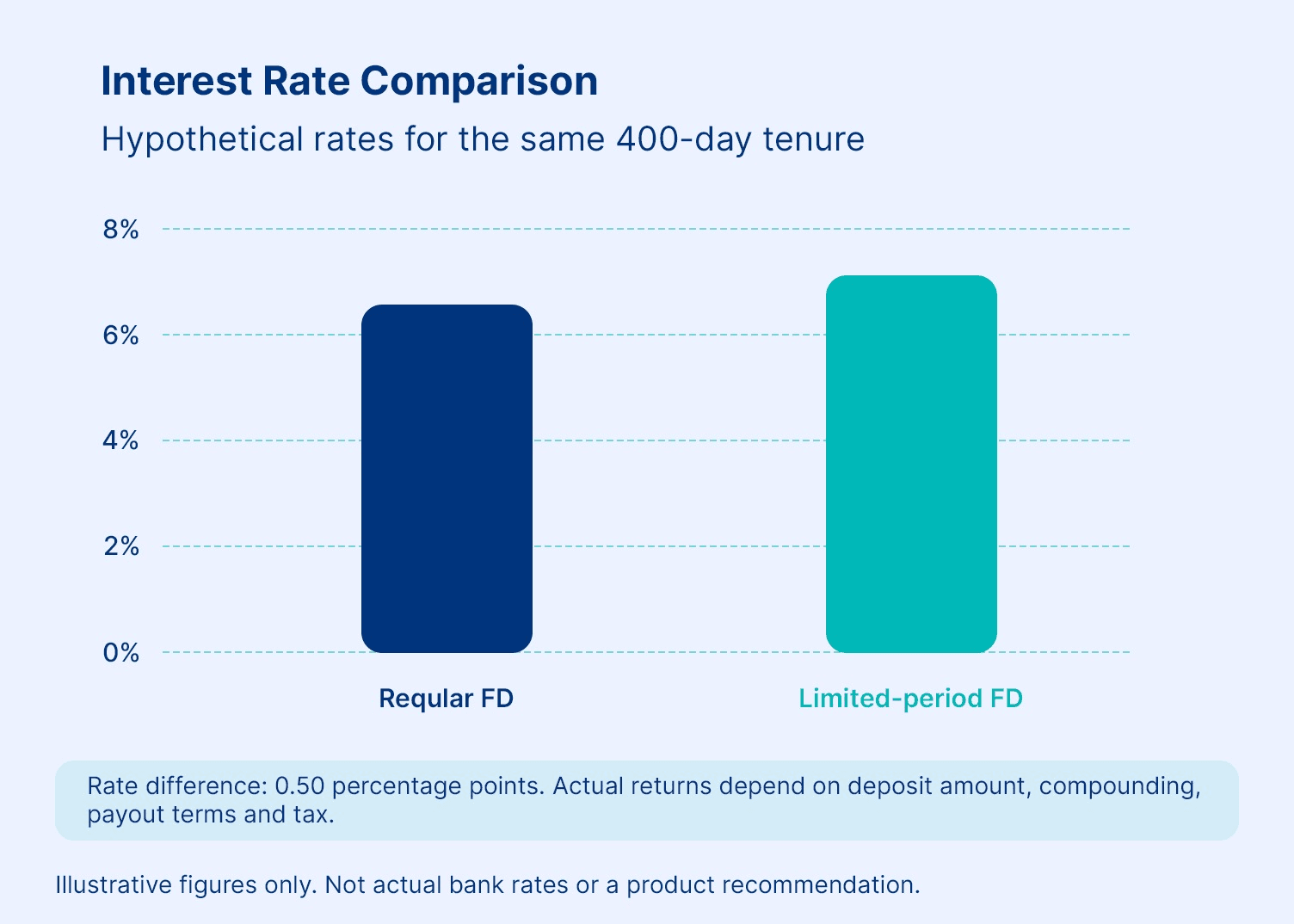
Interest Rate | May offer a special or comparatively attractive rate for the specified tenure | Regular card rate applicable to the chosen tenure |
Booking Deadline | Investment must be made before the offer closes | Generally no scheme-specific booking deadline |
Choice/Flexibility | Options may be relatively limited because the scheme has predefined terms | Greater flexibility to select a tenure according to your requirements |
After Maturity | The special rate may not be available for renewal; prevailing rates/terms would apply | Renewal is generally at the prevailing applicable rate |
Maturity Amount Comparison
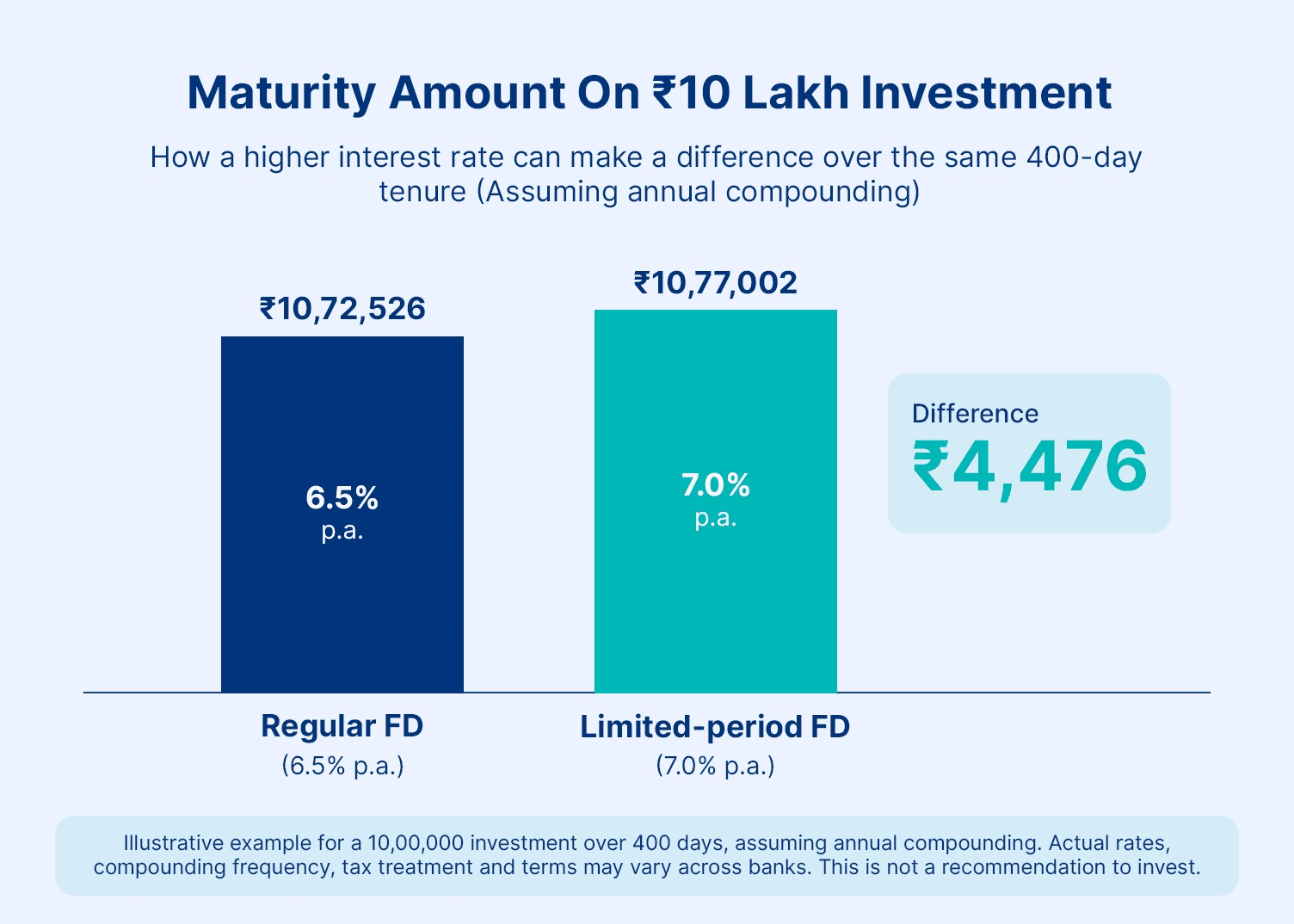
On an outlay, a difference of 0.50% or 1.00% does not seem too significant. However, if the FD tenure is substantial, it can have a major impact on the outcome, as well as on your personal financial planning. Let us take an example:
Factors To Consider Before Choosing A Limited Period FD
Here are a few factors you must consider if you are considering going for a limited period FD:
1. Interest Rate: Compare the offered interest rates with what is generally available. A higher marketed rate may not suit your needs, as other factors matter too.
2. Tenure: Check the commitment period and whether it aligns with your investment horizon.
3. Premature Withdrawal: You might need the funds at any time for an emergency, so you should be clear on the rules and regulations for premature withdrawal.
4. Interest Payout: Check whether the payout options meet your requirements. Payouts can be monthly, quarterly or annual.
5. Auto-Renewal: Don't assume the special rate will continue after maturity. Check the renewal instructions and the rate that may apply upon renewal.
6. Tax Impact: FD interest is generally taxable. Consider the post-tax return rather than comparing investment options solely on their advertised interest rates.
Checklist Before Booking A Limited-Period FD
Before booking a limited-period FD, quickly check the following:
- Note the last date for booking and the applicable tenure.
- Check the minimum deposit amount and eligibility requirements.
- Compare the offered rate with regular FDs of similar tenures.
- Check whether additional rates for senior citizens are available, if applicable.
- Review premature withdrawal rules and applicable penalties.
- Choose the appropriate interest payout frequency.
- Understand the auto-renewal terms and calculate your expected maturity amount.
- Consider the post-tax return instead of looking only at the advertised rate.
- Check nomination provisions and applicable deposit insurance coverage.
Conclusion
A limited-period FD scheme can provide you with an opportunity to book a higher rate of interest compared to other conventional fixed deposit options available. However, these FDs have a limited booking period and predecided tenures and interest rates. If you are willing to invest in any of these schemes, evaluate whether the offered rate and tenure fit your financial plans. Compare it with regular FD options, understand the tenure and withdrawal conditions, consider the post-tax returns, and check what happens to the deposit at maturity.
FAQs

Want to stay at the top of your finances?
Join the community of 22 lakh+ investors and learn more about Grip Invest, the latest financial knick-knacks, and shenanigans in the world of investing.
Happy Investing!
Disclaimer - Investments in debt securities/municipal debt securities/securitised debt instruments are subject to risks including delay and/ or default in payment. Read all the offer related documents carefully. The investor is requested to take into consideration all the risk factors before the commencement of trading.
This communication is prepared by Grip Broking Private Limited (bearing SEBI Registration No. INZ000312836 and NSE ID 90319) and/or its affiliate/ group company(ies) (together referred to as “Grip”) and the contents of this disclaimer are applicable to this document and any and all written or oral communication(s) made by Grip or its directors, employees, associates, representatives and agents. This communication does not constitute advice relating to investing or otherwise dealing in securities and is not an offer or solicitation for the purchase or sale of any securities. Grip does not guarantee or assure any return on investments and accepts no liability for consequences of any actions taken based on the information provided. For more details, please visit www.gripinvest.in
Registered Address - 106, II F, New Asiatic Building, H Block, Connaught Place, New Delhi 110001


