

RBI FD Disclosure Rules in India: Interest Rates, Penalties and Key Terms



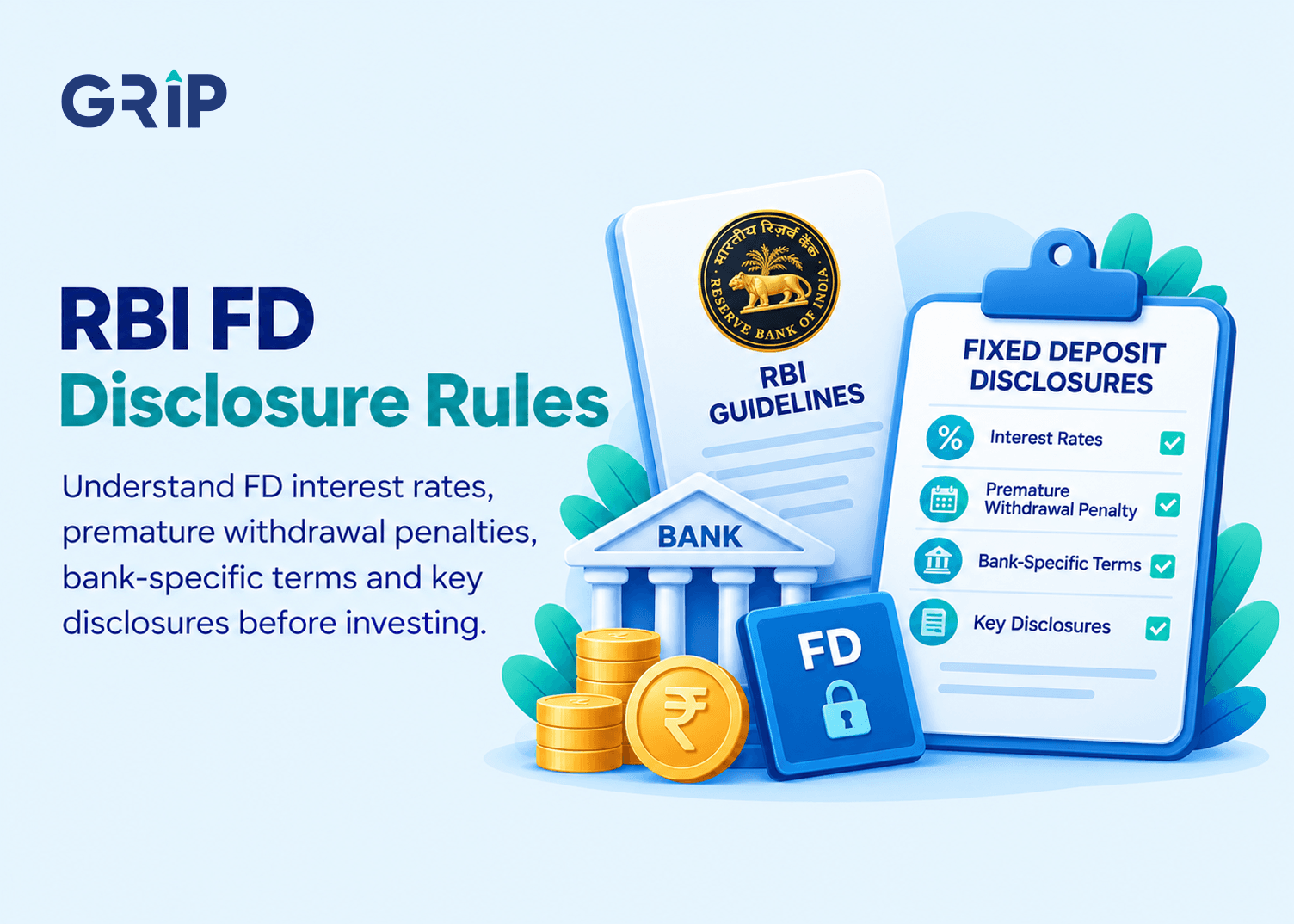
For risk-averse investors and those who want to avoid market-related volatility affecting returns, FDs or Fixed Deposits, have been a popular choice.
FDs are generally considered relatively safe, and investors seeking predictable returns over a chosen period often prefer them because of their inherent features.
However, before opening a fixed deposit, consider factors beyond the interest rates advertised by the bank or financial institution offering the FD. Factors such as premature withdrawal penalties, interest payout options, renewal instructions, taxes, and other terms can affect your eventual return on investment.
What Are RBI FD Disclosure Rules?
RBI FD disclosure rules are the regulatory requirements banks must follow when offering and managing fixed deposits. These requirements cover factors that ultimately affect investment returns, including interest rate policies, communication of deposit terms, premature withdrawals, and applicable penalties.1
The Reserve Bank of India does not prescribe a single FD interest rate for all banks. Instead, banks determine their deposit rates within the applicable regulatory framework.
This means that while two banks can offer different FD interest rates, they must still comply with the RBI directions applicable to their deposit products.
One should also understand the difference between RBI fixed deposit rules and individual bank policies, which are a bit flexible. While the RBI provides a broader regulatory framework and requirements, banks can set their own product-specific terms. This includes interest rate slabs, premature withdrawal penalties, etc.
What Information Must Banks Disclose Before an FD Is Opened?
One reason bank FDs are considered secure is the RBI's strict regulation and oversight, which includes proper disclosure of key factors to depositors. Investors are also expected to study and understand the factors that determine their interest earnings, access to funds, and maturity proceeds.
Here are some of the things that banks must disclose before an FD is opened:
1. Interest rate: Banks must follow their disclosed schedule of deposit interest rates. Depositors should check the rate applicable to their chosen tenure and deposit amount.
2. Premature withdrawal penalties: Banks must clearly communicate the components of any applicable penalty when accepting a deposit. These charges depend on the bank's approved policy.2
3. Deposit tenure and maturity: Check the deposit's start date, maturity date, and amount payable at maturity.
4. Interest payout options: Understand whether interest will be paid periodically or accumulated until maturity, depending on the FD product.
5. Renewal instructions: Check whether the FD will be renewed automatically or whether the maturity proceeds will be transferred to your account.
RBI Rules on FD Interest Rates and Premature Withdrawal
Under the RBI rules for fixed deposits, banks can determine FD interest rates, subject to applicable regulations. Once a fixed-rate FD is booked, the contracted interest rate generally remains the same until maturity, even when there are subsequent revisions in rates for new deposits.
However, withdrawing an FD before maturity may affect the interest earned. The premature withdrawal FD rules distinguish between deposits that must offer a withdrawal facility and deposits that may be offered with restrictions.
As per the RBI guidelines, banks are required to provide a premature withdrawal facility for term deposits of INR 1 crore or less.3
How Do Premature Withdrawal Penalties Work?
Banks can levy premature withdrawal penalties under board-approved policies. The RBI does not prescribe a uniform penalty rate for premature withdrawals across all banks.
For example, Ajay Raina has opened a fixed deposit with SBI at 7 percent per annum for INR 5 lakhs for a three-year period. He withdraws it after one year. If the applicable one-year FD interest rate at the time of booking was 6 percent, and the applicable premature withdrawal penalty is 1 percent, the effective interest rate can be reduced to 5 percent.
(Illustrative example only; the actual calculations depend on the bank's applicable policy and deposit terms).
This is why depositors should review the FD penalty rules before investing, particularly if they may need access to their funds before maturity.
FD Disclosure Rules vs Bank-Specific Terms
Here are the most important differences between FD disclosure rules, as mandated by the RBI and bank policies, which you must consider when comparing deposit options:
Aspect | RBI regulatory requirements | Bank-specific terms |
| Interest rates | Banks must follow applicable RBI directions when determining and communicating deposit rates. | Banks determine rates based on deposit tenure, amount, and eligible customer categories. |
| Premature withdrawal | Banks must provide withdrawal facilities for eligible deposits under RBI rules. | Banks specify withdrawal procedures and applicable conditions. |
| Withdrawal penalties | Applicable penalty components must be communicated when accepting deposits. | Banks determine penalty rates under their Board-approved policies. |
| Interest payout | Banks must comply with applicable rules governing interest calculation and payment. | Banks offer product-specific payout frequencies and cumulative options. |
| FD renewal | Applicable regulatory requirements govern the treatment of matured deposits. | Banks specify renewal options, instructions, and applicable renewal rates. |
This means two different banks may offer similar interest rates but different premature withdrawal rules or interest payout options.
How To Check An FD's Terms Before Investing
You can review the official FD terms and conditions on the bank’s website, or ask a branch to provide them. There are five things that you should take into account:
- Check the offered interest rate: Check the interest rate offered for your chosen deposit amount, tenure, and investor category on the bank's official website or rate card.
- Understand premature withdrawal conditions: Check whether early withdrawal is allowed and the penalties applicable.
- Understand interest payouts: Check whether the FD offers monthly, quarterly, or cumulative interest payments and how interest is calculated.
- Check maturity and renewal instructions: Understand what happens when the FD matures, including whether automatic renewal applies.
- Review the deposit documentation: Read the applicable terms, retain the FD receipt or confirmation, and verify the interest rate, tenure, maturity amount, and nominee details.
FAQs

Want to stay at the top of your finances?
Join the community of 22 lakh+ investors and learn more about Grip Invest, the latest financial knick-knacks, and shenanigans in the world of investing.
Happy Investing!
Disclaimer - Investments in debt securities/municipal debt securities/securitised debt instruments are subject to risks including delay and/ or default in payment. Read all the offer related documents carefully. The investor is requested to take into consideration all the risk factors before the commencement of trading.
This communication is prepared by Grip Broking Private Limited (bearing SEBI Registration No. INZ000312836 and NSE ID 90319) and/or its affiliate/ group company(ies) (together referred to as “Grip”) and the contents of this disclaimer are applicable to this document and any and all written or oral communication(s) made by Grip or its directors, employees, associates, representatives and agents. This communication does not constitute advice relating to investing or otherwise dealing in securities and is not an offer or solicitation for the purchase or sale of any securities. Grip does not guarantee or assure any return on investments and accepts no liability for consequences of any actions taken based on the information provided. For more details, please visit www.gripinvest.in
Registered Address - 106, II F, New Asiatic Building, H Block, Connaught Place, New Delhi 110001


