

Rupee Depreciation And Gold Prices: How Does A Falling Rupee Affect Gold?



Gold Rates Today
Live · Updated 11:00 AM, 25 Nov 2026
₹12,354
/ gram
−₹308 (2.43%)
₹1,23,540 per 10 g · 24 Nov: ₹12,662 / gram
Price breakdown
1 g
₹12,354
10 g
₹1,23,540
100 g
₹12,35,400
Rate trend
Gold 24K, last 3 months: ₹16,485 on 26 Aug 2026 to ₹12,354 on 25 Nov 2026. High ₹16,508, low ₹12,354.
Indicative retail rate. Local taxes and making charges may differ.
Rupee depreciation and gold prices are closely linked in India, since almost all the gold bought here is imported and paid for in US dollars.
When the rupee falls, the same dollar price of gold costs more rupees, and the price of gold in India generally goes up by about the same percentage, even if nothing changes in the world market. The effect is not always visible though, as international prices, import duty and local demand can pull gold the other way.
Rupee Depreciation And Gold Prices: What Is The Relationship?
The relationship comes from the way gold reaches India. The country produces very little gold of its own and depends on imports for most of its needs. Gold is bought and sold across the world in US dollars per troy ounce, so an Indian importer has to first buy dollars to pay for it. The price of gold in India is therefore broadly the international price multiplied by the rupee-dollar exchange rate, with import duty and GST added on top.
Rupee depreciation means that more rupees are needed to buy one US dollar. When this happens, the dollar price of gold gets converted at a higher rate and the rupee price goes up, even on a day when gold has not moved in the global market. In simple terms, if the rupee falls by 1% and everything else stays the same, gold in India becomes about 1% costlier. This is the basic link between the USD INR exchange rate and gold.
However, the rupee has been weakening for some time now. It was at INR 93.32 to the dollar on 19 November 2026, compared with INR 88.59 a year earlier, which is a fall of a little over 5%. As per the RBI's annual report, the rupee had already fallen 9.9% in the financial year 2025-26, mainly due to trade tensions, higher oil prices and foreign investors taking money out of India. A weaker rupee of this kind keeps raising the cost of every gram of gold brought into the country.
The same global events also tend to affect both at once. A war or a sharp rise in oil prices can lead investors to sell emerging market currencies like the rupee and buy gold, so the rupee often weakens just when gold is rising in dollars.
In such periods the rise in Indian gold prices becomes bigger than the rise abroad. However this is a tendency and not a fixed rule, and the rupee effect can be overshadowed by other factors.
How Does Rupee Depreciation Increase Gold Prices In India?
A fall in the rupee reaches the price of gold through the import chain, and the effect builds up at each stage. Gold is brought into India by banks and nominated agencies, who pay the foreign seller in US dollars. To do that, they buy dollars at the exchange rate of the day. If the rupee has weakened, the same quantity of gold needs more rupees, so the cost of import goes up straight away.
The higher rupee cost then carries through to the taxes. Customs duty, which is 15% at present, is worked out on the value of the import in rupees, so a higher rupee value means a higher duty amount as well. GST of 3% is charged on the selling price in the same way. Bullion dealers and jewellers then add their own premium and making charges on this higher base.
Suppose the international price of gold stays at US$4,000 an ounce for a month, while the rupee falls from INR 85 to INR 90 against the dollar during the same period. This is a fall of about 5.9% in the rupee.
The table below shows the price of 10 grams at each stage:
| Price per 10 grams | At INR 85 per dollar | At INR 90 per dollar | Increase |
| International price converted into rupees (US$4,000 × rate × 10 ÷ 31.1035) | INR 1,09,312 | INR 1,15,743 | INR 6,431 |
| After 15% import duty | INR 1,25,709 | INR 1,33,104 | INR 7,395 |
| After 3% GST | INR 1,29,481 | INR 1,37,097 | INR 7,616 |
Hypothetical example. 1 troy ounce equals 31.1035 grams. Bank charges, dealer premiums and making charges are ignored.
- At INR 85 to the dollar, 10 grams of gold works out to INR 1,09,312 before taxes.
- At INR 90 the same 10 grams costs INR 6,431 more.
The gap widens to INR 7,395 after import duty and to INR 7,616 after GST, so the buyer finally pays INR 1,37,097 instead of INR 1,29,481. All this happens although the price in the world market did not change by even a dollar.
Every stage goes up by the same 5.9% as the rupee, but the extra amount in rupees grows at each step, since duty and GST are charged on the higher value. For a family buying 50 grams of jewellery for a wedding, the same fall in the rupee would add about INR 38,000 (INR 7,616 × 5) to the bill even before making charges.
The change also shows up quickly. Benchmark rates such as the IBJA rate, which is published twice a day, and gold futures on MCX are worked out from the international price and the rupee rate at that time. A sharp fall in the rupee during the day is therefore usually seen in gold rates on the same day.
The example shows the rupee depreciation impact on gold in its simplest form. It holds fully only when the international price and the import duty stay where they were, which is rarely the case for long.
Other Factors That Influence Gold Prices In India
The rupee is only one of the inputs in the price of gold in India, and it rarely moves alone. Other factors can add to the rupee effect in some periods and cancel it in others, which is why gold prices in India do not always rise when the rupee falls.
- The biggest of these is the international price of gold in US dollars. This price depends on global factors such as US interest rates, the strength of the dollar and demand for safe assets during wars or financial stress. When US interest rates are expected to go up, gold usually becomes less attractive, as it does not pay any interest. Spot gold was about US$3,786 an ounce on 18 November 2026, down from US$4,078 a year earlier, as a strong dollar and expectations of higher US rates weighed on it. A fall of this size can wipe out the effect of a weaker rupee.
- Import duty is the second big factor, and it is set by the government, so it can change overnight. The duty was raised from 10.75% to 15% in July 2022, cut to 6% in July 2024 and raised back to 15% in May 2026 to save foreign exchange. A change of this kind moves domestic prices without any change in the rupee or in global prices. GST of 3% also applies on every purchase, and jewellery carries making charges on top of it.
- Local demand decides whether gold sells above or below its import cost. During weddings and festivals such as Akshaya Tritiya and Dhanteras, demand usually goes up and dealers can charge a premium. When buyers hold back, gold may sell at a discount instead. After the duty hike in May 2026, domestic prices traded at a discount of nearly US$150 an ounce to the landed price, as buyers waited and the Prime Minister appealed to households to put off gold purchases.
Hence, the final price in India is the result of all these forces acting together. The rupee may account for most of the change in one month and very little of it in the next.
Historical Relationship Between Rupee Depreciation And Gold Prices
Since so many factors move at the same time, past data is the best way to see how much of the rise in gold actually came from the rupee. There have been days when the rupee alone moved the price. The link between a rupee fall and gold rates was clearest on 28 August 2013, when the rupee dropped to a then record low of 68.75 to the dollar.
Gold in Delhi jumped INR 2,500 in a single day to a record INR 34,500 per 10 grams, though gold in Singapore was down 0.3% at US$1,419.55 an ounce that day. The government had raised the import duty several times that year, taking it to 10%, which also kept domestic prices above global levels.
Over longer periods, the picture is more mixed. In the last five financial years, both the dollar and gold have become costlier in rupee terms, but at very different speeds.
The chart below uses RBI data for the yearly average exchange rate and the yearly average price of standard gold in Mumbai.
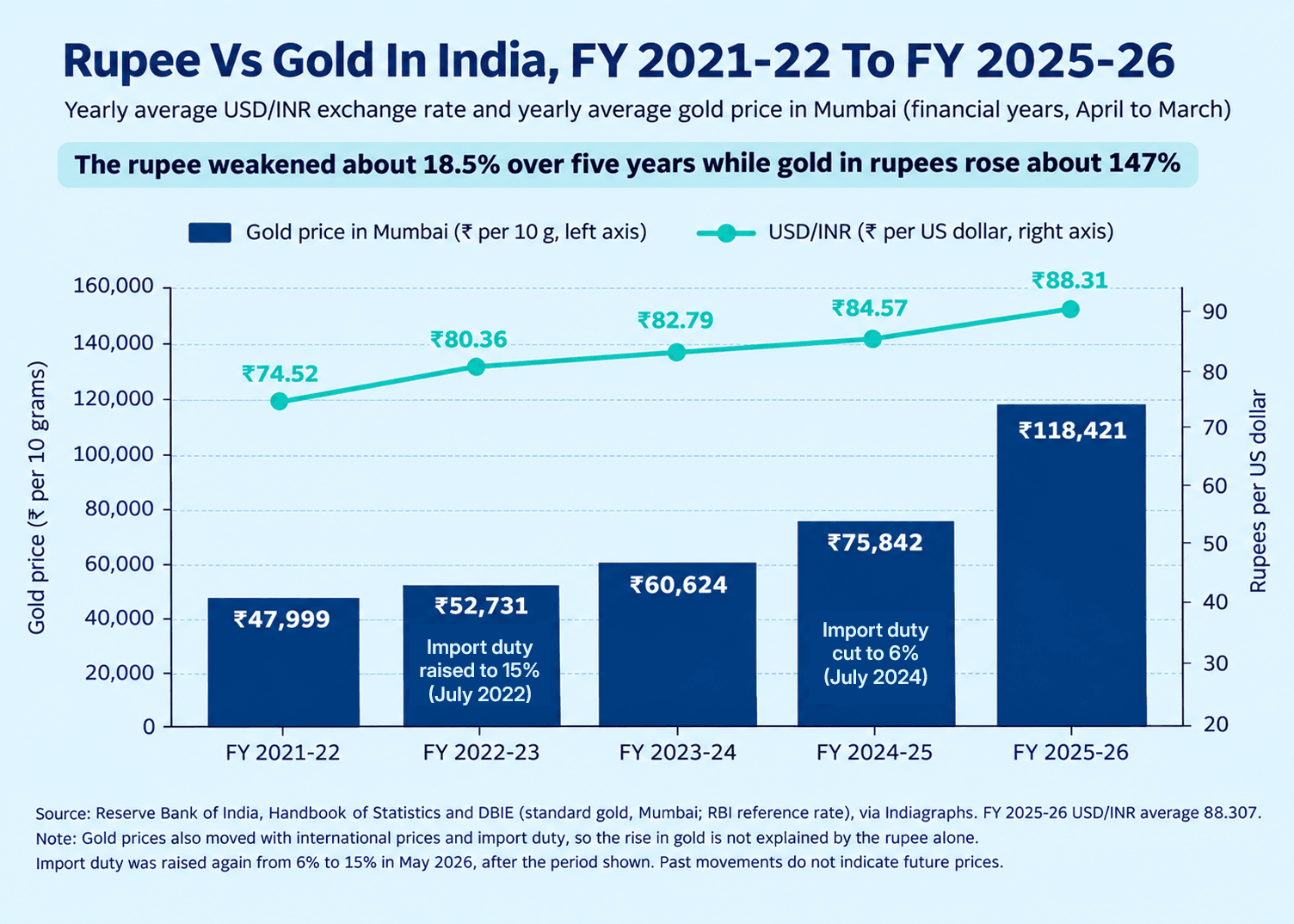
The rupee lost about 18.5% against the dollar over these five years, while gold in rupees went up by about 147%. The rupee therefore explains only a part of the rise. The table below splits the change in each year into the part that came from the rupee and the part that came from other factors:
| Period | Change in gold price in Mumbai | Change in USD/INR | Remaining change (global price, duty and local premium) |
| FY 2021-22 to FY 2022-23 | +9.9% | +7.8% | +1.9% |
| FY 2022-23 to FY 2023-24 | +15.0% | +3.0% | +11.6% |
| FY 2023-24 to FY 2024-25 | +25.1% | +2.2% | +22.5% |
| FY 2024-25 to FY 2025-26 | +56.1% | +4.4% | +49.5% |
Calculated from RBI yearly averages. Remaining change = (1 + change in gold) ÷ (1 + change in USD/INR) minus 1.
In FY 2022-23, the rupee did most of the work. It weakened 7.8% as the US raised interest rates sharply and the dollar gained against most currencies, while gold in dollars stayed nearly flat. Gold in India still rose 9.9%, helped also by the increase in import duty to 15% in July 2022.
From FY 2023-24 onwards, the global price took over. The rupee weakened only 3.0% in FY 2023-24 and 2.2% in FY 2024-25, but gold in India rose 15.0% and 25.1% in those years, as gold kept climbing in the world market. The duty cut to 6% in July 2024 even brought domestic prices down for some time, yet the yearly average for FY 2024-25 still went up.
FY 2025-26 saw the biggest jump of all. Gold in India rose 56.1% while the rupee fell 4.4%, so roughly nine-tenths of the rise came from higher international prices and only a small part from the weaker rupee.
The past year shows that the two can also move against each other. Between November 2025 and November 2026, the rupee weakened by about 5% and the import duty went up from 6% to 15%, and both of these should have raised the price.
Even so, the IBJA rate for 24 carat gold was INR 1,23,580 per 10 grams on 20 November 2026, almost the same as the RBI average of INR 1,22,962 for November 2025. The reason was a fall of about 7% in the dollar price of gold over the same period, along with weak local demand after the duty hike.
Does Rupee Depreciation Make Gold A Better Investment?
The history shows that the rupee explains only a part of gold's rise, and this matters for anyone buying gold as protection against a weaker rupee. For an Indian investor, the return on gold is made up of two parts, the change in the dollar price of gold and the change in the rupee. When both move in the investor's favour, the gains add up.
Suppose gold rises 5% in dollars in a year and the rupee also falls 5% then the return in rupees would be about 10.25% (1.05 × 1.05 minus 1).
The same arithmetic works against the investor too. If gold falls 10% in dollars and the rupee falls 5%, the investor would still lose about 5.5% (0.90 × 1.05 minus 1). The weaker rupee reduces the loss, but it does not turn it into a gain. Hence, the idea of gold as a hedge against currency depreciation needs some care. Gold can soften the effect of a weaker rupee over time, but its price can swing sharply on its own, as in April 2026 when gold fell about 9% in rupee terms within a month.
An investor who is buying gold mainly because the rupee is weak may check the following points first:
1. Direction of the dollar price: A falling international price can wipe out the gain from a weaker rupee, as it did over the past year.
2. Current duty level: Gold bought soon after a duty hike can lose value if the duty is cut later, as happened in July 2024.
3. Form of holding: Jewellery carries making charges and GST, while ETFs and funds carry an expense ratio, and both reduce the final return.
4. Share in the portfolio: Gold works better as one part of a portfolio than as the main holding, since it pays no regular income.
For the form of holding, investors who want gold without keeping it physically can use Gold ETFs or Gold Mutual Funds. A Gold ETF holds physical gold of 99.5% purity, trades on the stock exchange like a share and needs a demat account. A gold mutual fund usually invests in Gold ETFs and can be bought through a SIP without a demat account. Both track the domestic price of gold, so the effect of rupee movements reaches them in the same way as it reaches physical gold. Indian Gold ETFs held 116.7 tonnes of gold in April 2026.
The differences between the two lie mainly in cost, liquidity and the way they are bought. A gold investment plan can help decide how much of a portfolio may go into gold.
FAQs

Want to stay at the top of your finances?
Join the community of 22 lakh+ investors and learn more about Grip Invest, the latest financial knick-knacks, and shenanigans in the world of investing.
Happy Investing!
Disclaimer - Investments in debt securities/municipal debt securities/securitised debt instruments are subject to risks including delay and/ or default in payment. Read all the offer related documents carefully. The investor is requested to take into consideration all the risk factors before the commencement of trading.
This communication is prepared by Grip Broking Private Limited (bearing SEBI Registration No. INZ000312836 and NSE ID 90319) and/or its affiliate/ group company(ies) (together referred to as “Grip”) and the contents of this disclaimer are applicable to this document and any and all written or oral communication(s) made by Grip or its directors, employees, associates, representatives and agents. This communication does not constitute advice relating to investing or otherwise dealing in securities and is not an offer or solicitation for the purchase or sale of any securities. Grip does not guarantee or assure any return on investments and accepts no liability for consequences of any actions taken based on the information provided. For more details, please visit www.gripinvest.in
Registered Address - 106, II F, New Asiatic Building, H Block, Connaught Place, New Delhi 110001


