

Gilt Fund Vs Corporate Bond Fund: Returns, Risks And Differences




Gilt fund vs corporate bond fund compares two debt mutual fund categories that differ mainly in the type of borrower they lend to.
A gilt fund lends to the central and state governments while a corporate bond fund lends to highly rated companies. This single difference shapes how each fund earns returns and which risks the investor carries, so the choice generally depends on the investor's horizon and risk preference rather than on the past return alone.
What Is A Gilt Fund?
The core gilt fund meaning involves a debt mutual fund that has to invest at least 80% of its total assets in government securities across maturities, as per SEBI's circular on categorisation and rationalisation of mutual fund schemes dated 26 February 2026. Such government securities are issued by the central and state governments, so the scheme generally carries no default risk on that part of the portfolio. A separate category, the 10-year constant maturity gilt fund, has to keep the Macaulay duration of its portfolio at 10 years.
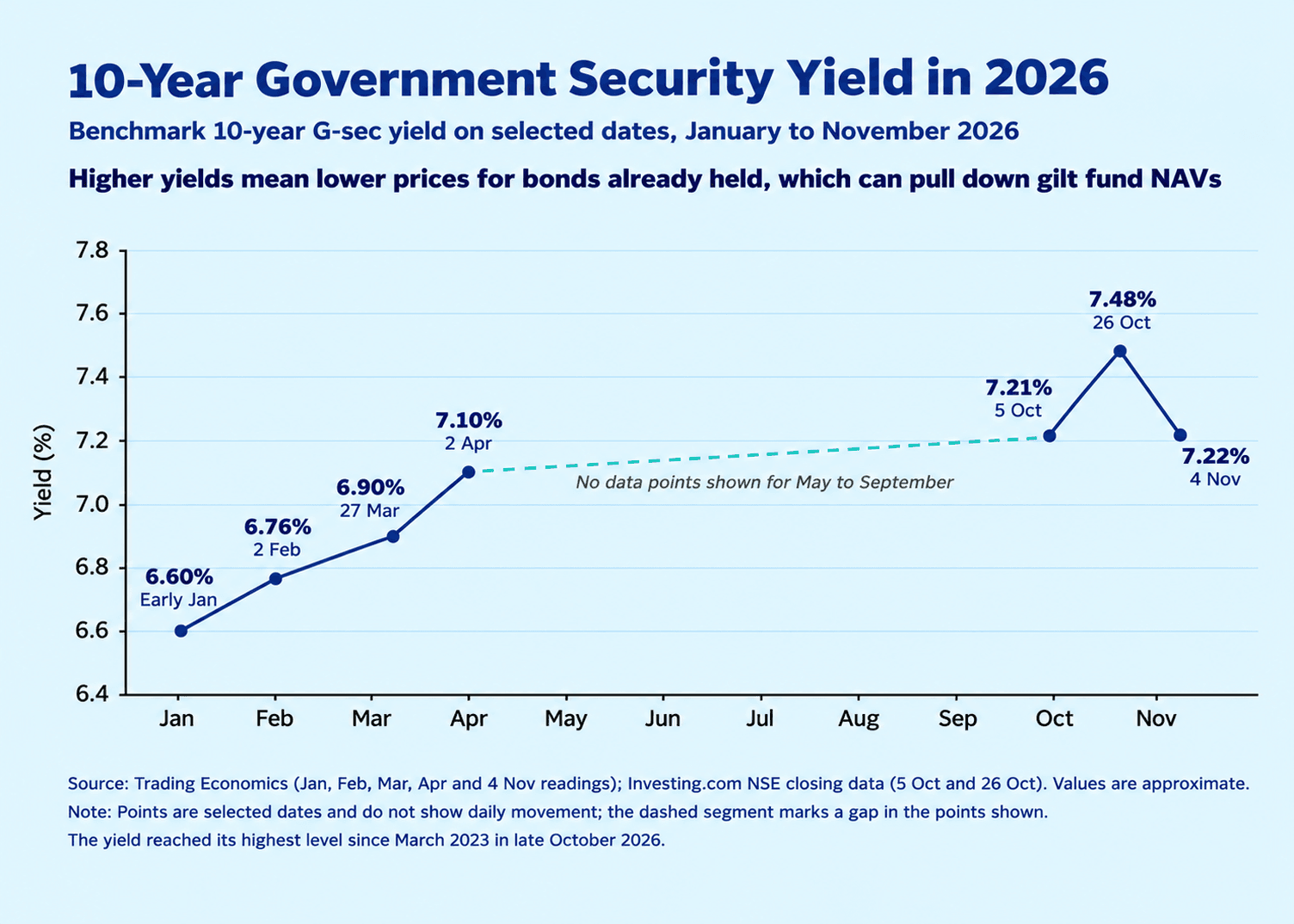
This point is often missed in a gilt fund vs corporate bond fund comparison as sovereign backing does not protect the NAV of a gilt mutual fund from interest rate risk. The 10-year G-sec yield rose from about 6.6% at the start of 2026 to about 7.47% in late October 2026, its highest level since March 2023, and bond prices fall when yields rise.
Suppose a gilt fund has a modified duration of 6 years and yields rise by 0.50%, then its NAV may fall by roughly 3% (6 × 0.50%) on that account. Interest earned on the portfolio can make up part of this over time, but the NAV may stay below the purchase price for some months.
The chart below shows the movement of the benchmark yield during 2026, which helps to explain the pressure on gilt fund NAVs during the year. The yield eased to about 7.22% on 4 November 2026 and such reversals can lift NAVs just as quickly.
What Is A Corporate Bond Fund?
A corporate bond fund is a debt mutual fund that invests at least 80% of its total assets in corporate bonds rated AA+ and above. Unlike a gilt fund, such a scheme lends to companies, banks, NBFCs and public sector undertakings, and it earns a higher yield than government securities of similar maturity in return for credit risk. As per the RBI Bulletin, 5-year AAA corporate bonds yielded 7.52% in March 2026, which was 92 basis points above the corresponding risk-free rate.
Note that a corporate bond mutual fund can lose value if an issuer is downgraded or defaults. Suppose 2% of the portfolio is in one bond and the value of that bond is written down by 50% then the NAV may fall by about 1% (2% × 50%) on the day of the write-down.
The remaining portion of up to 20% may go into other debt and money market instruments, depending on the scheme information document.
Gilt Fund Vs Corporate Bond Fund: Key Differences
The Gilt Fund Vs Corporate Bond Fund decision is mostly about which risk the investor is willing to carry in return for the yield on offer. The definitions above show that the two funds lend to different borrowers. This difference shows up in three places, namely how returns are generated, which risks affect the NAV and how each fund compares on practical parameters such as liquidity and horizon.
How Returns Are Generated
The return of a debt fund over a period generally comes from two parts:
- The first is accrual, which is the interest earned on the bonds and is broadly reflected in the portfolio's yield to maturity.
- The second is the change in bond prices, which depends on how much market yields move and on the portfolio's modified duration.
In simple terms, the one-year return may be estimated as the portfolio yield minus the modified duration multiplied by the change in yields.
- Gilt fund returns depend more on the second part as these funds can hold long-dated securities, so they may gain more when yields fall and lag behind when yields rise.
- Corporate bond fund returns depend more on accrual since these funds generally run shorter portfolios and earn a credit spread over G-secs.
Neither fund does better in every situation. A corporate bond fund may do better when yields are steady or rising and a gilt fund may do better when yields fall, though a widening of credit spreads or a default can pull the corporate bond fund's return below such estimates.
The below table uses the same 6-year duration from the gilt fund example and compares it with a corporate bond fund having a 3-year duration:
Change in yields over one year | Gilt fund (YTM 7.0%, duration 6 years) | Corporate bond fund (YTM 7.6%, duration 3 years) |
| Fall of 1.00% | About 13.0% (7.0% + 6 × 1.00%) | About 10.6% (7.6% + 3 × 1.00%) |
| Fall of 0.50% | About 10.0% (7.0% + 6 × 0.50%) | About 9.1% (7.6% + 3 × 0.50%) |
| No change | About 7.0% | About 7.6% |
| Rise of 0.50% | About 4.0% (7.0% minus 6 × 0.50%) | About 6.1% (7.6% minus 3 × 0.50%) |
| Rise of 1.00% | About 1.0% (7.0% minus 6 × 1.00%) | About 4.6% (7.6% minus 3 × 1.00%) |
Hypothetical figures for illustration only. They ignore expense ratio, changes in credit spreads, convexity and reinvestment, and are not the returns of any actual fund.
Credit Risk Vs Interest Rate Risk
Credit risk refers to the possibility that a borrower delays or fails to pay interest or principal. It is assessed through credit ratings and it mainly affects the corporate bond fund, as seen in the write-down example earlier. Interest rate risk refers to the change in bond prices when market yields change, and it is measured through duration. It affects both funds and is often the larger risk in a gilt fund.
SEBI's Potential Risk Class matrix, applicable to debt schemes since December 2021, shows the two risks separately. Credit risk is graded from Class A (relatively low) to Class C (relatively high) based on the credit risk value of the portfolio, while interest rate risk is graded from Class I to Class III based on Macaulay duration, with Class III covering a duration above 3 years. Hence a gilt fund would usually sit in Class A for credit risk even if it sits in Class III for interest rate risk. Investors can check this matrix in the scheme's factsheet before investing, although it shows the maximum risk a scheme may take and not its current position.
Comparison Table
In a broader gilt fund vs debt fund comparison, a gilt fund holds one type of borrower while other debt categories may hold a mix of borrowers and maturities. The below table helps to distinguish gilt funds and corporate bond funds on the main parameters:
Parameter | Gilt Fund | Corporate Bond Fund |
| Investment composition | Minimum 80% in central and state government securities | Minimum 80% in corporate bonds rated AA+ and above |
| Credit risk | Negligible on the government securities held | Low to moderate, depending on issuer ratings and concentration |
| Interest rate risk | Generally higher, as there is no cap on portfolio duration | Generally moderate, depending on the portfolio's duration |
| Yield potential | Close to G-sec yields of the maturities held | Above G-sec yields of similar maturity by the credit spread |
| Liquidity | Units redeemable on business days; G-secs are the most traded bonds in India | Units redeemable on business days; underlying corporate bonds trade less often |
| Investment horizon | Medium to long, ideally covering a full rate cycle | Medium, depending on the average maturity of the portfolio |
| Category size on 30 September 2026 | 23 schemes, net AUM of INR 29,559 crore | 21 schemes, net AUM of INR 1,71,903 crore |
| Net flow in September 2026 | Inflow of INR 600 crore | Outflow of INR 4,652 crore |
Gilt figures exclude the 10-year constant maturity gilt category.
Taxation Of Gilt Funds Vs Corporate Bond Funds
The tax treatment of gilt funds and corporate bond funds is the same for units acquired on or after 1 April 2023, as both are debt-oriented schemes. Returns and risks differ between the two, but tax does not change that comparison for new investments. Section 76 of the Income-tax Act, 2025 (earlier Section 50AA of the Income-tax Act, 1961) treats gains on units of a specified mutual fund as short-term capital gains irrespective of the holding period. From FY 2025-26, a specified mutual fund means a scheme investing more than 65% of its total proceeds in debt and money market instruments. Such gains would therefore be added to income and taxed at the applicable slab rate without indexation.
The treatment is different for older units and for bonds held directly, as per the points given below:
1. Units Acquired Before 1 April 2023: Gains on units held for more than 24 months are taxed at 12.5% without indexation under Section 197 of the Income-tax Act, 2025 (earlier Section 112), while units held for 24 months or less are taxed at slab rate.
2. Directly Held Government Securities: A listed G-sec becomes a long-term capital asset after 12 months, and the gain on its sale is taxed at 12.5% under Section 197.
3. Coupon on Directly Held Bonds: Interest from G-secs and corporate bonds held directly is taxable at slab rate in the year it is received, whereas a fund under the growth option is taxed only on redemption.
4. IDCW Option: Income distributed by either scheme is added to the investor's income and taxed at slab rate.
5. Switching Between Schemes: A switch from a gilt fund to a corporate bond fund, or the other way, is treated as a redemption and the gain on the units switched out is taxable.
6. Losses on Redemption: A loss on these units is treated as a short-term capital loss and may be set off against other capital gains, subject to the set-off rules.
Suppose an investor in the 30% slab redeems gilt fund units bought in June 2024 with a gain of INR 20,000 then the tax would be INR 6,240 (INR 20,000 × 31.2%, including 4% cess). The same INR 20,000 gain on a listed G-sec held for more than 12 months would attract tax of INR 2,600 (INR 20,000 × 13%, including cess). Hence, a gilt fund should not be assumed to get the tax treatment of a government security held directly. The investor should compare post-tax returns because a fund with a higher pre-tax return may still leave a smaller amount after tax, depending on the slab.
Between the two funds, tax at slab rate reduces both returns in the same proportion and does not change which one earns more. Suppose a gilt fund earns 7.0% and a corporate bond fund earns 7.6% in a year then the post-tax returns would be about 4.82% (7.0% × 0.688) and 5.23% (7.6% × 0.688) for an investor in the 30% slab. For an investor in the 5% slab the same returns would be about 6.64% (7.0% × 0.948) and 7.20% (7.6% × 0.948). The gap between the two funds therefore narrows in absolute terms at higher slabs.
Disclaimer: All calculations are illustrative, include 4% cess and ignore surcharge, which may apply at higher income levels.
When Should You Choose A Gilt Fund Or Corporate Bond Fund?
The choice between government securities mutual funds and corporate bond funds generally depends on whether the investor wants to avoid credit risk or wants the extra yield that comes from lending to companies. With returns, risks and tax set out above, the decision comes down to matching these features with the investor's own horizon and comfort with NAV movements. Neither category is free of risk.
The present rate environment can also influence the choice. RBI raised the repo rate to 5.50% in October 2026 and long-term G-sec yields were close to three-year highs during the month. An investor who expects yields to fall from such levels may lean towards a gilt fund, while one who expects further increases may prefer the generally shorter duration of a corporate bond fund.
However the direction of interest rates cannot be predicted reliably and such a view should not be the only basis for the decision.
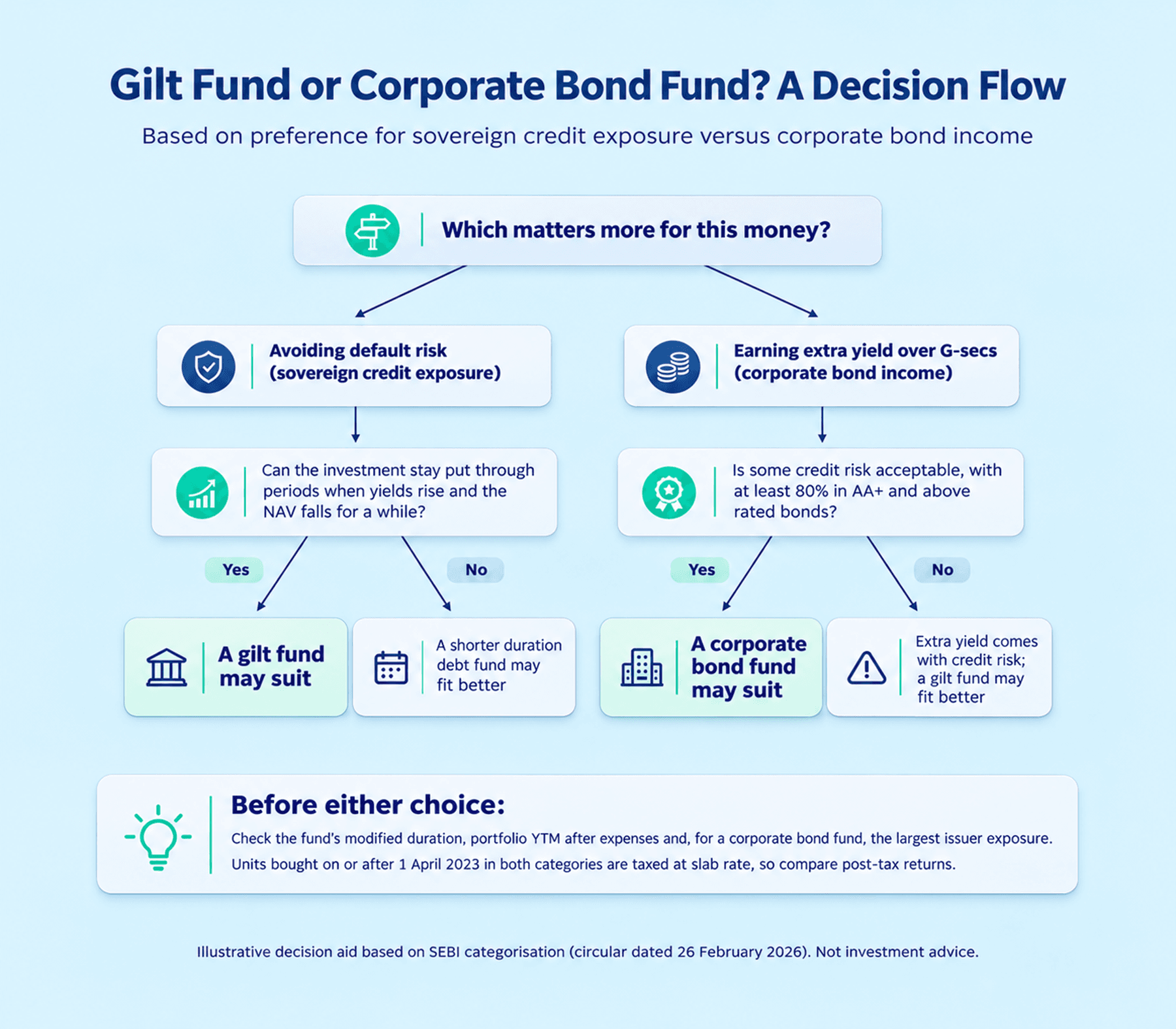
The decision flow below gives a starting point based on the investor's preference:
Investors may also go through the following checks before choosing between the two:
- A clear preference for sovereign credit exposure, where even a small chance of default is not acceptable, points towards a gilt fund.
- Preference for steady accrual income with some credit risk in highly rated bonds points towards a corporate bond fund.
- Modified duration shown in the factsheet, compared with how long the money can stay invested.
- Share of AAA, AA+ and sovereign holdings in a corporate bond fund, along with the largest single issuer exposure.
- Portfolio yield to maturity after deducting the expense ratio.
- The investor's tax slab, since gains from both funds are added to income.
- Whether the money may be needed at a time when yields are rising.
A higher portfolio yield in a corporate bond fund does not mean that it will always give higher returns than a gilt fund. Gilt funds can do better in a period of falling yields.
FAQs

Want to stay at the top of your finances?
Join the community of 22 lakh+ investors and learn more about Grip Invest, the latest financial knick-knacks, and shenanigans in the world of investing.
Happy Investing!
Disclaimer - Investments in debt securities/municipal debt securities/securitised debt instruments are subject to risks including delay and/ or default in payment. Read all the offer related documents carefully. The investor is requested to take into consideration all the risk factors before the commencement of trading.
This communication is prepared by Grip Broking Private Limited (bearing SEBI Registration No. INZ000312836 and NSE ID 90319) and/or its affiliate/ group company(ies) (together referred to as “Grip”) and the contents of this disclaimer are applicable to this document and any and all written or oral communication(s) made by Grip or its directors, employees, associates, representatives and agents. This communication does not constitute advice relating to investing or otherwise dealing in securities and is not an offer or solicitation for the purchase or sale of any securities. Grip does not guarantee or assure any return on investments and accepts no liability for consequences of any actions taken based on the information provided. For more details, please visit www.gripinvest.in
Registered Address - 106, II F, New Asiatic Building, H Block, Connaught Place, New Delhi 110001


