

3x Bull ETF: Meaning, Risks, Examples and SEBI Rules Explained


Introduction: 3x Bull ETFs
Exchange-traded funds in India have showcased a significant rise in popularity as retail folios grew 11-fold from March 2020 to 2.63 crore by March 20251. Moreover, the Asset Under Management (AUM) also reached INR 8.38 lakh crore in March 2025 from INR 1.54 lakh crore in March 2020.
While different types of ETFs, targeting different investor needs, exist in the market today, a unique category called the 3x Bull ETF aims to give three times the return of its underlying index. This blog decodes the 3x ETF meaning and its key aspects to analyse its suitability for particular investor groups.
How 3x Bull ETFs Work
An Exchange Traded Fund represents a pool of assets that trades in the stock market. It creates a blend between equity and mutual fund by allowing the pooling of individual investor funds and diverse asset allocation, like MFs, and stock market trading, like equity.
Now, one such type of ETF is a 3x Bull ETF. A 3x Bull ETF uses leverage (debt) to provide three times the daily return of its underlying index. For instance, let us compare the performance of a Nifty 50 ETF and a Nifty 50 3x Bull ETF, using an illustration.
3x Bull ETF Examples
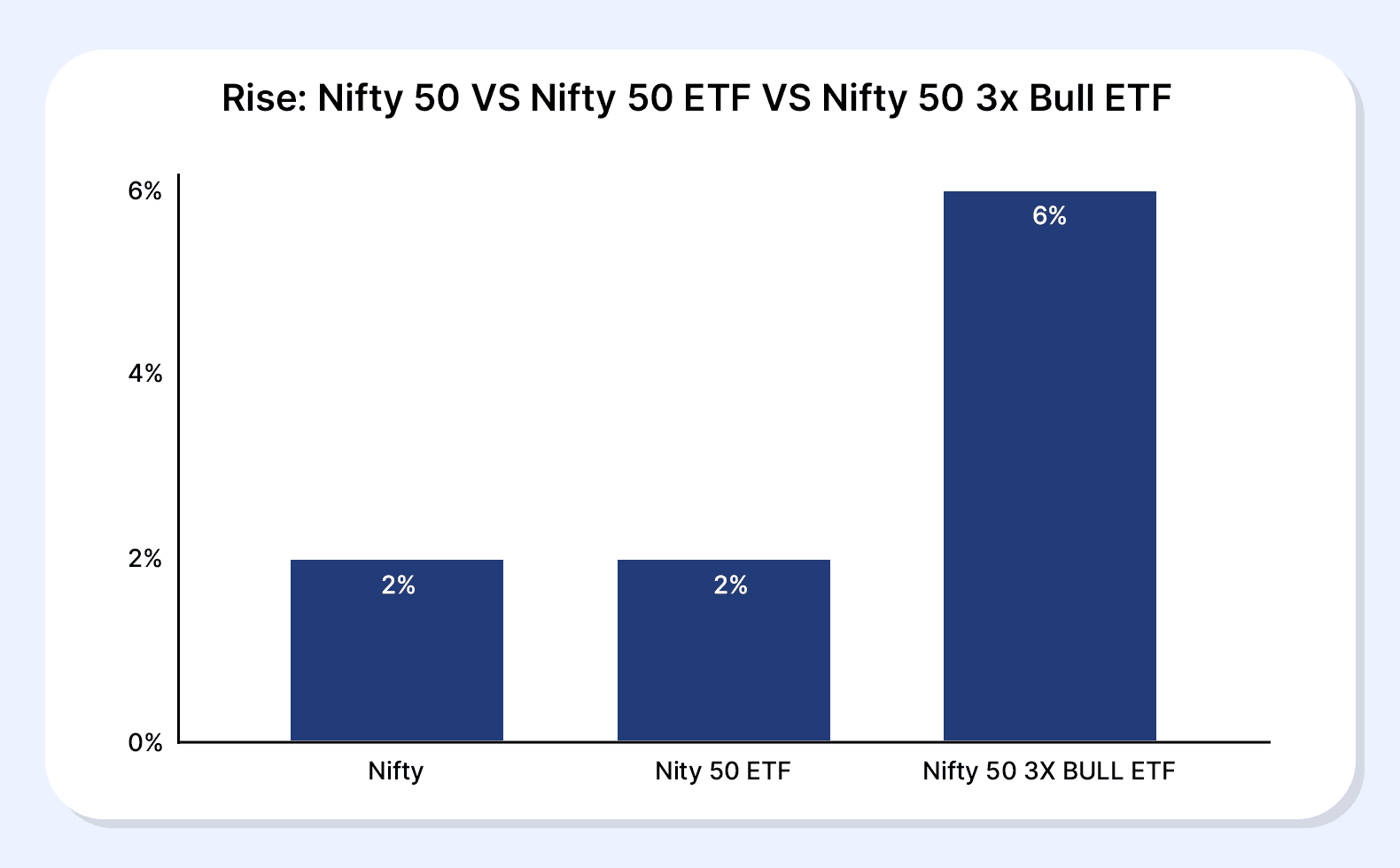
Mr K invested INR 100 each in Nifty 50 ETF and in Nifty 50 3x Bull ETF. If Nifty 50 increases by 2%, his Nifty 50 ETF will replicate the index and also rise by 2%, becoming INR 102.
However, the Nifty 50 3x Bull ETF will go up by 6% (2x3%) and become INR 106.
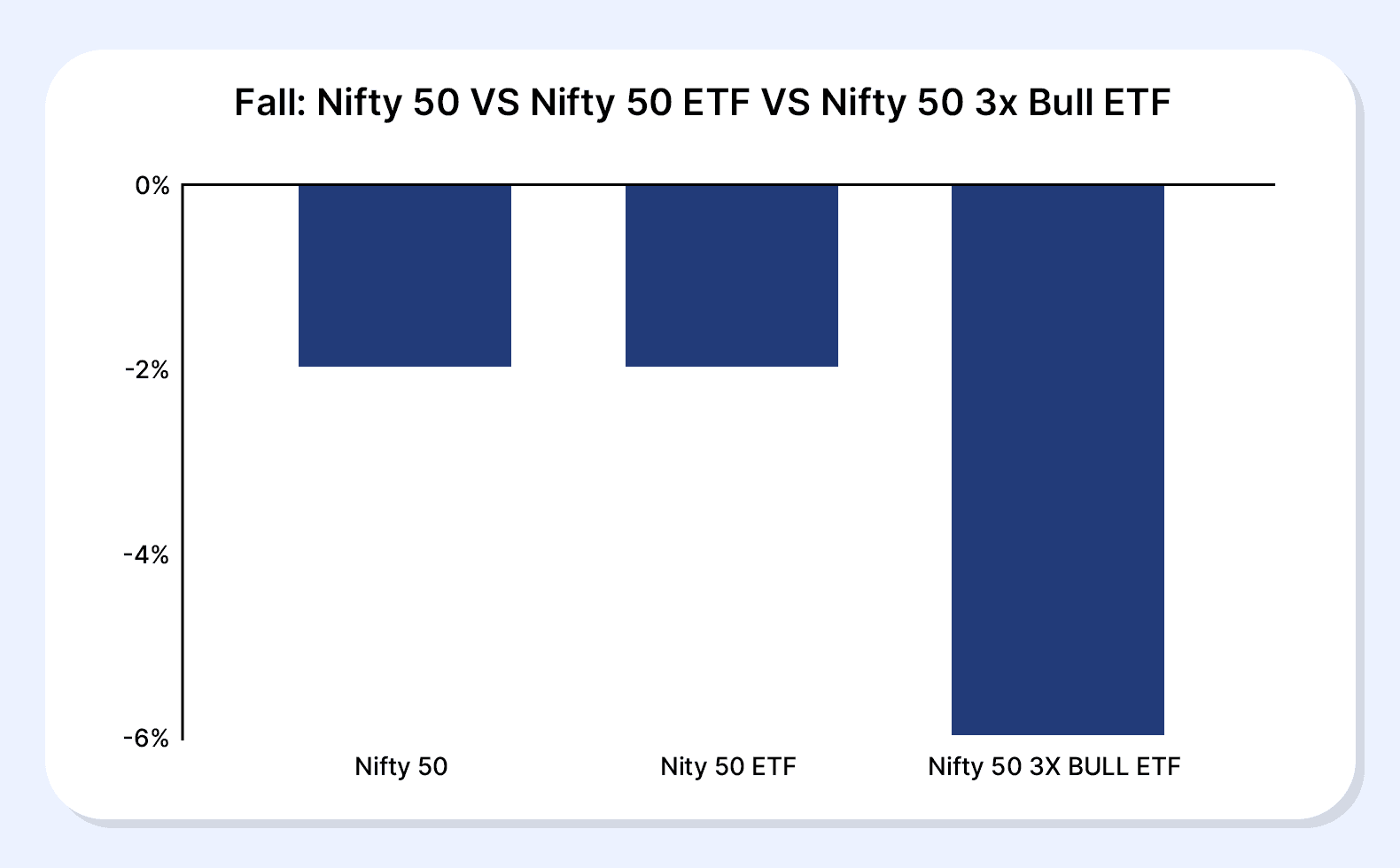
Just like during a market upturn, the growth is tripled, during a downturn, the fall is tripled. If Nifty 50 falls by 2%, the Nifty 50 ETF will also fall by 2% only. However, the Nifty 50 3x Bull ETF will fall by 6%.
Now, to crystallise our understanding of high-risk ETFs, let us take a look at the investment account of Mr K.
| Particulars | Nifty 50 ETF | Nifty 50 3x Bull ETF |
| Initial Investment | INR 100 | INR 100 |
| Day 1 Transactions: Rise | ||
| Rise (%) | 2% | 6% |
| Actual Value | INR 102 | INR 106 |
| Day 2 Transaction: Fall | ||
| Current Value | INR 102 | INR 106 |
| Fall (%) | -2% | -6% |
| Actual Value | INR 99.96 | INR 99.64 |
| Therefore, just like the 3x Bull ETF can make triple returns during an upturn, it can also make a greater fall during a downturn due to the compounding effect. | ||
The meaning and working methodology of the 3x Bull ETFs create a need to explore the limitations and risks associated with them for a complete review.
3x Leveraged ETF India: Risks
The 3x Bull ETFs are a high-stakes investment avenue that requires a thorough analysis of their associated risks before making an informed investment call. Discussed below are the 3x bull ETF risks.
1. Triple Leveraged ETF: The 3x Bull ETFs use financial leverage to achieve their 3x return. Imagine an Index earns 2% growth by investing in 10 units. To earn 6% growth, the leveraged exchange-traded funds have to invest in 30 such units (3 times 10). The 3x Bull ETF increases their exposure using leverage in the form of futures, swaps, etc.
2. Leveraged ETFs India Restrictions: According to the SEBI categorisation, ETFs need to invest 95% of their total assets in the index that they are tracking2. Moreover, these ETFs are required to track and replicate the performance of their benchmark. Subsequently, SEBI does not permit the sale of leveraged ETFs for Indian investors domestically3.
3. Short-Term Trading ETF: The 3x Bull ETFs provide three times the daily return of their underlying index. It means these ETFs give 3 times the daily performance and not the long-term growth.
The table below illustrates this further.
| Particular | Nifty 50 | Nifty 50 3x Bull ETF |
| Initial Investment | INR 100 | INR 100 |
| Day 1 | 10% | 30% |
| Value After Day 1 | INR 110 | INR 130 |
| Day 2 | -10% | -30% |
| Value After Day 2 | INR 99 | INR 91 |
| Now INR 91 is not 3 times that of INR 99. Therefore, while the 3x Bull ETF gave 3 times the daily performance and dropped 30%, the overall performance of the two days might be different. | ||
Since the performance of these ETFs changes over time, their investment is reset daily to align with market goals. The frequent adjustments of these daily rebalanced ETFs create a concern for potential decay during volatile market conditions.
4. High Expense Ratio: The complex nature of the 3x Bull ETFs requires active management, resulting in a high expense ratio. This reduces the amount of profit available for distribution among investors.
5. Market Timing Risk: Since these ETFs depend significantly on the use of leveraged assets like futures and swaps, the market-timing risk might be substantial.
Considering the above challenges of the 3x Bull ETFs, it is important to ensure that these investments are chosen by investors who are suitable for them.
Who Should Avoid 3x Bull ETFs?
The 3x Bull ETFs are suitable for growth-oriented investors with a high risk tolerance and substantial market expertise. Therefore, discussed below are key investor categories that might avoid them.
1. Risk-Averse Investors: Conservative investors with a preference towards a lower risk threshold might not choose 3x Bull ETFs.
2. Long-Term Investors: Investors striving for long-term growth might not align their fiscal goals with these short-term trading ETFs.
3. Income-Oriented Investors: If an investor is looking for passive, consistent income generation, these high-risk ETFs might not satisfy their fiscal goals.
4. Amateur Investors: Beginners who are undertaking their first investments might not possess the required know-how for this complex avenue.
However, several other investment avenues, like bonds, can meet unique investor needs.
Conclusion
Leveraged ETFs can amplify gains during strong market phases, but they also magnify volatility and require precise timing. For most investors, long term ETFs, index funds, and fixed income products can offer a steadier path toward wealth creation.
If you are looking for predictable returns with lower volatility, explore fixed income opportunities on Grip Invest and build a more stable investment strategy.
FAQs On 3x Bull ETFs
1. What is a 3x bull ETF?
The 3x Bull ETFs use leverage to maximise their exposure and provide three times the performance of the underlying index.
2. How risky are leveraged ETFs?
The 3x Bull ETFs have a high risk threshold. Therefore, these investments are suitable for growth-oriented investors with high risk tolerance.
3. Can Indian investors buy them?
The leveraged ETFs are restricted by SEBI in the Indian markets. Therefore, Indian investors cannot buy these investments through domestic AMCs.
References:
1. Economic times, accessed from: https://economictimes.indiatimes.com/markets/stocks/news/indias-etf-aum-jumps-5-5x-in-5-years-retail-folios-surge-11x-zerodha-fund-house/articleshow/122198688.cms
2. SEBI, accessed from: https://www.sebi.gov.in/legal/circulars/oct-2017/categorization-and-rationalization-of-mutual-fund-schemes_36199.html
3. MSTOCK, accessed from: https://www.mstock.com/articles/leveraged-etf-investment
Want to stay at the top of your finances?
Join the community of 4 lakh+ investors and learn more about Grip Invest, the latest financial knick-knacks, and shenanigans in the world of investing.
Happy Investing!
Disclaimer - Investments in debt securities/municipal debt securities/securitised debt instruments are subject to risks including delay and/ or default in payment. Read all the offer related documents carefully. The investor is requested to take into consideration all the risk factors before the commencement of trading.
This communication is prepared by Grip Broking Private Limited (bearing SEBI Registration No. INZ000312836 and NSE ID 90319) and/or its affiliate/ group company(ies) (together referred to as “Grip”) and the contents of this disclaimer are applicable to this document and any and all written or oral communication(s) made by Grip or its directors, employees, associates, representatives and agents. This communication does not constitute advice relating to investing or otherwise dealing in securities and is not an offer or solicitation for the purchase or sale of any securities. Grip does not guarantee or assure any return on investments and accepts no liability for consequences of any actions taken based on the information provided. For more details, please visit www.gripinvest.in
Registered Address - 106, II F, New Asiatic Building, H Block, Connaught Place, New Delhi 110001


