

Equity Fund vs Mutual Fund: Which Is Better For Your Investment Goals?


Investment in equity and mutual funds has become quite popular among Indian investors, especially in the past two decades, when the markets have become more reliable, transparent, and consistent. Even though any investment in stock-market-related investments is subject to market risks, these funds are preferred for wealth building by crores of investors across the country.
However, a very common question asked is whether equity or mutual funds are better for investment goals. Even though an equity fund is a category of mutual funds (a broader term), it is important to understand how these two terms differ and which one is best suited for financial goals like retirement, passive income, and long-term wealth building.
Let us carry out a detailed assessment of equity fund vs mutual fund.
What Are Equity Funds?
As mentioned before, equity funds are a category of mutual funds where a significant portion (can be up to 100%, but at least 65% in equity stocks). These are also known as growth funds, as the central objective of a fund manager is to ensure growth of the corpus as the value of underlying shares increases.
These funds are professionally managed and cater to investors who can withstand short-term volatility in exchange for potentially higher long-term gains.
High Growth Potential Comes With High Volatility
Since a major exposure of the fund is in equity shares, any movement in prices in the underlying assets will cause significant volatility. Compared to debt or hybrid funds, equity funds have a higher risk as market fluctuations can affect the funds’ NAV (Net Asset Value).
So, any individual investing in these funds should have a moderate to high propensity for risk and should have a long-term investment vision. At the same time, it is important to note that equity funds have outclassed other funds (debt or hybrid) in terms of return in the long term.
Understanding Different Mutual Funds Types
As explained before, equity funds are a category of mutual fund, an umbrella term that includes a wide range of fund categories: equity, debt, hybrid and liquid. Depending on the investment mix and objective, they are classified as:
1. Equity Funds: Equity mutual funds primarily invest 65% or more of their portfolio in company stocks. They aim for long-term capital appreciation and are ideal for investors with higher risk appetite and longer investment horizons (5+ years). Over time, they tend to outperform fixed-income options and are suitable for wealth creation through market growth.
2. Debt Funds: Debt funds invest in fixed-income securities such as bonds, government securities, and corporate debentures. They offer stable, predictable returns and lower volatility compared to equities. These are best suited for risk-averse investors looking for steady income and capital preservation over short to medium terms.
3. Hybrid Funds: Hybrid mutual funds combine both equity and debt investments to balance growth and stability. Their asset allocation can vary (for instance, 60% equity and 40% debt) depending on market conditions. They suit moderate-risk investors seeking diversified exposure and consistent returns with reduced volatility.
4. Liquid Funds: Liquid funds are ultra-short-term debt instruments that invest in securities with maturities up to 91 days. Known for high liquidity, low risk, and instant redemption, they’re ideal for parking surplus cash or building an emergency fund. Investors can earn better returns than traditional savings accounts while maintaining easy access to their funds.
Benefits of Diversification and Professional Management
One of the core benefits of mutual funds is diversification. Instead of relying on a single stock or sector, the investment is spread across companies, industries and even geographies. This lowers the impact of any one asset performing poorly and makes the portfolio more balanced over time.
Mutual funds are also managed by professional fund managers who analyse markets, track performance, rebalance allocations and take data-backed decisions on behalf of investors. This removes the need for individuals to actively monitor markets or make complex calls on their own.
Investors who want more predictable cash flows in addition to mutual fund exposure can also explore curated fixed income options, for example, through platforms like Grip that offer access to structured fixed income products aligned with long-term financial goals.
Equity Fund vs Mutual Fund: Key Differences
Let us understand the difference between equity and mutual fund, which might look semantic, but it helps in classifying investment risk and return:
Factor | Equity Fund | Mutual Fund (Broad Category) |
Investment Focus | Primarily equities/stocks | Equities, debt, hybrid, liquid, etc. |
Risk Level | High | Ranges from low to high depending on fund type |
Return Potential | High (market-linked) | Moderate to high, depending on composition |
Liquidity | High (subject to market NAVs) | High |
Investment Horizon | Long term (5+ years) | Short to long term (based on fund type) |
Performance Comparison: Equity vs Hybrid Funds
Historically, equity funds have dominated hybrid funds in terms of return. There is no doubt that hybrid funds offer lower risk to the investors due to the presence of debt, fixed income and cash elements.
Here is the performance comparison of equity fund returns 2025 [Nifty 50 TRI (Total Return Index)] and Nifty 50 Composite Hybrid (65:35) Index:
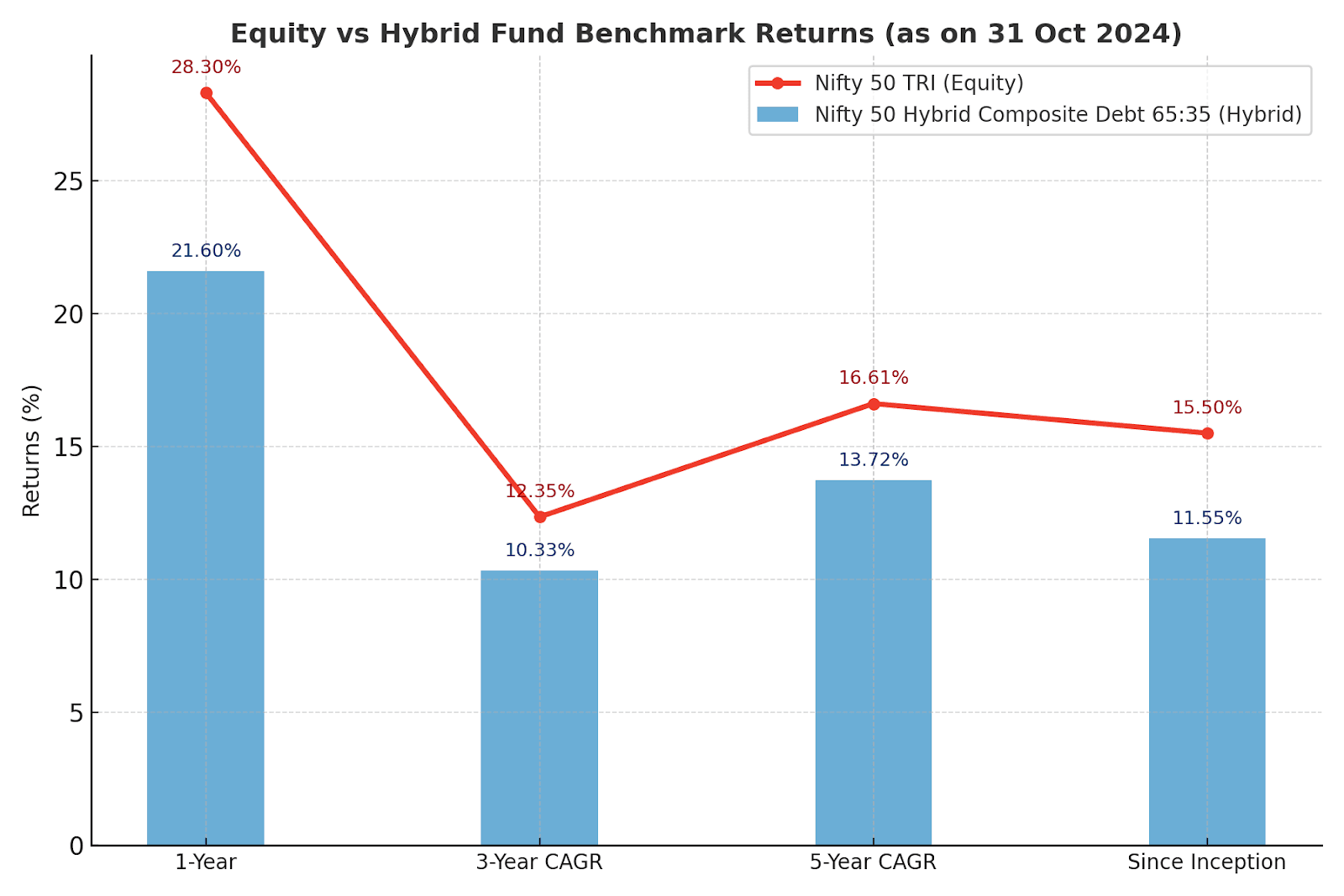
We chose to analyze indices instead of individual funds because there are hundreds of equity and hybrid funds managed by different asset managers, each following unique strategies. Indices, on the other hand, offer a broader and more standardized reflection of market trends and returns, making them ideal for general analysis.
Which Mutual Fund Should You Choose?
Matching Your Risk Profile and Investment Horizon
There is no one-size-fits-all approach to selecting funds for your portfolio. It purely depends on an investor’s risk appetite, investment goals, and time horizon as to which fund is selected. Here is a general understanding:
- Aggressive investors seeking long-term growth can allocate more towards equity-oriented schemes, including best mid-cap mutual funds India, best small-cap mutual funds India, and best index funds India 2025.
- Conservative investors who prioritize stability might prefer hybrid or debt mutual funds that deliver moderate but steady returns.
You can also look for top ELSS mutual funds 2025 if your target is diversification, low to moderate risk, and balanced performance with tax efficiency.
Build Balance By Mixing Fund Types
Based on the historical performance of the equity funds and a definitive edge over hybrid funds (in terms of total returns), anyone can be tempted to invest 100% funds into an equity fund to earn the highest returns possible. However, that can easily jeopardise financial planning as equity funds are subject to market volatility.
You can allocate a portion of your portfolio to equity funds for growth while using debt or liquid funds to preserve capital and ensure liquidity. This strategy not only optimizes returns but also cushions against market volatility.
For investors who prefer sectoral or thematic exposure, options like top sectoral equity funds India, best international equity funds India, or best multi-cap mutual funds India can provide global and cross-sector diversification. It’s also wise to consider funds with a low expense ratio equity funds India focus to minimize costs and maximize net returns.
Conclusion
The comparison between an equity fund vs. mutual fund is not about which one is better. Since a mutual fund is a broader term and an equity fund is just a category of a wide range of mutual funds available, it is hard to segregate one from the other. Equity funds, as a category of mutual funds, can help in wealth creation but are riskier than other forms of mutual funds (such as debt and hybrid funds). The other categories of mutual funds offer flexibility, diversification, and tailored risk levels.
If you are looking to craft a balanced, goal-driven portfolio, explore the curated fixed income and debt securities selections and insights available through GripInvest, and start investing with confidence.
FAQs On Equity vs Mutual Fund
1. Are equity funds and mutual funds the same?
No, equity funds are a type of mutual fund that primarily invests in stocks or equity-related securities. Mutual funds, on the other hand, cover a broader range of categories — including equity, debt, hybrid, and liquid funds — each designed to suit different risk profiles and investment goals.
2. Which gives better returns , equity funds or mutual funds?
Equity funds generally offer higher returns over the long term but come with higher risks due to market volatility. Mutual funds can include equity, debt, and hybrid schemes, offering diversified risk-return potential. The right choice depends on your time horizon and risk appetite.
3. Which is safer to invest in: equity funds or mutual funds?
Mutual funds that include debt or hybrid schemes are safer than pure equity funds since their portfolios are partly allocated to fixed-income instruments. Equity funds are more market-sensitive and ideal for long-term investors comfortable with short-term volatility.
4. How can I create a balanced portfolio using equity and mutual funds?
Combine equity mutual funds for wealth creation with hybrid or debt mutual funds to stabilize returns. You can also explore fixed-income securities on platforms like GripInvest to add non-market-linked assets, balancing growth and safety in your portfolio.
Want to stay at the top of your finances?
Join the community of 4 lakh+ investors and learn more about Grip Invest, the latest financial knick-knacks, and shenanigans in the world of investing.
Happy Investing!
Disclaimer - Investments in debt securities/municipal debt securities/securitised debt instruments are subject to risks, including delay and/ or default in payment. Read all the offer-related documents carefully. The investor is requested to take into consideration all the risk factors before the commencement of trading.
This communication is prepared by Grip Broking Private Limited (bearing SEBI Registration No. INZ000312836 and NSE ID 90319) and/or its affiliate/ group company(ies) (together referred to as “Grip”) and the contents of this disclaimer are applicable to this document and any and all written or oral communication(s) made by Grip or its directors, employees, associates, representatives and agents. This communication does not constitute advice relating to investing or otherwise dealing in securities and is not an offer or solicitation for the purchase or sale of any securities. Grip does not guarantee or assure any return on investments and accepts no liability for the consequences of any actions taken based on the information provided. For more details, please visit www.gripinvest.in
Registered Address - 106, II F, New Asiatic Building, H Block, Connaught Place, New Delhi 110001


