

Arbitrage Funds India 2026: Low-Risk Equity Returns and How They Work


The Indian mutual fund industry commands an asset under management (AUM) of INR 75,18,702 crore as of 31 August 2025, with various fund categories targeting the unique needs of diverse investors. Arbitrage funds are one such key category in India1.
A hybrid fund category that takes advantage of the price difference of the same asset in different exchanges and simultaneously purchases and sells them in distinct markets is called an arbitrage fund. As of 31 August 2025, the average asset under management of this category was INR 3,06,405.45 crores.
Their popularity stems from the low-risk equity exposure they offer to their investors. Especially during volatile market conditions, these funds offer controlled risk investment mediums because they lock in gains by utilising temporary and visible price disparities.
Diversification by reinvesting the periodic Grip bond returns into arbitrage funds can aid in achieving portfolio growth, whilst controlling the risk. Therefore, to understand this better, this blog decodes the essence of arbitrage funds in detail.
How Arbitrage Funds Work
We already know that arbitrage funds exploit the price differences in different markets. However, let us take a brief look at these markets before we understand how arbitrage funds work.
Cash Market (Spot Market): Shares of companies are traded, and transactions are settled instantly in this market.
Derivatives Market: Assets like futures and options are traded, which are contracts on assets to be bought or sold at future dates.
Arbitrage funds are constantly on the lookout for price differences of the same asset in these two markets. Fund managers simultaneously purchase the security at a lower price in the cash market and sell it at a higher price in the futures market. Moreover, when there are no arbitrage opportunities, the fund parks its corpus in low-risk short-term debt instruments that offer capital preservation and liquidity.
Let us take an example to understand how these low-risk equity funds in India work.
Suppose the shares of XYZ Limited are trading at INR 100 in the spot market and at INR 105 in the futures market (one-month contract).
In such a situation, an arbitrage fund manager can choose to buy 1000 shares from the spot market and sell them at the futures market. After one month, the fund can earn the following profit from this transaction.
(1000 x INR 105) - (1000 x INR 100) = INR 5000
The understanding of the meaning and operating philosophy of arbitrage funds reveals their advantages and disadvantages.
Benefits And Drawbacks Of Arbitrage Funds
Arbitrage fund returns in India can be low-risk and market-neutral even during volatile market conditions. However, there are certain risks associated with them too. Let us decode the benefits and drawbacks of arbitrage funds in India.
Benefits of Arbitrage Funds
Discussed below are the key advantages of arbitrage funds in India.
1. Low Risk Exposure: Arbitrage funds are mainly protected from the overall direction of the market by concurrently purchasing and selling the same securities in other marketplaces. Like short-term debt funds, they are stable since the majority of risks are hedged.
The table below shows the category average risk measures of arbitrage funds.
| Parameter | 1 Year | 3 Years | 5 Years |
| Standard Deviation | 0.4913 | 0.5530 | 0.7477 |
| Sharpe Ratio | 0.4934 | 0.6180 | 0.1069 |
| Sortino Ratio | 2.9125 | 1.9715 | 0.4038 |
Source: Morning Star2
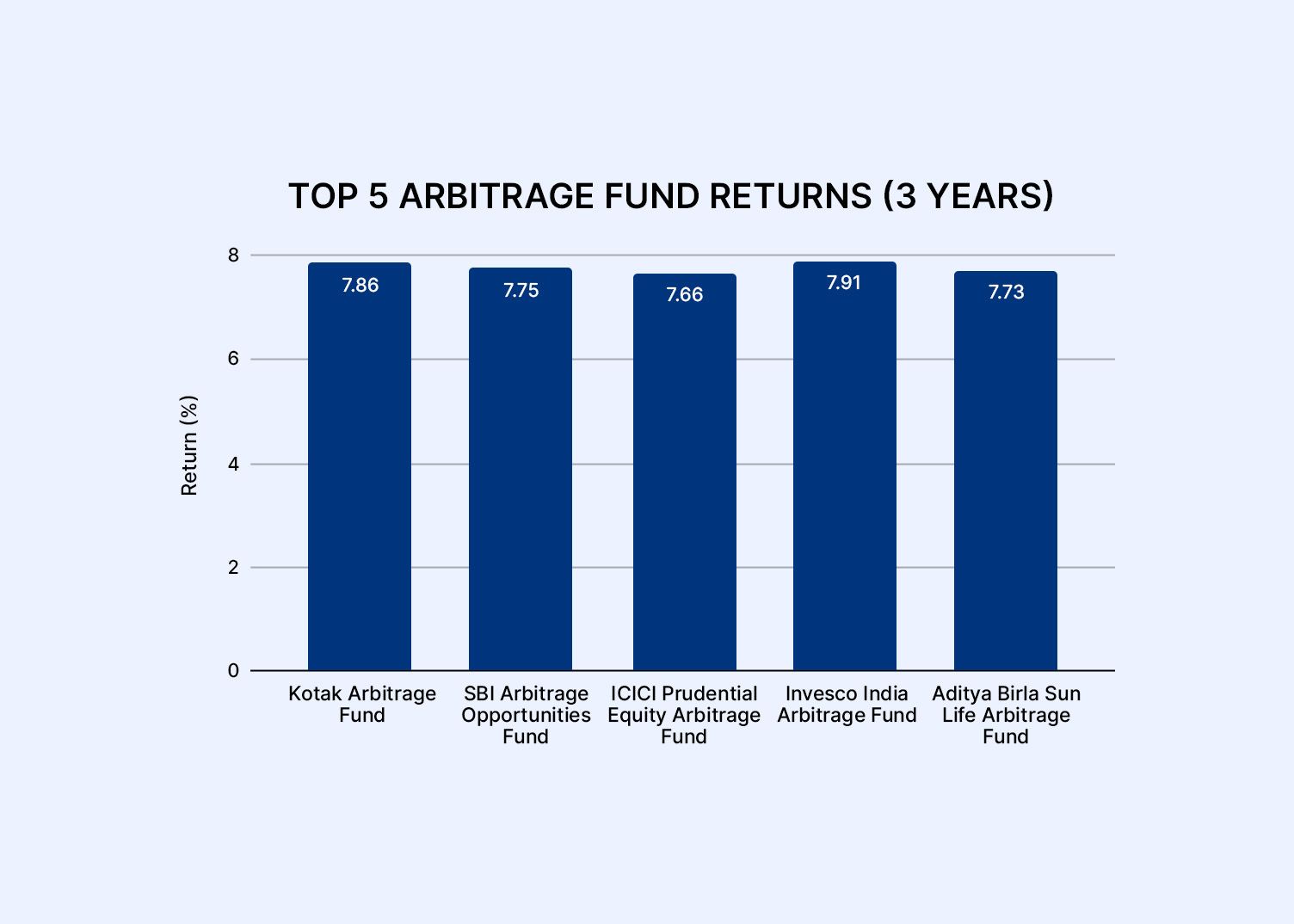
2. Returns: The returns offered by arbitrage funds can be consistent and stable. This feature becomes more advantageous during volatile market conditions. Arbitrage margins, or the gap between cash and futures prices, typically increase in tumultuous markets, offering more lucrative potential.
The graph below shows the arbitrage fund returns in India (3 Years) of the top five funds, selected based on their net assets (as of 13 September 2025).
3. Liquidity: Unlike longer-term products, arbitrage funds offer relatively simple access and rapid redemption, making them ideal for holding excess capital for a limited tenure.
4. Market Stability: Arbitrage funds, though equity-oriented with at least 65% in equities, carry primarily hedged exposures to lower risk. They can deliver better post-tax returns compared to non-equity options and perform well even in volatile markets, offering investors a stable and reliable avenue during uncertainty.
Now, let us explore the cautionary parameters associated with arbitrage funds.
Drawbacks Of Arbitrage Funds
Discussed below are some disadvantages of arbitrage mutual funds in India.
1. Return Potential: Returns of arbitrage funds are lower than those of pure equity funds, particularly when market conditions are stable and arbitrage possibilities decline. Moreover, the profitability may be impacted if funds act momentarily like debt funds, in the absence of arbitrage opportunities.
2. Dependent on Specific Conditions: The existence of adequate price differences is crucial for the performance of arbitrage funds. Returns may decrease during calm or range-bound situations.
3. High Expense Ratio: Optimal arbitrage fund performance requires active trading and consistent dynamic monitoring to take advantage of short-term market conditions. Therefore, these funds have high management fees, resulting from the hands-on presence of the top fund managers.
Now, keeping these advantages and disadvantages of arbitrage funds in mind, let us explore some key considerations before choosing the right arbitrage funds.
Choosing The Best Arbitrage Funds 2026
Discussed below are some key parameters that investors must consider before choosing an arbitrage fund.
1. Risk-Return Analysis: Comparing the risk and return metrics of a particular fund with the category average and benchmark reveals key insights. Moreover, a comparison of a category with another, like liquid funds vs arbitrage funds, can show the suitability of the category in general.
2. Fund Managers: A research into the experience of fund managers is also a key consideration. Since arbitrage funds require significant expertise, due to the consistent monitoring needs, an optimal management team is important.
3. Expense Ratio: High management fees create a reduction in the amount of gains available for distribution among investors. Comparing the expense ratios of different funds can aid in making an optimal decision.
The table below shows the expense ratios of the top five arbitrage funds, selected based on their net assets (as of 13 September 2025).
| Arbitrage Funds (Direct Plan) | Expense Ratio |
| Kotak Arbitrage Fund | 0.44 |
| SBI Arbitrage Opportunities Fund | 0.41 |
| ICICI Prudential Equity Arbitrage Fund | 0.40 |
| Invesco India Arbitrage Fund | 0.39 |
| Aditya Birla Sun Life Arbitrage Fund | 0.31 |
4. Curated Platforms: Manual analysis of funds can be tedious and error-prone for individual investors. Opting for platforms like Grip can minimise effort and mitigate the risk of error through their curation of top funds and screening tools.
Analysis of funds and categories is not enough when choosing the right investment; investors should also consider if their personal investment features match those of the fund and category.
Who Should Invest In Arbitrage Funds
Discussed below are some key aspects of investor-specific suitability metrics that should be considered before choosing an arbitrage fund.
Conservative Investors: Arbitrage funds give an opportunity to conservative and risk-averse investors to gain equity exposure.
Boost to fixed returns: Period returns generated from bonds and other fixed-income securities can be reinvested into arbitrage funds. It might aid in generating low-risk portfolio growth.
Conclusion
The Indian investment landscape is evolving rapidly, giving investors access to a wider variety of assets than ever before. For conservative investors, arbitrage funds stand out by offering a smart, low-risk way to participate in equity markets while aiming for steady portfolio growth. By capitalizing on market inefficiencies through hedged positions, these funds balance safety with returns—making them an attractive choice in both stable and volatile markets.
For those looking beyond equities, Grip Invest is India’s one-stop destination for reliable fixed-income returns.
References:
1. AMFI India, accessed from: https://tinyurl.com/6zvvb2bd
2. Morning Star, accessed from: https://www.morningstar.in/tools/mutual-fund-category-risk-measures.aspx
Want to stay at the top of your finances?
Join the community of 4 lakh+ investors and learn more about Grip Invest, the latest financial knick-knacks, and shenanigans in the world of investing.
Happy Investing!
Disclaimer - Investments in debt securities/municipal debt securities/securitised debt instruments are subject to risks including delay and/ or default in payment. Read all the offer related documents carefully. The investor is requested to take into consideration all the risk factors before the commencement of trading.
This communication is prepared by Grip Broking Private Limited (bearing SEBI Registration No. INZ000312836 and NSE ID 90319) and/or its affiliate/ group company(ies) (together referred to as “Grip”) and the contents of this disclaimer are applicable to this document and any and all written or oral communication(s) made by Grip or its directors, employees, associates, representatives and agents. This communication does not constitute advice relating to investing or otherwise dealing in securities and is not an offer or solicitation for the purchase or sale of any securities. Grip does not guarantee or assure any return on investments and accepts no liability for consequences of any actions taken based on the information provided. For more details, please visit www.gripinvest.in
Registered Address - 106, II F, New Asiatic Building, H Block, Connaught Place, New Delhi 110001


