

Debt Mutual Funds: Types, Benefits & Returns Guide


When it comes to investing, most people immediately think of the stock market. While stocks offer the potential for high returns, they also come with significant risks. On the other hand, traditional options like fixed deposits (FDs) provide stability but often fail to beat inflation. So, what’s the middle ground?
This is where debt funds come in. If you are wondering, what is a debt fund? It’s a type of debt-oriented mutual fund that invests in fixed-income securities like government bonds, corporate bonds, treasury bills, and other low-risk instruments. The returns of debt mutual funds in India are stable with lower risk compared to equities, making them a smart debt investment option for conservative investors.
How to invest in debt funds? The process is simple—you can choose from various categories based on your risk tolerance and investment horizon. Over 200 debt funds have delivered higher returns than bank FDs, proving that you do not need to compromise between safety and returns1.
To know more about this amazing investment avenue, read this article to the end. It will cover the types, benefits, and returns of these funds in detail.
Types Of Debt Mutual Funds
There are various kinds of debt funds. Moreover, understanding what is a debt fund is incomplete without acknowledging its types. They are explained as follows:
1. Money Market Funds
These funds invest in short-term debt securities with a maximum maturity of one year. They are ideal for conservative investors seeking stability and low risk.
2. Short-Term Debt Funds
Short-term debt funds invest in securities with maturities of 1 to 3 years, offering relatively stable returns with low risk and high liquidity.
3. Long-Term Debt Funds
These funds focus on debt securities with maturities ranging from 4 to 6 years. They are suitable for investors seeking higher returns over an extended period.
4. Dynamic Bond Funds
Dynamic bond funds actively adjust their portfolio by varying the duration and maturity of bonds. They include a mix of short, medium, and long-term bonds but are subject to market fluctuations.
5. Corporate Bond Funds
These funds allocate at least 80% of their portfolio to high-rated corporate bonds. They offer higher returns than government securities but come with slightly higher risk.
6. Gilt Funds
Gilt funds invest exclusively in government securities with no credit risk, making them a safe option for risk-averse investors. However, they are sensitive to interest rate movements.
7. Credit Risk Funds
Credit risk funds invest at least 65% of their assets in lower-rated debt instruments (below AA+ ratings) to earn higher yields. These funds carry a higher risk due to the possibility of default by issuers, making them suitable for investors willing to accept greater credit exposure for potentially higher returns.
8. Overnight Funds
Overnight funds invest in securities with a maturity of just one day. They offer the lowest risk and are ideal for investors looking for ultra-short-term parking of surplus cash.
9. Liquid Funds
Liquid funds invest in highly liquid short-term instruments with maturities of up to 91 days. They provide quick access to funds while earning better returns than a savings account.
Let’s also compare these fund categories based on the category average returns and risk metrics. The metrics are for one year, unless mentioned otherwise. While the returns are stated as of 7 August 2025, the risk measures are as of 31 July 2025.
| Fund Category | One-Year Return | Five-Year Return | Standard Deviation | Sharpe Ratio | Sortino Ratio |
| Money Market Funds | 7.23 | 5.72 | 0.5603 | 1.9323 | 160.9317 |
| Short Term Debt Fund | 8.78 | 6.36 | 1.3903 | 1.8189 | 9.2362 |
| Credit Risk Fund | 10.84 | 9.51 | 1.3904 | 2.1765 | 34.6045 |
| Dynamic Bond Fund | 7.38 | 5.96 | 3.1717 | 0.5500 | 1.4315 |
| Corporate Bond Fund | 8.61 | 6.26 | 1.9440 | 1.4496 | 5.6859 |
Source: Morning Star2
Now that we understand the types of debt mutual funds, let’s also explore their benefits.
Benefits Of Debt Mutual Funds
To crystallise the understanding of what is a debt fund, we must explore the characteristic traits that make them beneficial. Investing in debt funds has numerous benefits. Some of them are:
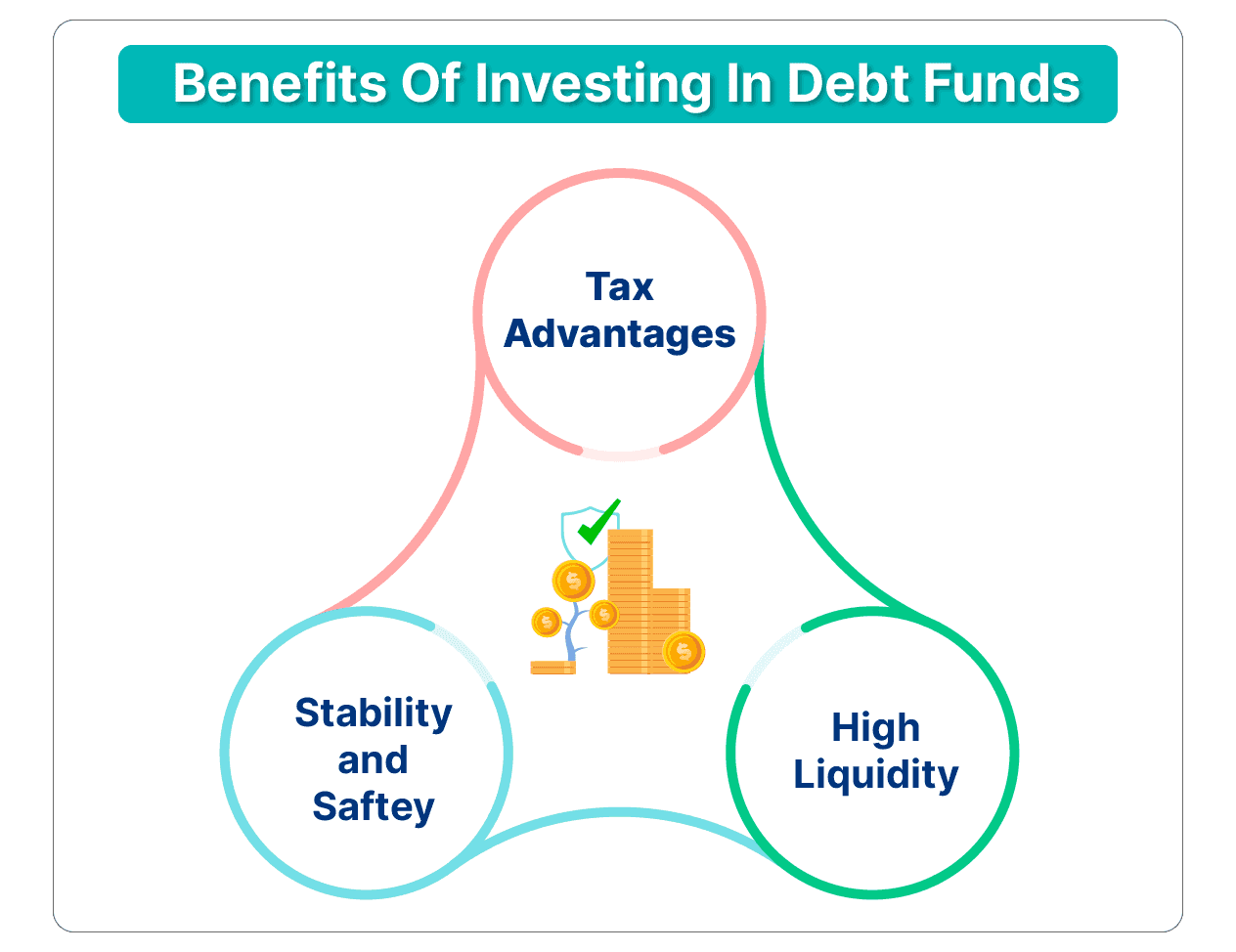
A. High On Liquidity
Debt funds generally do not come with a lock-in period that prevents you from utilising them. This is the reason why these funds are more popular than bonds, as investors feel comfortable knowing that the money is accessible.
B. Relatively Stable And Safe
Investing wisely requires assessing risk and reliability. When chosen carefully, liquid debt funds can offer a safer and more stable option than many other investment avenues, providing both security and liquidity for short-term financial goals.
This will help you get an idea of whether that particular fund’s strategies align with your risk appetite. To further add to the stability factor, you must know that debt funds majorly invest in bond markets that are less prone to volatility than equity markets.
C. Capital Gains Tax
Liquid mutual funds provide numerous tax advantages through capital gain tax benefits. As per Section 112 of the Indian Income Tax Act, long-term investments get an indexation advantage of up to 20%, which reduces the overall taxable amount. This makes them more tax-efficient in comparison to fixed deposits, helping investors gain more returns.
Overall, returns of debt funds in India are stable with the benefit of high liquidity. You can achieve similar stable returns by directly investing in fixed-income securities like corporate bonds and securitised debt instruments on Grip Invest. This helps you save on expense ratios. Click the link below to explore live corporate bonds and SDIs offering fixed returns of up to 14%.
Despite the benefits of debt mutual funds, optimisation of debt fund investment requires that such investments be undertaken by those whose fiscal goal and investment philosophy align with the nature of the fund.
Understanding Investor Suitability
If you are still not sure whether you should invest in debt funds or not, then stick with us. We have curated a list of investors who may benefit from investing in these funds. Acknowledgement of these traits, along with the understanding of what a debt fund is, can aid in making the right investment.
1. Conservative Investors: Investors who seek stability and lower risks should consider investing in mutual funds that invest in debt securities. The best debt mutual funds for conservative investors offer lower fluctuations than equities.
2. Income-seeking Investors: These funds can provide a regular income stream through consistent returns through interest payouts. Thus, such funds are considered suitable for retired individuals or people looking to have a passive source of income.
3. Tax-Conscious Investors: If you are someone who does not want your profit gains to be minimised due to taxes, you should consider investing in these mutual funds. This is so because these funds offer substantial tax benefits in the long run.
4. Diversification Seekers: Debt funds invest in a variety of debt securities, helping to enhance portfolio stability and reduce overall risk.
Choosing the best funds is as important as creating an alignment between investor needs and fund characteristics.
Key Considerations Before Investing
Although there are numerous benefits of investing in debt funds, it also comes with a certain level of risk. However, its risk factors can be minimised by keeping the following things in consideration before investing:
1. Interest rate risk
Prices of fixed-income securities are inversely related to interest rate changes. If the interest rate goes up, the price decreases, and vice versa. Hence, the longer the duration of a fund, the higher the sensitivity to interest rate changes.
2. Credit risk
Credit risk refers to the risk of default, i.e., failure to pay interest or the principal by the issuer of the debt instrument. If the credit rating of an instrument reduces, the price of the fund is likely to fall. Likewise, if the credit rating gets upgraded, the price will rise.
3. Risk and Returns of Debt Mutual Funds in India
Debt funds have always been considered less risky compared to equity funds; however, they carry their own risk. A debt fund's return may be affected by credit risk, interest rate movements, and liquidity risk. Thus, it is vital to make proper debt investment decisions by considering all these factors in play.
4. Fund History
You must prioritise fund houses with a promising history of sustained performance over at least five to ten years. Investing in such a reputed debt fund would minimise the risk that comes along with such funds.
5. Expense Ratio
Assess how much of your investment covers fund management expenses. Ideally, you must opt for lower expense ratios as they provide higher take-home returns, especially when comparing funds with similar asset allocations and returns.
6. Financial Ratios
To evaluate funds, you must utilise metrics like standard deviation, Sharpe ratio, alpha, and beta. It will help you get a better idea of the kind of risk you would be taking by investing in a particular debt mutual fund. Higher standard deviation and beta indicate increased risk compared to lower counterparts. Prefer funds with higher Sharpe ratios, signalling enhanced returns per unit of risk undertaken.
Now, let us explore the steps required for mutual fund investing.
How to Invest in Debt Mutual Funds?
Investors must follow the steps discussed below if they wish to invest in debt funds after understanding the meaning and various other aspects of them.
Step 1: Choose the type of debt fund suitable for you, based on the anticipated returns, fiscal goal, and investment philosophy.
Step 2: Once a category is chosen, select the best-performing fund house within the category. Which fund is suitable for investment depends on the metric by which the investor sorts the funds.
Step 3: The investor can invest in the fund directly through the fund house, a bank, or through various platforms.
Conclusion
Debt funds are a balanced investment approach, providing stability, liquidity, and predictable returns. The different types of debt mutual funds can play a crucial role in helping you diversify your investment portfolio. However, recognising the varieties of available debt funds, advantages, and risk parameters is critical for you to make significant financial choices. To learn more about investing in fixed-income opportunities like corporate bonds and SDIs, sign up on Grip Invest today.
FAQs On Debt Mutual Funds
1. What is the minimum investment requirement in debt mutual funds?
According to SEBI, an investment in debt mutual funds requires a minimum investment of INR 100 for a lump sum investment and a minimum investment of INR 500 for SIP. However, some mutual funds may require a high minimum investment.
2. How are debt mutual funds taxed?
From April 1, 2023, indexation benefits for long-term capital gains were removed. Now, both long-term and short-term gains are taxed according to the investor's income tax slab.
3. Do Debt Mutual Funds provide returns during a market downturn?
Yes, debt mutual funds can offer returns during a market downturn, the reason being that they invest in fixed-income securities such as bonds. These are usually less volatile than equity. However, factors such as changes in interest rates and credit risk can affect their performance.
4. How can I choose the best Debt Mutual Fund for my needs?
To choose a proper Debt Mutual Fund, you should consider the time you want to invest, the level of risk you are willing to take, and your financial targets. You should also assess the credit quality of the fund, the duration, the past performance of the fund and the expense ratio. To make an informed decision, align these with your objectives.
5. What are the liquidity options available in debt mutual funds?
Debt Mutual Funds, for the most part, provide fairly good liquidity. Some provide easy access to your money. These funds can give you access to your money in as little as 24 hours. Some other corporate debt funds may require a period of a few days. You should watch for any exit loads or penalties for early withdrawals.
6. What are debt mutual funds and how do they work?
A debt fund is a type of mutual fund scheme that makes investments in fixed-income assets that offer capital appreciation, along with controlled risk. Some asset categories commonly found in debt mutual fund portfolios are government and corporate bonds, corporate debt securities, money market instruments, etc. Bond funds and fixed income funds are other names for debt funds.
7. Which type of debt mutual fund is best for short-term investment?
Several debt mutual funds are targeting short-term growth. For instance, money market mutual funds invest in money market instruments like treasury bills, commercial papers, etc, that have limited maturity tenure. The suitability of a short-term debt fund for a particular investor lies in their investment philosophy and financial goals.
8. Are debt mutual funds better than fixed deposits in 2026?
Debt mutual funds offer higher security than equity and other market-linked securities. Moreover, the capital appreciation offered is often higher than that of regular fixed deposits. However, it is important to remember that there are high-yield FDs as well. Investors must choose an investment medium based on their individual fiscal goals and reality.
9. What are the risks involved in debt mutual funds?
The capital appreciation offered by debt mutual funds is conservative compared to equity or other market-linked funds. Moreover, lack of equity in the portfolio does not discount them from liquidity risk or interest risk. Investors should choose a particular fund after optimal market, category and fund-specific research.
10. How to invest in debt mutual funds online in India?
While investment in debt funds can be done directly through a fund house or bank, such organisations are skewed towards the particular funds offered by them. In such a scenario, different platforms offer a diverse curation of funds offered by various AMCs, with sophisticated sorting mechanisms.
References:
1. Economic Times, accessed from: https://tinyurl.com/3v8yr7sf
2. Morning Start, accessed from: https://www.morningstar.in/tools/mutual-fund-category-performance.aspx
3. Grip Invest, accessed from: https://www.gripinvest.in/assets#active#mutual-funds
Want to stay at the top of your finances?
Join the community of 4 lakh+ investors and learn more about Grip Invest, the latest financial knick-knacks, and shenanigans in the world of investing.
Happy Investing!
Disclaimer - Investments in debt securities/municipal debt securities/securitised debt instruments are subject to risks including delay and/ or default in payment. Read all the offer related documents carefully. The investor is requested to take into consideration all the risk factors before the commencement of trading.
This communication is prepared by Grip Broking Private Limited (bearing SEBI Registration No. INZ000312836 and NSE ID 90319) and/or its affiliate/ group company(ies) (together referred to as “Grip”) and the contents of this disclaimer are applicable to this document and any and all written or oral communication(s) made by Grip or its directors, employees, associates, representatives and agents. This communication does not constitute advice relating to investing or otherwise dealing in securities and is not an offer or solicitation for the purchase or sale of any securities. Grip does not guarantee or assure any return on investments and accepts no liability for consequences of any actions taken based on the information provided. For more details, please visit www.gripinvest.in
Registered Address - 106, II F, New Asiatic Building, H Block, Connaught Place, New Delhi 110001


