

Mutual Fund NAV: Meaning, Calculation And Its Impact On Your Investments


Net Asset Value (NAV) is the value of a mutual fund’s assets after subtracting its liabilities. In simple terms, it shows how much one unit of the fund is worth. The NAV per unit is calculated by dividing the total NAV of the fund by the number of units issued. This is the price you pay when you buy one unit of the fund.
The first aspect that any investor looks at a mutual fund is its NAV. The mutual fund performance is determined by the changes in NAV. A high-performing mutual fund will have an upward trend in its NAV. Let's explore NAV computation in detail and understand its impact on mutual fund return performance.
What Is Mutual Fund NAV?
NAV means Net Asset Value. It is the per-unit market value of a mutual fund. You derive it by deducting liabilities from the total assets and dividing the resultant figure by the units outstanding. Essentially, NAV indicates what one unit of a mutual fund is worth at the close of the trading day.
Why Is NAV Important To Mutual Fund Investors?
NAV is important because it determines the price at which investors purchase or redeem fund units. You always invest or withdraw at that figure, not higher or lower. The NAV is disclosed on a daily basis, showing current valuations of the fund's underlying holdings.
While NAV itself does not tell you how well a fund has performed, it helps monitor growth over time. Increasing NAV is not the only measure of performance, but it indicates appreciation of the underlying assets in the fund.
You can invest through a Systematic Investment Plan (SIP) or a lump sum, and fluctuations in NAV allow you to keep track of your asset value and make smart decisions.
Moreover, the NAV of a mutual fund of the same scheme may be different for different options. For example, for the same scheme - Axis Largecap mutual fund, the NAV will be different for the growth plan, regular plan, direct plan, ICDW plan, etc. That's why choosing the right scheme and right option determines the price of a mutual fund unit.
How Is The Mutual Fund NAV Calculated?
The formula is simple:
NAV = (Assets – Liabilities) / Outstanding Units
1. What Are Assets?
Assets are:
- Market value of the fund's holdings (stocks, corporate bonds, etc.).
- Cash equivalents (like money market funds).
- Receivables (dividends, interest received but not yet received).
These elements represent the actual value of holdings and proceeds to come.
2. What Comprises Liabilities?
Liabilities account for:
- Debts and outstanding payments.
- Operating costs accrued (e.g., management charges, administrative charges)
They keep NAV an accurate reflection of the fund's real financial position following expenses.
NAV And Mutual Fund Performance
NAV trends provide insights into the performance of a mutual fund. Let us understand some common myths about the NAV:
Myth 1: Higher NAV means a 'better' fund
High NAV doesn't automatically mean that the mutual fund's performance is better. High NAV may only be due to the lower number of mutual fund units. So, it's not an accurate representation of the return performance.
Myth 2: NAV comparisons across funds indicate performance
Different NAV levels in two significantly different funds can provide equal returns to each INR 1,000 invested. Performance is based on growth in returns and not absolute NAV.
Myth 3: Growth in NAV is equivalent to returns to investors
NAV can decline following dividend distributions or asset revaluations, but overall returns with distributions might be unchanged or even higher.
How To Use NAV For Informed Investment Decisions?
While the absolute NAV of a mutual fund cannot reveal whether a mutual fund offers higher returns, it's still of value to investors:
- Monitor long-term trends: Watch NAV over 3–5 years instead of short-term jumps. A consistent uptrend indicates steady value creation.
- Measure NAV returns: Watch NAV-return, that is, how much NAV fluctuates over a specified timeframe. It's the clean measure of appreciation or loss.
- Combine NAV with total return: The actual performance of a fund incorporates both NAV changes and distributions or dividends. Omitting distributions can be misleading.
- Compare similar funds: Use NAV trends to compare same-type funds (e.g., large-cap equity). That ensures apples-to-apples evaluation on a fair basis.
Understanding NAV And NAV Returns
Let's understand NAV and NAV returns through two mutual funds:
- Quant Small Cap Fund Direct Plan-Growth
- Edelweiss Greater China Equity Offshore Fund Direct-Growth
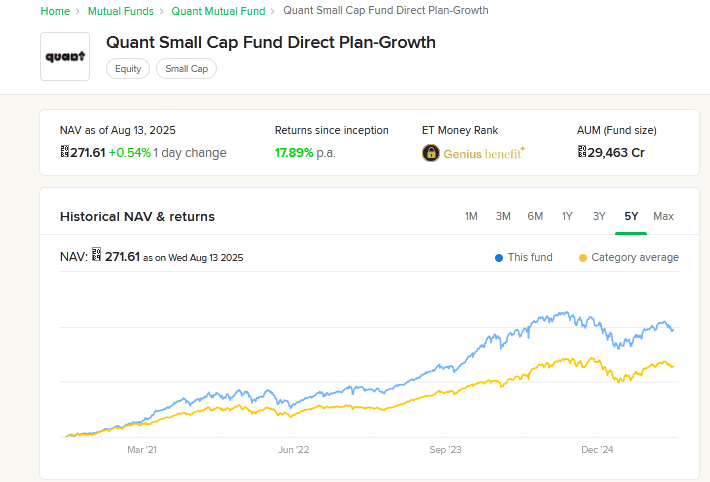
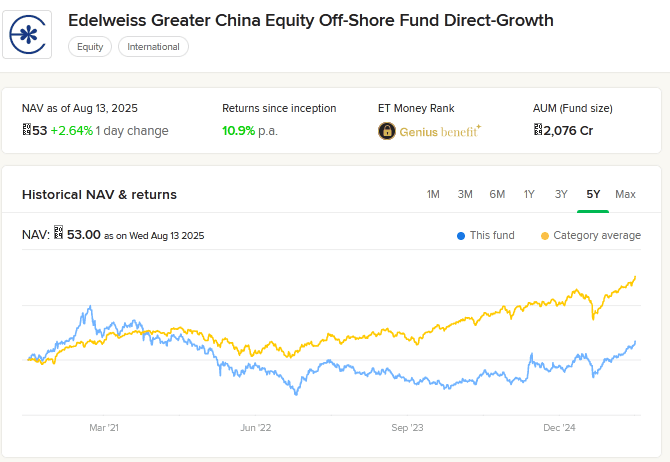
Both of these are equity growth funds with varying performance. The NAV returns charts of these funds are given below:
Source: ET Money1
Source: ET Money2
Now, if you look at the NAV of both funds, the Quant small-cap fund has a higher NAV than the Edelweiss fund. This alone doesn't mean that it's a better-performing fund.
NAV of the Quant smallcap and Edelweiss fund were 59.28 and 45.31 5 years ago. NAV of both funds has grown, but there is a vast difference in their growth.
The true picture of growth and performance can be seen only if you look at the NAV returns chart over a period of time. The Quant small-cap fund shows an upward trend, while the Edelweiss fund shows a downward trend. Quant small-cap fund has offered a ~36%-39% 5-year annualised return3, while Edelweiss fund's 5-year CAGR is ~14%-15%4.
Absolute NAV alone doesn't show you which fund is better. Following the past trend gives you a clear picture of which fund is performing better.
Tips For Using NAV In Mutual Fund Selection
The following tips help you use NAV in the right way to choose mutual funds:
1. Don't Judge Solely By NAV: More or less NAV doesn't always mean more or less performance. Both INR 15 and INR 90 NAV plans can provide the same return if they increase proportionally.
2. Focus On Fund Quality Rather Than NAV Level: A fund with a greater NAV may do better if well-managed. Always consider the fund manager's record and reliability to deliver returns.
3. Correlate NAV With Total Returns: NAV tends to fall after paying dividends, even when holding your total value. Employ total return or CAGR rather than NAV change to evaluate fund performance.
4. Monitor Key Fund Metrics: Beyond NAV, pay attention to
- Expense Ratio: Protect your returns by choosing a fund with a lower expense ratio. Small variances add up in the long run.
- Track Record: Opt for funds that perform steadily during market highs and lows.
- Manager Expertise: An experienced fund manager indicates superior management of market cycles.
- Fund Size: Overly large funds can be cumbersome, particularly in specialised segments like mid-cap or small-cap.
5. Choose Funds That Align With Your Goals: Always select funds that align with your investment goals. For instance, select equity funds for long-term growth and go for debt or balanced funds in case of a shorter horizon.
6. Employ NAV As Part Of The Complete Picture: NAV is a tool for denominating, not marking value. It is erroneous to compare NAVs across funds or use only low NAVs to define better bargains. Instead, pay attention to drivers of performance such as fund strategy and portfolio composition.
Conclusion
NAV of a mutual fund is the price that you pay per unit when you buy a mutual fund. It differs every day and impacts your mutual fund returns. But, absolute NAV doesn't directly measure mutual fund performance.
To invest wisely, combine NAV movement with total returns, quality of the fund, expense ratio, and personal objectives. Use it as one of the tools, not as the whole toolbox. By tracking value, NAV also helps you choose mutual funds aligned with your goals and expectations.
Frequently Asked Questions On Mutual Fund NAV
1. Is a higher NAV better for mutual funds?
No higher NAV doesn't equate to a superior fund. NAV is simply a per-unit figure. Two different funds with dramatically different NAVs may have the same returns if they increase at the same percentage. Instead, look at performance, not absolute NAV.
2. How frequently is a mutual fund's NAV updated?
NAV is updated once a business day, typically after the close of markets. In the U.S., that's normally between 4 p.m. and 6 p.m. EST. In India, it's typically released by 9 p.m. IST.
3. Can NAV be negative?
No, the NAV itself cannot be negative. Although the returns on the fund can be negative, the NAV will always be positive except when the liabilities of the fund are higher than its assets, which is very unlikely.
References:
- ET Money, accessed from: https://www.etmoney.com/mutual-funds/quant-small-cap-fund-direct-plan-growth/16925
- ET Money, accessed from: https://www.etmoney.com/mutual-funds/edelweiss-greater-china-equity-off-shore-fund-direct-growth/16691
- Economic Times, accessed from: https://economictimes.indiatimes.com/quant-small-cap-fund-direct-plan/mffactsheet/schemeid-17366.cms
- Paytm Money, accessed from: https://www.paytmmoney.com/mutual-funds/scheme/edelweiss-greater-china-equity-off-shore-fund-direct-growth/inf843k01au1
Want to stay at the top of your finances?
Join the community of 4 lakh+ investors and learn more about Grip Invest, the latest financial knick-knacks, and shenanigans in the world of investing.
Happy Investing!
Disclaimer - Investments in debt securities/municipal debt securities/securitised debt instruments are subject to risks including delay and/ or default in payment. Read all the offer related documents carefully. The investor is requested to take into consideration all the risk factors before the commencement of trading.
This communication is prepared by Grip Broking Private Limited (bearing SEBI Registration No. INZ000312836 and NSE ID 90319) and/or its affiliate/ group company(ies) (together referred to as “Grip”) and the contents of this disclaimer are applicable to this document and any and all written or oral communication(s) made by Grip or its directors, employees, associates, representatives and agents. This communication does not constitute advice relating to investing or otherwise dealing in securities and is not an offer or solicitation for the purchase or sale of any securities. Grip does not guarantee or assure any return on investments and accepts no liability for consequences of any actions taken based on the information provided. For more details, please visit www.gripinvest.in
Registered Address - 106, II F, New Asiatic Building, H Block, Connaught Place, New Delhi 110001


