

Aadhaar Authentication History: How To Check Your Aadhaar Usage Online?


In today’s digital-first ecosystem, your Aadhaar is not just an identity document; it is a critical access point to banking, investments, telecom services, and government benefits. Every time your Aadhaar is used for verification, a digital trail is created.
Reviewing your Aadhaar authentication history is therefore essential to ensure that your identity is being used appropriately and securely.
Much like monitoring your bank statements, this simple practice helps you detect unauthorized activity early, reduce the risk of identity misuse, and maintain control over your personal data in an increasingly connected financial environment.
What Aadhaar Authentication History Shows?
The Aadhaar authentication history is a record of every time your identification linked with your Aadhaar database has been verified. Here are some details of what your Aadhaar Authentication History shows:
1. This information tells you the date and time the authentication occurred. Therefore, you understand whether it happened as part of your loan application process or as part of your SIM Card registration for KYC purposes.
2. Informs you about the type of authentication, whether biometric, based on finger/eye scan, OTP verification or demographic used to authenticate your Aadhaar number. It gives you an indication of how your information was used.
The document outlines which institutions can request this type of data, including banks, telecommunications companies, and even local governments. If you receive one of these forms of data, you will know which particular body has verified your Aadhaar card.
Suppose you applied for a personal loan. In that case, you may see an OTP-based authentication request from the financial organization.
If any authentication requests appear out of place, you might need to investigate further.
How To Check Aadhaar Authentication History Online?
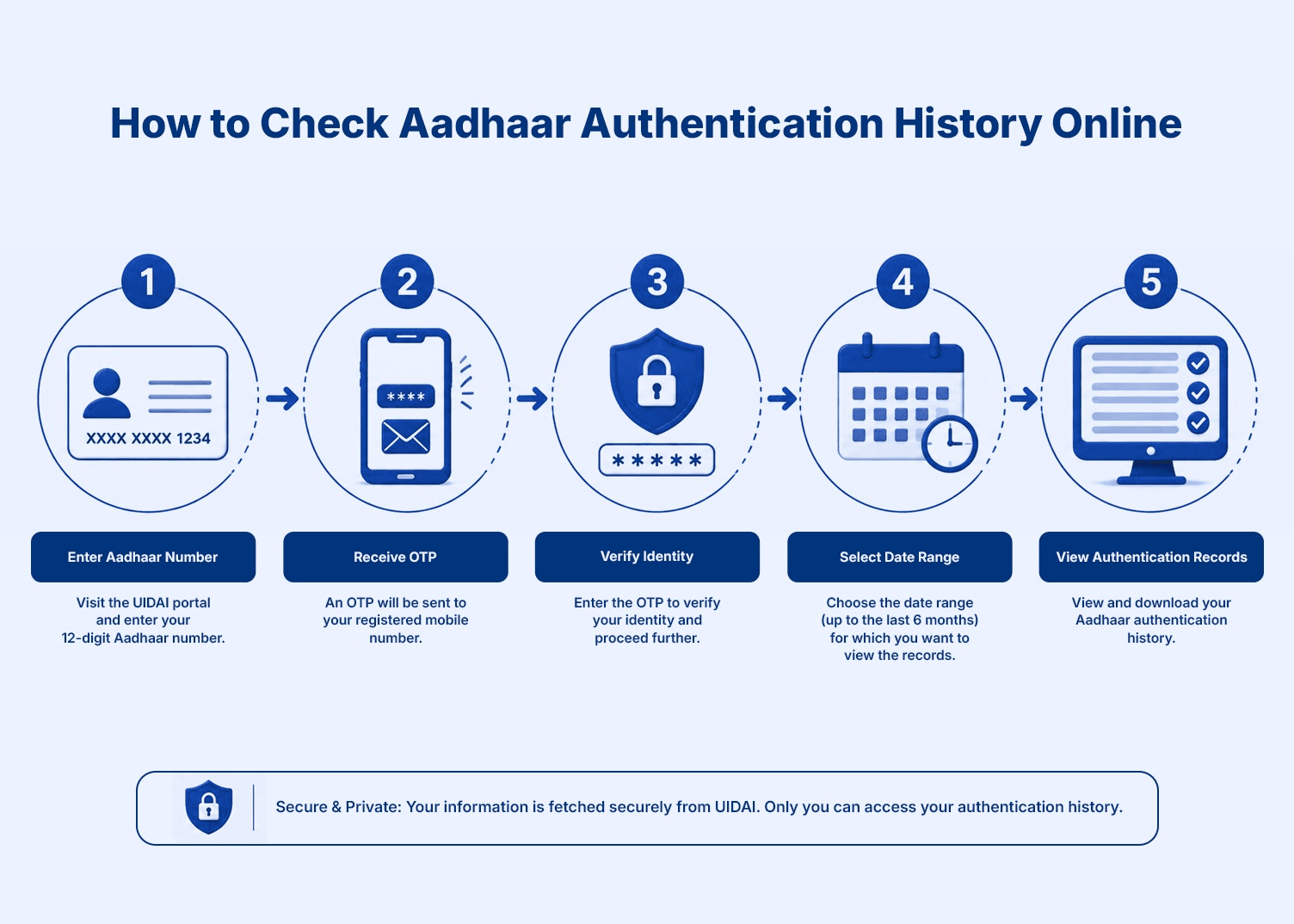
In addition to knowing what you can find in history, you can check Aadhaar usage history online. It is very simple and will only take a few minutes.
- Step 1: Go to the official UIDAI website (www.uidai.gov.in) and click on the Aadhaar transaction log.
- Step 2: Enter your Aadhaar number to access your UIDAI account. To do so, you will receive an OTP on your UIDAI-registered mobile number.
- Step 3: Once authenticated, choose the time period you would like to view your Auth records. This is usually within 6 months of today's date.
- Step 4: Once you have selected the time frame, click on the request to check Aadhaar usage.
Why Should You Review It Regularly?
Checking the history of your Aadhaar authentication is a critical practice and should be part of your personal due diligence.
If you review it regularly, you can spot any unauthorized usage of your Aadhaar number. Therefore, preventing future misuse of your personal data.
Also, you have better visibility into your KYC processes and will know whether there were multiple authentication requests from various institutions and companies.
It also improves your digital identity protection. Just as you monitor your credit report and bank transactions, monitoring your Aadhaar usage history helps keep your digital identity safe.
Let us understand this with an example. Suppose Rohan regularly reviews his Aadhaar authentication history. On one such check, he notices an OTP-based authentication request linked to a SIM card issuance from an unfamiliar telecom provider. This immediately signals a potential misuse of his identity. By identifying this early, Rohan can promptly report the incident, initiate corrective action, and safeguard himself against possible fraud or unauthorised transactions.
What To Do If You Spot Suspicious Activity?
Should you receive any unusual information in your Aadhaar activity log, then immediate action must be taken.
1. The first thing to do is lock your biometrics. Thus, no one would be able to authenticate themselves through your fingerprints or iris without your permission.
2. The next step is to call up the UIDAI customer service and inform them about the problem. Their specialists will assist you in taking the necessary actions.
3. Another thing to check is your mobile phone number. As this is used in the authentication process for one-time password generation, it adds more security.
Sometimes, it is also advisable to review your financial or other accounts to ensure everything is in order.
Conclusion
There was a time when identification was carried out manually. The procedure was quite long and time-consuming. Before Aadhar was introduced, some popular IDs included a driving license, PAN, and Voter ID Card. It was quite normal to keep such documents under lock and key because unauthorized usage was quite a possibility.
In the digital age, the authentication process has become swifter, faster, and easier. However, every individual should ensure that the highest standards of diligence are upheld to protect privacy and security. Reviewing your Aadhaar history is one such step.
It helps you gain control over your information by monitoring your UIDAI authentication history. This turns Aadhaar from a mere identity utility into something that you can manage yourself.
FAQs On Aadhar Authentication History
 |
Author: Grip Invest Editorial Team The Grip Invest Editorial Team is a group of Chartered Accountants, MBA (Finance) graduates, and Qualified Research Analysts dedicated to helping you invest smarter. We dive deep into India's fixed income landscape to deliver content that is accurate, up-to-date, and easy to understand. Whether you're exploring bonds, fixed deposits, or other fixed income opportunities, our guides cut through the noise and give you the clarity to make better financial decisions. |
Want to stay at the top of your finances?
Join the community of 4 lakh+ investors and learn more about Grip Invest, the latest financial knick-knacks, and shenanigans in the world of investing.
Happy Investing!
Disclaimer - Investments in debt securities/municipal debt securities/securitised debt instruments are subject to risks including delay and/ or default in payment. Read all the offer related documents carefully. The investor is requested to take into consideration all the risk factors before the commencement of trading.
This communication is prepared by Grip Broking Private Limited (bearing SEBI Registration No. INZ000312836 and NSE ID 90319) and/or its affiliate/ group company(ies) (together referred to as “Grip”) and the contents of this disclaimer are applicable to this document and any and all written or oral communication(s) made by Grip or its directors, employees, associates, representatives and agents. This communication does not constitute advice relating to investing or otherwise dealing in securities and is not an offer or solicitation for the purchase or sale of any securities. Grip does not guarantee or assure any return on investments and accepts no liability for consequences of any actions taken based on the information provided. For more details, please visit www.gripinvest.in
Registered Address - 106, II F, New Asiatic Building, H Block, Connaught Place, New Delhi 110001


