

Bond Market vs Stock Market: Where Should Investors Put Their Money?


There are generally two places that investors look to invest - either in the bond markets or the stock markets. Both play an important role for investors in their long-term investment strategy. In addition to being a vehicle for investment, they also provide a "buffer" against times when the economy is not performing well.
Bonds are like loans to governments, corporations, or other entities, meaning that they generally provide a fixed return over a set period of time. While stocks provide investors with ownership in a company, investors expect that the price of the stock will continue to increase over time.
In general, bonds are safe investment options for conservative investors; however, stocks have been known to exceed the returns with higher risks. There is a great deal of volatility in the stock market that can create excitement but also create fear for investors.
This guide will help simplify the process for Indian investors who want to make investment decisions.
What Is The Bond Market?
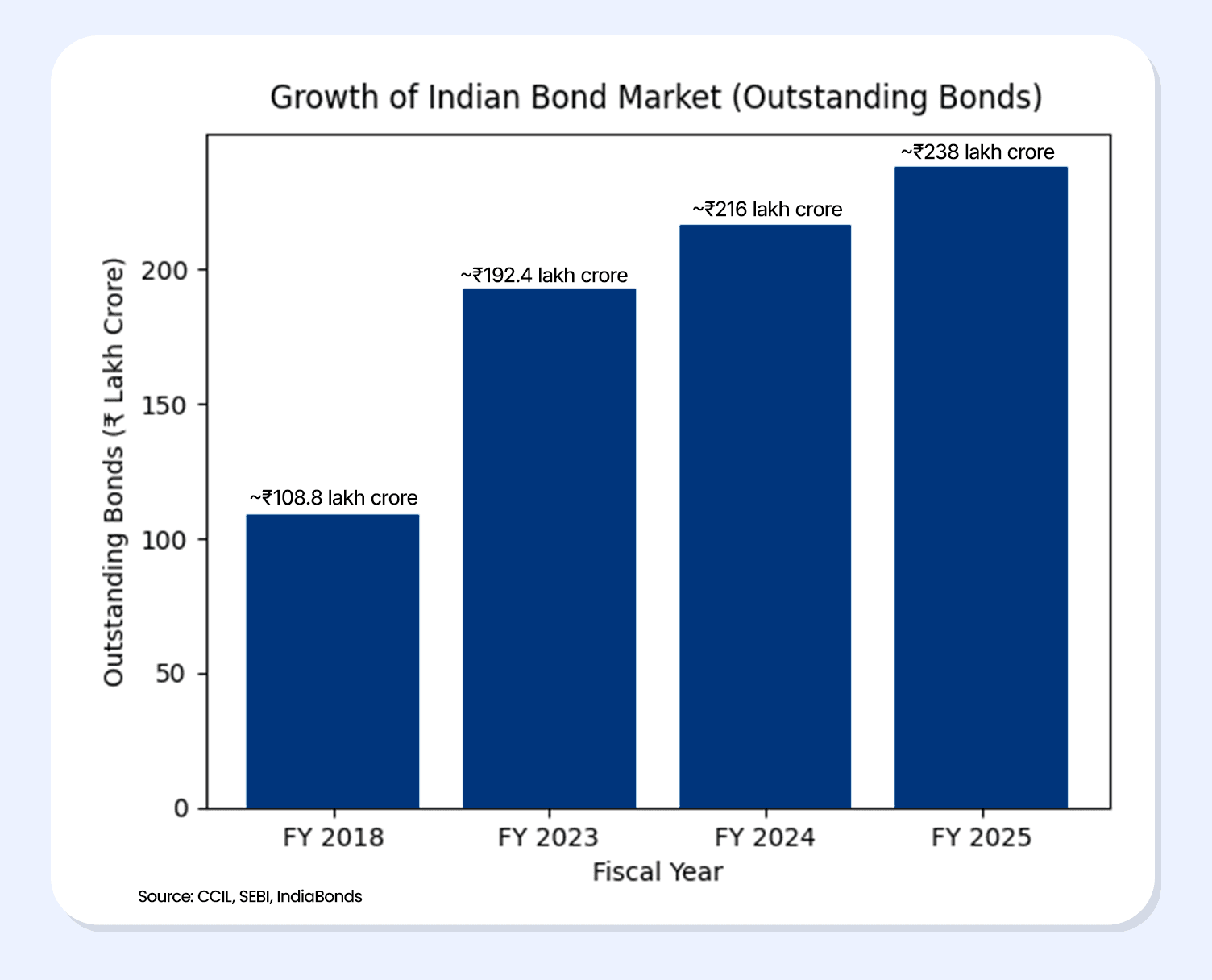
You can lend money to issuers like governments or corporations for a return through an interest payment associated with the bond issued. Issuers of a bond will pay interest on a set schedule and return your principal amount when the bond matures.
The bond market provides a more stable expectation of returns than the equity market because of its predictability. In fact, bonds will remain stable regardless of economic fluctuations within India.
Buying a government-issued bond with a fixed coupon payment every year will consistently provide an annual income return, irrespective of the overall market sentiment. With the assistance of Grip Invest, you can easily invest in different forms of corporate bonds without any difficulty.
Bond Market Update: What's Happening in India Right Now (2026)
In 2026, India's bond market is navigating a period of heightened uncertainty. The benchmark 10-year government bond yield has risen by 34 basis points since February 2026, driven by geopolitical tensions and a depreciating rupee. With the RBI's Monetary Policy Committee signalling a possible repo rate hike, existing long-duration bond holders may face short-term price pressure.
However, for new investors, rising yields present an attractive opportunity to lock into better fixed returns, particularly in short-to-medium duration corporate bonds. This makes the current environment especially relevant for conservative investors looking to add stable, predictable income to their portfolio through platforms like Grip Invest.
What Is The Stock Market?
The equity market provides investors with an opportunity to purchase ownership shares in publicly traded companies. The equity share prices increase with a rise in the company's profits and go down when the profits tumble.
Stocks typically pay dividends, as well. But, stock market risk vs bonds is much greater because of the wild fluctuations in prices.
If the price of a company increases substantially over a period of time, significant gains can be booked. The NSE and the BSE handle a large volume of trading daily. But long-term investment in India with stocks requires patience because of the volatility.
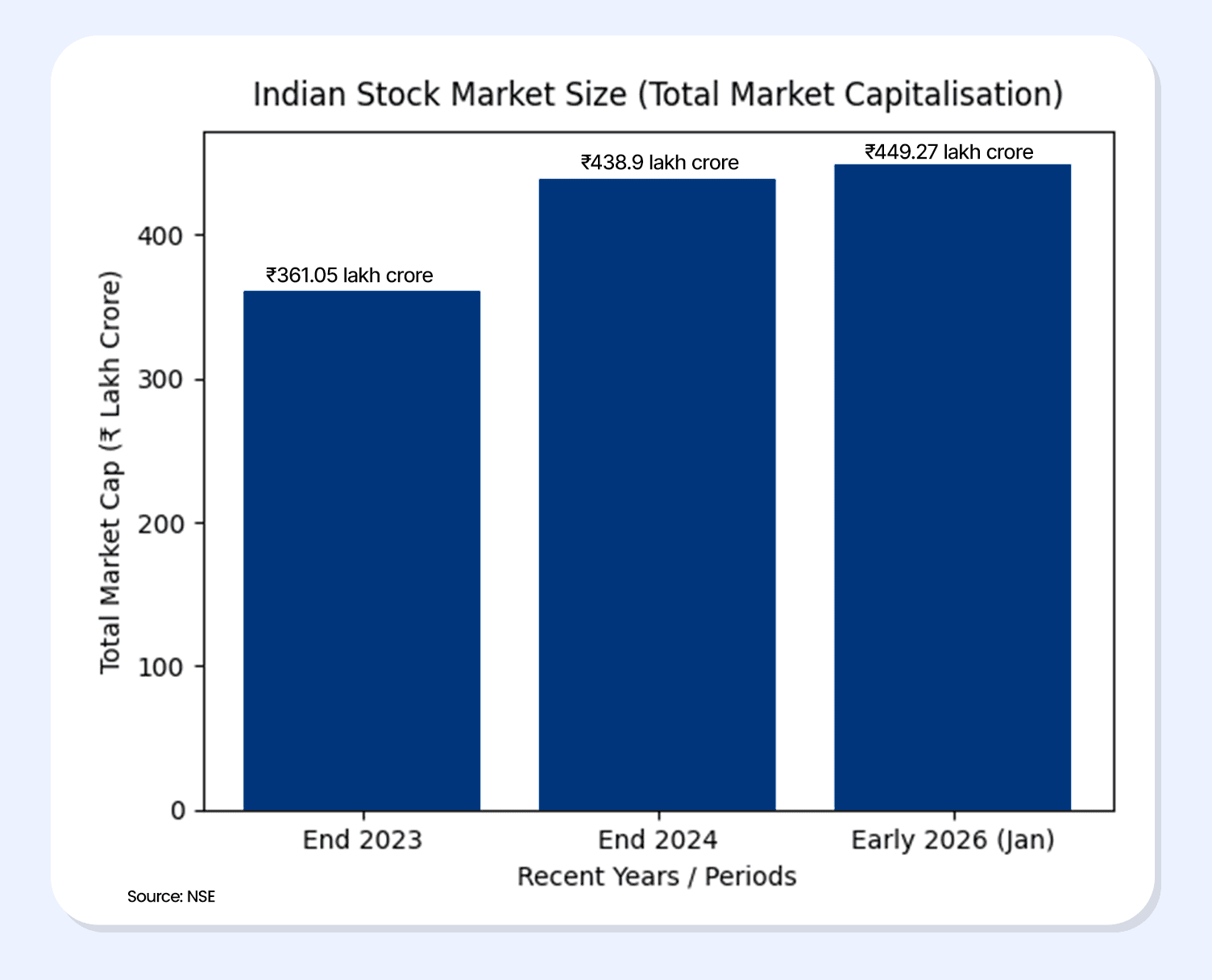
Key Differences: Bond vs Equity Investment
There are many variations between bonds and stocks. It will benefit the investor to understand the differences between equity and bond market returns India has before making a decision on where to invest.
| Aspect | Bonds | Stocks |
| Risk | Lower, fixed payments | Higher, market dependent |
| Returns | Steady interest | Growth plus dividends |
| Volatility | Minimal price swings | High ups and downs |
| Income Predictability | Guaranteed coupons till maturity | Uncertain dividends |
How Economic Cycles Affect Bonds And Stocks
The bonds, like fixed income vs equity, are affected by economic cycles consistently.
Stocks are lifted by growth cycles of the company as it is affected by the quarterly earnings. Whereas bonds are less affected by the growth cycle and are therefore more stable in the meantime, still generating a fixed yield.
During economic slowdowns, declining profits can adversely affect equities, often prompting investors to seek safety in bonds. In such periods of low or shrinking profits, capital tends to shift away from equities toward fixed-income instruments.
Equity interest rates and bond prices share an inverse relationship—bond prices rise as interest rates fall. In India, when the RBI cuts interest rates during a slowdown, it typically leads to an increase in bond prices, making them more attractive to investors.
During recovery, stocks surge approximately ten to twenty per cent while bonds yield steady five percent. This is where asset allocation, bonds, and equities balance this entire investment strategy. You just cannot trust equities alone as volatility in stock market peaks in uncertainty.
Combining Bonds And Stocks Smartly
The best way to keep a balanced portfolio is to use both bonds and stocks. You would normally have 60% stocks in a bull run and then have a 40% allocation of bonds in a bear market.
The best practice is to rebalance your asset allocation each year, based on your goals. Bonds and equities are best used together. Accessing the corporate bond market through companies like Grip may help you diversify the quickest way to diversify.
Long term investing India will benefit from having a balanced portfolio. This means that in a downturn, a balanced portfolio will do better than having strictly equities. Bonds will anchor your equities during periods of marked volatility. Asset Allocation is appropriate for all age groups.
New Investors should build their portfolio by starting with 70% bonds and working their way into equities gradually.
Tax And Liquidity Angles
Tax benefits of bonds are available on some issues compared to stocks. Long-term capital gains (LTCG) are the taxes charged on shares after a specified holding period, while the bond's tax is only assessed on a yearly basis via interest earned.
In terms of liquidity, it can be beneficial when stocks are held for a trading day and bonds are held to maturity. A demat account allows for seamless storage of both bond and stock investments. The hypothetical scenario would involve selling the shares quickly to obtain cash and, conversely, keeping the bonds until maturity.
Real-World Investor Choices
Younger people saving for retirement, retirees who look to generate income through bonds, and families creating an educational fund for their children will blend both types of investments together.
The bond market and stock market correspond perfectly with people's various stages of life. In fact, the Indian mutual funds make it easy to create these mixed investment portfolios.
Indian Market Tips for Bonds And Stocks
The Reserve Bank of India influences bond yields directly through its monetary policy, while the Securities Exchange Board of India oversees stock market activities. Investors can follow stock indices (Nifty) and bond indices (G-Sec).
Investors can take advantage of Systematic Investment Plans (SIP) to invest in both the stock market and bonds. Diversifying your investments over different sectors and time frames is an excellent way to reduce the impact of stock market declines.
Conclusion
Choosing between the bond market vs stock market is not about picking one winner, but about aligning your investments with your risk appetite, time horizon, and financial goals. Bonds offer stability, predictable income, and lower volatility, making them suitable during economic slowdowns or for conservative investors.
Stocks, on the other hand, drive long-term wealth creation through growth, but come with higher volatility and short-term market swings. Understanding fixed income vs equity dynamics helps Indian investors navigate economic cycles more confidently.
For long term investing in India, a balanced mix of bonds and equities through smart asset allocation can reduce risk while improving portfolio resilience. Rebalancing regularly, tracking interest rate movements, and diversifying across instruments ensures smoother returns across market phases.
As markets evolve, combining stability from bonds with growth from equities remains one of the most effective investment strategies.
Explore curated corporate bond opportunities on Grip Invest to add predictable income and stability to your portfolio.
FAQs On Stock Vs Bond Market In India 2026
1. Are bonds safer than stocks for Indian investors?
Yes. Bonds generally carry lower risk than stocks because they offer fixed income and lower volatility, making them safer investment options during uncertain market conditions.
2. How do economic cycles affect bond and stock returns in India?
Stocks usually perform better during economic growth phases, while bonds tend to perform well during slowdowns when interest rates fall and volatility in the stock market rises.
3. What is the ideal asset allocation between bonds and equities?
Asset allocation depends on age and risk tolerance. Younger investors may hold more equities, while conservative or retired investors often prefer higher bond exposure for income stability.
Want to stay at the top of your finances?
Join the community of 4 lakh+ investors and learn more about Grip Invest, the latest financial knick-knacks, and shenanigans in the world of investing.
Happy Investing!
Disclaimer - Investments in debt securities are subject to risks. Read all the offer-related documents carefully. The investor is requested to take into consideration all the risk factors before the commencement of trading. This communication is prepared by Grip Broking Private Limited (bearing SEBI Registration No. INZ000312836 and NSE ID 90319) and/or its affiliate/ group company(ies) (together referred to as “Grip Invest”) and the contents of this disclaimer are applicable to this document and any and all written or oral communication(s) made by Grip Invest or its directors, employees, associates, representatives and agents. This communication does not constitute advice relating to investing or otherwise dealing in securities and is not an offer or solicitation for the purchase or sale of any securities. Grip Invest does not guarantee or assure any return on investments and accepts no liability for the consequences of any actions taken based on the information provided. For more details, please visit https://www.gripinvest.in/.
Registered Address - 106, II F, New Asiatic Building, H Block, Connaught Place, New Delhi 110001.


