

Bull And Bear Market Explained: Meaning, Differences And Investment Strategies


Introduction To Bear And Bull Market
Warren Buffett’s famous line, “be fearful when others are greedy and greedy only when others are fearful,” is often repeated during market extremes.
But the deeper point is not to blindly go against the crowd. It is to recognise when prices are being driven more by emotion than by business value.
That is why understanding bull and bear markets matters. These are not just stock market labels. They describe shifts in price, sentiment, risk appetite and investor behaviour.
For Indian investors, this is especially important because the market does not move as one single block. Large caps, mid caps, small caps, IPOs and mutual funds can all experience the same stock market cycle differently.
To read these phases better, it helps to start with the basic meaning.
What Is A Bull Market?
This upward cycle appears when share values climb steadily and confidence improves across the investing community. It is often supported by stronger economic activity, better corporate earnings and favourable liquidity conditions.
Suppose the Nifty 50 moves from 20000 to 24000 over several months. During the same period, companies report healthier profits, buyers return during minor declines and equity participation widens. This points to a constructive market mood.
At its core, this environment reflects a stronger risk appetite. People are more willing to own stocks, accept uncertainty and pay higher valuations for businesses with future growth potential.
Daily gains are not guaranteed. Short corrections may still occur, while the broader direction remains positive.
What Is A Bear Market?
A prolonged downturn develops when share values decline steadily and sentiment turns cautious. It may follow weak growth, disappointing earnings, recession concerns, geopolitical tension or sudden external shocks.
In market commentary, a drop of around 20% from a recent high is often used as a broad reference point. This is not a fixed rule, but it helps separate a deeper decline from a routine correction.1
For example, a stock drops from INR 1,000 to INR 750. If broader weakness is the main reason and the company’s earnings remain healthy, the damage may be temporary. If profits are shrinking, debt is rising and the outlook has worsened, the lower valuation may signal a more serious concern.
Once the bull and bear market meanings are clear, the differences become easier to understand.
Bull Market vs Bear Market
Here are the key differences between bull and bear markets:
| Factor | Bull market | Bear market |
| Price movement | Prices rise over a sustained period | Prices fall over a sustained period |
| Investor sentiment | Optimism, confidence and FOMO | Fear, caution and panic |
| Risk appetite | High | Low |
| Valuation behaviour | Valuations often expand | Valuations often contract |
| Buying behaviour | Investors chase growth and momentum | Investors prefer safety and quality |
| IPO activity | Usually stronger | Usually weaker |
| Common mistake | Buying anything that is rising | Selling everything after prices fall |
| Better response | Rebalance and stay selective | Review quality and avoid panic |
Historical Examples
Indian equities have seen several phases where optimism, valuation and liquidity changed with remarkable speed.
Period | Market phase | What happened | Investor lesson |
2007 rally | Bull phase | Sensex and Nifty rose 47.1% and 54.8%, respectively, during 2007. The Sensex crossed 20,000 in December 2007 and touched 21,000 intraday in January 2008.2 | Strong rallies often come with rising participation and richer valuations. |
January 2008 fall | Sharp correction | On 21 January 2008, the Sensex fell 1,408 points and closed at 17,605.40 amid weak global cues and fears of a US recession.3 | External shocks can quickly affect Indian equities. |
March 2020 Covid crash | On 23 March 2020, the Nifty 50 fell 12.98% to 7,610.25, while the Sensex fell 13.15% to 25,981.24.4 | Sudden sell-offs test liquidity, patience and portfolio quality. | |
2024–25 small-cap correction | Segment-level bear phase | Nifty Smallcap 100 ended 21.6% below its record closing high on 14 February 2025, crossing the widely used 20% bear-market threshold.5 | A headline index may look stable while parts of the market face deeper stress. |
Investment Strategies In Both Markets
The right response is not to predict every top and bottom. It is to avoid emotional decisions when the market mood changes.
In A Bull Market:
A bull market investing rewards patience, but it can also encourage overconfidence. Investors may start believing that recent returns are normal. That is when asset allocation becomes important.
1. Review asset allocation
A strong rally can quietly change the character of a portfolio. For example, an investor who planned a 60:40 equity-debt mix may find that equity has moved to 75% after a long rise. The portfolio value may look stronger, but the risk level has also increased.
This is where rebalancing becomes useful. It helps investors bring the portfolio closer to the original plan instead of allowing the rally to decide the risk level.
2. Do not chase every recent winner
Bull markets make recent performance look persuasive. A stock, sector or mutual fund that has already delivered strong returns may continue to attract money because investors fear missing out.
The better question is whether future earnings can still support the price. A good company can become a poor investment if the entry valuation is too stretched.
3. Watch concentration in popular themes
In India, bull phases often create strong narratives around certain segments such as PSUs, defence, railways, banking, IT, infrastructure or small caps. Some of these themes may have genuine merit. The risk begins when one idea becomes too large inside the portfolio.
A concentrated bet can lift returns during a rally. It can also hurt sharply when the cycle turns.
4. Be selective with IPOs and thematic funds
Bull markets usually bring heavier interest in IPOs and new fund offers. The excitement around listing gains or a fashionable theme can cloud basic checks.
Investors may need to review the business model, pricing, debt, profitability and time horizon before committing money. The presence of a popular theme does not remove investment risk.
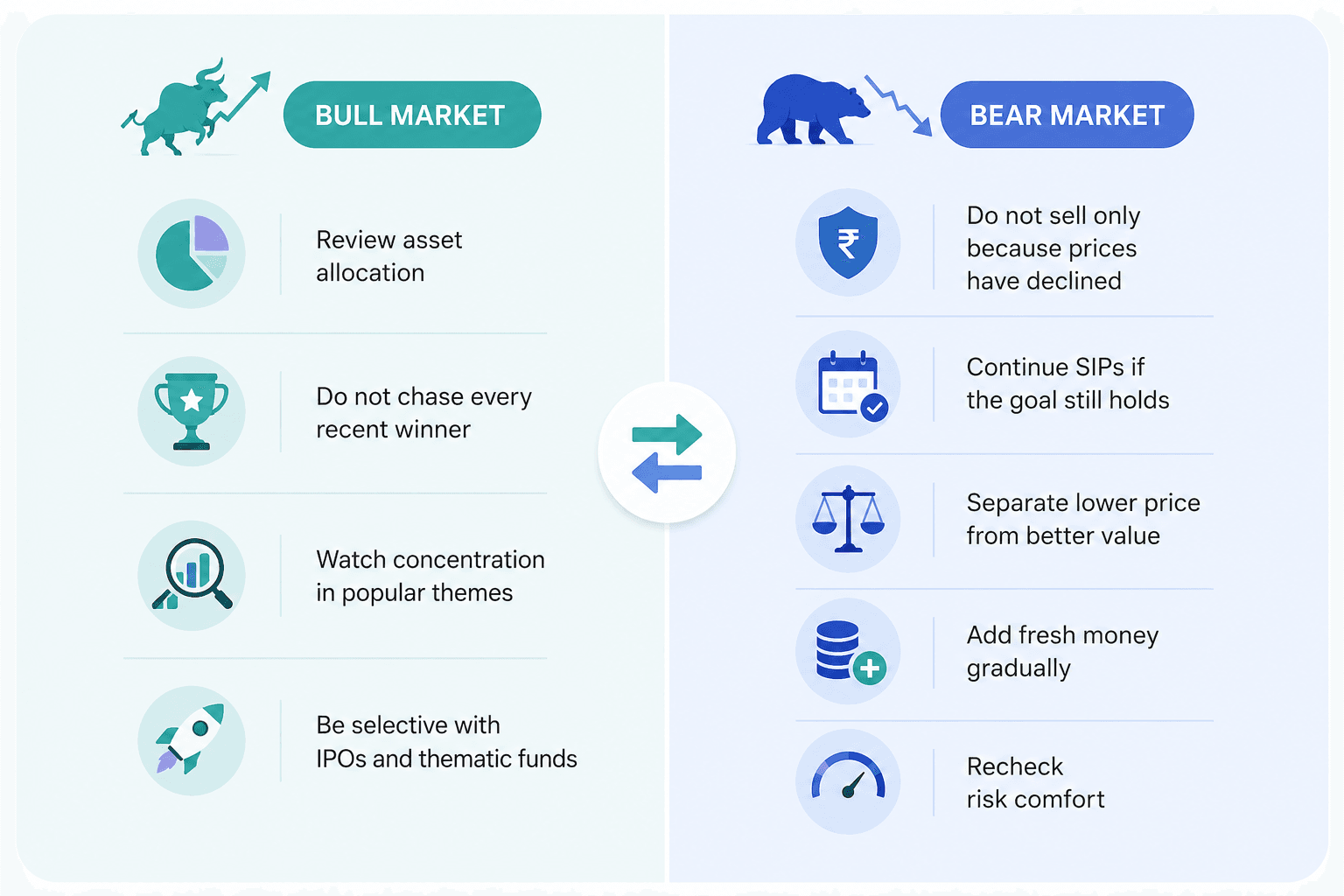
In A Bear Market:
Bear markets test patience. Falling prices can make investors doubt even sound investments. But this is also when quality matters most.
1. Do not sell only because prices have declined
A weak market can make even sound holdings feel uncomfortable. Before exiting, investors may need to ask whether the problem is temporary price weakness or a genuine deterioration in the business.
A company with steady cash flows, manageable debt and durable demand may recover differently from a company with falling earnings and stretched leverage.
2. Continue SIPs if the goal still holds
For long-term investors, stopping SIPs during every decline can weaken the discipline of the plan. Lower NAVs allow investors to accumulate more units through rupee cost averaging. AMFI explains that SIPs help investors buy more units when NAVs are low and fewer units when NAVs are high.
This approach works best when the fund still suits the investor’s risk profile, time horizon and financial goal.
3. Separate lower price from better value
A stock trading below its recent high may look attractive. That alone is not enough. Bear phases often expose weak earnings, poor governance, heavy debt and expensive valuations.
Investors should check whether the fall has made the investment more reasonable or simply revealed a risk that was earlier ignored.
4. Add fresh money gradually
Catching the exact bottom is difficult. A staggered approach can reduce timing risk, especially when the market is still absorbing bad news.
This is useful during uncertain periods because prices may remain volatile even after the first sharp fall.
5. Recheck risk comfort
Bear markets reveal whether the original portfolio was suitable. If an investor loses sleep over normal equity declines, the allocation may have been too aggressive.
This review should include equity exposure, small-cap allocation, sector concentration and the need for emergency liquidity.
Conclusion
Bull and bear markets are part of equity investing. A bull market creates confidence, but it can also hide risk. A bear market creates fear, but it can also reveal which investments were built on weak assumptions.
For Indian investors, the better approach is to understand the phase, check portfolio quality and stay aligned with goals. The market will keep moving between greed and fear. Investor discipline is what should remain steady.
Investors who want to balance equity volatility can also explore fixed-income products for more predictable cash flows and portfolio stability. Platforms like Grip Invest offer access to curated fixed-income opportunities that can complement an equity-led portfolio.
FAQs On Bull And Bear Market
 |
Author: Grip Invest Editorial Team The Grip Invest Editorial Team is a group of Chartered Accountants, MBA (Finance) graduates, and Qualified Research Analysts dedicated to helping you invest smarter. We dive deep into India's fixed income landscape to deliver content that is accurate, up-to-date, and easy to understand. Whether you're exploring bonds, fixed deposits, or other fixed income opportunities, our guides cut through the noise and give you the clarity to make better financial decisions. |
Want to stay at the top of your finances?
Join the community of 4 lakh+ investors and learn more about Grip Invest, the latest financial knick-knacks, and shenanigans in the world of investing.
Happy Investing!
Disclaimer - Investments in debt securities/municipal debt securities/securitised debt instruments are subject to risks including delay and/ or default in payment. Read all the offer related documents carefully. The investor is requested to take into consideration all the risk factors before the commencement of trading.
This communication is prepared by Grip Broking Private Limited (bearing SEBI Registration No. INZ000312836 and NSE ID 90319) and/or its affiliate/ group company(ies) (together referred to as “Grip”) and the contents of this disclaimer are applicable to this document and any and all written or oral communication(s) made by Grip or its directors, employees, associates, representatives and agents. This communication does not constitute advice relating to investing or otherwise dealing in securities and is not an offer or solicitation for the purchase or sale of any securities. Grip does not guarantee or assure any return on investments and accepts no liability for consequences of any actions taken based on the information provided. For more details, please visit www.gripinvest.in
Registered Address - 106, II F, New Asiatic Building, H Block, Connaught Place, New Delhi 110001


