

Balanced Advantage Funds In India 2026: How They Work, Benefits And Risks



What Are Balanced Advantage Funds?
Balanced Advantage Funds (BAFs), also known as Dynamic Asset Allocation Funds, are hybrid mutual funds that dynamically adjust their allocation between equity and debt based on market conditions.
Unlike hybrid fund categories that have prescribed equity and debt allocation ranges, BAFs have greater flexibility to change their asset mix according to the scheme’s investment strategy and asset-allocation framework.
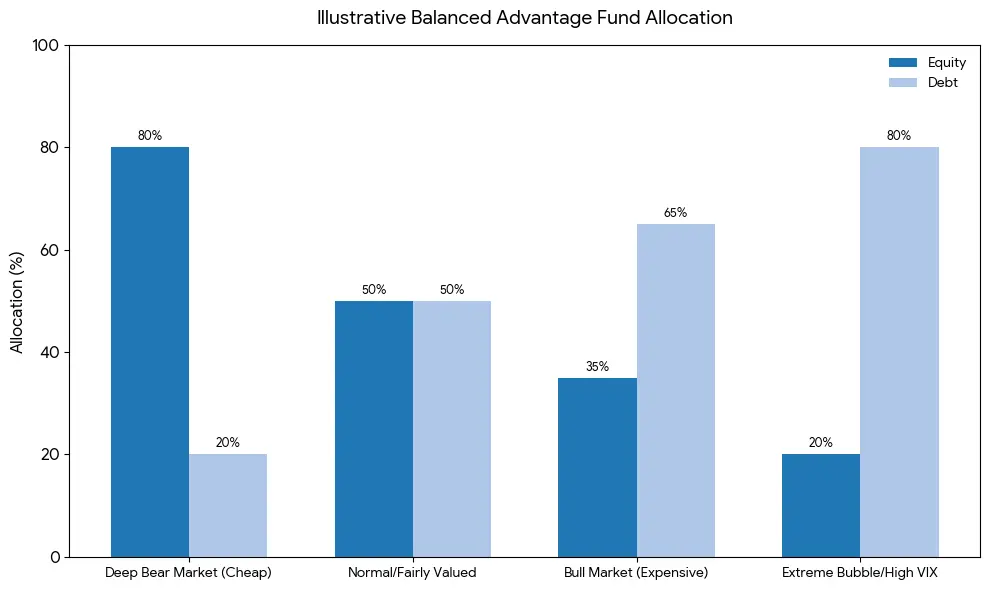
Fund managers may use valuation indicators such as Price-to-Earnings (P/E) ratios, market valuations, interest rates and bond yields, along with quantitative models, to determine the appropriate asset mix. When equity valuations are relatively high, the fund can reduce equity exposure and increase allocation to debt instruments. Conversely, when stock prices fall and valuations become attractive, it can increase equity exposure.
By dynamically changing the portfolio mix, a balanced advantage mutual fund aims to combine the growth potential of equities with the relative stability of debt investments. BAFs are, however, market-linked investments and do not guarantee returns.
How Do Balanced Advantage Funds Work?
The balanced advantage fund meaning lies in its dynamic investment process, which changes the equity-debt mix as valuations and market conditions evolve. The approach combines asset allocation, portfolio diversification and risk management within one fund.
1. Dynamic Asset Allocation: Compared to standard mutual funds with a fixed asset mix, BAFs change asset allocation actively. Its equity levels may move, depending on market cycles.
2. Valuation-Based Models: The fund managers may use quantitative models and indicators such as P/E and P/B ratios, market trends, interest rates and other valuation measures to determine allocation levels.
3. Rebalancing With Valuations: The fund regularly reviews market valuation indicators and adjusts its equity and debt allocation based on changes in valuation levels and the signals generated by its allocation model.
4. Derivatives and Hedging: Some BAFs use equity derivatives, arbitrage strategies and other instruments to manage their effective equity exposure and control portfolio risk. The approach varies across schemes.
5. Portfolio Diversification: By combining equity, debt, cash and, in some schemes, derivatives, BAFs diversify portfolio risks across asset classes. This approach is an important part of mutual fund education when learning about asset allocation.
What Affects A Balanced Advantage Fund’s Allocation?
The allocation of Balanced Advantage Funds is typically based on multiple market, valuation and economic signals before deciding the equity-debt mix.
- Equity Valuations: The measures such as P/E ratios, earnings yields and market-cap-to-GDP ratios can influence how much equity the fund holds within its allocation model.
- Interest Rates: The changes in interest rates and the monetary policy environment can affect both equity valuations and debt-market conditions, influencing the allocation between the two asset classes.
- Market Momentum: The allocation models assess price trends, rolling returns and relative strength across asset classes to identify changes in market direction and determine rebalancing signals.
- Market Volatility: Indicators such as the India VIX can form part of an allocation model. Changes in expected market volatility may influence the level of equity exposure maintained by the scheme.
- Economic Conditions: Inflation, liquidity, fiscal conditions, economic growth and broader market conditions can affect the fund manager’s assessment of equity and debt and influence portfolio allocation.
Benefits And Risks Of Balanced Advantage Funds
Balanced Advantage Funds combine dynamic asset allocation with portfolio diversification, offering potential benefits while carrying market-linked risks. Understanding these balanced advantage fund risks is important before investing.
Benefits:
- Model-Based Decisions: Since the allocation models use valuation indicators like the P/E and P/B ratios to determine asset allocation, this reduces the reliance on subjective market-timing decisions.
- Lower Emotional Bias: Data-driven valuation models reduce the influence of emotions and human judgement when deciding whether to increase or reduce equity allocation.
- Downside Management: Funds may use debt, cash, hedging or arbitrage strategies alongside equity to reduce net equity exposure and potentially limit portfolio drawdowns during market corrections.
Risks:
- Market Risk: Since the fund retains equity exposure, significant stock-market declines can reduce NAV even when the fund has lowered its equity allocation or uses hedging strategies.
- Model Timing Risk: The valuation-based model may misjudge market reversals or provide lagging signals. This can cause the fund to reduce or increase equity allocation at an unfavourable point in the cycle.
- Debt and Credit Risk: The debt portion can be affected by changes in interest rates, while credit deterioration or default by an issuer can reduce the value of debt holdings.
Balanced Advantage Funds Vs Other Hybrid Funds
The balanced advantage funds vs hybrid funds comparison mainly differs in how much flexibility each category has to change its equity-debt allocation:
Fund Category | Equity Allocation | Debt Allocation | Allocation Flexibility |
| Balanced Advantage Funds | Dynamic, scheme-specific | Dynamic, scheme-specific | Equity and debt allocation is managed dynamically according to the scheme’s investment strategy and asset-allocation framework. |
| Aggressive Hybrid Funds | 65-80% | 20-35% | Must remain within the prescribed allocation range and maintain a predominantly equity-oriented portfolio. |
| Balanced Hybrid Funds | 40-60% | 40-60% | Maintains equity and debt within the prescribed 40–60% ranges, providing a relatively balanced allocation between the two asset classes. |
| Conservative Hybrid Funds | 10-25% | 75-90% | Predominantly invests in debt while maintaining a smaller allocation to equity within the prescribed range. |
Source: AMFI India1
Taxation And Liquidity Of Balanced Advantage Funds
The balanced advantage fund taxation depends on whether the scheme qualifies as an equity-oriented fund under the applicable tax rules.
- Taxation on Equity-Oriented Funds: If a BAF is classified as an equity-oriented fund, the units held for 12 months or less attract 20% short-term capital gains tax. Units held for more than 12 months attract 12.5% long-term capital gains tax on gains exceeding INR 1.25 lakh in a financial year.2
- Taxation on Debt-Oriented Funds: If the fund falls under the applicable specified mutual fund or debt-oriented provisions, the gains are taxed at the applicable income-tax slab rate, irrespective of the holding period.3
- Liquidity: BAFs are open-ended mutual funds, so you can generally redeem the units on the business days at the applicable NAV. However, the scheme may charge an exit load if units are redeemed within the specified period.
Conclusion
Investors who want a single portfolio that adjusts allocation as market conditions change, without having to rebalance it by themselves, may find Balanced Advantage Funds suitable. However, the outcome depends on the allocation model and underlying investments of the scheme.
The factors, including the allocation model, portfolio, costs, taxation and risk profile, should therefore be assessed before investing.
FAQs

Want to stay at the top of your finances?
Join the community of 22 lakh+ investors and learn more about Grip Invest, the latest financial knick-knacks, and shenanigans in the world of investing.
Happy Investing!
Disclaimer - Investments in debt securities/municipal debt securities/securitised debt instruments are subject to risks including delay and/ or default in payment. Read all the offer related documents carefully. The investor is requested to take into consideration all the risk factors before the commencement of trading.
This communication is prepared by Grip Broking Private Limited (bearing SEBI Registration No. INZ000312836 and NSE ID 90319) and/or its affiliate/ group company(ies) (together referred to as “Grip”) and the contents of this disclaimer are applicable to this document and any and all written or oral communication(s) made by Grip or its directors, employees, associates, representatives and agents. This communication does not constitute advice relating to investing or otherwise dealing in securities and is not an offer or solicitation for the purchase or sale of any securities. Grip does not guarantee or assure any return on investments and accepts no liability for consequences of any actions taken based on the information provided. For more details, please visit www.gripinvest.in
Registered Address - 106, II F, New Asiatic Building, H Block, Connaught Place, New Delhi 110001


