

Overnight Funds In India 2026: How They Work, Returns And Risks



What Are Overnight Funds?
Overnight funds are open-ended debt mutual fund schemes that primarily invest in overnight securities with a maturity of one day. Under SEBI’s 2026 framework, they may also hold up to 5% of net assets in eligible G-secs or T-bills with a residual maturity of up to 30 days for margin and collateral requirements.1
This daily maturity cycle is central to the overnight fund meaning, as the scheme continually invests in instruments that mature on the next business day.
The overnight mutual fund manager deploys the available capital into short-term assets including Tri-Party Repos (TREPS), reverse repos and other permitted instruments.
Since the core portfolio matures every day, overnight funds have relatively low interest-rate and credit risk compared with debt funds that invest for longer periods. They also offer high liquidity, with no exit load in most cases, allowing investors to place redemption requests subject to the scheme’s applicable timelines.
However, their conservative nature also means overnight fund returns are usually lower than those of debt funds that take higher risks. They can suit investors looking to invest surplus money for a short period.
How Do Overnight Funds Work?
An overnight mutual fund operates through a continuous, 24-hour investment, settlement, and reinvestment cycle:
1. Daily Deployment: At the start of each business day, the fund manager deploys the scheme’s available cash into overnight instruments, such as TREPS, repos and other permitted money-market instruments.
2. Next-Day Maturity: The core portfolio is invested in securities that mature in one business day. Under SEBI’s 2026 framework, up to 5% of net assets may also be held in eligible G-secs or T-bills with a residual maturity of up to 30 days for margin and collateral requirements.
3. Daily Reinvestment: Upon overnight fund maturity, the fund receives the principal and income earned and redeploys the available money into fresh overnight instruments for the next cycle.
4. Continuous Cycle: This daily reset repeats on every business day. It allows the fund to maintain its overnight mandate, limits/reduces interest-rate sensitivity, and offer ultra-high liquidity to investors.
Overnight Funds Vs Liquid Funds Vs Money Market Funds
Overnight, liquid and money market funds are short-duration categories within the debt mutual fund category. They can be used for managing surplus cash, with the appropriate category depending largely on the investor’s time horizon and liquidity needs.
Overnight fund vs liquid fund comparisons mainly come down to the maturity of their underlying investments, investment horizon and sensitivity to interest-rate movements. Money market funds allow a longer maturity profile, making them distinct from the other two categories.
Basis | Overnight Funds | Liquid Funds | Money Market Funds |
| Maturity | 1 business day | Up to 91 days | Up to 1 year |
| Underlying assets | TREPS, Reverse Repos | T-Bills, Commercial Papers | Certificates of Deposit, T-Bills |
| Interest-Rate Risk | Relatively low | Relatively low | Relatively higher |
| Return potential | Usually lower | Comparatively higher than overnight funds | Comparatively higher than both |
| Exit load | Nil. | Graded load apply if exited in the first 6 days | Nil. |
| Suitable Use | Very short-term cash investing | Short-term cash management | Short-term investment with a longer horizon |
Source: AMFI India,SEBI2,3
What Returns Can Investors Expect From Overnight Funds?
Overnight fund returns are closely linked to prevailing overnight and other short-term money-market rates. AMFI states that returns from liquid, overnight and money-market funds depend on the short-term interest rates prevailing in the market.
Since overnight fund maturity is only 1 day, their return potential is comparatively modest compared to debt funds that invest in longer-maturity securities.
Based on the annualised returns of overnight funds in India as of 29 September 2026, the 1-year return ranges from 4.98% to 5.49%, averaging about 5.25%.
However, these are historical averages, not assured returns. Overnight fund returns are market-linked and not guaranteed, and the actual return depends on the fund’s portfolio, expenses and prevailing money-market conditions.
Risks Of Overnight Funds
The following overnight fund risks should be considered before investing:
1. Lower Returns: Overnight funds typically offer lower returns than other short-term investments because they invest in securities with very short maturities and prioritise liquidity and capital preservation.
2. Operational Risk: Any errors in trade execution, settlement, valuation or other fund operations can affect the management and performance of the scheme.
3. Interest Rate Impact: A sudden change in market interest rates may slightly affect returns. However, the impact is usually minimal because the fund replaces its investments frequently.
4. Do Not Support Long-Term Investment: The overnight funds are designed for short-term investing of surplus funds rather than long-term wealth creation. Investors seeking higher growth may need other mutual fund categories.
5. Reinvestment Risk: The fund reinvests its money as securities mature each day. The subsequent returns can decline during a declining rate environment.
Taxation And Costs
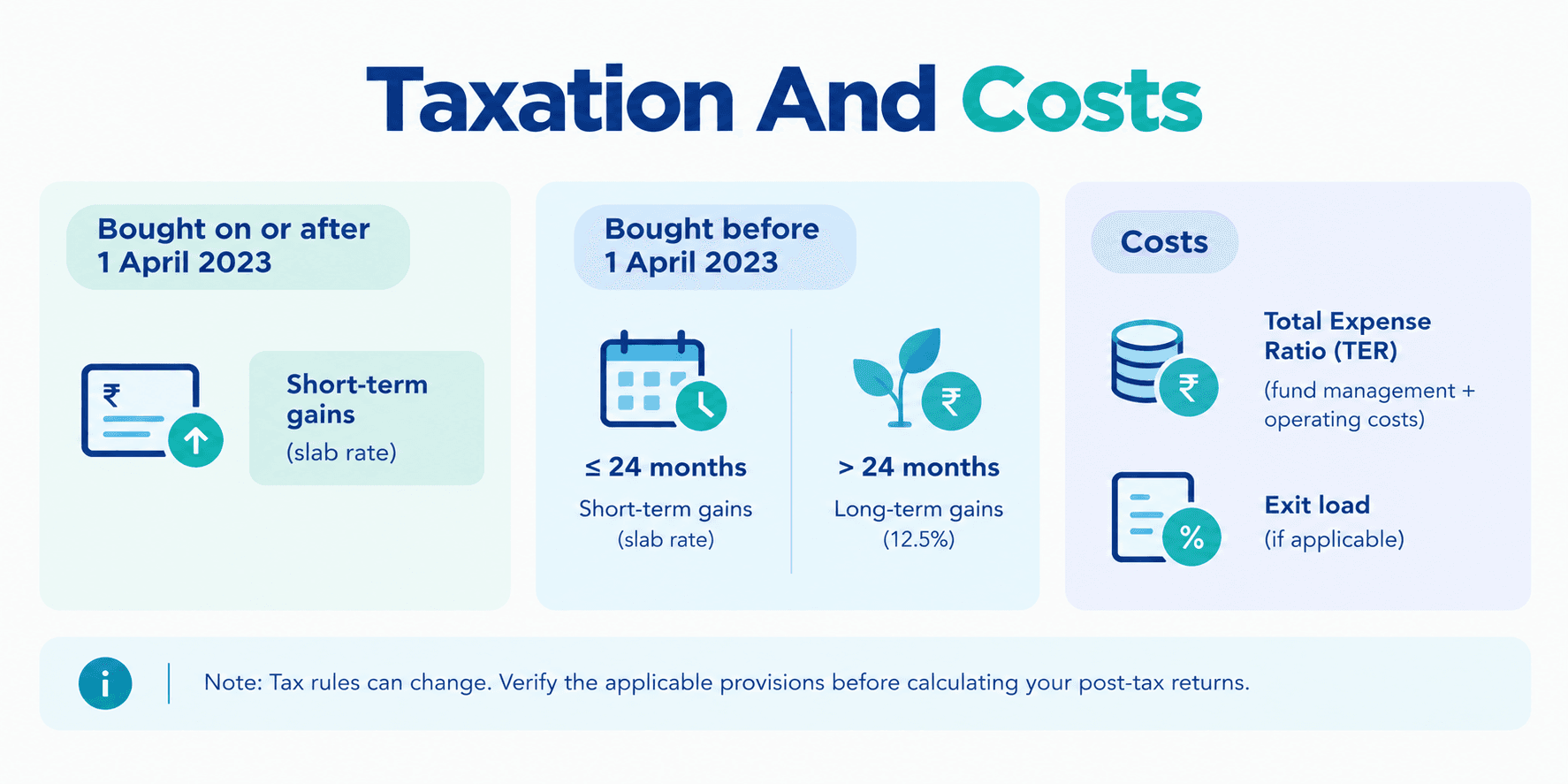
Overnight mutual fund taxation follows the tax treatment applicable to specified mutual funds.
- Purchases on or after 1 April 2023
Gains from Overnight Fund units acquired on or after 1 April 2023 are treated as short-term capital gains, irrespective of the holding period. It is taxed at the applicable slab rate of the investor.4
- Purchases before 1 April 2023
The overnight fund units purchased before 1 April 2023 are taxed based on their holding period. The units held for more than 24 months are taxed as long-term capital gains at 12.5% without indexation and the gains from shorter holding periods are taxed at slab rates.5
- Costs
The main cost involved in overnight mutual funds is the Total Expense Ratio (TER). This can include fund-management and operating expenses, which are reflected in the NAV. An exit load may also apply if specified in the scheme documents.
Note: Tax rules can change. Verify the provisions applicable to the relevant financial year before calculating your post-tax returns.
Who May Consider Overnight Funds?
Overnight funds may suit investors who want to invest surplus money for a very short period while keeping interest-rate and credit risk relatively low. However, suitability depends on the objective, investment horizon and risk profile of the investors.
1. Short-term investors: Investors with a temporary cash surplus and a horizon of a few days or weeks may consider overnight funds for short-duration investments.
2. Low-risk investors: Those who prefer relatively lower volatility and want limited sensitivity to changes in interest rates may find these funds suitable.
3. Investors awaiting deployment: Investors planning to invest in equities, bonds or other investments shortly may use overnight funds for temporary allocation, depending on their liquidity requirements.
4. Investors seeking liquidity: Since the underlying securities mature within one business day, this makes the funds suitable for investors who value high liquidity.
Conclusion
Overnight funds offer a short-duration debt option where the portfolio resets its maturity every business day. This limits the interest-rate and credit sensitivity. But it also leaves returns closely tied to existing interest rates.
Before investing, compare the expected return of the fund with its costs and consider the tax treatment, liquidity requirement and investment horizon. A very short holding period can make the category more relevant than a longer-duration debt fund.
FAQs

Want to stay at the top of your finances?
Join the community of 22 lakh+ investors and learn more about Grip Invest, the latest financial knick-knacks, and shenanigans in the world of investing.
Happy Investing!
Disclaimer - Investments in debt securities/municipal debt securities/securitised debt instruments are subject to risks including delay and/ or default in payment. Read all the offer related documents carefully. The investor is requested to take into consideration all the risk factors before the commencement of trading.
This communication is prepared by Grip Broking Private Limited (bearing SEBI Registration No. INZ000312836 and NSE ID 90319) and/or its affiliate/ group company(ies) (together referred to as “Grip”) and the contents of this disclaimer are applicable to this document and any and all written or oral communication(s) made by Grip or its directors, employees, associates, representatives and agents. This communication does not constitute advice relating to investing or otherwise dealing in securities and is not an offer or solicitation for the purchase or sale of any securities. Grip does not guarantee or assure any return on investments and accepts no liability for consequences of any actions taken based on the information provided. For more details, please visit www.gripinvest.in
Registered Address - 106, II F, New Asiatic Building, H Block, Connaught Place, New Delhi 110001


