

Sectoral And Thematic Funds Launch In India 2026: Are AMCs Following Market Rallies?



In 2026, several new sectoral and thematic mutual funds were launched, focusing on sectors such as auto, energy, pharma, IT, defence, and chemicals. Some of these launches came after the respective sectors had already delivered strong returns.
The Nifty Pharma index had gained 25.45% over one year by August 2026, while the BSE Auto index was up 19.6% over one year by the end of July. This raises a key question: Are AMCs launching sectoral and thematic funds after a market rally?
The data shows some interesting overlaps, but this does not prove that AMCs are simply following past returns. Launch frequency, NFO collection, and sector performance are three distinct measures and should be examined separately.
What Are Sectoral And Thematic Funds?
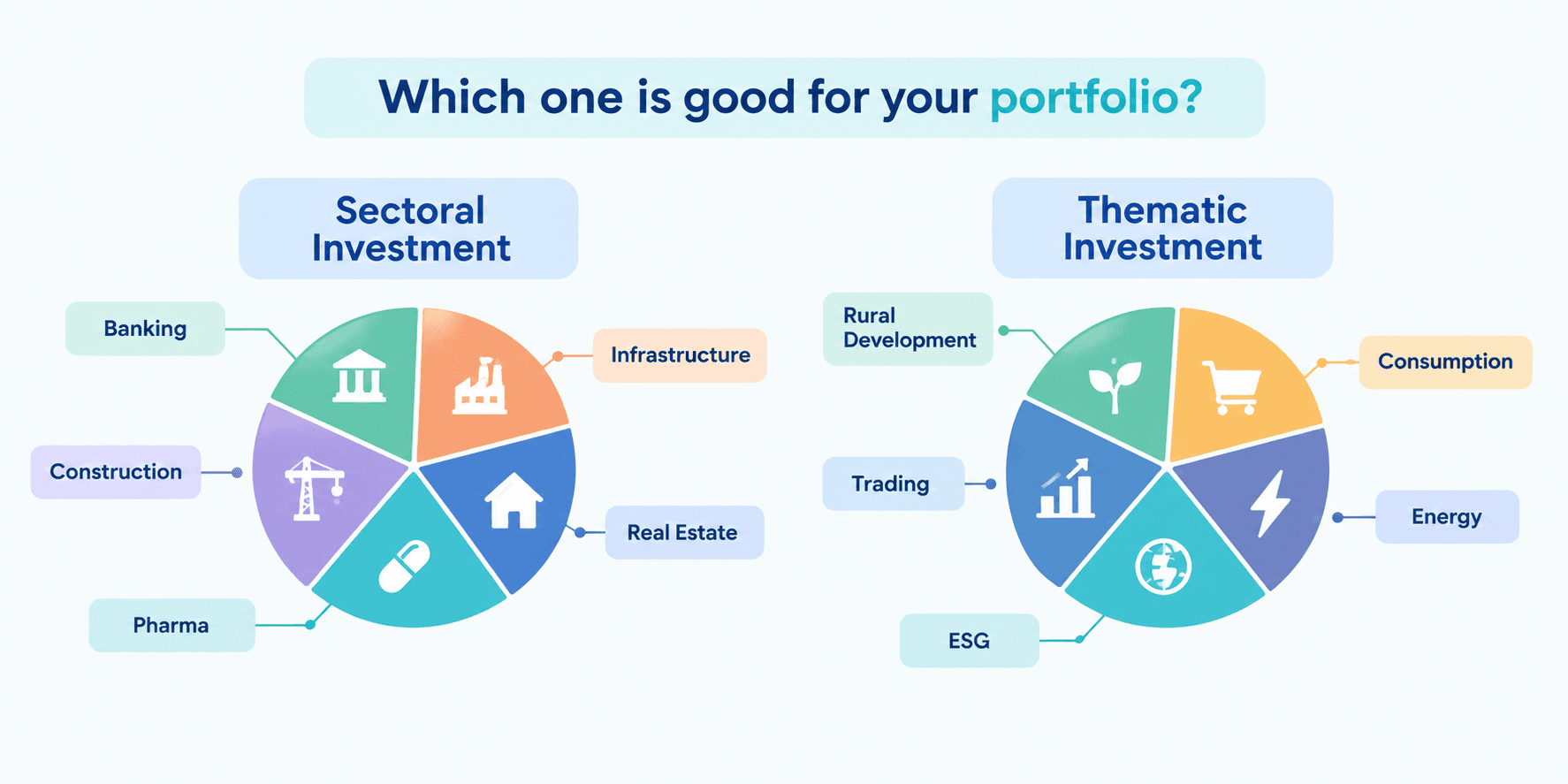
Sectoral and thematic mutual funds are equity mutual funds. They focus on particular sectors or investment themes. A sectoral fund invests mainly in a specific sector, such as banking, IT, healthcare, or energy. Whereas a thematic fund covers companies from different sectors, such as infrastructure, innovation, and quality.
Under SEBI’s framework, sectoral and thematic funds generally need to invest at least 80% of their total assets in companies related to the specified sector or theme. This makes them different from diversified funds.
For example, a flexi-cap fund can invest across different sectors based on the mutual fund manager’s view. Whereas sectoral funds have less freedom because their investment universe is already defined.
What Is Happening With Sectoral And Thematic Fund Launches In 2026?
The first part of 2026 was relatively quiet for this category. There were no sectoral thematic NFO in Q1 FY27 compared with 12 launches in the previous quarter. The activity picked up in July. HDFC launched the Nifty Auto Index Fund, followed by funds such as Axis Nifty Energy Index Fund and Invesco India Pharma and Healthcare funds.
There were more launches seen in September, including funds linked to IT, chemicals, and defence.
Period | Key Development |
Q4 FY26 | 12 sectoral/thematic NFOs raised ?5,330 crore |
Q1 FY27 | No sectoral/thermatic NFOs |
July 2026 | Auto-focused NFOs and other sector products launched |
August 2026 | Energy and pharma/healthcare funds launched |
September 2026 | IT, chemicals and defense funds launched |
Do AMCs Launch More Sectoral And Thematic Funds After Market Rallies?
In 2026, new funds were launched after a strong performance in the related sector. For example, the Nifty Pharma gained 24.45% over one year by August 2026. In August, Invesco launched the Invesco India Pharma and Healthcare Fund.
Auto is another example; the BSE Auto index also gained 19.6% over one year. HDFC’s Nifty Auto Index Fund opened its NFO in June. However, this does not follow the same pattern for every sector.
Mirae Asset launched its BSE Information Technology Index Fund in September, even though the Nifty IT index had a negative one-year return by the end of August. The index had recovered over the previous three months.
It suggests that a fund launch cannot automatically be linked with its rally, as AMCs also consider long-term sector growth, investor demand, product gaps, and the growing popularity of index-based investing.
Which Sectors And Themes Are Seeing New Fund Launches?
Several sectors have seen new fund launches in 2026.
- Auto - HDFC launched the Nifty Auto Index Fund in June-July.
- Energy - Axis launched the Nifty Energy Index Fund in August, covering areas such as oil and gas, power, and renewable energy.
- Pharma and Healthcare - Invesco launched its Pharma and Healthcare Fund in August. It covers pharmaceuticals, hospitals, diagnostics, and medical devices.
- IT - Mirae Asset launched the BSE Information Technology Index Fund in September.
- Defence and Chemicals - Invesco launched index funds linked to the Nifty India Defence and Nifty Chemical indices in September.
Fund/Theme | Launch | Sector performance before launch |
Auto | Jun-Jul | BSE Auto: 19.6% in 1 year |
Pharma | Aug-Sep | Nifty Pharma: +25.45% IN 1 year |
IT | Sep | Nifty IT: negative 1-year return |
Defence | Sep | Nifty India Defence: +26.67% in 6 months |
What Are The Risks Of Investing In A Sectoral Or Thematic Fund After A Rally?
Investors should know about these risks before investing in a sectoral and thematic mutual fund after a rally.
Concentration Risk
These funds focus on a sector or theme. Hence, their performance can depend heavily on a limited group of companies. So if that sector fails, the funds can also see a sharp decline.
High Valuation Risk
After a strong rally, stocks in a sector may already be trading at high valuations. If their earnings do not grow as expected, the stock price may fall.
Timing Risk
A sector that has performed well in the past may not continue with the same performance. Investors entering after a rally could face a correction if market sentiment changes.
Past Returns May Not Continue
A sector that has already benefited from favourable economic conditions or rising demand does not guarantee similar returns in the future.
Limited Diversification
Unlike diversified equity funds, sectoral and thematic funds have a narrower investment focus. This can make them more volatile when the sector or theme underperforms.
What Should Investors Check Before Investing In A Sectoral Or Thematic NFO?
Before investing in sectoral or thematic funds, investors should check these factors.
Investment mandate:
1. Investment mandate: Understand the sector or theme the fund is designed to follow.
2. Portfolio concentration: Understand how concentrated funds could be in a few companies or industries. Higher concentration can increase risk.
3. Valuation: Look at the valuation of the underlying companies. A sector that has already rallied sharply may have stocks trading at higher valuations.
4. Benchmark: Check the index against which the fund's performance will be measured. It will help investors decide how to track how the fund will perform against the chosen sector.
5. Existing funds: Consider investments already held in the same sector through other mutual funds or stocks, as new investment could increase overall exposure to the sector.
6. Costs: Check the expense ratio, exit load, and other applicable charges, as these can affect the return earned by investors.
7. NFO collection: High collection indicates strong investor participation. However, it does not guarantee better returns.
8. Long-term role: Decide whether the fund is a focused addition or is replacing a diversified investment.
Conclusion
The 2026 NFO trends show that some sectoral and thematic fund launches coincided with strong recent performance in their respective sectors. However, past sector performance does not indicate how a fund may perform in the future. Investors should consider valuations, concentration risks, the fund’s mandate, and its role in their overall portfolio before investing.
For more investment insights, explore Grip Invest, an Investment Discovery Platform offering access to a range of fixed-income opportunities and other investment options.
FAQs

Want to stay at the top of your finances?
Join the community of 22 lakh+ investors and learn more about Grip Invest, the latest financial knick-knacks, and shenanigans in the world of investing.
Happy Investing!
Disclaimer - Investments in debt securities/municipal debt securities/securitised debt instruments are subject to risks including delay and/ or default in payment. Read all the offer related documents carefully. The investor is requested to take into consideration all the risk factors before the commencement of trading.
This communication is prepared by Grip Broking Private Limited (bearing SEBI Registration No. INZ000312836 and NSE ID 90319) and/or its affiliate/ group company(ies) (together referred to as “Grip”) and the contents of this disclaimer are applicable to this document and any and all written or oral communication(s) made by Grip or its directors, employees, associates, representatives and agents. This communication does not constitute advice relating to investing or otherwise dealing in securities and is not an offer or solicitation for the purchase or sale of any securities. Grip does not guarantee or assure any return on investments and accepts no liability for consequences of any actions taken based on the information provided. For more details, please visit www.gripinvest.in
Registered Address - 106, II F, New Asiatic Building, H Block, Connaught Place, New Delhi 110001


