

Mutual Fund Intraday Borrowing In India 2026: SEBI Rules, Purpose And What It Means



A mutual fund can have money flowing in and out on the same day, but these transactions may happen at different times. It creates a temporary liquidity gap even when the scheme has sufficient money or receivables due later that day.
As of August 31, 2026, the industry had INR 87.08 lakh crore in AUM and 28.35 crore folios. At this scale, even a few hours' difference between cash inflow and outflow can create a temporary liquidity gap for a scheme.
SEBI’s 2026 framework for intraday borrowing addresses this timing mismatch without allowing mutual funds to use the facility as a regular source of investment funding. It is meant to bridge same-day cash-flow mismatches and not to help increase their investment exposure.
Keep reading to know more about this and how it would affect you as an investor.
What Is Mutual Fund Intraday Borrowing?
Mutual fund intraday borrowing is a short-term facility that allows a scheme to meet an eligible payment when the money it expects to receive is due later on the same day. Intraday borrowing is meant for liquidity management and not for increasing exposure.
Under SEBI’s July 10, 2026 circular, mutual funds must ensure that intraday borrowings are repaid by the end of the day. If any borrowing becomes an overnight borrowing, it must comply with the applicable regulatory limits and permitted purposes under Regulation 42(1) of the SEBI (Mutual Funds) Regulations, 2026.
Why Do Mutual Funds Need Intraday Borrowing?
Mutual fund intraday borrowing is needed because of the difference in timing of cash inflows and outflows. A mutual fund scheme may have to pay investors for redemption or make a payment for securities purchased before its expected receivables are credited. It does not mean the scheme lacks sufficient assets but simply means that the money is arriving later in the day.
SEBI’s July framework aims to address liquidity mismatch caused by differences in market settlement timings. Intraday borrowing provides a temporary bridge between these two events. Once the expected amount is received, the borrowing is repaid.
What Are The SEBI Rules For Mutual Fund Intraday Borrowing In 2026?
SEBI initially introduced specific provisions for intraday borrowing through its March 13, 2026 circular. Following operational concerns raised by AMCs, SEBI subsequently revised the framework. The July 10, 2026 circular superseded the earlier intraday borrowing guidelines and introduced the current framework, effective September 1, 2026.
The key SEBI rules for Mutual Fund intraday borrowing are:
- Permitted Uses - Redemption, IDWC and interest payments, investment pay-in, MTM obligation, foreign exchange settlement and repayment of existing borrowings.
- Borrowing Basis - The amount is generally linked to eligible receivables expected during the day, with additional borrowing permitted for specified unitholder payouts under the prescribed conditions.
- Repayment - The borrowing must be repaid by the end of the day.
- Overnight Borrowing - If it continues overnight, applicable regular borrowing rules will apply.
- Cost - The AMC bears the cost of intraday borrowing.
- Monitoring - AMCs and trustees must have an approved borrowing policy and maintain records of the liquidity mismatch and repayment source.
How Does Intraday Borrowing Work?
The process of the intraday borrowing facility can be understood through a simple same-day cash-flow cycle.
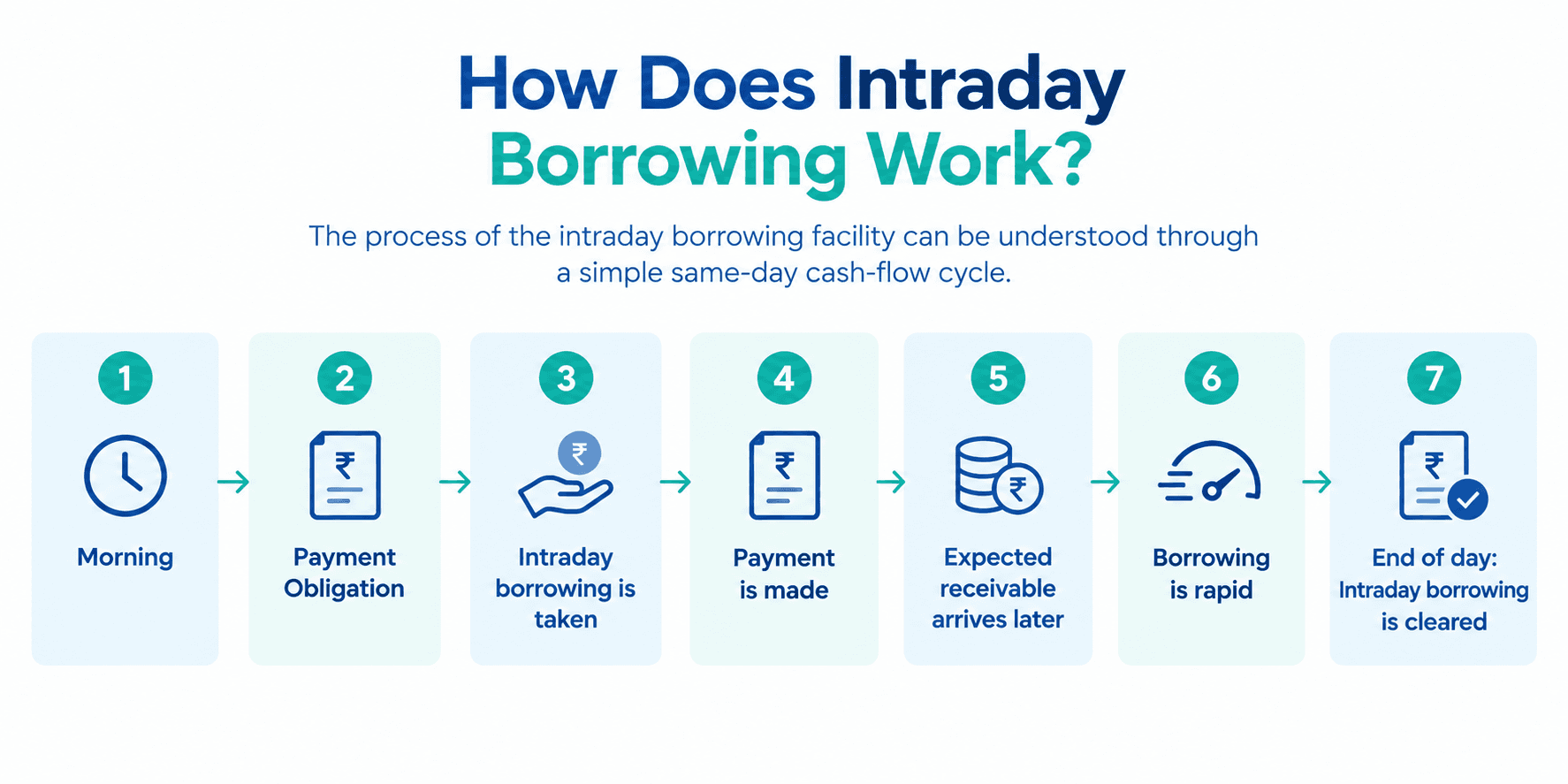
For example, suppose a scheme needs INR 150 crore for an eligible payment in the morning and expects INR 150 crore from an eligible receivable later that day. In this scheme, intraday borrowing is used to bridge the gap, subject to SEBI conditions. When the INR 150 crore receivable arrives, the borrowed amount is repaid.
It requires same-day repayment, which makes it different from other borrowing facilities.
Intraday Borrowing Vs Regular Mutual Fund Borrowing
The regular borrowing by a mutual fund is generally capped at 20% of the scheme's net assets and cannot remain outstanding for more than six months. Whereas mutual fund intraday borrowing works differently.
Let us understand this better with the below mentioned comparison:
| Features | Intraday Borrowing | Regular Borrowing |
| Main Purpose | Manage same-day liquidity mismatch | Meet specified temporary funding needs |
| Duration | Intended to end within the same day | Can remain outstanding subject to regulations |
| Permitted Use | Specified payouts, investment payings, MTM, forex settlements | Purposes permitted under Regulation 42(1) |
| Borrowing Basis | Linked to specified receivables with an additional provision for certain unitholder payouts | Subject to applicable borrowing limits |
| Investment leverage | Not intended to increase investment exposure | Not a general-purpose investment facility |
What Does Intraday Borrowing Mean For Mutual Fund Investors?
For investors, borrowing is mainly a liquidity management tool. Here are features of the intraday borrowing facility.
- It helps mutual funds manage the temporary gap between cash inflows and outflows.
- The scheme makes eligible payments on time when the expected money is due later in the day.
- The borrowed amount cannot be used to make any additional investments or increase investment exposure.
- The borrowing is subject to SEBI rules and must be repaid by the end of the day.
- The AMC bears the cost of intraday borrowing, so this cost is not passed on to the scheme.
What Changed With The 2026 Intraday Borrowing Framework?
The key changes in 2026 were the move from a narrow intraday borrowing provision to a more detailed framework covering different types of same-day liquidity mismatches.
1. Better Liquidity Management
The framework gives mutual funds a regulated way to manage short-term cash mismatches, which can help them meet eligible payment obligations on time.
2. No Permission for Extra Investment Leverage
Intraday borrowing is meant for temporary liquidity needs. It is not provided for making additional investments.
3. AMC Bears the Borrowing Cost
AMC must bear the cost of intraday borrowing, so the cost is not passed on to the mutual fund scheme.
4. Limited Impact on Investment Risk
The framework does not change the normal market risk of a mutual fund. The scheme’s investment performance will still depend on the securities it holds and their market performance.
5. More Regulatory Oversight
AMCs must follow SEBI’s conditions, maintain records, and have an approved intraday policy. These things provide transparency around the use of the facility.
Conclusion
SEBI’s 2026 framework provides mutual funds with a regulated mechanism to manage temporary same-day cash-flow mismatches. By limiting intraday borrowing to specified purposes and requiring repayment by the end of the day, the framework aims to support liquidity management without turning borrowing into a regular funding source.
For investors, the change primarily relates to how mutual funds manage short-term liquidity. The underlying investment risks of a scheme continue to depend on the securities it holds, their performance, and the scheme’s investment strategy.
FAQs

Want to stay at the top of your finances?
Join the community of 22 lakh+ investors and learn more about Grip Invest, the latest financial knick-knacks, and shenanigans in the world of investing.
Happy Investing!
Disclaimer - Investments in debt securities/municipal debt securities/securitised debt instruments are subject to risks including delay and/ or default in payment. Read all the offer related documents carefully. The investor is requested to take into consideration all the risk factors before the commencement of trading.
This communication is prepared by Grip Broking Private Limited (bearing SEBI Registration No. INZ000312836 and NSE ID 90319) and/or its affiliate/ group company(ies) (together referred to as “Grip”) and the contents of this disclaimer are applicable to this document and any and all written or oral communication(s) made by Grip or its directors, employees, associates, representatives and agents. This communication does not constitute advice relating to investing or otherwise dealing in securities and is not an offer or solicitation for the purchase or sale of any securities. Grip does not guarantee or assure any return on investments and accepts no liability for consequences of any actions taken based on the information provided. For more details, please visit www.gripinvest.in
Registered Address - 106, II F, New Asiatic Building, H Block, Connaught Place, New Delhi 110001


