

Corporate Bond Interest Rates How They Work And What Investors Should Check



Corporate bond interest rates indicate the interest an issuer pays on money borrowed through a bond. However, the coupon rate alone does not determine an investor’s overall return. The purchase price, payment schedule, maturity, credit rating and repayment terms also matter.
Understanding these factors can help investors compare corporate bonds beyond their advertised interest rates and assess how the bond’s price and cash flows affect its potential return.
One of the first things that needs to be done is to compare three important numbers including, face value, purchase price and yield at maturity. If different, coupon payment alone would not do the job. Keep reading the blog to understand it better.
What Are Corporate Bond Interest Rates
When a company issues a corporate bond, it essentially gets money loaned out to it by the buyer for a definite period. As agreed by the corporation that issues the bond, and by the buyer, the bond issuer will be paying interest on the loaned money. They will also return back the amount of principal according to the bond terms.
Consider a bond that has a face value of INR 1,000, and coupon payment rate of INR 80 annually. The interest is being calculated from INR 1,000. This would still hold true in case the corporate bond is bought at INR 980. If the issuer then repays INR 1,000 at maturity, the INR 20 difference between your purchase price and redemption value also contributes to your return.
That is why Corporate Bond Interest Rates in India should be read alongside the price paid. The example assumes all scheduled payments are made; it does not mean every bond bought below face value will deliver the same return.
How Do Corporate Bond Interest Rates Work
Every bond has a cash-flow schedule. It explains:
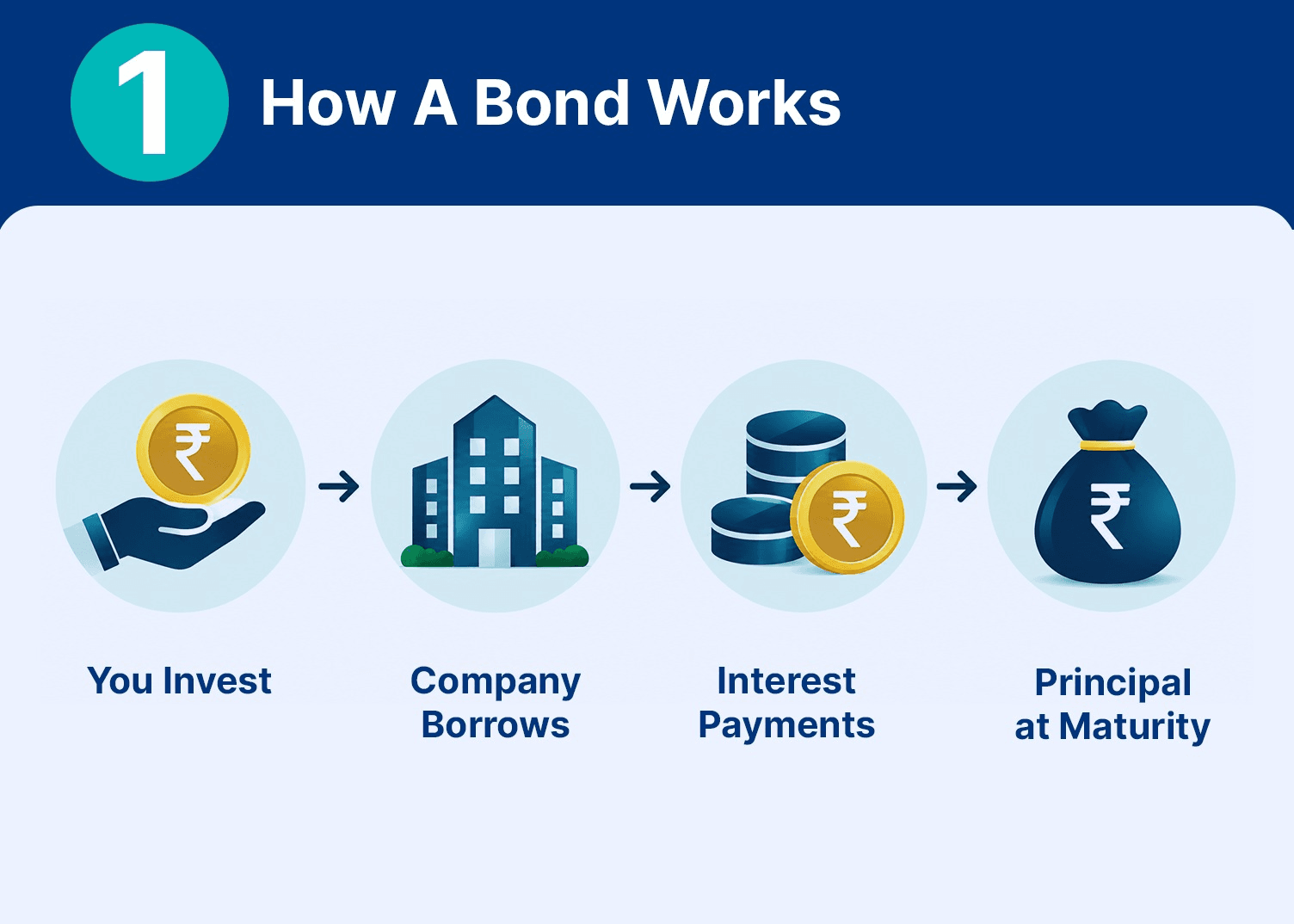
- How often interest will be paid
- When the principal will be returned
- Whether repayment will happen at once or in instalments
- Whether the issuer can redeem the bond early
In a fixed-rate bond, the coupon normally stays the same. Despite this, the market price of the bond may change.
For instance, if a new bond is issued that has a higher interest rate than the previous one, the old bond may lose its value as people will prefer to invest in the new one. Alternatively, if interest rates fall, older bonds may become more valuable.
This price movement is critical when selling it before bond maturity. If the bond is held until maturity, however, the focus switches to whether or not the issuer will pay.
What Determines Corporate Bond Interest Rates In India
Why is it that one bond may pay 9% interest while another pays 12%? The difference lies in the terms and the risks attached to the bonds.
1. Issuer’s Repayment Capacity
A company with steady cash flow and manageable debt may be able to borrow at a lower rate. One with strained finances may have to offer more to attract investors.
The higher rate is only useful if the company can make the promised payments, so examine its financial position as well as the coupon.
2. Credit Rating
A corporate bond credit rating expresses a rating agency’s assessment of credit risk. It gives you a starting point for comparing issuers, but it is neither a repayment guarantee nor a substitute for reading the bond terms. Ratings can change as an issuer’s finances change, so check the current rating and its outlook.
3. Time Left Until Maturity
The longer your money is committed, the more time there is for market rates or the issuer’s business conditions to change. Investors may seek a higher yield for that uncertainty. Compare the remaining tenure with the date when you might need the money: selling early could mean accepting the market price available then.
4. Security And Repayment Terms
A secured bond is backed by specified assets. An unsecured bond does not carry the same collateral support.
The following terms can also affect the rate:
- Seniority of the bond
- Security cover
- Principal repayment structure
- Call or put options
- Investor-protection covenants
5. Market Conditions
Inflation, government bond yields, RBI policy expectations and demand for debt securities affect the rates at which companies can borrow.
They also influence the prices of bonds already trading. As prices move, the corporate bond yield available to a new buyer can move even though a fixed coupon has not changed.
Corporate Bond Coupon Rate Vs Yield To Maturity
The corporate bond coupon rate is the annual interest calculated on the bond’s face value. Yield to maturity, commonly called YTM, estimates the annualised return if you buy the bond at the quoted price, receive all scheduled payments and hold it until maturity.
YTM considers:
- Purchase price
- Remaining coupon payments
- Time until maturity
- Principal repayment
- Redemption value
This makes YTM useful when two bonds have similar coupons but different prices or maturities.
Understanding Coupon And Yield With An Example
A bond listing simplifies the distinction between the coupon and the yield. In the case of the Muthoot Fincorp bond below, the values are presented with the face value as well as the monthly payment plan of the bond. Analyzing both the coupon and the yield helps in interpreting the actual amount the bond will pay and what is meant by the yield.
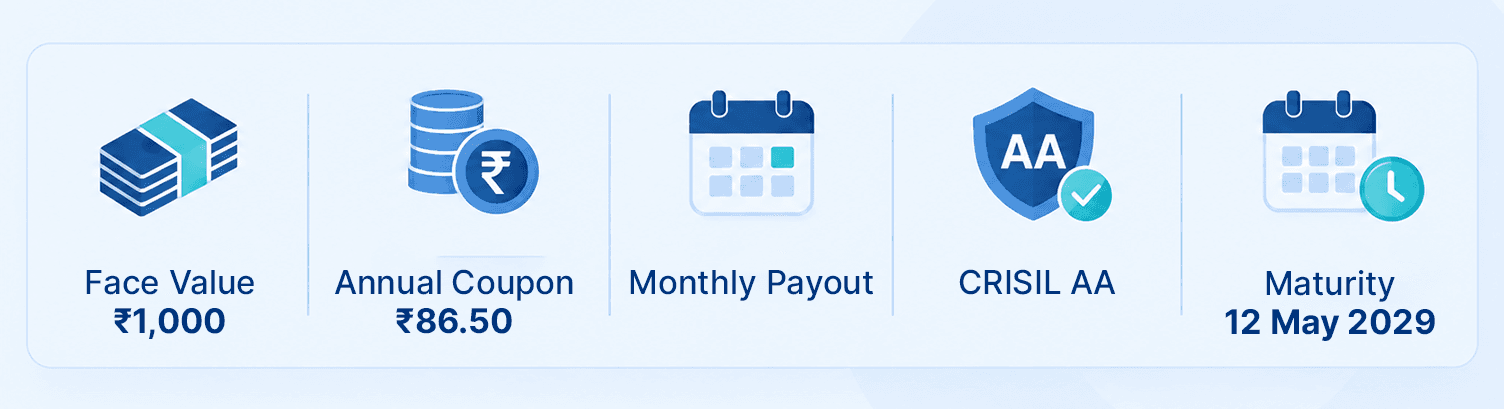
The following details appeared on Grip Invest’s public bond directory on 18 September 2026.
Muthoot Fincorp Limited 8.65% 2029 Bond
Detail | Muthoot Fincorp Limited 8.65% 2029 Bond |
| ISIN | INE549K07IF6 |
| Face value | INR 1,000 |
| Minimum investment displayed | INR 1,001 |
| Coupon | 8.65% per annum |
| Payment frequency | Monthly |
| Yield on Grip | 8.85% |
| Rating | CRISIL AA |
| Maturity | 12 May 2029 |
Corporate Bond Interest Calculation
The annual coupon for one bond can be calculated as follows:
INR 1,000 × 8.65% = INR 86.50 per year
As the bond carries monthly payments, the interest is distributed through it. The given YTM value of 8.85% is based on the price paid for the bond, the future payments that are remaining, and the value at maturity.
The bond has a coupon rate of 8.65% and a YTM of 8.85%, a difference of 20 basis points. The coupon represents the interest payable on the bond’s face value, while YTM estimates the annualised return based on the purchase price and expected cash flows if held until maturity.
The minimum investment is not sufficient in itself to conclude a calculation for YTM since it involves more complex calculations involving total price paid and the cash flow analysis.
How To Read A Corporate Bond Listing
Reading a corporate bond listing involves checking its key terms, payment schedule, pricing and repayment details.
1. Confirm The ISIN
ISIN helps to precisely identify the specific security. The same issuer can have different bonds with different coupon rates, credit rating and term to maturity.
2. Check The Coupon And Payment Frequency
Calculate interest using the face value, then look at the payment schedule. An 8% coupon on INR 1,000 represents INR 80 in annual interest. A monthly payment schedule spreads that interest across scheduled monthly payments; it does not mean an 8% payment each month.
3. Compare Price And YTM
While the coupon provides you with interest of face value of the bond, Yield To Maturity gives you broader measure of potential annualised return based on market price and future payments.
4. Review The Rating And Security
Check:
- The credit rating and rating agency
- Whether the bond is secured
- Its seniority
- The available security cover
- Any protective covenants
5. Read The Repayment Schedule
Some bonds return total capital upon maturity, while others make periodic repayments. This variability can affect cash flow and the amount of capital remaining invested.
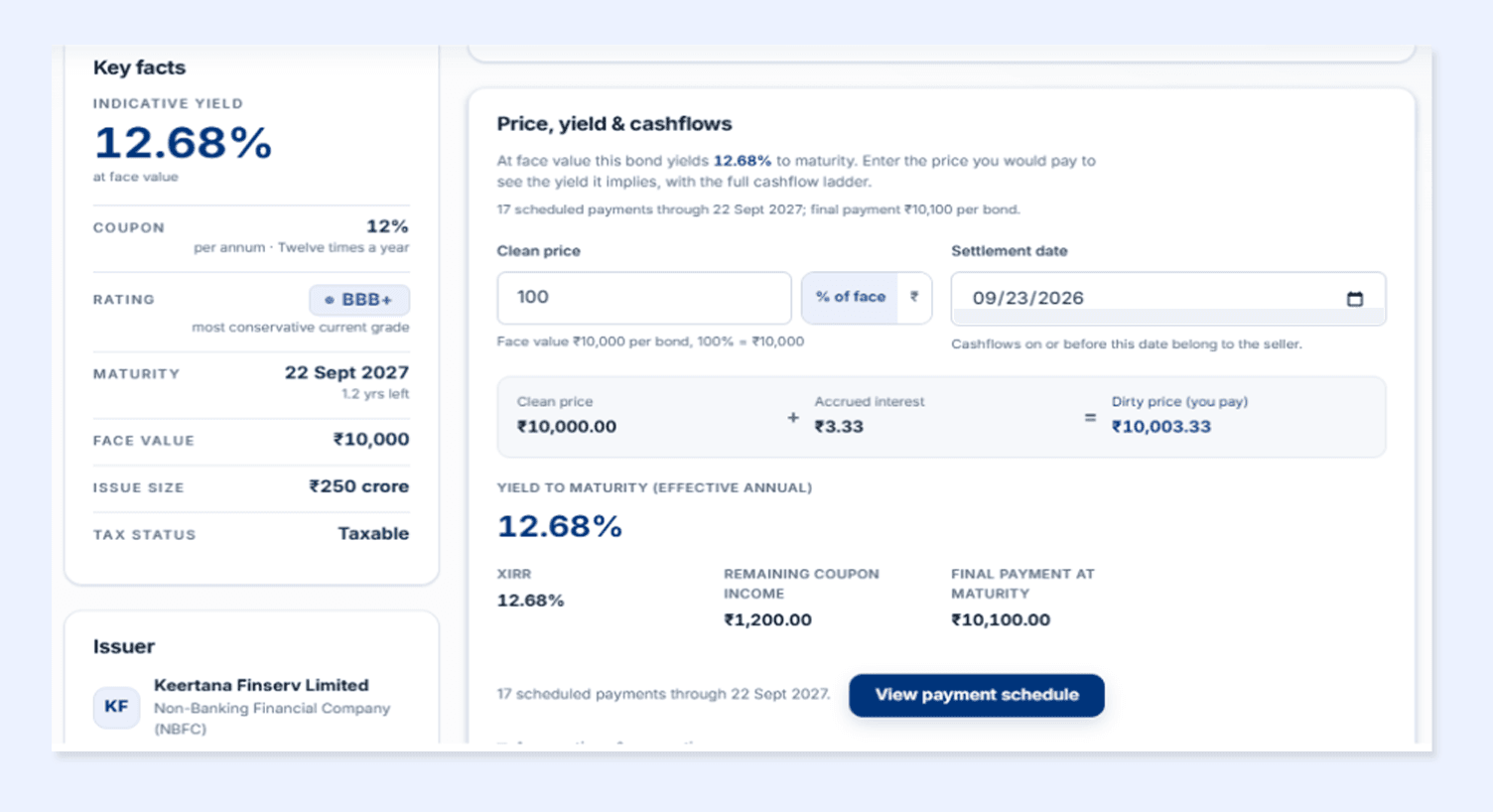
For example: Grip Invest lists the Keertana Finserv Limited 12% 2027 bond with an INR 10,000 face value, a 12% annual coupon paid monthly, and a final scheduled payment of INR 10,100 on 22 September 2027. The listing shows 17 scheduled payments, so readers should check the full cash-flow schedule to see how much arrives on each date.
The displayed 12.68% indicative YTM is calculated at face value; it is not a yield based on a quoted market purchase price.
Corporate Bond Interest Rates Vs Bank FD Interest Rates
Higher advertised rates, however, do not mean that a bond is more advantageous than a fixed deposit.
These investment vehicles involve different risks and exit options.
Factor | Direct Corporate Bond | Bank Fixed Deposit |
| Return measure | Coupon, price and YTM | Contracted deposit rate |
| Main risk | Issuer credit and default risk | Bank credit risk |
| Early exit | Depends on buyers, liquidity and price | Usually permitted with a penalty |
| Value before maturity | Market value can change | Deposit value does not normally fluctuate |
| Deposit insurance | Not covered by DICGC | Eligible deposits covered within the DICGC limit |
| Tax | Coupon is generally taxable | Interest is generally taxable |
The DICGC insures eligible deposits up to INR 5 lakh per depositor per bank, including principal and interest together. This protection does not apply to direct corporate bonds.
Before choosing between the two, ask:
- When will I need the money?
- Can I accept credit and liquidity risk?
- What will the post-tax return be?
- Do I need regular income?
- What happens if I exit early?
Common Mistakes To Avoid
A large percentage can attract attention, but it may hide important details. Avoid these common mistakes:
- Treating the coupon as the final return
- Ignoring the purchase price
- Comparing bonds with different ratings as equal-risk options
- Assuming “fixed return” means guaranteed repayment
- Overlooking call options or staggered principal payments
- Expecting immediate liquidity in the secondary market
- Comparing a pre-tax bond return with a post-tax FD return
Final Checklist Before Investing
Before placing an order, make sure you can answer these five questions:
- What is the coupon and how frequently will it be paid?
- What is the current YTM?
- What does the credit rating indicate?
- When and how will the principal be repaid?
- Can I hold the bond until maturity if an early buyer is unavailable?
Corporate bond interest rates are useful for finding potential opportunities. Your final decision should also account for the price, payment schedule, issuer’s financial position and possible exit conditions.
FAQs

Want to stay at the top of your finances?
Join the community of 22 lakh+ investors and learn more about Grip Invest, the latest financial knick-knacks, and shenanigans in the world of investing.
Happy Investing!
Disclaimer - Investments in debt securities/municipal debt securities/securitised debt instruments are subject to risks including delay and/ or default in payment. Read all the offer related documents carefully. The investor is requested to take into consideration all the risk factors before the commencement of trading.
This communication is prepared by Grip Broking Private Limited (bearing SEBI Registration No. INZ000312836 and NSE ID 90319) and/or its affiliate/ group company(ies) (together referred to as “Grip”) and the contents of this disclaimer are applicable to this document and any and all written or oral communication(s) made by Grip or its directors, employees, associates, representatives and agents. This communication does not constitute advice relating to investing or otherwise dealing in securities and is not an offer or solicitation for the purchase or sale of any securities. Grip does not guarantee or assure any return on investments and accepts no liability for consequences of any actions taken based on the information provided. For more details, please visit www.gripinvest.in
Registered Address - 106, II F, New Asiatic Building, H Block, Connaught Place, New Delhi 110001


