

Foreign Investment In Government Bonds In India: How It Works And Why It Matters



What Is Foreign Investment In Government Bonds In India?
Foreign investment in government bonds (India) is money placed by overseas investors in debt issued by the Central or state governments. Most of it comes through registered Foreign Portfolio Investors (FPIs), which buy eligible Central Government Securities and State Government Securities under permitted routes.
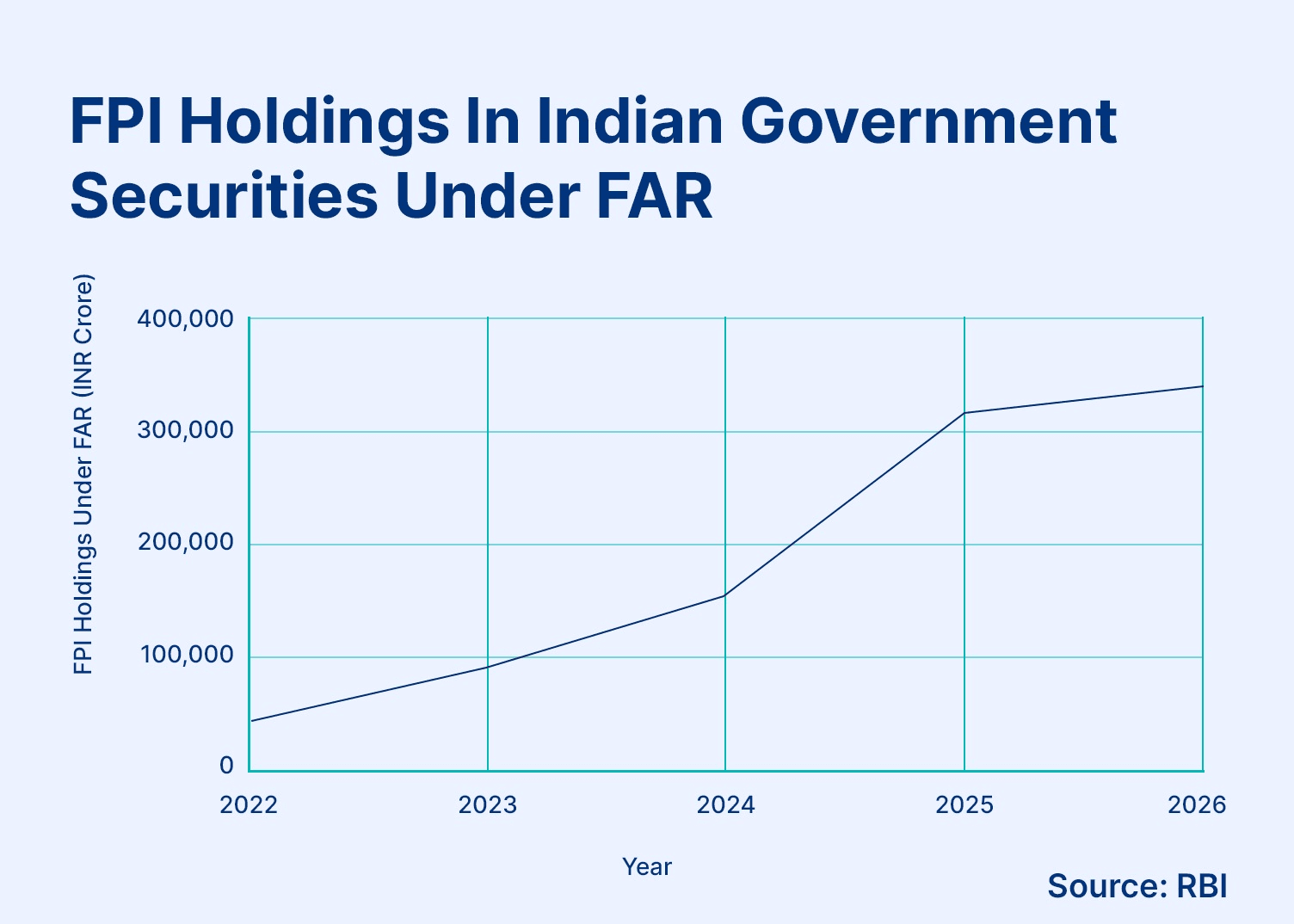
As of 12 May 2026, FPIs held INR 3,75,171 crore of Indian government securities, accounting for 3.34% of the market. Of this, INR 3,21,080 crore was invested through FAR.1
How Can Foreign Investors Invest In Indian Government Bonds?
For current FPI investment in government bonds, the two main channels are:
General Route
The General Route is the standard capped route for FPI investment in government debt. For FY2026-27, the overall limits are 6% of outstanding Central Government securities and 2% of State Government Securities.2 Since 1 April 2026, investments that earlier sat under the Voluntary Retention Route are counted within General Route limits.3
Fully Accessible Route
The Fully Accessible Route covers only securities designated as eligible for FAR. Unlike the General Route, these specified Central Government securities do not carry an overall foreign investment ceiling. The route therefore gives eligible investors uncapped access to a defined part of the sovereign bond market.
What Is The Fully Accessible Route (FAR)?
RBI introduced the Fully Accessible Route, or FAR, from 1 April 2020. It allows eligible non-resident investors to invest in specified Central Government securities without the quantitative ceilings used under the General Route.4
Eligibility depends on the security, not simply on whether it is a government bond. RBI identifies the issues treated as “specified securities”, while other eligible G-Secs remain subject to the applicable investment route and limits. Domestic investors can continue to buy the same FAR-designated securities.
For FAR government bonds, the absence of an overall foreign ownership cap matters for large global investors and index-linked funds. It also gives index providers a clearer pool of Indian sovereign bonds that foreign investors can access. FAR-eligible securities have since been included in major emerging-market bond indices.
Why Is India Attracting More Foreign Investment Into Government Bonds?
Foreign buying accelerated in June 2026, when FPIs purchased nearly USD 3 billion of FAR bonds. That was the highest monthly inflow recorded under the route and exceeded the roughly USD 1.7 billion bought from January to May combined.5
Several factors were behind the June pickup.
- From 1 April, qualifying FPI interest and capital gains on G-Secs became tax-exempt. In June, RBI also widened FAR eligibility to additional long-dated securities.7
- Global bond indices were already bringing more attention to Indian G-Secs. JPMorgan added eligible bonds to its GBI-EM index in June 2024, while FTSE started including them in stages from September 2025.8
- Brent crude dropped more than 20% in June, which eased some concerns around inflation and India's import bill, although currency moves and global rates still shaped foreign demand.9
The June surge did not happen in isolation. It came during a year when the rules governing foreign investment in Indian debt were changing on several fronts.
2026 Changes Affecting Foreign Investment In Indian Government Bonds
The main 2026 changes centred on tax, market access and compliance:
1. 1 April: Qualifying FPI interest income and capital gains from G-Secs became tax-exempt. VRR investments also started counting towards General Route limits.10
2. 1 June: SEBI's SWAGAT-FI rules came into effect. Eligible trusted foreign investors could use a unified registration process instead of completing the same requirements separately across investment routes.11
3. 5 June: RBI added new 15-year, 30-year and 40-year G-Secs to FAR, along with Sovereign Green Bonds in eligible tenors. It also removed the short-term, concentration and security-wise restrictions that applied under the General Route.12
4. 31 July: Bloomberg postponed the inclusion of Indian G-Secs in its Global Aggregate Index. It wanted more time to assess how the recent access reforms worked in regular market conditions.13
5. 7 September: SEBI removed the investor-group disclosure requirement for FPIs investing only in government securities.14
Together, these developments changed the operating framework for foreign investment in Indian debt during 2026.
How Do Foreign Inflows Affect Indian Government Bond Yields And Prices?
Foreign purchases add to demand for G-Secs. If other market forces are unchanged, stronger demand supports prices and pulls yields lower because the bond's fixed cash flows are being bought at a higher price.
For example, in June-July 2026, nearly USD 6.5 billion flowed into Indian government bonds from early June to 14 July, while the benchmark 10-year yield fell about 25 basis points to 6.73%. The move was not driven by foreign buying alone. Tax changes, RBI policy and currency conditions were also influencing yields.
Selling reverses that pressure. More bonds offered into the market can push prices down and yields up.
Foreign flows matter, but RBI policy, inflation, government borrowing and domestic demand can outweigh them.
Foreign Investment In Government Bonds Vs Corporate Bonds In India
Government and corporate bonds both form part of foreign investment in Indian debt, but the risks and access rules differ.
Factor | Government Bonds | Corporate Bonds |
Issuer | Central or state governments | Companies |
FPI access | General Route and FAR for specified G-Secs | General Route |
FAR eligibility | Specified Central G-Secs only | Not applicable |
FY2026-27 General Route limit | 6% for G-Secs and 2% for SGSs | 15% of outstanding corporate bonds |
Credit risk | Sovereign or state issuer exposure | Depends on the issuing company |
Liquidity | Generally deeper in benchmark G-Secs | Varies by issuer and security |
Yield | Driven mainly by sovereign rates and maturity | Usually includes a credit spread |
Source: Reuters15
The FY2026-27 limits of 6%, 2% and 15% apply to G-Secs, SGSs and corporate bonds respectively under the General Route.
The yield gap is not free return. Corporate debt adds company-specific credit and liquidity risk. For Foreign Investment Government Bonds India, government debt instead gives investors direct exposure to sovereign interest rates, duration and currency movements.
FAQs

Want to stay at the top of your finances?
Join the community of 22 lakh+ investors and learn more about Grip Invest, the latest financial knick-knacks, and shenanigans in the world of investing.
Happy Investing!
Disclaimer - Investments in debt securities/municipal debt securities/securitised debt instruments are subject to risks including delay and/ or default in payment. Read all the offer related documents carefully. The investor is requested to take into consideration all the risk factors before the commencement of trading.
This communication is prepared by Grip Broking Private Limited (bearing SEBI Registration No. INZ000312836 and NSE ID 90319) and/or its affiliate/ group company(ies) (together referred to as “Grip”) and the contents of this disclaimer are applicable to this document and any and all written or oral communication(s) made by Grip or its directors, employees, associates, representatives and agents. This communication does not constitute advice relating to investing or otherwise dealing in securities and is not an offer or solicitation for the purchase or sale of any securities. Grip does not guarantee or assure any return on investments and accepts no liability for consequences of any actions taken based on the information provided. For more details, please visit www.gripinvest.in
Registered Address - 106, II F, New Asiatic Building, H Block, Connaught Place, New Delhi 110001


