

Special Tenure FD vs Regular FD: Key Differences Explained



Special Tenure vs Regular FD: What is the Difference?
Fixed deposits (FDs) are often treated as a simple choice. However, the type of FD you choose can affect how long your money remains locked in, the interest you earn, and how easily you can get access to your deposit before maturity.
The primary difference between a special tenure FD and a regular FD is the structure. Special tenure FDs are offered for special periods. Whereas regular FDs provide a wider choice of standard tenures. They also provide different interest rates and levels of flexibility. Therefore, it is important to evaluate the interest rate, withdrawal rules, and exact tenure before investing in an FD.
What Is A Special Tenure FD?
A special tenure FD is a fixed deposit offered by a bank for a specific period, such as 444 days, 300 days, 35 months, or 55 months, instead of the regular 1 year, 3 years, or 5 years duration slab. Banks launch these time-bound campaigns with a fixed tenure to mobilise deposits. For example, SBI’s Amrit Vrishti Scheme offers a fixed 444-day tenure at 6.45% p.a. for general citizens and 6.95% p.a. for senior citizens, effective from 15 December 2025.1
What Is A Regular FD?
A regular FD is a standard fixed deposit at a bank’s published rate slab, where the tenures range typically from 7 days to 10 years. Unlike special tenures, regular FDs are not tied to a promotional window and are always available at the bank. The interest rate is periodically revised based on RBI policy and the bank’s liquidity. For example, as of March 2026, HDFC Bank’s regular FD rates range from 2.75% to 6.50% p.a. for tenures between 7 days and 10 years.2
Special Tenure vs Regular FD: Key Differences
Both special tenure and regular FD are lump sum deposits with a fixed maturity. However, they differ in the interest rate, flexibility, and duration.
| Basis | Special Tenure FD | Regular FD |
| Interest Rate | Often marginally different from nearby regular slabs, which is not guaranteed to be the highest | Follows the published slab, which is fixed and stable until the next revision |
| Maturity Date | Fixed by the scheme’s exact day count | Fixed by the depositor while booking |
| Tenure | Fixed and non-standard duration set by the bank (e.g. 444 days, 35 months) | Any duration within the bank’s standard range (7 days to 10 years) |
| Flexibility | None, since the tenure is fixed by the bank itself | Allowed to pick any tenure within the published ranges |
Source: FI Money3
They both carry the same DICGC deposit insurance cover of INR 5 lakh per depositor, which exempts safety from its differentiator.
Does a Special Tenure FD Always Offer Higher Returns?
This is a common misconception. Not all special tenures provide higher returns. However, they are marketed as high-return products, but the rate depends on the bank’s funding requirements.
Let us consider a hypothetical deposit of INR 5,00,000. In SBI’s 444-day Amrit Vrishti scheme at 6.45% p.a., effective from December 2025, the deposit would grow to approximately INR 5,40,148 at maturity. However, in SBI’s 1-year FD at 6.25% p.a., the deposit would grow to around INR 5,31,990.
However, this is not universal. As of HDFC Bank’s March 2026 rate card, its special-edition 55-month FD offers 6.40% p.a., which is lower than its 3-year-1-day and 4-year-7-month slabs at 6.50% p.a. Therefore, it is important to compare the actual rate against neighbouring regular slabs before assuming the special tenure wins.
Checklist Before Choosing Between a Special and Regular FD?
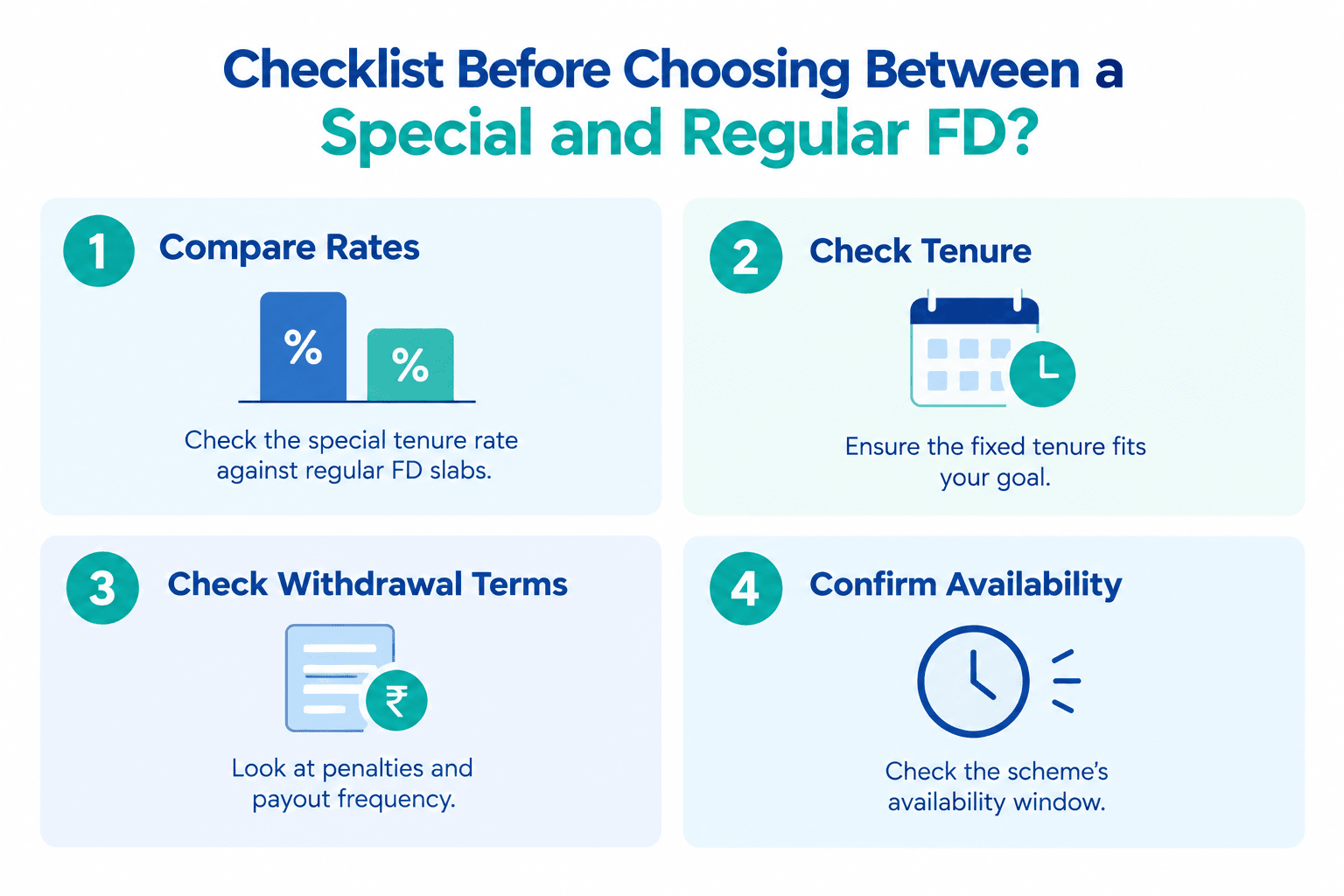
The following are factors to consider before choosing between a special tenure FD and a regular FD.
- Compare the special tenure’s rate against regular FD rate slabs for similar duration.
- Check the fixed tenure and if it aligns with the timeline of the deposit objective, since special tenure durations can not be adjusted.
- Check withdrawal penalties if withdrawn before maturity and payout frequency, i.e., monthly, quarterly, or on maturity, for both the FDs.
- Confirm the scheme’s availability window, since special tenure FDs can be withdrawn without much notice.
FAQs

Want to stay at the top of your finances?
Join the community of 22 lakh+ investors and learn more about Grip Invest, the latest financial knick-knacks, and shenanigans in the world of investing.
Happy Investing!
Disclaimer - Investments in debt securities/municipal debt securities/securitised debt instruments are subject to risks including delay and/ or default in payment. Read all the offer related documents carefully. The investor is requested to take into consideration all the risk factors before the commencement of trading.
This communication is prepared by Grip Broking Private Limited (bearing SEBI Registration No. INZ000312836 and NSE ID 90319) and/or its affiliate/ group company(ies) (together referred to as “Grip”) and the contents of this disclaimer are applicable to this document and any and all written or oral communication(s) made by Grip or its directors, employees, associates, representatives and agents. This communication does not constitute advice relating to investing or otherwise dealing in securities and is not an offer or solicitation for the purchase or sale of any securities. Grip does not guarantee or assure any return on investments and accepts no liability for consequences of any actions taken based on the information provided. For more details, please visit www.gripinvest.in
Registered Address - 106, II F, New Asiatic Building, H Block, Connaught Place, New Delhi 110001


