

Why Is India’s 10-Year Bond Yield Rising? Key Factors Explained



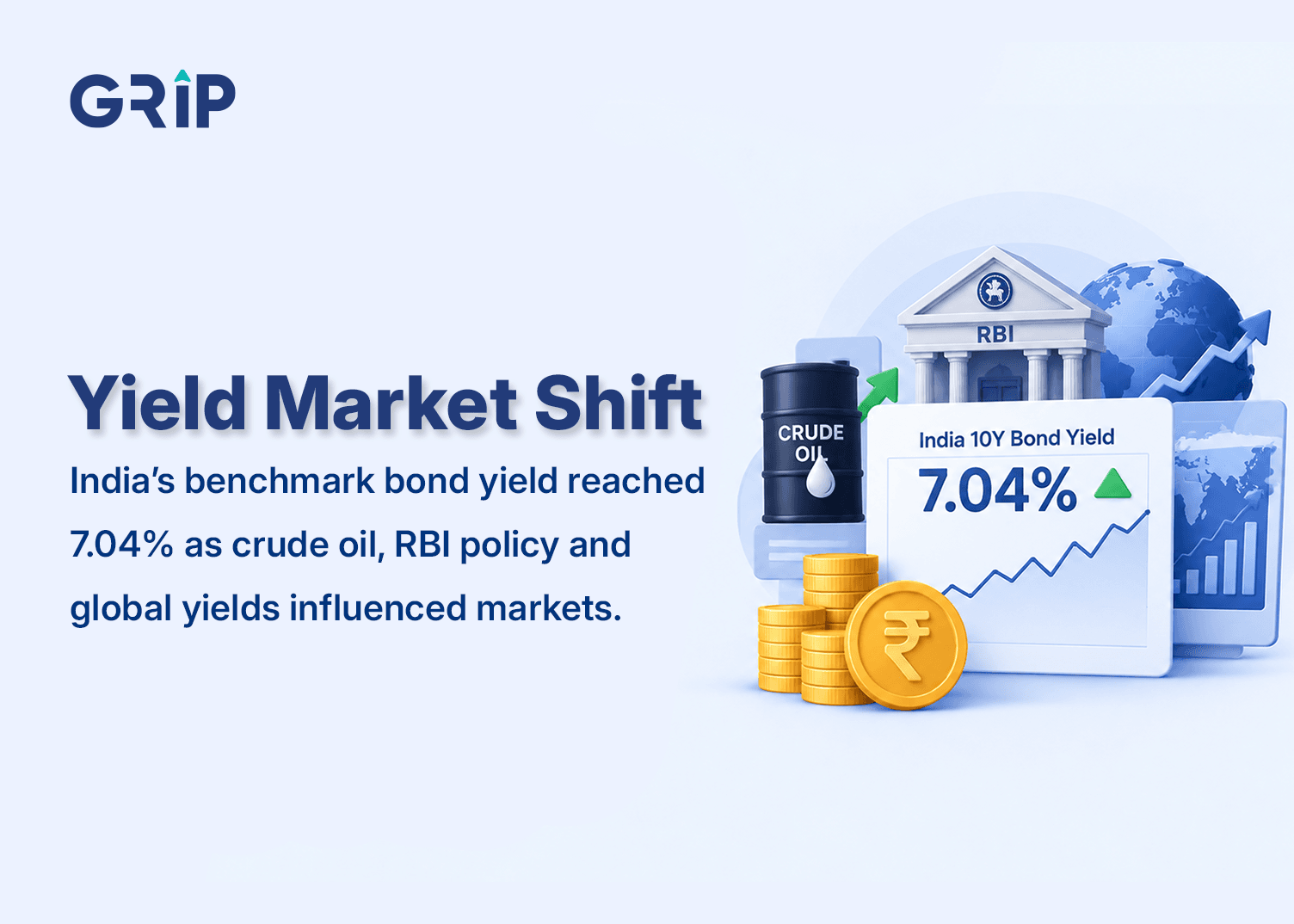
What is The India 10 Year Bond Yield?
The India 10-year bond yield is the annual return the government promises an investor who buys its 10-year government security (G-Sec) and holds it for the full tenure. It is set by the coupon rate at issuance, but the yield earned after buying it in the secondary market moves frequently, as bond yields and prices move in opposite directions.
Suppose a 10-year G-Sec is issued at a face value of INR 100 with a 6.94% coupon rate. If the bond demand falls and its price drops to INR 97, the coupon payment will represent a higher return at the lower price. Hence, the yield rises. This indicates that investors are demanding a higher return on current prices, possibly due to inflation or better alternatives.
Why Does The India 10 Year Bond Yield Move?
The 10-year bond yield is treated as the benchmark for the entire Indian debt market, so its movements reflect a range of factors. As of September 2026, the inflation is based on CPI, rupee movement, banking-system liquidity, US Treasury yield, foreign portfolio investor (FPI) flows, crude oil, geopolitical developments, US Federal Reserve policy, and investor risk sentiment as the primary factors shaping the 10-year bond yield. The Reserve Bank of India policy stance and its liquidity operations matter most, since it is the regulator and one of the largest participants in the bond markets.
How Does Inflation Affect The India 10 Year Bond Yield?
Inflation erodes the real return an investor earns from a fixed-coupon bond. Therefore, the bond market prices in expected inflation when demanding a yield rise. If inflation is expected to rise, investors demand a higher yield to compensate for the erosion in purchasing power over the bond’s 10-year life.
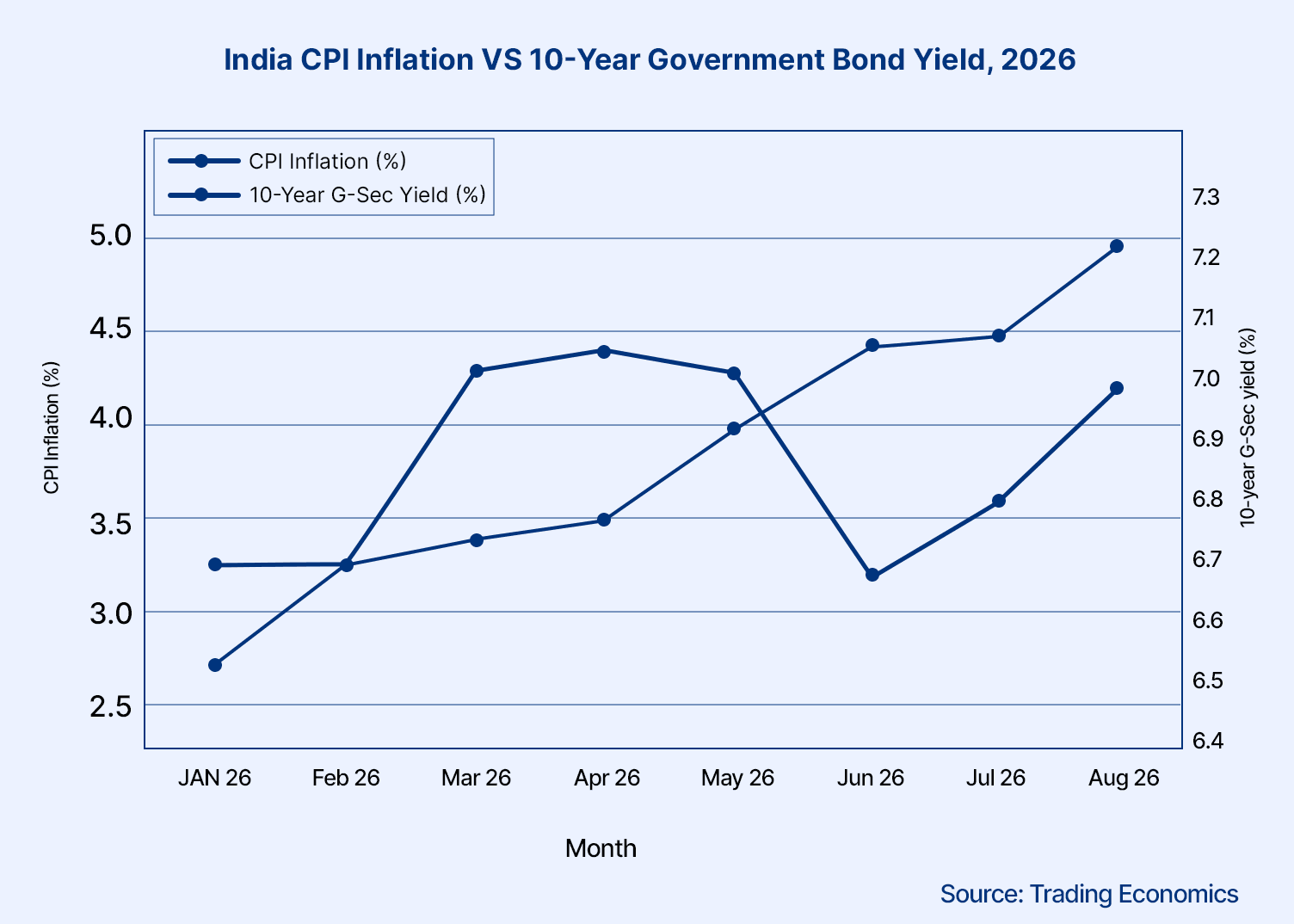
Retail inflation (CPI) in India has been on a gradual uptrend through 2026, climbing from 2.75% in January to 4.82% in August, its highest reading since December 2024.1
Source: Trading Economics2
The CPI figures are recorded as January CPI was 2.74%, rising to 3.21% in February, 3.40% in March, 3.48% in April, 3.93% in May, 4.38% in June, 4.45% in July and 4.82% in August.
How Does RBI Policy Affect The 10 Year Bond Yield?
The RBI policy influences the 10-year bond yield through three main factors.
1. The Repo Rate: Markets often move the 10-year yield in anticipation of where the repo rate is headed. After cutting it by a cumulative 125 basis points through 2025 to 5.25, the RBI has held steady since. With August inflation at 4.82%, markets now price in a possible hike at the October 5-7 MPC meeting.
2. The Policy Stance: The RBI’s stance, whether accommodative, neutral, or tightening, indicates future intent. The current neutral stance leaves the market split between a hold and a hike.
3. Liquidity Operations: Open Market Operation (OMO) bond sales absorb rupee liquidity and increase the supply of securities available to the market. VRRR auctions also absorb surplus liquidity, but do not increase bond supply.3
What Is Driving The Recent India 10 Year Bond Yield Movement?
The benchmark 10-year yield moved above 7% on 11 September 2026, driven by a combination of rising crude oil prices, a broader global bond-market sell-off, and uncertainty around the RBI’s liquidity stance. Brent Crude had climbed above $100 a barrel, as an escalating Middle East conflict disrupted shipping through the Strait of Hormuz and the Red Sea, stoking fears of imported inflation for India, which sources the bulk of its crude overseas.4
The oil shock coincided with a global rout in sovereign bonds. The US 10-year Treasury yield pushed past 5% after the US Federal Reserve delivered a 25-basis-point rate hike on September 16, 2026, as persistently elevated US inflation forced its hand despite a slower labour market.5
Domestically, the RBI added to the pressure with its own liquidity withdrawal plan. After banks raised a larger-than-expected $133 billion through the RBI’s special forex mobilisation scheme, the central bank announced INR 1 trillion of bond sales through September to drain the resulting surplus liquidity from the banking system.6 The September 17 OMO sale itself drew strong demand, with INR 66,590 crore in bids against INR 50,000 crore on offer, which helped limit/cap rising pressure on yields. The rupee, meanwhile, weakened past 95.5 to the US dollar in mid-September.7
By September 21, Brent crude fell around 10% from the prior week's peak to around $98 a barrel as supply concerns receded.8 As of September 23, 2026, the 10-year yield stood at 7.04%, up roughly 17 basis points over the past month and 56 basis points higher than a year earlier, still elevated, but off its mid-month highs near 7.1%, as markets now turn their attention to the RBI's October 5–7 policy review for the next major signal.
What Does a Rising 10 Year Bond Yield Mean for Investors?
A rising 10-year yield affects different investors differently.
- Existing bondholders face a mark-to-market loss. If you bought a 10-year G-Sec when yields were at 6.75%, and yields subsequently rise to 7.05%, the market price of your bond falls, because new bonds now offer a better return at the same price. Selling before maturity locks in a capital loss, even though the bond hasn't defaulted on anything.
- New investors get better entry yields. A higher yield means fresh government bonds, and by extension corporate bonds, fixed deposits, and NCDs benchmarked off the G-Sec curve, start offering more attractive coupons. Someone allocating fresh capital today locks in a higher running yield than they would have three months ago, provided they're comfortable holding to maturity.
- The government's borrowing cost rises. Since new government bonds are issued at current market rates, higher yields can increase the government’s borrowing costs and put more pressure on the fiscal deficit.
What Should Investors Watch Next?
Investors must check the following factors while tracking the India 10-year bond yield.
1. RBI policy announcements: Investors may look up to the October 5-7 MPC outcome and any shift away from the neutral stance.
2. CPI inflation: They must check whether August’s 4.82% was a peak or just a trend.
3. Government borrowing: They must track bond auction sizes, yields, and the borrowing calendar.
4. Crude oil: They must check the oil prices, since higher prices may increase imported inflation.
5. US 10-year Treasury yield: The US Treasury yield is now above 4.9%, which is nearly a 2-decade high.
6. Global geopolitical developments: They must particularly check for any de-escalation or escalation in the Middle East.
7. Rupee movement: The currency movement should be evaluated, which is currently under pressure past 95.5/USD.9
8. Banking Liquidity: Investors must check the RBI liquidity operations and any system surplus or deficit.
9. FPI flows: They must check the FPI flows as foreign buying and selling can influence demand for bonds.
FAQs

Want to stay at the top of your finances?
Join the community of 22 lakh+ investors and learn more about Grip Invest, the latest financial knick-knacks, and shenanigans in the world of investing.
Happy Investing!
Disclaimer - Investments in debt securities/municipal debt securities/securitised debt instruments are subject to risks including delay and/ or default in payment. Read all the offer related documents carefully. The investor is requested to take into consideration all the risk factors before the commencement of trading.
This communication is prepared by Grip Broking Private Limited (bearing SEBI Registration No. INZ000312836 and NSE ID 90319) and/or its affiliate/ group company(ies) (together referred to as “Grip”) and the contents of this disclaimer are applicable to this document and any and all written or oral communication(s) made by Grip or its directors, employees, associates, representatives and agents. This communication does not constitute advice relating to investing or otherwise dealing in securities and is not an offer or solicitation for the purchase or sale of any securities. Grip does not guarantee or assure any return on investments and accepts no liability for consequences of any actions taken based on the information provided. For more details, please visit www.gripinvest.in


