

Top Specialized Investment Funds (SIFs) To Invest In India In 2026


Specialized Investment Funds (SIFs) are SEBI?regulated schemes that sit between traditional mutual funds and high?ticket PMS/AIF products, offering strategy?driven portfolios such as long–short, sector?thematic and tactical asset allocation. SEBI formally introduced SIFs as a new asset class under the SEBI (Mutual Funds) Regulations, 1996 via the 2024 amendment, with the full framework made effective from April 1, 2025.
Each SIF strategy requires a minimum INR 10 lakh investment at the PAN level across all SIF strategies of an AMC, making sophisticated, semi?alternatives accessible to affluent but not only ultra?HNI investors. This blog explains the essence of SIF and the Best SIF Funds India, how SIFs work, the latest SEBI rules, evolving investor sentiment, and how to pick the right SIF strategy for your portfolio.
What Are Specialized Investment Funds?
SIFs are not be to be confused with AIFs; they are mutual fund schemes under a separate SIF category, but they borrow several features from PMS/AIF strategies such as concentrated bets, hedging and use of derivatives. SIFs pool funds for niche investment. Through professionally managed, focused investment in particular assets like real estate, commodities, private equity, etc., the Best SIF Funds India offer greater flexibility, control and sophistication than regular mutual funds, whilst avoiding the minimum investment requirement of INR 10 lakhs by Portfolio Management Services. The table offers a quick snapshot of SIFs3.
| Regulated By | SEBI |
| Minimum Investment | INR 10,00,000 |
| Investment Strategies | Equity-oriented schemes, debt-oriented schemes and hybrid schemes |
Source: SEBI4
Therefore, sophisticated investors are attracted to SIFs, owing to their advanced investment techniques (like tactical asset allocation, sector rotation), greater portfolio control, niche investing, etc.
Now, let us understand the Top SIF Funds India.
Best Performing SIF 2026
SEBI introduced SIF in December 2024. Subsequently, the first SIF to be launched was as recently as September 2025 by Quant5. Therefore, while several mutual fund houses are gearing up to make space in this new space of SIFs, the market in itself is fairly new. This results in a lack of the most common fund comparison metrics, like one-year or three-year returns, risk-adjusted metrics and so on.
Such a scenario calls for the utilisation of other metrics that aid in gauging potential SIF performance comparison, like portfolio structure, return anticipation, ratings, minimum investment, etc.
Discussed below is an analysis of SIFs active recently. This will aid in gauging the pattern of SIF performance comparison.
1. Quant Equity Long Short Fund
Launched on 17 September 2025, the new fund offer period of the Quant Equity Long Short Fund closed on 1 October 2025. The top three components of its portfolio are discussed below6.
| Asset | Range (%) | Risk |
| All cash cap equity or equity arbitrage | 65 to 100 | High or Low |
| All cap unhedged derivative strategies (Long) | 0 to 35 | High |
| All cap unhedged derivative strategies (Short) | 0 to 25 | High |
Now, let us look at some other metrics.
| Minimum Investment | INR 10 Lakhs |
| SIP | INR 10,000 |
| Entry Load | Nil |
| Exit Load | 1% if units redeemed or switched before 15 days from unit allotment |
| Risk Band Level | 5 |
| Fund Managers | Sandeep Tandon, Sameer Kate, etc. |
Return Anticipation (QSIF Equity Centric) | Underperformance in a raging bull market, Moderate performance in a bull market and outperformance in a bear market, volatile market, rage-bound market, etc. |
The fund has declared the NIFTY 500 Total Return Index (TRI) as its benchmark. The benchmark has delivered 149.62% growth in the past 5 years.
2. Quant Hybrid Long-Short Fund
The NFO period is between 25 September 2025 and 9 October 2025. The top three components of its portfolio are discussed below.
| Asset | Range (%) | Risk |
| Equity arbitrage or unhedged equity spot (Long) | 35 to 65 | Low or High |
| Debt | 25 to 65 | Moderate |
| Unhedged equity derivative strategies (Long) | 0 to 40 | High |
Now, let us look at some other metrics.
| Minimum Investment | INR 10 Lakhs |
| SIP | INR 10,000 |
| Entry Load | Nil |
| Exit Load | 1% if units redeemed or switched before 15 days from unit allotment |
| Risk Band Level | 5 |
| Fund Managers | Sandeep Tandon, Sameer Kate, etc. |
Return Anticipation (QSIF Equity Centric) | Underperformance in a raging bull market, Moderate performance in a bull market and outperformance in a bear market, volatile market, rage-bound market, etc. |
The fund has declared Nifty 50 Hybrid Composite Debt 50:50 Index as its benchmark. The 3 year return of the benchmark was at 12.37 as of 30 September 20257.
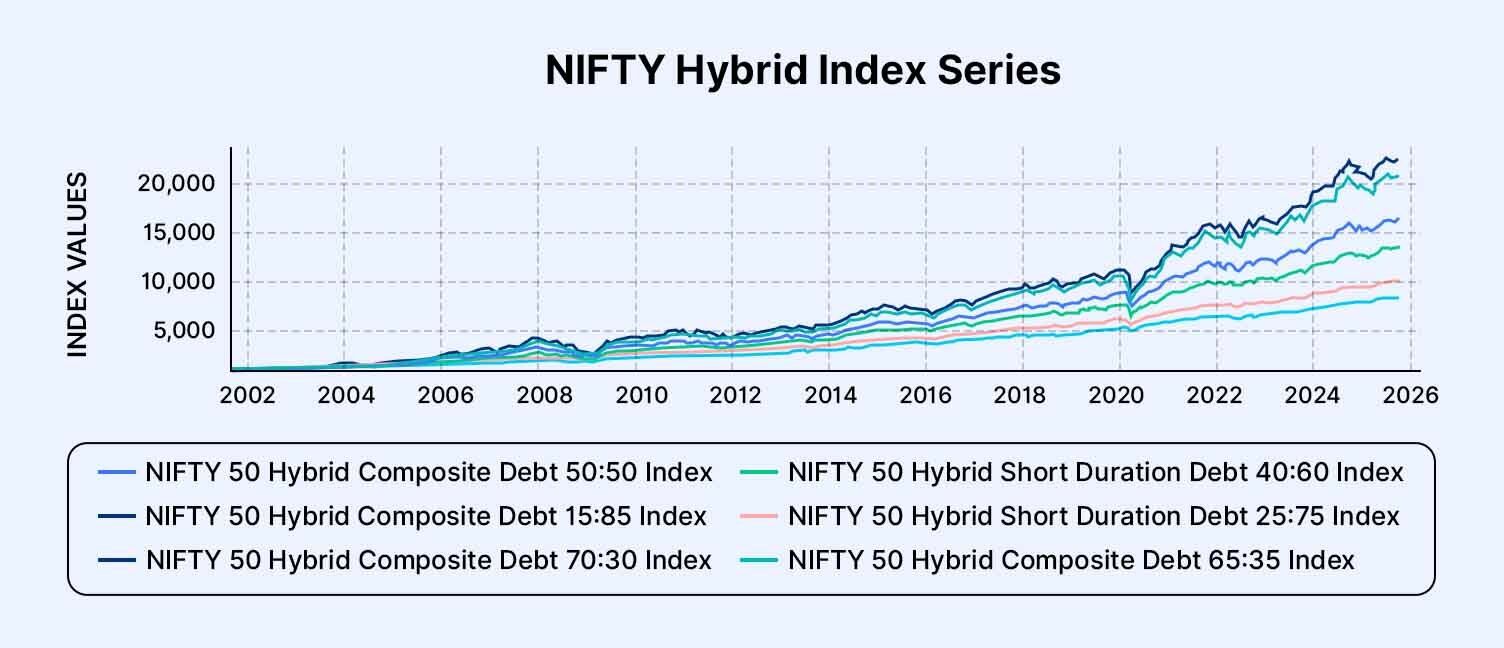
Source: Nifty Indices8
3. Altiva Hybrid Long Short Fund
The NFO period of the Altiva fund is between 1 October 2025 and 15 October 2025. The portfolio allocation of the fund is unique and detailed.
| Core Strategy | Allocation Range |
| Cash-Future Arbitrage and Covered Call | 20% to 40% |
| Fixed Income | 40% to 60% |
| Enhanced Drivers | |
| Special Situations like IPO, Buybacks, Mergers, etc. | 0 to 10% |
| Derivative Strategies | 10% to 20% |
Some other fund features are discussed below.
| Minimum Investment | INR 10 Lakhs |
| Minimum SIP, SWP, STP | INR 1000 |
| Exit Load | 0.5% of NAV if units are redeemed or switched before 90 days from allotment |
| Risk Band Level | 5 |
| Fund Managers | Bhavesh Jain, Bharat Lahoti, etc. |
| Return Anticipation | Arbitrage Plus and the back-tested strategy have shown a two-year return of 11.53% and an average back-tested two-year rolling return of 10.10% |
Similar to the Fund before, Altiva’s benchmark is NIFTY 50 Hybrid Composite Debt 50:50 Index. Understanding these benchmark performance aids in understanding prospective fund returns.
Similar to these funds, there are some more active SIFs, currently. The table below shows the NFO dates of the funds that can become the Best SIF Funds India in the future.
| SIF | NFO Period | Minimum Investment |
| Magnum Hybrid Long Short Fund (G) | 1 October 2025 to 15 October 2025 | INR 10 Lakhs |
| Magnum Hybrid Long Short Fund (I) | 1 October 2025 to 15 October 2025 | INR 10 Lakhs |
Source: Sharekhan9
Now, for optimal future evaluation of SIFs, let us explore some parameters that must be analysed before SIF investment.
SIF Market Growth in India
Specialised Investment Funds are witnessing rapid early adoption in India. The category’s assets under management have grown sharply, rising from around INR 2,010 crore in October 2025 to nearly INR 9,711 crore by February 2026.
Hybrid long short strategies are driving this growth, accounting for roughly 76% of total SIF assets and attracting the majority of investor inflows.
This trend highlights strong investor interest in diversified, risk managed strategies that combine equity, debt and derivatives. The rising AUM also signals that SIFs are gradually emerging as a credible investment option positioned between traditional mutual funds and high ticket PMS offerings
Latest SEBI Rules For SIFs (2024-2025)
- SEBI introduced SIFs via the Securities and Exchange Board of India (Mutual Funds) (Third Amendment) Regulations, 2024, creating SIF as a separate asset class alongside existing mutual fund categories.
- SEBI’s February 27, 2025 circular operationalised the framework from April 1, 2025, laying out minimum investment, disclosure norms, leverage/derivative limits, risk buckets and reporting standards for SIF strategies.
- AMCs may offer SIP, SWP and STP in SIF strategies, but must ensure that the investor’s cumulative investment across all SIF strategies of that AMC is at least INR 10 lakh.
- SEBI also prescribes detailed risk labelling and strategy disclosures so that investors clearly understand leverage, concentration and downside risk before investing.
Choosing Top SIF Funds India: Key Factors To Evaluate
Discussed below are some parameters that can help you analyse SIFs optimally.
1. Investment strategy and underlying assets: Each SIF fund discloses its investment strategy, along with its portfolio constituents, in its fact sheet. This is a mandatory requirement. Analysing the investment strategy and portfolio distribution helps to understand the degree of risk.
This becomes more crucial due to the lack of a historic record since SIFs are a new investment. Investors can then judge if the asset is within their risk appetite.
2. Risk-return balance and liquidity profile: Certain metrics, like performance in different market conditions, back-tested strategy returns, help us understand the return expectations of the SIF. Note that these are not historic records but expectations based on optimal analysis and research.
Moreover, liquidity of the fund, analysed through exit load and other such facilities, helps us understand if the liquidity profile suits our investment goal.
3. Minimum investment and target investors: The fact sheet also notifies about the minimum total investment, minimum SIP and target audience. These disclosures help us understand if the investment is within our investment budget.
Now, a clear understanding of an asset is incomplete without comparing it with other investments. So, let us compare SIFs with other investment avenues.
How SIFs Compare to Other Investment Options
Discussed below is the SIF performance comparison with mutual funds and bonds.
| Parameters | SIFs | Mutual Funds |
| Strategy Flexibility | High flexibility with sophisticated investment strategies, like sector rotation, special situation investing, long-short equity, etc. | Lower flexibility with common dependence on long-only strategies for debt, equity and hybrid. Limited use of derivatives. |
| Risk | Higher risks compared to traditional mutual funds due to investment philosophy, target audience and portfolio. | Lower risk compared to SIFs. Risk further varies significantly between categories. |
| Parameters | SIFs | Bonds |
| Liquidity | Moderate liquidity. SIFs do have exit loads, which vary with the fund. | Liquidity varies significantly. However, the secondary market exists. |
| Return | They have potentially higher returns due to sophisticated and niche investing. | It is generally categorised as a fixed-income bearing security. |
Conclusion
As SIFs gain traction in India, we can expect a growing number of funds to cater to evolving investor needs. In the interim, platforms like Grip continue to fill market gaps with innovative products, offering investors additional avenues to diversify and optimize their portfolios. Together, these developments signal a more robust and versatile investment landscape for Indian investors.
Login to Grip Invest and get upto 14% post-tax return! Don’t miss out and visit Grip Today!
FAQs On Best SIF In India
References:
1. Indus Valley Annual Report, accessed from: https://docsend.com/view/pyxuqunkm9ejw38q
2. SEBI, accessed from: https://www.sebi.gov.in/legal/regulations/dec-2024/securities-and-exchange-board-of-india-mutual-funds-third-amendment-regulations-2024_89978.html
3. SEBI, accessed from: https://tinyurl.com/bdtmfcs3
4. SEBI, accessed from: https://www.sebi.gov.in/legal/circulars/feb-2025/regulatory-framework-for-specialized-investment-funds-sif-_92299.html
5. The Economic Times, accessed from: https://economictimes.indiatimes.com/mf/analysis/explainer-are-sifs-too-complex-for-first-time-investors-to-handle/articleshow/124104729.cms
6. QSIF, accessed from: https://www.qsif.com/Admin/Pdf/qsif_Equity_Long-Short_Fund_Presentation.pdf
7. Nifty Indices, accessed from: https://www.niftyindices.com/Factsheet/Factsheet_NIFTY_Hybrid_Indices.pdf
8. Nifty Indices, accessed from: https://www.niftyindices.com/Factsheet/Factsheet_NIFTY_Hybrid_Indices.pdf
9. Sharekhan, accessed from: https://www.sharekhan.com/mutual-funds/upcoming-and-current-nfo
Want to stay at the top of your finances?
Join the community of 4 lakh+ investors and learn more about Grip Invest, the latest financial knick-knacks, and shenanigans in the world of investing.
Happy Investing!
Disclaimer - Investments in debt securities/municipal debt securities/securitised debt instruments are subject to risks including delay and/ or default in payment. Read all the offer related documents carefully. The investor is requested to take into consideration all the risk factors before the commencement of trading.
This communication is prepared by Grip Broking Private Limited (bearing SEBI Registration No. INZ000312836 and NSE ID 90319) and/or its affiliate/ group company(ies) (together referred to as “Grip”) and the contents of this disclaimer are applicable to this document and any and all written or oral communication(s) made by Grip or its directors, employees, associates, representatives and agents. This communication does not constitute advice relating to investing or otherwise dealing in securities and is not an offer or solicitation for the purchase or sale of any securities. Grip does not guarantee or assure any return on investments and accepts no liability for consequences of any actions taken based on the information provided. For more details, please visit www.gripinvest.in
Registered Address - 106, II F, New Asiatic Building, H Block, Connaught Place, New Delhi 110001


