

Bond Strategy For Retirement: How To Build A Fixed-Income Plan?



Apart from saving a huge corpus for your retirement, you need to plan how to utilize it for yourself. After you stop earning a regular salary, there will be a need for regular income.
The Bond Strategy for Retirement can prove to be useful for this purpose. You get regular interest, and the principal amount gets returned to you after a certain period of time. There are risks involved, which include credit risk, interest risk, inflation risk, and liquidity risk.
A systematic approach can help you invest in bonds in such a way that will serve your needs in the future and also prevent any hasty selling of your investments. This can be done by not treating all bonds alike.
Your requirements can differ according to the various stages of your life. So, accordingly, you need to invest in bonds. Below, are discussed how you can do it.
Why Bonds Can Matter In Retirement Planning?
Retirement spans a long period of many decades. Hence, the importance of having an effective income strategy. Bonds could be used to generate fairly consistent sources of income.
In contrast to stocks, bonds typically have fixed interest payments and maturity dates. Such aspects could assist in planning for certain expenses in the future.
Bond investments can further make it possible to avoid selling market-related investments at retirement. This could be relevant when markets go through temporary downtrends. Yet, bonds still face various risks.
Internationally, the World Bank notes that inflation is a factor to consider in economics. This underscores the relevance of purchasing power in retirement planning.
An effective Bond Strategy for Retirement could thus center on income, maturity, and diversification. These would complement other investments at retirement.
What Is A Bond Strategy For Retirement?
Bond Strategy for Retirement can be defined as an intentional way of investing in bonds with respect to retirement objectives. Such strategies involve selection of bonds on the basis of income generation, time to maturity, and risks involved.
While selecting bonds haphazardly, one may correlate each individual bond purchase with an intended objective of the investor. For instance, bonds with shorter maturity periods can be chosen for nearer expenses.
This strategy can also involve diversification in terms of issuer and time to maturity of bonds. The investor can avoid being dependent on any single bond or issuer in this way.
Nevertheless, this strategy will not protect an investor from the risks of investing. Factors like credit rating, interest rate changes, inflation, and liquidity can influence results. Hence, an appropriate diversification strategy needs to be included in your plans.
How To Build A Bond Strategy For Retirement
Forming a bond strategy for retirement begins with determining when you would need the money. Here are some guidelines for creating your strategy based on these steps:
- Define your retirement objectives: Specify your anticipated expenses and when you will need the money.
- Identify your investment horizon: Choose bonds whose maturity period matches your financial requirements.
- Diversify your bond investments: Diversify across different bonds based on issuers, maturities, and quality ratings.
- Plan based on income needs: Select bonds that pay interest according to your future income requirements.
- Identify the risk: Be aware of the risk of credit, interest rates, inflation, liquidity, and reinvestment before making an investment.
Alternatively, you could compare your own strategy to the National Pension System (NPS). The NPS invests in diverse asset classes, including government securities and corporate debt.
When using the NPS, you do not have much control over selecting individual bonds. Forming your own bond portfolio will give you more control over your maturity and income requirements.
But having more control comes with having more responsibility. You would be required to review your portfolio as your requirements keep changing.
Match Bond Maturity With Retirement Goals
A Strategy for Bonds In Retirement should be formulated based on the timing of your needs. The maturity of the bond is the date at which the principal is repaid. Aligning your needs with the maturity will simplify your planning process.
Your needs can be categorized into three broad time periods:
- Short-term needs: You may use shorter maturity instruments for those needs that arise shortly.
- Medium-term needs: You may consider bonds of various maturity dates for your medium-term needs.
- Long-term needs: You may include appropriate long-maturity bonds along with other retirement savings.
Do not tie all your money into one maturity date. Maturity of different dates can give you more flexibility.
Bear in mind that interest payments and return of principal have separate utilities. Interest can provide you with steady income flows throughout the period of holding bonds. Principal is normally paid out at maturity.
This framework can assist in matching your investments to your expenses.
Types Of Bonds To Consider For Retirement Planning
Bonds have varying functions when used in a retirement portfolio. This will be dictated by various factors, including your needs and preferences.
Bond Type | Issuer | Income Structure | Credit Exposure | Liquidity | Maturity |
Government Bonds | Government | Fixed interest | Generally lower | Varies | Short to long term |
Corporate Bonds | Companies | Fixed or variable interest | Depends on issuer | Varies | Short to long term |
Tax-Free Bonds | Government-backed entities | Fixed interest | Generally lower | Limited to market conditions | Usually longer term |
Floating-Rate Bonds | Government or companies | Interest can change | Depends on issuer | Varies | Short to medium term |
If you intend to invest in government bonds for retirement, then this will provide you with exposure to sovereign bonds. Investing in corporate bonds, however, will mean a higher income but will come at a higher risk level.
Issues of taxation, liquidity, and interest levels also influence performance. In light of this, corporate bonds for retirees should be evaluated using the strength of the issuer.
There is no universal bond that can suit all retirement portfolios.
Bond Laddering For Retirement Income
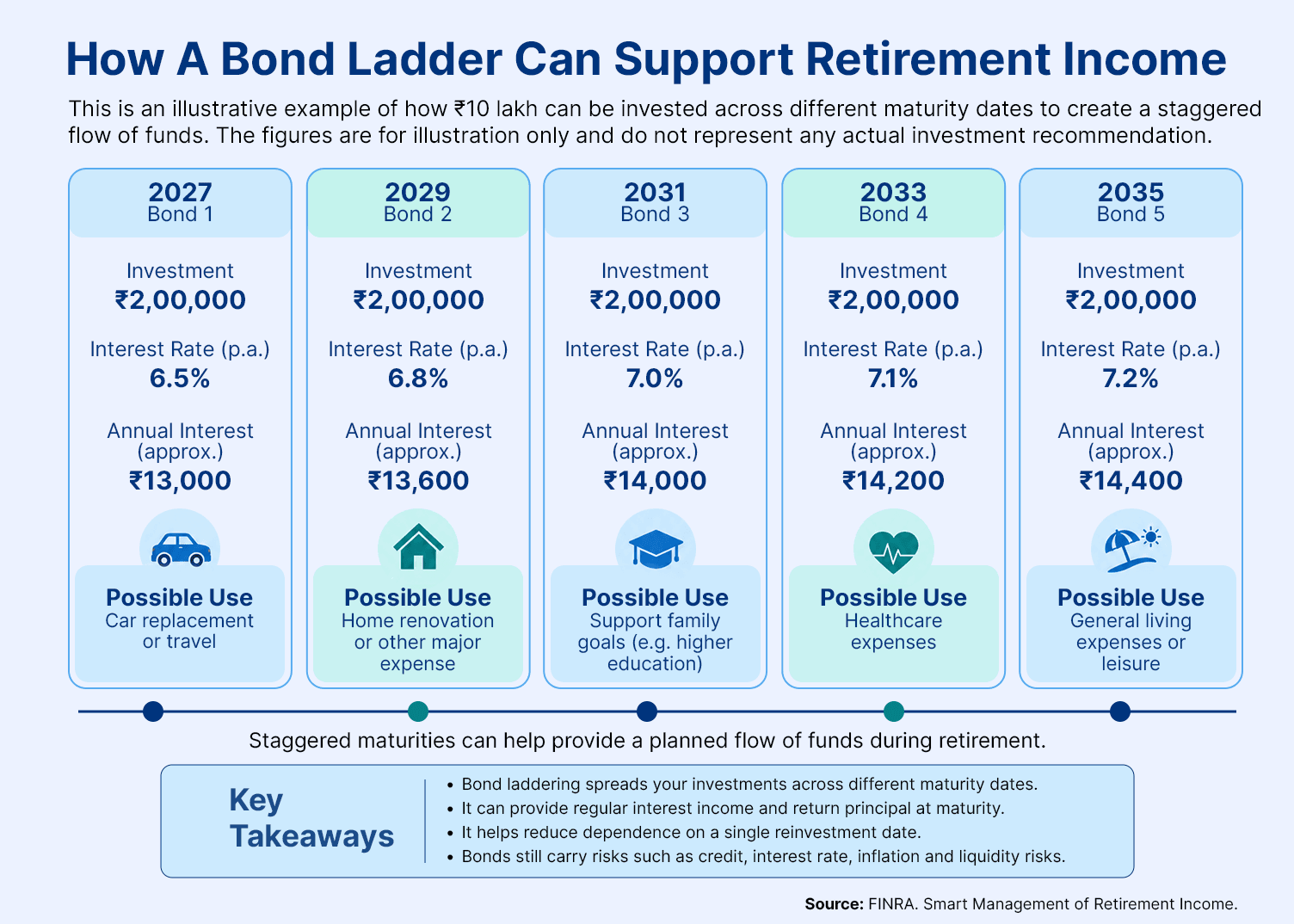
In bond laddering for retirement, investments are made in bonds having different maturities.
For instance, suppose you have INR 10 lakh to plan for your retirement. Rather than investing all in one bond, you can split this sum into five INR 2 lakh investments.
You can choose bonds that mature in 2027, 2029, 2031, 2033, and 2035. Each time a bond matures, you can use its principal amount for your expected expenses. Otherwise, you can invest it in another bond according to your preference.
You may also earn interest on your investment. But when it comes to reinvestment, the interest rate may vary from before.
Thus, you can ensure a gradual receipt of money rather than receiving it at once. Furthermore, you will not rely upon one reinvestment date only.
Nevertheless, bond laddering for retirement does not minimize investment risks. They are susceptible to credit risk, liquidity risk, and interest rate risk.
How Much Of A Retirement Portfolio Should Be In Bonds?
There is no one-size-fits-all approach when it comes to allocating bonds within a retirement portfolio. The allocation should take into account factors such as age, time to retirement, income requirement, and risk appetite.
The individual’s other sources of investment and planned income in retirement should also be considered. A person who will be receiving significant pension income might need something different than another who will depend mostly on his investments.
Higher bond allocation can mean more investment in fixed income instruments. But putting all your eggs in one basket by allocating your corpus too heavily towards bonds can result in inflation and reinvestment risks.
Bond Allocation for Retirement should be a balanced approach rather than a fixed percentage.
FAQs

Want to stay at the top of your finances?
Join the community of 22 lakh+ investors and learn more about Grip Invest, the latest financial knick-knacks, and shenanigans in the world of investing.
Happy Investing!
Disclaimer - Investments in debt securities/municipal debt securities/securitised debt instruments are subject to risks including delay and/ or default in payment. Read all the offer related documents carefully. The investor is requested to take into consideration all the risk factors before the commencement of trading.
This communication is prepared by Grip Broking Private Limited (bearing SEBI Registration No. INZ000312836 and NSE ID 90319) and/or its affiliate/ group company(ies) (together referred to as “Grip”) and the contents of this disclaimer are applicable to this document and any and all written or oral communication(s) made by Grip or its directors, employees, associates, representatives and agents. This communication does not constitute advice relating to investing or otherwise dealing in securities and is not an offer or solicitation for the purchase or sale of any securities. Grip does not guarantee or assure any return on investments and accepts no liability for consequences of any actions taken based on the information provided. For more details, please visit www.gripinvest.in
Registered Address - 106, II F, New Asiatic Building, H Block, Connaught Place, New Delhi 110001


