

Long Duration Bonds India: How They Work And What Investors Should Consider



What Are Long Duration Bonds?
Long duration bonds are fixed-income debt securities that have an extended maturity period, typically 10 years or more, and are highly sensitive to interest rate changes.1
While bonds with long maturity and long duration are related terms, they have different concepts. Maturity is the date when the bond principal is repaid. On the contrary, duration measures the weighted average time until the bond cash flows are received and indicates how sensitive its price is to interest rate movements.
A bond can have a long maturity without having an equally long duration, particularly when it pays regular coupons.
How Do Long Duration Bonds Work?
The following is the basic structure of how long-term bond investment works in India:
- Purchase and Investment: The investor purchases long duration bonds at issue or market price to acquire them.
- Transfer of funds to Issuer: The issuer receives the investment amount and uses the funds raised through the bond for its stated purpose.
- Periodic Payouts: The issuer pays interest at the fixed interest or coupon rate and frequency as specified in the bond terms.
- Maturity and Repayment: The issuer returns the full face value of the bond at the end of its bond maturity period.
- Secondary Trading: Investors can either hold the bond until maturity or sell it in the secondary market, subject to available liquidity and interest rate risk in bonds.
Note: The actual return depends on the coupon, purchase price, maturity, credit quality and whether the bond is sold before maturity.
Types Of Long Duration Bonds In India
1. Government Securities (G-Secs): Central Government-dated securities in India are issued for maturities extending up to 50 years and carry sovereign support with negligible default risk.2
2. State Government Securities (SGSs): State governments issue SGSs through RBI auctions to raise funds for their financial requirements, with yields typically higher than comparable G-Secs.
3. Corporate Bonds/NCDs: Private and public companies issue long-term corporate bonds and offer higher yields linked directly to the credit rating and default risk of the specific issuer.
4. Capital Gains Bonds: These are issued by NHAI and PFC. They allow investors to save capital gains tax under Section 85 of the ITA 2025, subject to strict investment limits and a lock-in period.3
5. Tax-Free Bonds: Public sector enterprises like NHAI used to issue these bonds. While new primary issuances are not currently common, existing bonds may be available in the secondary market.
Why Do Investors Consider Long Duration Bonds?
Here are some reasons why investors may consider bond investment for long-term goals:
- Long-term income: Fixed coupons can provide predictable interest payments over the investment period.
- Goal alignment: Long-term bond investment may suit retirement, education or other long-term financial goals.
- Diversification: Long-term bonds in India can add government or corporate debt to a portfolio alongside equities.
- Capital appreciation: The prices of bonds with long maturity may rise when interest rates decline and allow gains on sale.
- Predictable cash flows: Fixed coupon payments make future income easier to estimate.
- Debt markets: Investors can choose government securities or long-term corporate bonds based on their requirements.
However, the longer investment period does not make them suitable for everyone. Their suitability rather depends on the investors’ risk tolerance, cash-flow needs and expected holding period.
How Interest Rates Affect Long Duration Bonds
Bond investment for long-term goals involves significant impact from interest rate changes, creating both risks and opportunities for investors.
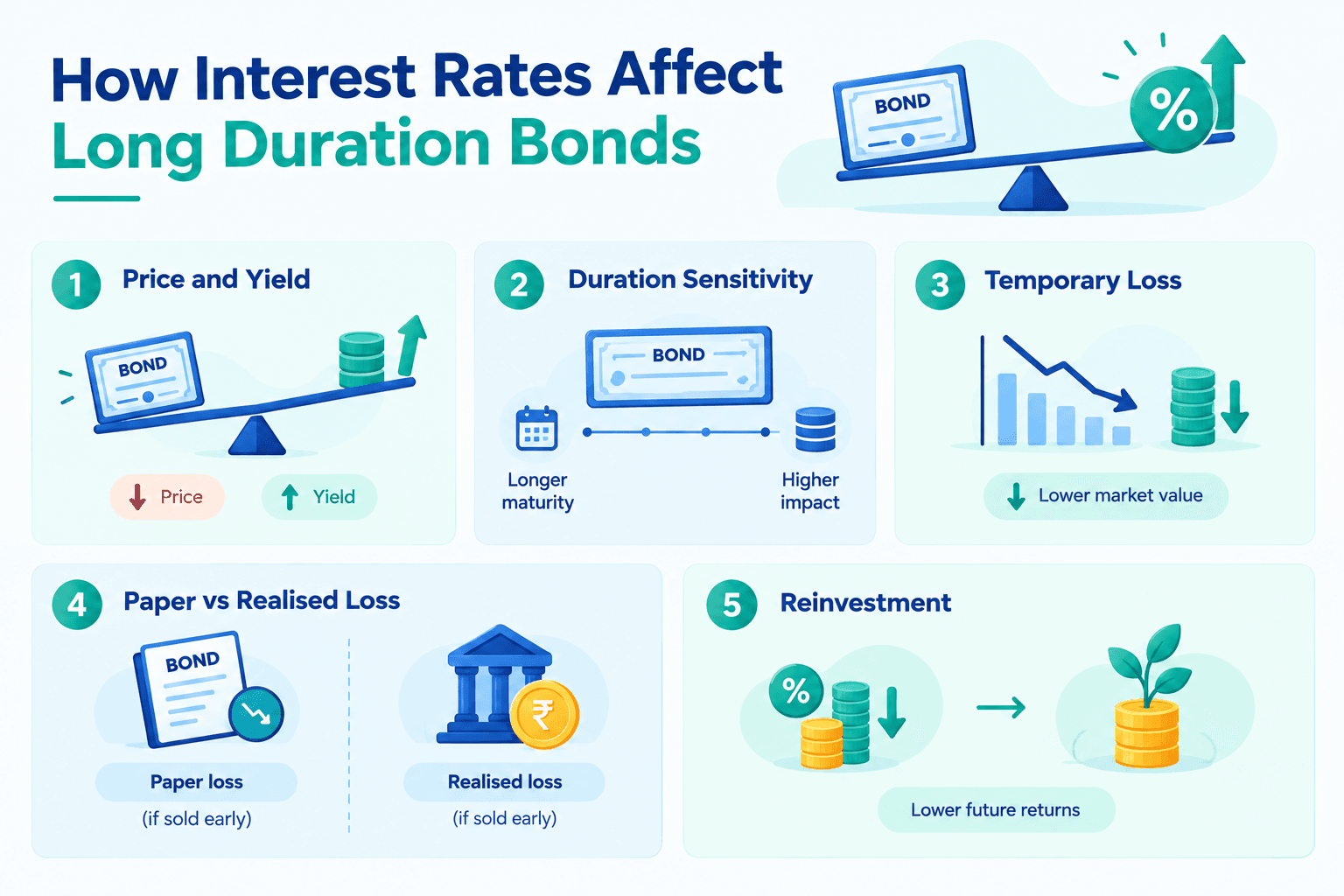
- Price and yield: Bond prices and market yields move in opposite directions and higher rates can reduce the value of existing bonds with lower coupons.
- Duration sensitivity: Bonds with long maturity and lower coupon rates are more sensitive to rate changes because more cash flows are received later.
- Temporary loss: The market price can fall even when interest payments continue, as higher market yields reduce the present value of the bond’s remaining fixed cash flows.
- Paper vs realised loss: If held until maturity, the investor can continue receiving interest and may receive the face value, subject to the issuer meeting its obligations. Selling earlier can realise the market loss.
- Reinvestment: When rates fall, bond prices may rise, but subsequent interest payments may have to be reinvested at lower prevailing rates, adding to interest rate risk in bonds.
Long Duration Bonds Vs Short Duration Bonds
The short-term vs long-term bonds comparison mainly comes down to their maturity and sensitivity to interest rate movements.
Parameters | Long Duration Bonds | Short Duration Bonds |
| Maturity Period | 10 years and more | 3-5 years |
| Interest Rate Risk | High, as prices drop significantly if rates rise | Low, as price fluctuations are minimal when rates change |
| Yield | May offer higher yields to compensate for time risk, subject to market inversions. | Typically lower, but can be equal or exceed long yields during rate-hike cycles. |
| Price Volatility | Highly volatile in shifting markets | Stable and predictable |
| Primary Objective | Total return potential and locking in rates ahead of anticipated rate cuts. | Capital preservation, liquidity, and flexibility in volatile environments. |
Source: SEBI4
Credit Risk And Other Risks To Consider
Long duration bonds carry different risks depending on the issuer and market conditions. Investors should consider these factors before investing:
1. Credit risk: Corporate bonds carry default risk if issuers face financial difficulties, while government-backed bonds may have lower credit risk but can still experience price volatility before maturity.
2. Interest rate risk: Interest rate risk in bonds can cause prices to fall when market rates rise, with longer-duration bonds generally experiencing larger price movements.
3. Liquidity risk: The limited trading activity may make it difficult to sell a bond at the desired price before maturity.
4. Reinvestment risk: The falling interest rates can reduce the returns available when coupon payments are reinvested.
5. Inflation risk: Rising inflation can reduce the purchasing power of future interest payments and principal repayments.
FAQs

Want to stay at the top of your finances?
Join the community of 22 lakh+ investors and learn more about Grip Invest, the latest financial knick-knacks, and shenanigans in the world of investing.
Happy Investing!
Disclaimer - Investments in debt securities/municipal debt securities/securitised debt instruments are subject to risks including delay and/ or default in payment. Read all the offer related documents carefully. The investor is requested to take into consideration all the risk factors before the commencement of trading.
This communication is prepared by Grip Broking Private Limited (bearing SEBI Registration No. INZ000312836 and NSE ID 90319) and/or its affiliate/ group company(ies) (together referred to as “Grip”) and the contents of this disclaimer are applicable to this document and any and all written or oral communication(s) made by Grip or its directors, employees, associates, representatives and agents. This communication does not constitute advice relating to investing or otherwise dealing in securities and is not an offer or solicitation for the purchase or sale of any securities. Grip does not guarantee or assure any return on investments and accepts no liability for consequences of any actions taken based on the information provided. For more details, please visit www.gripinvest.in
Registered Address - 106, II F, New Asiatic Building, H Block, Connaught Place, New Delhi 110001


