

How To Choose The Best FD Tenure For Your Financial Goals



What Is FD Tenure?
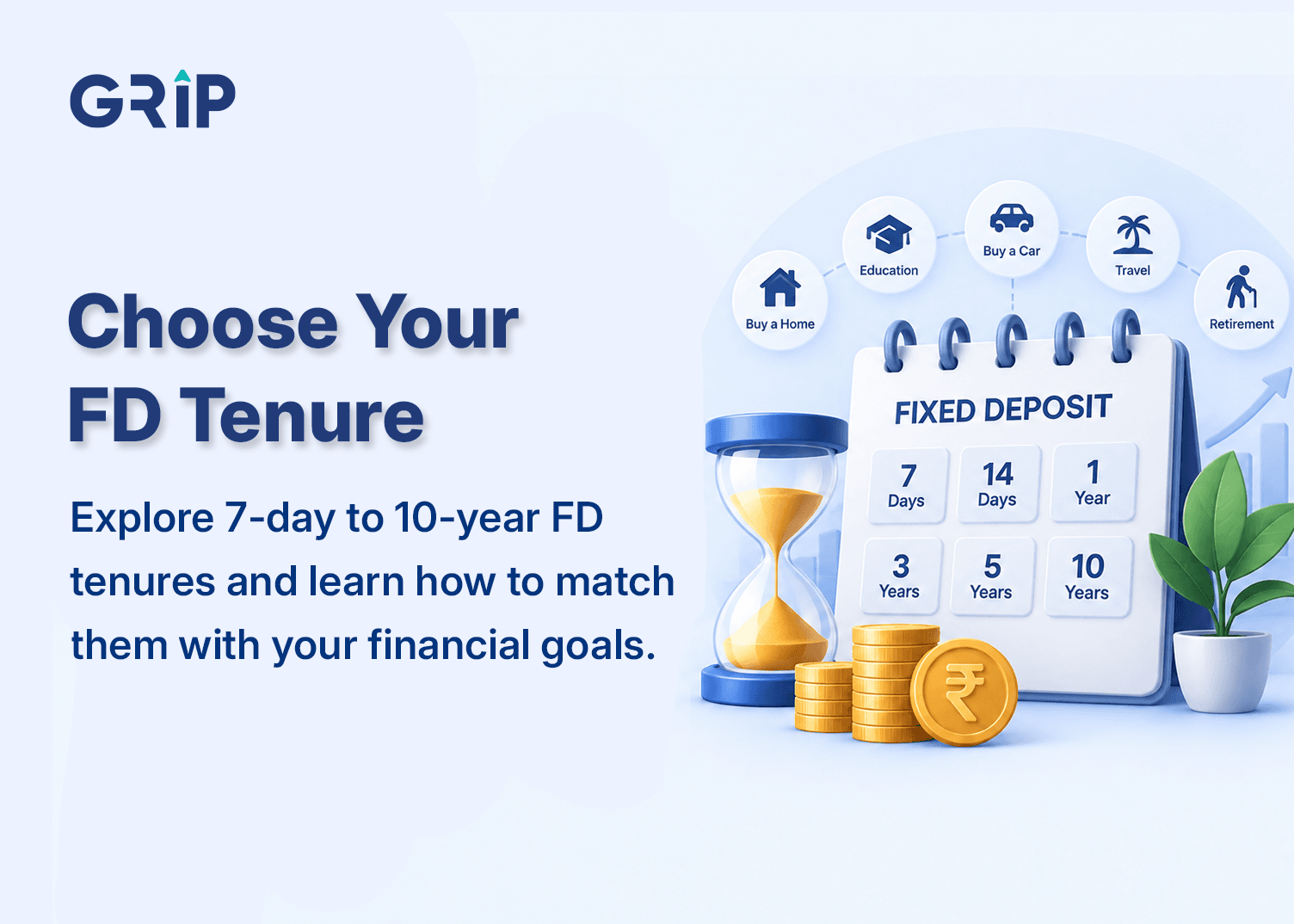
A fixed deposit (FD) tenure is a pre-agreed period of time that an investor commits to keep their money deposited in a bank or financial institution through an FD. These fixed deposit tenure options can range from 7 days to 10 years.1
Depending on the tenure selected, banks or institutions offer varied interest rates. For instance, small finance banks can provide around 7.00% to 8.25% for regular citizens over 5 years.2
However, it should be noted that high interest rates do not make a particular FD investment period suitable for every investor. The best FD Tenure should rather align with the timeline when the investor would need the money.
How To Choose The Best FD Tenure?
Ask these questions to yourself before picking the best FD tenure for yourself:
- When will I need the money? The FD maturity period and your financial requirement timeline should match.
- What is my financial goal? Compare the short-term vs long-term FD options based on whether you need the money in the short-term or have long-term goals.
- How much interest does each tenure offer? Compare interest rates across available fixed deposit tenure options to identify an FD tenure for better returns, instead of assuming a longer tenure will pay more.
- Will I need access to the money early? Checking the FD premature withdrawal terms and applicable charges can also help you select the ideal FD tenure for your needs.
Best FD Tenure Based On Financial Goals
Financial goals mostly have different timelines, so the ideal FD tenure would vary among the investors. The table below provides broad illustrations of possible tenure choices based on common financial goals:
Goal | Possible Tenure | Suitable For |
| Short-term Goals | 7 days to 1 year | Vacations, buying gadgets, or building an emergency buffer. |
| Medium-term Goals | 1 to 5 years | Buying a car, home renovations, or funding higher education. |
| Long-term Goals | 5 to 10 years | Retirement planning or building funds for long-term needs. |
| Tax-saving Goals | 5 years | Section 80C deduction, subject to applicable rules. |
Should You Choose The FD With The Highest Interest Rate?
While a high interest rate can maximise returns, the FD investment period should first match your financial goals and liquidity needs.
Consider this comparison:
FD Option A | FD Option B | |
| Interest Rate | 8.0% | 7.10% |
| Tenure | 5 years | 1 year |
If you need the deposited amount within 1 year to 3 years, let’s say, for a planned car purchase, Option B would be a better match for you, despite its lower rate.
However, if you go for Option A, based on its high rates, it could require a premature withdrawal if you need the money before 5 years.
The best fixed deposit tenure should not be based on the highest advertised rate alone.
How FD Tenure Affects Interest And Maturity Value
The FD investment period directly dictates the total interest earned and final maturity value through compounding. While the interest rate might remain constant, a longer tenure allows your money to grow exponentially because you earn interest on your previously earned interest.
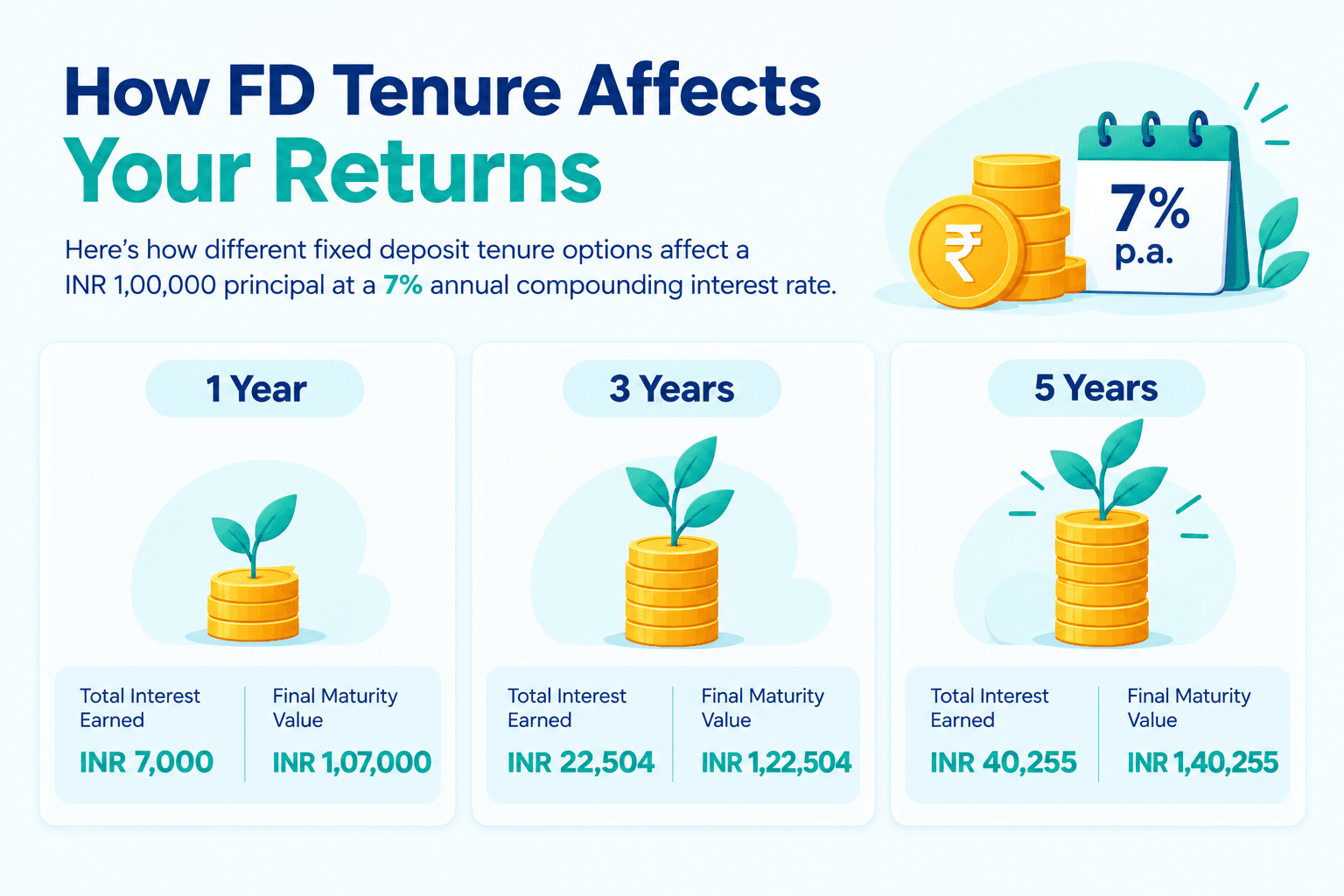
Here is how different fixed deposit tenure options affect a INR 1,00,000 principal at a 7% annual compounding interest rate:
FD Tenure | Total Interest Earned | Final Maturity Value |
1-year | INR 7,000 | INR 1,07,000 |
3-year | INR 22,504 | INR 1,22,504 |
5-year | INR 40,255 | INR 1,40,255 |
At 3 years, the FD earns INR 15,504 more in interest compared to the 1-year deposit. Further, when extended to 5 years, it takes the difference to INR 33,255. The figures show how keeping the deposit invested for longer can increase the maturity amount when the interest is compounded.
Note: This is an illustrative example. The actual maturity values depend on the compounding frequency of a bank (quarterly vs annual), chosen payout options, and specific bank terms and conditions.
Factors To Check Before Selecting An FD Tenure
When you ask, “How to choose FD Tenure?”, the answer is to look beyond the interest rates. The tenure is one part of the FD decision. Before selecting the best FD tenure, consider these factors:
1. Available Tenure Options: Banks offer periods ranging from a few days to several years, with different rates across each option.
2. Liquidity Needs: The deposited amount should remain committed without affecting your regular financial needs or emergency reserves.
3. Interest Rate Cycle: The longer FD tenures can benefit from a high-rate environment, while opting for short tenures can provide opportunities when the rates rise.
4. Inflation Risk: The FD fixed return can lose its purchasing power over a longer period if inflation remains above the FD return.
5. Tax Treatment: Interest income is taxable. 5-year tax-saving FDs, however, with mandatory lock-in, may qualify for Section 80C benefits, subject to applicable rules.
6. Premature Closure: FD premature withdrawal can affect the interest earned and may attract a penalty under the applicable bank terms.
Common Mistakes While Choosing FD Tenure
- Chasing highest rates: Selecting a long tenure only for high interest, which traps your cash if an emergency arises.
- Single-tenure trap: Depositing all the savings into one FD can be less efficient. FD laddering divides the money across deposits with different tenures.
- Ignoring liquidity needs: Failing to align the maturity period with your expected cash requirements or life goals.
- Forgetting penalties: Overlooking extra costs and lower interest rates charged for breaking your FD early.
FAQs

Want to stay at the top of your finances?
Join the community of 22 lakh+ investors and learn more about Grip Invest, the latest financial knick-knacks, and shenanigans in the world of investing.
Happy Investing!
Disclaimer - Investments in debt securities/municipal debt securities/securitised debt instruments are subject to risks including delay and/ or default in payment. Read all the offer related documents carefully. The investor is requested to take into consideration all the risk factors before the commencement of trading.
This communication is prepared by Grip Broking Private Limited (bearing SEBI Registration No. INZ000312836 and NSE ID 90319) and/or its affiliate/ group company(ies) (together referred to as “Grip”) and the contents of this disclaimer are applicable to this document and any and all written or oral communication(s) made by Grip or its directors, employees, associates, representatives and agents. This communication does not constitute advice relating to investing or otherwise dealing in securities and is not an offer or solicitation for the purchase or sale of any securities. Grip does not guarantee or assure any return on investments and accepts no liability for consequences of any actions taken based on the information provided. For more details, please visit www.gripinvest.in
Registered Address - 106, II F, New Asiatic Building, H Block, Connaught Place, New Delhi 110001


