

BSE Sensex Futures: Meaning, Trading, And How They Work?


The Indian derivatives market has grown into one of the busiest trading arenas in the world, and BSE Sensex futures are a key part of this activity.
These BSE derivatives allow traders to speculate on the future movement of the 30-stock benchmark index without buying individual shares.1 As volatility and global cues continue to influence markets, investors closely monitor Sensex futures trading activity to gauge market sentiment and hedge risk.
At the same time, the growing scale of BSE derivatives has also increased retail participation in index futures in India, with better digital access and increasing awareness.
With this, understanding the Sensex futures meaning, pricing mechanism, and Sensex futures lot size is becoming increasingly important for active market participants.
What Are BSE Sensex Futures?
BSE Sensex futures are derivative contracts that allow traders to take positions on the future movement of the BSE Sensex without purchasing the underlying stocks. These contracts are cash-settled and are mainly used for hedging and short-term speculation in the Indian derivatives market.
In simple terms, an index future is a contract where buyers and sellers agree to trade the value of a stock index at a future date. In Sensex futures trading, the underlying asset is the Sensex index itself, not the individual shares.
Now, how do the Sensex futures derive value from the BSE Sensex?
The price of BSE Sensex futures moves according to the spot value of the S&P BSE Sensex. If the index rises, futures prices generally move higher, while a fall in the index pulls futures prices lower.
Since the Sensex is calculated using the free-float market capitalisation of 30 major companies, the futures contracts also reflect the combined performance of these stocks, using the following formula:
| Futures price = Spot price X [1 + (Risk-Free Rate X x/365) – Dividen Yield] |
On expiry, the contract is cash-settled at the closing value of the Sensex.
How Sensex Futures Trading Works?
In Sensex futures trading, each contract carries a fixed lot size decided by the exchange, and traders can participate through near, next, and far-month contracts. These BSE Sensex futures contracts expire on the last Thursday of the contract month, while holiday expiries are shifted to the previous trading day.
To trade in BSE derivatives, investors must maintain SPAN and exposure margins of 10-15%, which act as security deposits against market volatility and daily price fluctuations.
The contracts follow a cash settlement mechanism where profits and losses are adjusted daily through mark-to-market settlement. On expiry, the final settlement price is determined using the official closing value of the BSE Sensex.2
Who Uses Sensex Futures?
BSE Sensex futures are primarily used by a diverse set of market participants to manage risk, speculate on price movements, or arbitrage price differences between the spot (cash) market and the derivatives market.
1. Retail traders:
Individual traders use BSE Sensex futures to benefit from short-term market movements without purchasing the Sensex stocks. The futures contracts also allow retail participants to trade larger positions through margin-based trading.
2. Institutional investors:
Mutual funds, banks, and portfolio managers actively engage in Sensex futures trading to manage portfolio risk, adjust market positions, and respond to macroeconomic events efficiently.
3. Hedgers and speculators:
Hedgers use futures contracts to protect portfolios during volatile phases, while speculators trade on expected index movements to generate short-term profits in the BSE derivatives market.
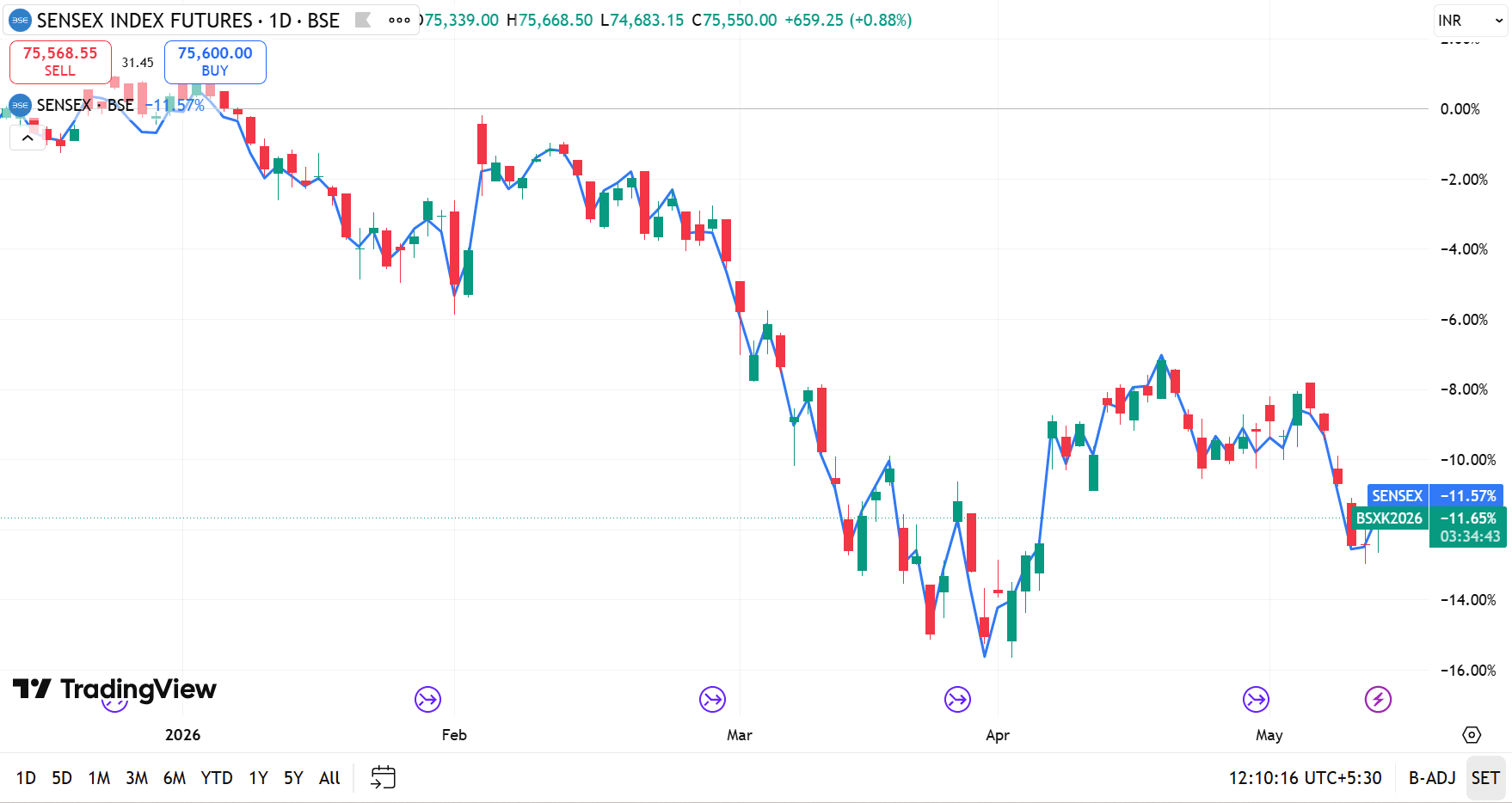
The following chart represents a comparative performance of BSE Sensex futures and the spot BSE Sensex as of 14 May 2026.
The movement highlights how futures contracts closely track the underlying index, leading to corresponding profit and loss fluctuations for traders.
Source: TradingView,3
Advantages And Risks Of Sensex Futures
The advantages and risks of BSE Sensex futures depend on leverage, market volatility, and how traders use futures contracts for speculation or portfolio protection.
1. Leverage benefits:
BSE Sensex futures allow traders to control large index positions by paying only a margin amount instead of the full contract value. This leverage feature increases potential returns in Sensex futures trading, making futures popular among active traders in the BSE derivatives segment.
2. Hedging opportunities:
The institutional and retail investors use futures contracts to hedge portfolios against short-term market declines. Since the contracts track the S&P BSE Sensex, they are widely used in index futures in India for managing market risk during volatile conditions.
3. High volatility and margin risks:
While leverage can magnify gains, it can also increase losses rapidly. The traders must maintain SPAN and exposure margins, and daily mark-to-market settlements can create additional capital pressure during sharp market swings.
Sensex Futures vs Nifty Futures
Both Sensex and Nifty futures are widely traded index derivatives in India, but they differ in liquidity, trading participation, and overall market dominance within the derivatives segment.
Aspect | Sensex Futures | Nifty Futures |
| Liquidity comparison | BSE Sensex futures have comparatively lower liquidity and open interest levels in the Indian derivatives market. | Nifty futures generally have deeper liquidity, tighter bid-ask spreads, and higher market participation. |
| Trading volume differences | Sensex futures volumes have improved recently, but trading activity remains lower than NSE index derivatives. | Nifty futures consistently record the highest turnover in the Indian index futures segment. |
| Which is more popular among traders? | Sensex futures are mainly preferred by traders focused on BSE-linked strategies and Sensex-based market tracking. | Nifty futures remain more popular among retail traders, institutions, and algorithmic traders because of stronger liquidity and higher daily volumes. |
Conclusion
While BSE Sensex futures offer opportunities for leverage, hedging, and short-term trading, they also carry significant market and margin risks. Since derivatives can amplify both profits and losses, traders must carefully manage volatility, leverage, and position sizing while participating in Sensex futures trading.
Investors looking for more stable portfolio growth may also balance their portfolios with lower-volatility fixed-income options alongside exposure to equity and BSE derivatives markets.
FAQs On BSE Sensex Futures 2026
 |
Author: Grip Invest Editorial Team The Grip Invest Editorial Team is a group of Chartered Accountants, MBA (Finance) graduates, and Qualified Research Analysts dedicated to helping you invest smarter. We dive deep into India's fixed income landscape to deliver content that is accurate, up-to-date, and easy to understand. Whether you're exploring bonds, fixed deposits, or other fixed income opportunities, our guides cut through the noise and give you the clarity to make better financial decisions. |
Want to stay at the top of your finances?
Join the community of 4 lakh+ investors and learn more about Grip Invest, the latest financial knick-knacks, and shenanigans in the world of investing.
Happy Investing!
Disclaimer - Investments in debt securities/municipal debt securities/securitised debt instruments are subject to risks including delay and/ or default in payment. Read all the offer related documents carefully. The investor is requested to take into consideration all the risk factors before the commencement of trading.
This communication is prepared by Grip Broking Private Limited (bearing SEBI Registration No. INZ000312836 and NSE ID 90319) and/or its affiliate/ group company(ies) (together referred to as “Grip”) and the contents of this disclaimer are applicable to this document and any and all written or oral communication(s) made by Grip or its directors, employees, associates, representatives and agents. This communication does not constitute advice relating to investing or otherwise dealing in securities and is not an offer or solicitation for the purchase or sale of any securities. Grip does not guarantee or assure any return on investments and accepts no liability for consequences of any actions taken based on the information provided. For more details, please visit www.gripinvest.in
Registered Address - 106, II F, New Asiatic Building, H Block, Connaught Place, New Delhi 110001


