

Gold Vs Sensex In 2026: Historical Returns, Risks, And Investment Guide For India


Over half of the total USD 14 trillion injected into the Indian economy since Independence, that is around USD 8 trillion, was invested in the last 10 years alone1. Amidst this rapidly evolving economic landscape, several investment mediums have emerged, ranging from low-risk to high-return options. Moreover, debates regarding the suitability of different investment avenues continue.
One such comparison is gold vs equity investment. While gold is considered a safe-haven asset that can aid in volatility protection, especially during market downturns, equity is popular for its potential to provide exponential growth. However, comparing gold with any particular equity stock would be unfair. Therefore, this blog compares gold vs Sensex.
Since Sensex is a market benchmark, indicating the performance of all equities listed on the Bombay Stock Exchange, a comparison between gold vs Sensex can compare the suitability of gold investment to stock investment as a whole.
Now, let’s begin our comparative analysis with historic gold vs Sensex returns.
Also Read: Understand What is Bull and Bear Market And Its Investment Strategies
Gold Vs Sensex Historical Performance
The past price trend of gold vs Sensex performance can aid in optimally understanding the suitability of them as an investment medium. Therefore, let’s understand the past performance of Gold first.
1. Historical Price Of Gold
The price of 24-carat gold is more than INR 1,00,000 per 10 grams. A consistent growth has been witnessed in the Indian gold market over the past decade. A primary cause of this trend is the rise in global uncertainty. Major events like the pandemic, wars, and the recent tariffs have positioned gold as a safe-haven investment that can aid in reducing market volatility.
The graph shows the price movement of 24-carat gold per 10 grams over 10 years.
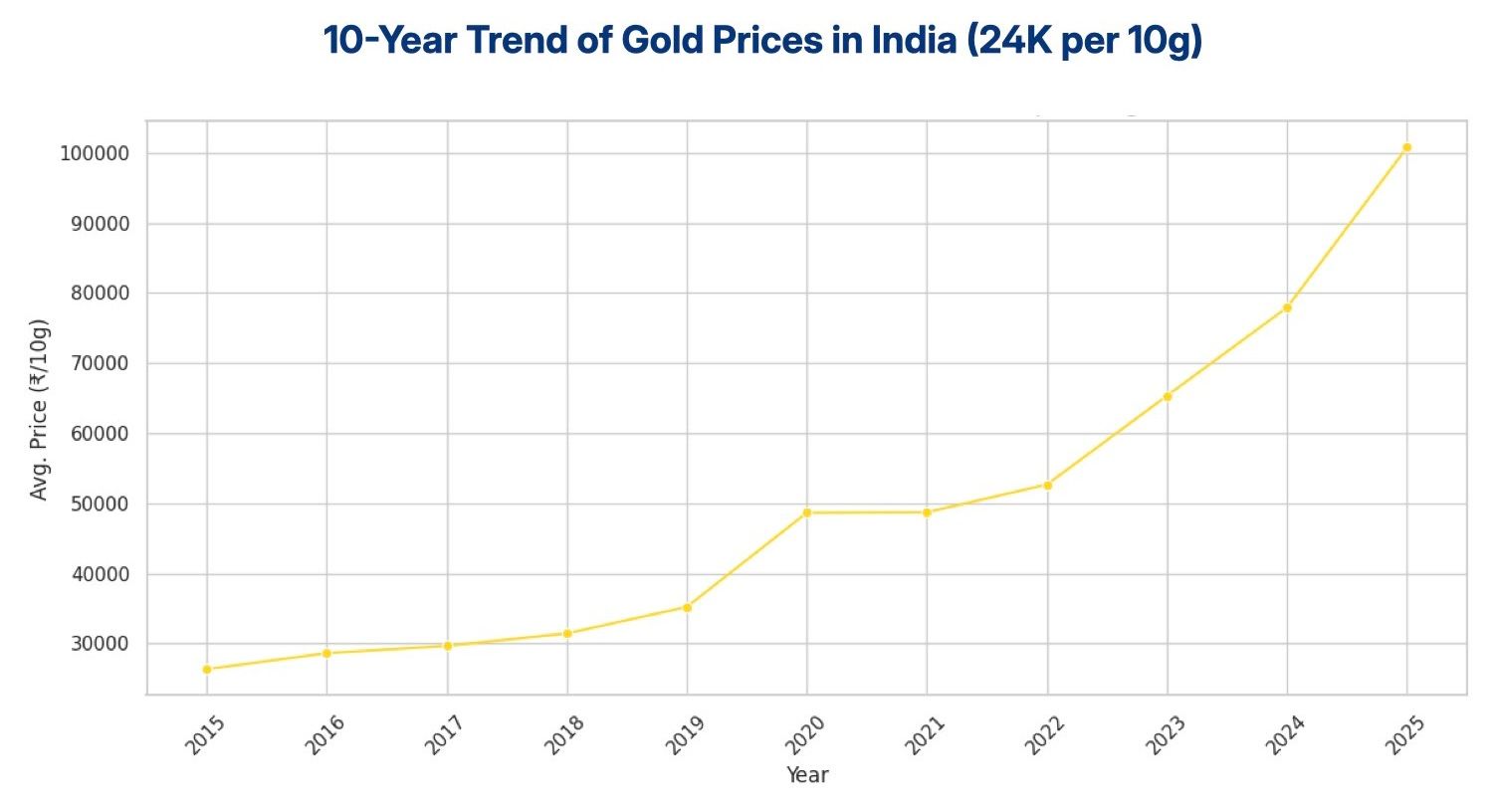
Source: Forbes India2
2. Historical Price Of Sensex
Now, with 11.1% CAGR over 10 years and 16.0% CAGR over 5 years, BSE Sensex has also fared well in terms of growth3. In the last 52 weeks, the Sensex hit its highest of INR 85,978.25. Moreover, its 52-week low was at INR 71,425.014. The trading price of Sensex rose from 25,610.21 on 11 September 2015 to 85,571.85 on 26 September 2024, indicating a growth of approximately 234%.
The graph below shows the 10-year movement of the Sensex.
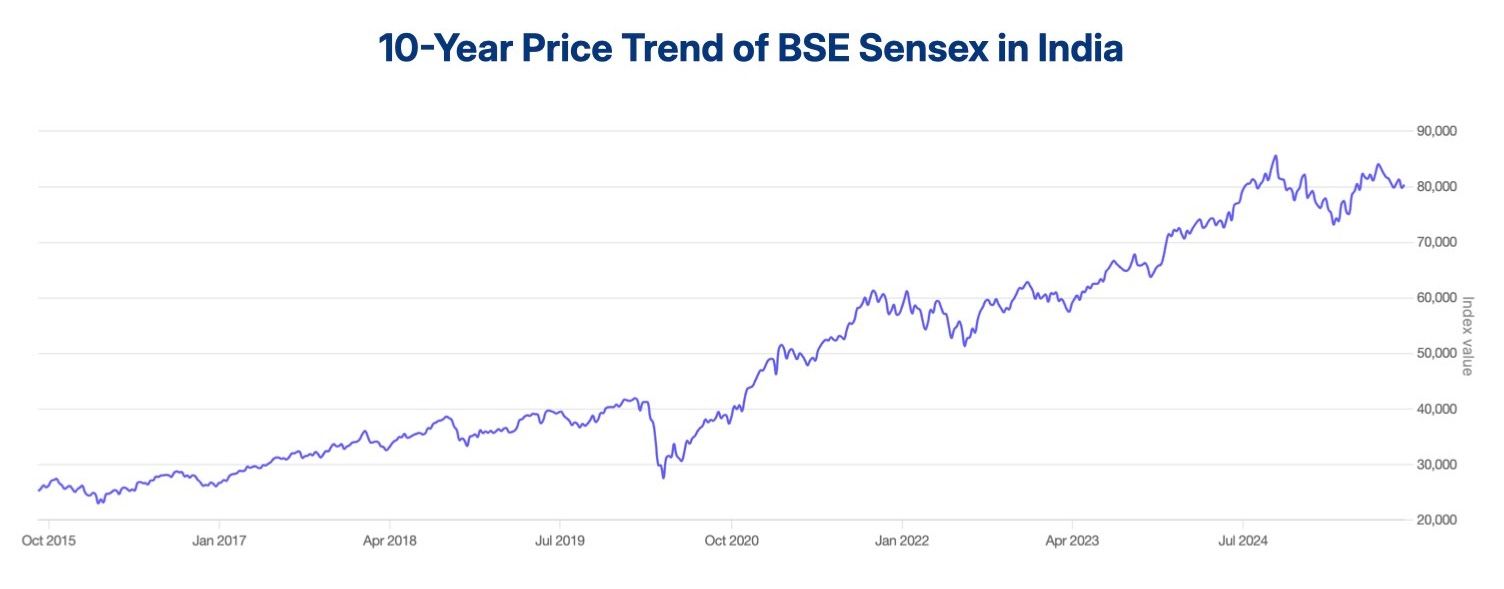
Source: Screener.in4
Now, to solidify our understanding of gold returns vs Sensex CAGR, let’s take an example.
Gold Vs Sensex Investment In 2026: Example
Imagine 5 years ago, Mr A invested INR 50,000 in the Sensex, and his wife purchased 10 grams of 24-carat gold at INR 50,151.
Given that the 5-year return of Sensex has been 110.24%, Mr A earned a profit of INR 55,120. Moreover, his wife made a profit of INR 54,169 or 108.01% by selling her gold at INR 1,04,320. (The selling price of both assets is taken from the historical returns.)
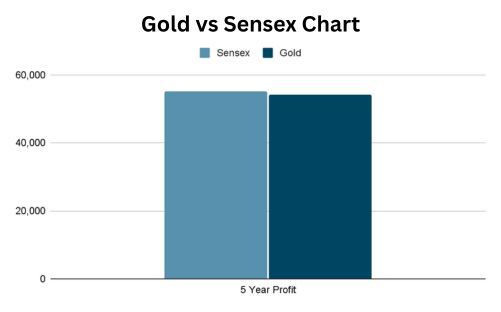
Now, as you can see, both gold vs Sensex investments can be optimised to get a higher return. The point that should be noted here is that timing plays an important role. If we change the timing from the last 5 years to the last 10 or 15 years, the results will be different for both assets. Therefore, let us now explore the next step of the gold vs stock market comparison, which is the analysis of their risk.
Gold vs Sensex Risk Comparison
An analysis of Gold vs Sensex is incomplete without understanding the degree of risk associated with each.
- Gold: It is usually considered a safe-haven asset because it protects investments against rising inflation and other economic downturns. While we will cover how it protects against inflation later in detail, it is important to understand that when markets act with volatility, investors tend to shift their market investment to safe-haven assets like gold.
- Sensex: The stock market is susceptible to market volatility. Therefore, Sensex, being a market benchmark, is also susceptible to these fluctuations. Usually, during bullish trends, meaning when the prices of stocks increase, investors expect a high growth potential from the Sensex, which is an equity benchmark.
Given that Gold and Stocks are considered substitutes for one another, a time when both experience a dip together is rare. However, in 2015, the BSE Sensex ended 5% lower at 26,117.54 levels5.
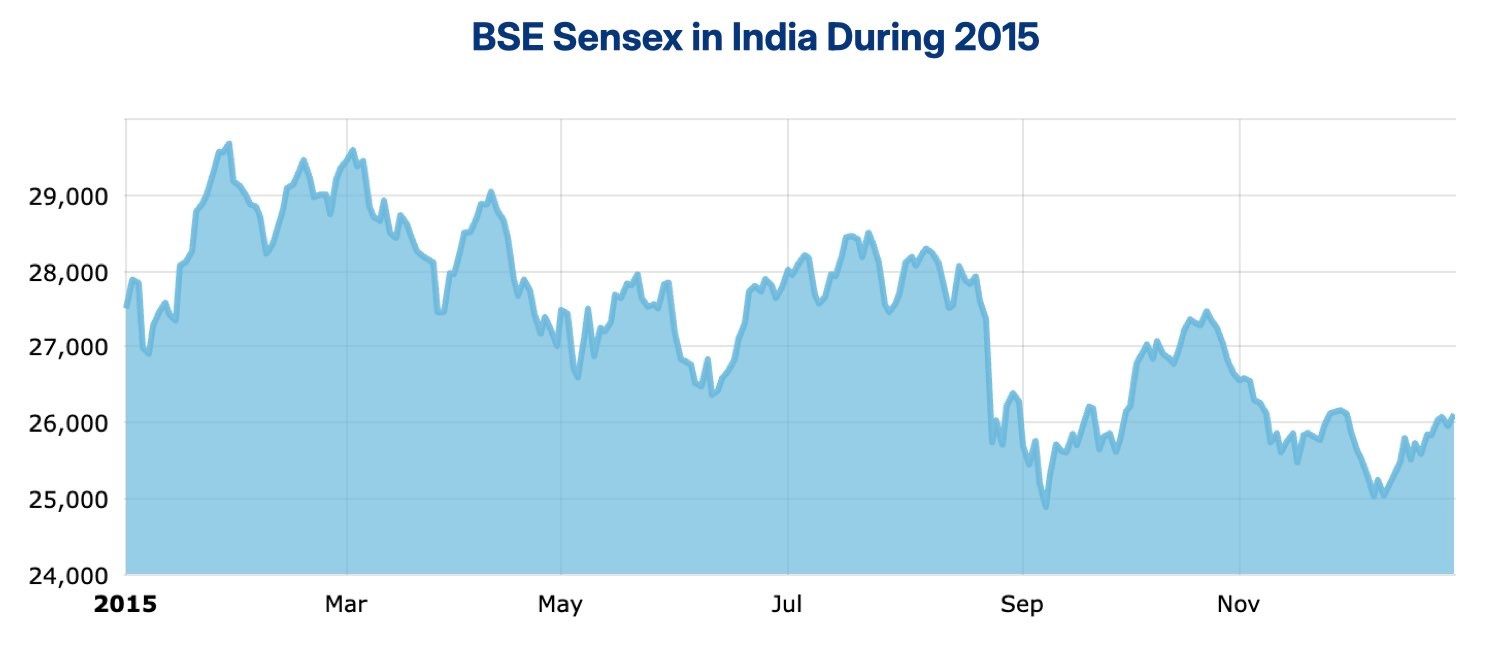
Source: BSE India6
During the same year, the gold market witnessed a downturn too. Starting with a dip in gold futures in July, the gold prices ultimately fell by over 5%, compared to the previous yearly close by Christmas of 2015.
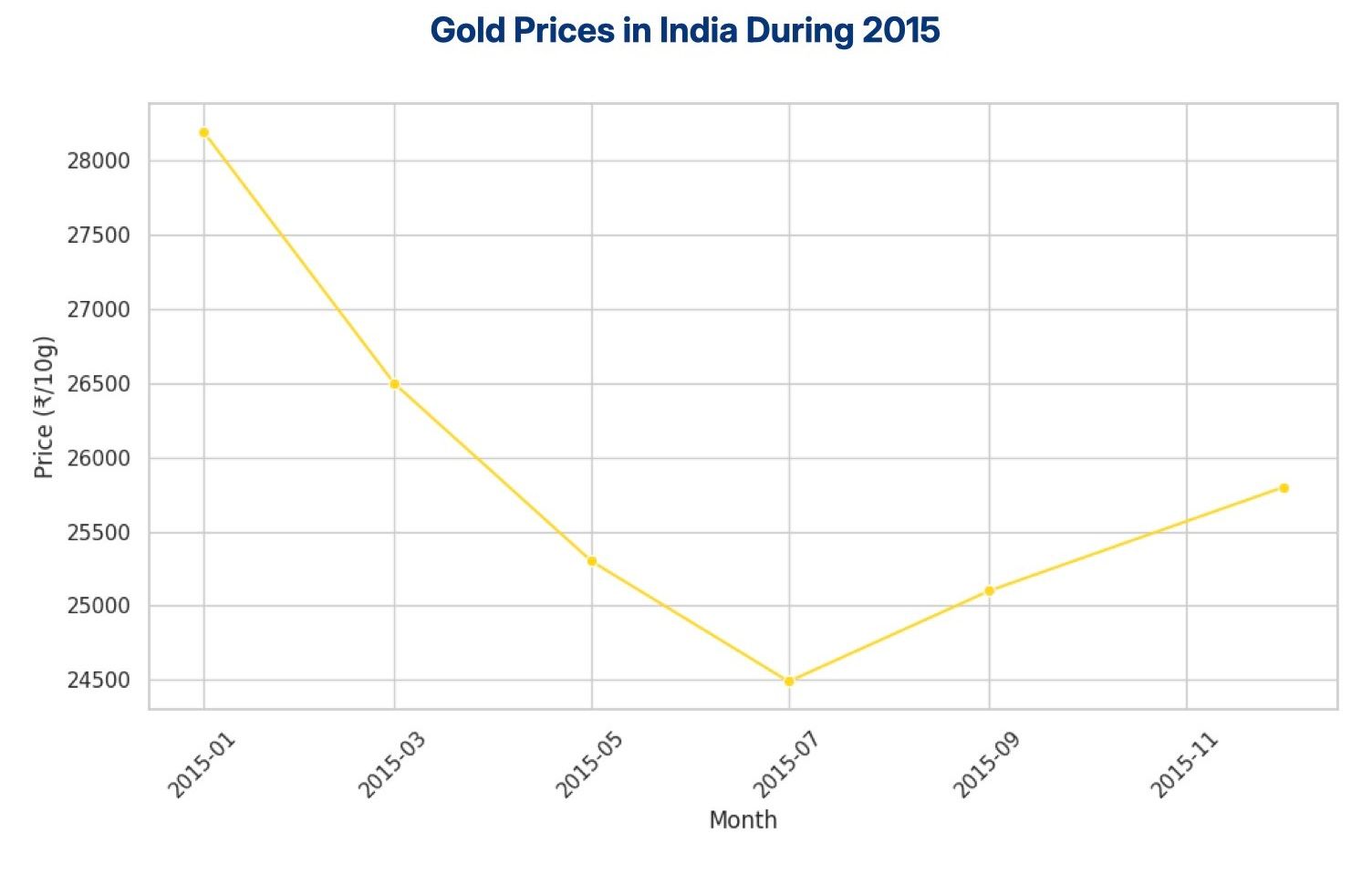
Source: Economic Times7
Therefore, although gold is favoured during periods of stock market volatility, it is important to consider individual market dynamics before making an investment decision.
Now, let’s explore another gold investment benefit in India, which is an inflation hedge and also understand how the stock market performs during inflation to better understand gold vs Sensex long-term returns.
Also Read: How Will The Sensex Look In 2026?
Inflation Hedge And Economic Cycles
Detailed below is a comparison of the stock market vs gold during inflation.
1. Gold as an inflation hedge in India
Unlike conventional fiat currencies, whose value might fluctuate, gold has an intrinsic worth and acts as an optimal store of wealth. When fiat currencies depreciate, investors turn to gold to preserve their purchasing power during times of excessive inflation. The intrinsic worth and restricted availability of gold make it a desirable asset to hold wealth. Not only during inflation, this trend continues during economic, social or global downturns.
For instance, as the pandemic stirred instability across economic segments, the gold prices surged 27% in six months during 20208.
2. Sensex’s performance during economic upturns and downturns
However, the stock market, therefore, the Sensex is sensitive to economic upturns and downturns. During economic downturns, stirred by domestic or global issues, the market tends to suffer a negative impact.
For instance, on 31 July 2025, the Sensex lost 500 points after Donald Trump’s tariffs started impacting the stock market9.
Which One Should You Choose?
In reality, the choice between gold investment vs shares lies with the individual's financial goal and temperament. The secret to a stable portfolio is diversification and not choosing one. Diversification mitigates risk and optimises return over time. Investors should diversify their portfolio not only with equity and gold but also with non-market-linked fixed income opportunities like corporate bonds and securitised debt instruments (SDIs). With fixed income options, the portfolio will be stable during times of stress like global uncertainty.
To learn more about portfolio diversification with fixed income options, sign up on Grip Invest today.
Frequently Asked Questions On Gold Vs Sensex
1. What is the relationship between the gold rate and the Sensex?
Usually, it has been found that the gold rate and the Sensex have an inverse relationship. When there is a decline in the stock market, investors generally move towards gold, and hence gold prices go up. However, the correlation between gold rate and Sensex can vary from time to time depending on the global geopolitical and economic scenarios.
2. How many stocks are in the Sensex?
The Sensex is composed of 30 of the largest and most actively traded stocks listed on the Bombay Stock Exchange, representing a cross-section of Indian industry.
3. What is the return on gold in the last 10 years?
As of July 2025, gold has delivered a compound annual growth rate (CAGR) of about 12.16%; in absolute terms, prices have risen by over 200% in the last decade.
References:
- The Times of India, accessed from: https://timesofindia.indiatimes.com/business/india-business/india-invested-14-trillion-since-independence-over-50-in-the-last-decade-report/articleshow/115617618.cms
- Forbes India, accessed from: https://www.forbesindia.com/article/explainers/gold-rate-history-india/92539/1
- Money Control, accessed from: https://www.moneycontrol.com/indian-indices/sensex-4.html
- Screener, accessed from: https://www.screener.in/company/1001/
- Business Standard, accessed from: https://www.business-standard.com/article/markets/2015-a-turbulent-year-for-indian-stock-markets-115123100566_1.html
- BSE India, accessed from: https://www.bseindia.com/sensex/code/16/
- Economic Times, accessed from: https://economictimes.indiatimes.com/markets/commodities/gold-had-a-hot-cold-story-in-2015-what-took-the-sheen-off-yellow-metal/articleshow/50390037.cms?from=mdr
- Investopedia, accessed from: https://www.investopedia.com/gold-price-history-highs-and-lows-7375273
- Investopedia, accessed from: https://www.investopedia.com/gold-price-history-highs-and-lows-7375273
Want to stay at the top of your finances?
Join the community of 4 lakh+ investors and learn more about Grip Invest, the latest financial knick-knacks, and shenanigans in the world of investing.
Happy Investing!
Disclaimer - Investments in debt securities/municipal debt securities/securitised debt instruments are subject to risks including delay and/ or default in payment. Read all the offer related documents carefully. The investor is requested to take into consideration all the risk factors before the commencement of trading.
This communication is prepared by Grip Broking Private Limited (bearing SEBI Registration No. INZ000312836 and NSE ID 90319) and/or its affiliate/ group company(ies) (together referred to as “Grip”) and the contents of this disclaimer are applicable to this document and any and all written or oral communication(s) made by Grip or its directors, employees, associates, representatives and agents. This communication does not constitute advice relating to investing or otherwise dealing in securities and is not an offer or solicitation for the purchase or sale of any securities. Grip does not guarantee or assure any return on investments and accepts no liability for consequences of any actions taken based on the information provided. For more details, please visit www.gripinvest.in
Registered Address - 106, II F, New Asiatic Building, H Block, Connaught Place, New Delhi 110001


