

Corporate Bond Liquidity Risk In India: Meaning, Causes And How To Assess It



Let us assume you buy a corporate bond that will mature in three years. After six months, you are suddenly in need of cash. You consider selling the bond before maturity, but you might find it difficult to find someone who would be willing to buy the bond at a fair price.
Here comes Corporate Bond Liquidity Risk. It is about the difficulty that you might have in selling a bond. Moreover, the sale might be made at a lower price than anticipated. Corporate Bond Liquidity is not universal. Its level can be affected by a variety of factors.
The global market of corporate debt has remained significant. The amount of corporate borrowings in the market has been estimated to have grown to $13.7 trillion worldwide in 2025. Out of this total figure, corporate bonds constituted $6.8 trillion.
What Is Corporate Bond Liquidity Risk?
Liquidity Risk associated with corporate bonds is the inability to sell easily. You may also get a relatively bad deal while selling your investment.
As compared to stocks, bonds may not be traded continuously. There may be times when there will be fewer buyers for some bonds. This makes it harder to sell off your bonds easily.
For instance, Priya buys bonds worth INR 2 lakh and decides to hold them till their maturity period. After one year, she suddenly needs INR 1 lakh for some other purpose.
She tries to sell her bonds in the secondary market but does not find enough interested buyers. This means she may have to wait for a buyer or sell it at a relatively cheaper rate.
This is what Bond Liquidity Risk means for the investor even before the bond matures. Here, the company will be financially healthy despite everything else.
SEBI has also observed that there are problems with the liquidity of the bonds in the secondary market. This was revealed through its consultation on market-making.
Why Are Some Corporate Bonds Less Liquid?
Liquidity Risk In Corporate Bonds may be determined by several influencing factors. The first factor is trading volume. Less traded bonds may be sold more easily.
Issue size might impact Liquidity as well. The bigger the issue is, the more market participants might be involved. But a bigger issue doesn't mean there would be an active secondary market. Credit quality also might affect demand for the securities. The higher-rated bonds attract a wider range of investors. But credit quality alone wouldn't help to determine liquidity of the bond.
Bond structure might also affect the activity on the market. Bonds with different coupons, maturities, and issue sizes might diversify the investor base. The investor base is also important. Institutional investors play a very important role in corporate bond markets. Besides, their large-size transactions might affect price formation when markets are illiquid.
Also, market conditions might affect Liquidity Risk In Corporate Bonds. During periods of uncertainty, buyers would be more selective. It would complicate finding a counterparty. The global market demonstrates the level of corporate borrowings. Global corporate bond outstanding amounted to $36.4 trillion by the end of 2025.
How Does Liquidity Affect Corporate Bond Prices and Yields?
Corporate Bond Liquidity Risk may affect the price obtained from the sale. Take two comparable bonds with equivalent coupons. The former has high liquidity, while the latter is not as traded.
There may be a need for a higher price concession for the least liquid bond because buyers will need to be compensated for the added difficulty of getting out of the position.
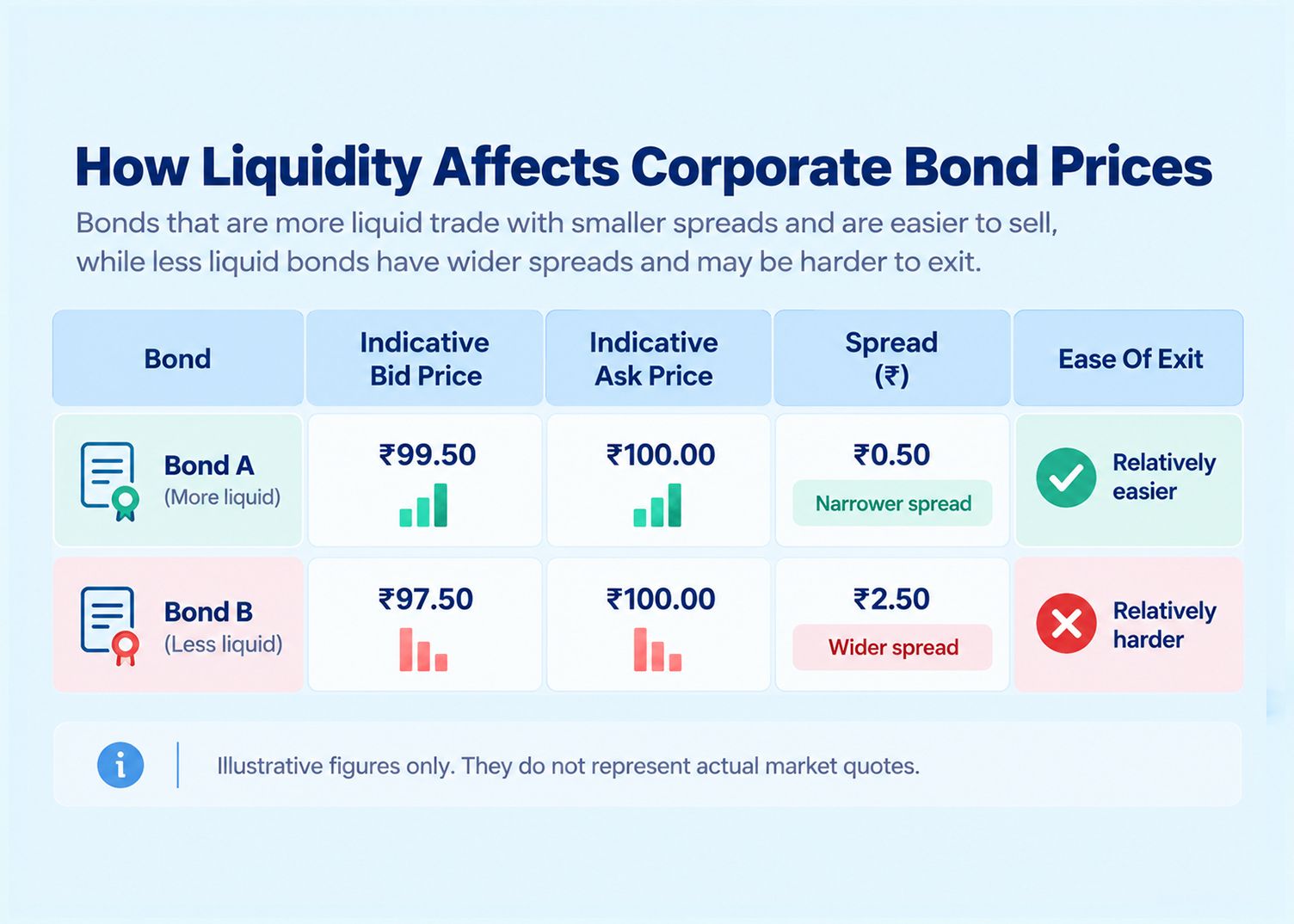
The bid-ask spread can provide a good measure. This is the difference between the buying and selling prices. Higher spreads may make it more expensive to exit investments.
Take the following hypothetical example of two bonds:
Bond | Indicative Bid | Indicative Ask | Spread | Ease Of Exit |
Bond A | INR 99.50 | INR 100.00 | INR 0.50 | Relatively easier |
Bond B | INR 97.50 | INR 100.00 | INR 2.50 | Relatively harder |
Higher spreads do not always imply a lack of liquidity. This has to be evaluated along with trading volumes and other conditions.
BIS has highlighted bid-ask spread as one of the measures of liquidity in the market. Another observation made by BIS is that corporate bonds usually have less trading activity compared to many other instruments.
Liquidity Risk Vs Credit Risk Vs Interest-Rate Risk
Corporate bond liquidity risk is distinct from credit risk and interest rate risk. All three risks will have a different effect on the way your investment is being affected.
Credit risk is all about the issuer's ability to pay back interest and principal. The weaker the financial state of the issuer, the harder it will be for him to pay off his debt.
On the other hand, interest rate risk is completely different. The value of bonds may shift depending on what happens to market interest rates.
Market interest rates that go up might lower the value of fixed-rate bonds.
Risk | What It Means | Potential Impact |
| Liquidity Risk | Difficulty finding buyers | Delayed exit or lower selling price |
| Credit Risk | Issuer struggles to repay | Missed interest or principal |
| Interest-Rate Risk | Market yields change | Bond price may change |
When Does Corporate Bond Liquidity Risk Matter Most?
The significance of Corporate Bond Liquidity Risk is greater in cases where there is a chance that you might require an early exit from the investment. The investor who intends to remain invested till the maturity date will depend less on the liquidity of the bond in the secondary market.
For instance, Rohan purchases a five-year bond and proceeds in accordance with his plan. According to his investment strategy, he does not have any urgency for the money and can wait until the bond matures. The secondary market liquidity will thus become a relatively less significant issue.
In the case of an investor who expects to receive the money within a period of one year, the importance of secondary market liquidity increases.
What Should Investors Check Before Buying A Corporate Bond?
Before investing, evaluate Corporate Bond Liquidity Risk along with other risks. A couple of tests can help you get familiar with the bond and possible exit scenarios.
1. Test Trading Volume: Analyze recent trades and transaction history. They may give hints about demand in the secondary market.
2. Test Issue Size: Analyze the issue size and outstanding size. These parameters may give hints about possible investor composition.
3. Test Credit Rating: Analyze the credit rating and most recent rationale for the credit rating. Nevertheless, it is not the sole parameter to be considered.
4. Test the Maturity: Compare the bond maturity with your financial goals. Do not depend on early redemption to cover some important short-term needs.
5. Test Bid-Ask Prices: If available, analyze the indicative bid-ask prices. Larger bid-ask spreads mean higher costs of exiting.
6. Test The Issuer: Analyze the position and track record of the bond's issuer. You can use Grip's guide for corporate bonds and important terminology. It explains coupon, maturity, and YTM.
Conclusion
Liquidity Risk of Corporate Bonds can influence the degree of ease with which you can get out of your investment. You may come across bonds that have a good yield but have a low level of trading.
Yield is not the only thing that needs to be considered by you. Consider factors like the trading activity, size of the issuance, creditworthiness, maturity date, and current market conditions.
Another aspect that comes into the picture is the period during which you are going to stay invested. The investors who plan to remain till maturity will face liquidity risk differently from those who expect an early exit.
If you understand the concept of Corporate Bond Liquidity Risk, you will be able to determine whether selling can be a problem for you.
FAQs
Want to stay at the top of your finances?
Join the community of 22 lakh+ investors and learn more about Grip Invest, the latest financial knick-knacks, and shenanigans in the world of investing.
Happy Investing!
Disclaimer - Investments in debt securities/municipal debt securities/securitised debt instruments are subject to risks including delay and/ or default in payment. Read all the offer related documents carefully. The investor is requested to take into consideration all the risk factors before the commencement of trading.
This communication is prepared by Grip Broking Private Limited (bearing SEBI Registration No. INZ000312836 and NSE ID 90319) and/or its affiliate/ group company(ies) (together referred to as “Grip”) and the contents of this disclaimer are applicable to this document and any and all written or oral communication(s) made by Grip or its directors, employees, associates, representatives and agents. This communication does not constitute advice relating to investing or otherwise dealing in securities and is not an offer or solicitation for the purchase or sale of any securities. Grip does not guarantee or assure any return on investments and accepts no liability for consequences of any actions taken based on the information provided. For more details, please visit www.gripinvest.in
Registered Address - 106, II F, New Asiatic Building, H Block, Connaught Place, New Delhi 110001


