

How Are SIP Returns Taxed In India 2026?



A Systematic Investment Plan (SIP) makes mutual fund investing simple. It allows investors to invest a fixed amount at regular intervals. However, every SIP installment is treated as a separate investment for taxation. A INR 5,000 monthly SIP running for three years does not have one single holding period.
Each instalment has its own purchase date, cost, and holding period. This means when someone redeems units, the resulting gains may be taxed differently.
In 2026, the tax treatment also depends on whether the fund is equity-oriented or falls under the specified mutual fund rules. Understanding these rules is important before you redeem your SIP investment.
How Is A SIP Taxed?
An SIP itself is not taxed during the investment. SIP tax generally arises when investors redeem or transfer mutual fund units and make a capital gain.
The basic calculation is
Capital Gain = Sale Value-Cost of Acquisition- Eligible Transfer Expense
The gain can be either Short-Term Capital Gain (STCG) or Long-Term Capital Gain (LTCG) based on how long the redeemed units are held.
For equity-oriented mutual units that are held for more than 12 months treated as long-term. If the units are held for 12 months or less, the gain is generally short-term.
For equity-oriented funds, STCG on transfer covered by the specified securities rules is taxed at 20%. LTCG is taxed at 12.5% on aggregated eligible gains exceeding INR 1.25 lakh in the relevant tax year.
How Is Capital Gains Tax Calculated For SIPs?
A separate tax lot is created for every SIP installment. The purchase date of each installment determines its holding period.
For example, if you invested INR 10,000 every month in an equity mutual fund. After two years, units bought in the first few months qualify as long-term, while units purchased more recently are considered short-term.
When units are redeemed, the first-in, first-out (FIFO) method is used to identify which units are sold first. The income tax department’s mutual fund transaction guidelines specifically provide for FIFO when identifying corresponding purchases and calculating the holding period.
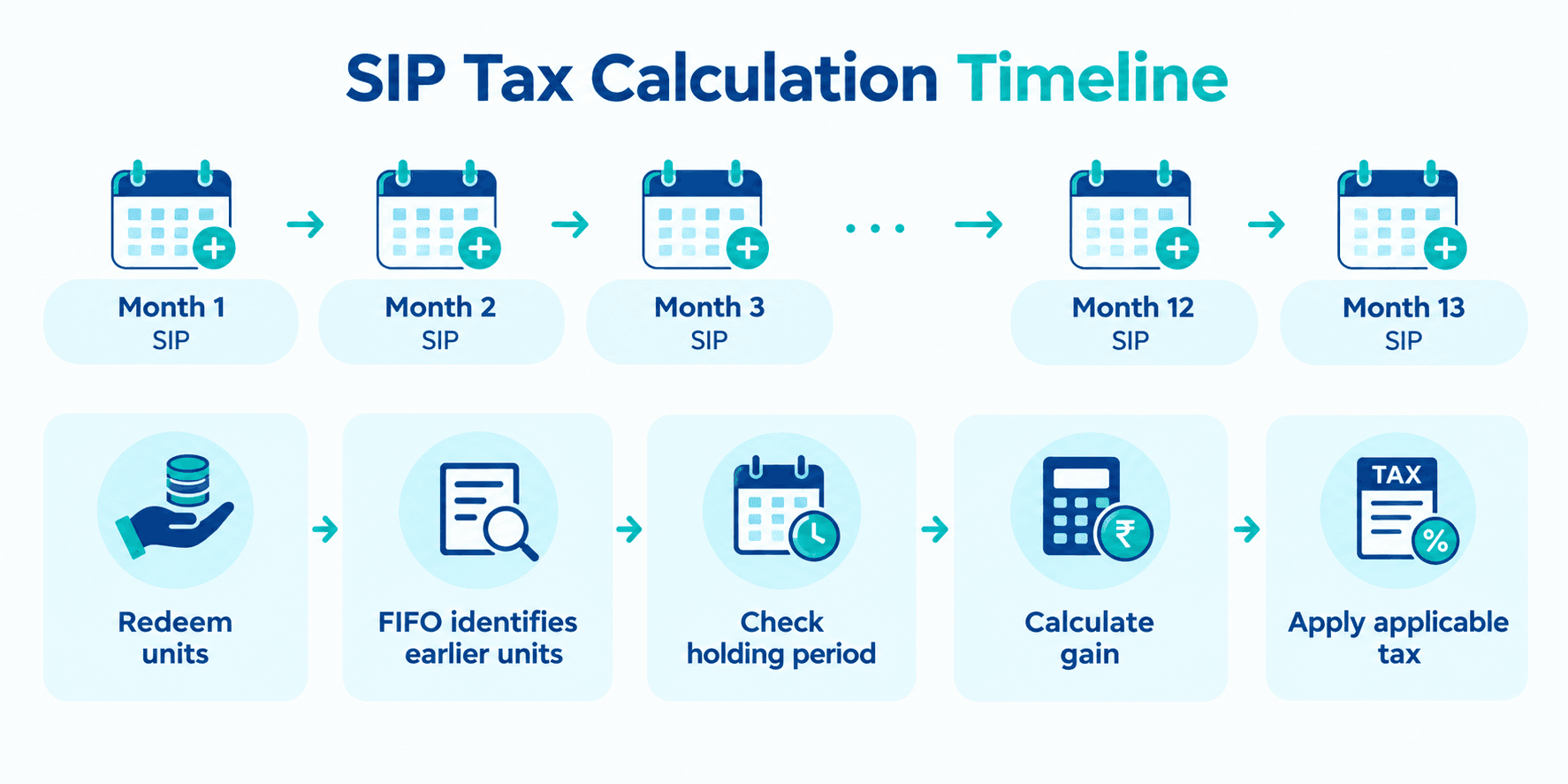
- Older Units: Held for more than 12 months ? potentially LTCG for an equity fund.
- Newer Units: Held for 12 months or less ? potentially STCG
- Each lot: Gain = Redemption value of units ? Cost of those units
Therefore, redeeming part of a long-running SIP does not automatically mean that the entire redemption will receive the same tax treatment.
Equity Vs Debt Mutual Fund SIP Taxation
The SIP tax treatment differs by the type of mutual fund. The following broad framework applies in 2026. The exact treatment can therefore depend on the fund’s portfolio and acquisition.
| Mutual Fund Type | Holding Period | Tax Treatment |
| Equity-oriented mutual fund | Up to 12 months | STCG generally taxed at 20% |
| Equity-oriented mutual fund | More than 12 months | LTCG taxed at 12.5% on eligible gains exceeding INR 1.25 lakh |
| Specified mutual fund covered by Section 50 AA | Any period | Gains treated as STCG and taxed at applicable slab rate |
How Does Tax Work When You Redeem Only Part Of A SIP?
You do not have to redeem your entire SIP investment at once. However, a partial redemption can still create a taxable event if the redeemed units generate a capital gain.
If you have invested INR 5,000 every month for two years and decide to redeem units worth INR 30,000. The tax is not calculated on the entire SIP corpus but only on the units that are redeemed. This creates a mix of tax outcomes if the redemption involves units from different investment dates or schemes. Investors should check the purchase date, number of units, purchase NAV, redemption NAV, and applicable tax category before making a partial withdrawal.
SIP Taxation In 2026: What Investors Should Know
The tax framework applicable from 1 April 2026 operates under the Income Tax Act 2025. The new Act applies to the tax year 2026-27 onwards. For 2026, investors should remember these SIP taxation rules.
1. Equity-oriented mutual fund STCG
If eligible equity mutual fund units are sold within 12 months, then the short-term capital gain is taxed at 20%.
2. Equity-oriented mutual fund LTCG
If the eligible equity mutual fund units are held for more than 12 months, then the long-term capital gains are taxed at 12.5%. The INR 1.25 lakh exemption applies to aggregate eligible LTCG during the tax year.
3. Equity holding period
For equity-oriented mutual funds, units generally need to be held for more than 12 months to qualify as long-term. However, units that are sold within 12 months are generally treated as short-term.
4. Specified mutual funds
Certain mutual funds covered by the specific mutual fund rules are treated as generating short-term capital gains, regardless of how long the units are held. These gains are generally taxed at the investor's applicable tax rate.
How Can Investors Track SIP Tax Liability?
Tracking each SIP installment can make SIP tax calculation much easier, especially if the investment is running for several years. Investors should maintain records for the following:
- Investment details - Keep records of SIP instalment date, amount invested, number of units allotted, and purchase NAV.
- Redemption & Tax Details - Redemption date, units redeemed, redemption NAV, and capital gain/loss.
- Reports & Tax Filing - Investors can use the mutual fund transaction statement to track purchases and redemptions. Capital gains reports to calculate taxable gain.
- Income Tax Department info - The pre-filled information can be used as a reference, while checking against their own records before filing.
Conclusion
SIP taxation in India depends on the type of mutual fund, the holding period of each instalment, and the gains made when units are redeemed. Since every SIP instalment has a separate purchase date, the FIFO method helps determine which units are sold and whether the resulting gains qualify as short-term or long-term.
Understanding the applicable tax rates, exemption limits, and record-keeping requirements can help investors estimate their tax liability and make more informed redemption decisions in 2026.
FAQs

Want to stay at the top of your finances?
Join the community of 22 lakh+ investors and learn more about Grip Invest, the latest financial knick-knacks, and shenanigans in the world of investing.
Happy Investing!
Disclaimer - Investments in debt securities/municipal debt securities/securitised debt instruments are subject to risks including delay and/ or default in payment. Read all the offer related documents carefully. The investor is requested to take into consideration all the risk factors before the commencement of trading.
This communication is prepared by Grip Broking Private Limited (bearing SEBI Registration No. INZ000312836 and NSE ID 90319) and/or its affiliate/ group company(ies) (together referred to as “Grip”) and the contents of this disclaimer are applicable to this document and any and all written or oral communication(s) made by Grip or its directors, employees, associates, representatives and agents. This communication does not constitute advice relating to investing or otherwise dealing in securities and is not an offer or solicitation for the purchase or sale of any securities. Grip does not guarantee or assure any return on investments and accepts no liability for consequences of any actions taken based on the information provided. For more details, please visit www.gripinvest.in
Registered Address - 106, II F, New Asiatic Building, H Block, Connaught Place, New Delhi 110001


