

FD Interest Taxation In India 2026 Explained With TDS Rules And Tax Rates



How Is FD Interest Taxed In India?
Fixed deposits (FDs) interest is taxable under the head ‘Income from Other Sources’ under the Income-tax Act, 2025, Section 92.1
The FD interest taxation depends on your total taxable income and the applicable tax regime. The interest is added to your total taxable income and taxed at the applicable slab rate under your chosen tax regime.2
Is FD Interest Taxable Even If TDS Is Not Deducted?
Yes, FD interest is taxable even if TDS is not deducted. TDS is only a method of collecting tax at source and does not determine whether the interest is taxable. FD interest must be considered while calculating your total taxable income and reported accordingly.3
If your interest falls below the applicable TDS threshold, the bank may not deduct TDS on FD interest, but you may still have a tax liability based on your total income and applicable tax slab.
FD TDS Rules In 2026
Effective from 1 April 2026, under the Income-tax Act 2025, FD TDS rules 2026 are governed by Section 393. This replaces the corresponding TDS provision under Section 194A of the Income-tax Act 1961.4
The FD interest TDS rate remains 10% when PAN is furnished and 20% without PAN. The Income Tax Department states that TDS rates and monetary thresholds were largely retained during the transition.
These thresholds determine when FD interest TDS is deducted5 :
- INR 1,00,000 in the case of a senior citizen
- INR 50,000 in the case of a person other than a senior citizen
How Much Tax Do You Pay On FD Interest?
The fixed deposit tax calculation includes each and every interest you earn during the year under “Income from Other Sources” in your Income Tax Return (ITR), even if the FD has not matured. Then the combined taxable income determines the applicable slab rates.
For example, Kabir, a 45 years old banker, has an FD and earns salary income under the new tax regime:
Particulars | Amount |
| FD principal | INR 10,00,000 |
| Interest earned at 7% | INR 70,000 |
| Other taxable income (Salary) | INR 16,30,000 |
| Total taxable income | INR 17,00,000 |
| Applicable tax rate | 20% |
| Tax on FD interest | INR 14,000 |
| Health and education cess at 4% | INR 560 |
| Estimated tax on FD interest | INR 14,560 |
The interest on FD, INR 70,000, takes the total taxable income from INR 16.30 lakh to INR 17 lakh. Since both amounts fall within the INR 16 lakh to INR 20 lakh slab, the interest amount is taxed at the 20% rate. After the 4% cess, the estimated tax on FD interest is INR 14,560.
TDS Deducted vs Final Tax Payable
Here, if the bank deducts 10% TDS, INR 7,000 is deducted from the interest amount of INR 70,000. However, this is not the final tax on FD interest.
The TDS amount is adjusted against your total tax when you file your ITR. The estimated tax on FD interest, in this example, is INR 14,560, which leaves INR 7,560, subject to the overall tax calculation of the taxpayer.
FD Interest Tax Under The Old And New Tax Regimes
FD interest income tax is applicable under both the old and new tax regimes. The main difference is that the old regime allows various deductions and exemptions, while the new regime has lower slab rates but fewer deductions.
Factor | Old Tax Regime | New Tax Regime |
| FD interest tax | FD interest is added to taxable income and taxed at the applicable slab rate. | FD interest is added to taxable income and taxed at the applicable slab rate. |
| Tax slabs | Uses the old regime slab rates, with 5%, 20% and 30% rates.6 | Uses revised slabs with rates ranging from 5% to 30%. |
| Deductions allowed | Allows various eligible deductions for investments, health insurance and certain interest income, subject to the applicable provisions.7 | Most deductions are not allowed. Specified deductions such as 80CCD(2) (ITA 1961) are available. |
| Impact on tax liability | Deductions can reduce taxable income and the tax payable. | Lower slab rates may reduce tax, but fewer deductions increase taxable income. |
| TDS on FD interest | TDS deducted by the bank is adjusted against the final tax liability. | TDS deducted by the bank is adjusted against the final tax liability. |
How To Calculate Post-Tax FD Returns
To calculate your post-tax FD return, you first need to calculate the interest earned and then account for the tax applicable to that additional income. The actual tax liability depends on your total taxable income, deductions, exemptions and applicable slab.
The post-tax FD return is calculated as,
Post-tax FD return = FD interest rate × (1 - applicable tax rate)
Let us say, if your FD earns 7% annually and the applicable tax rate is 20%,
Post-Tax Return = 7% × (1 - 20%) = 5.6%
On an investment of INR 8,00,000, the annual interest would be INR 56,000 before tax. At an assumed 20% tax rate, the illustrative tax on this interest would be INR 11,200, leaving INR 44,800 after tax.
Here is an illustration of estimated annual post-tax returns at different FD interest rates and assumed income tax rates:
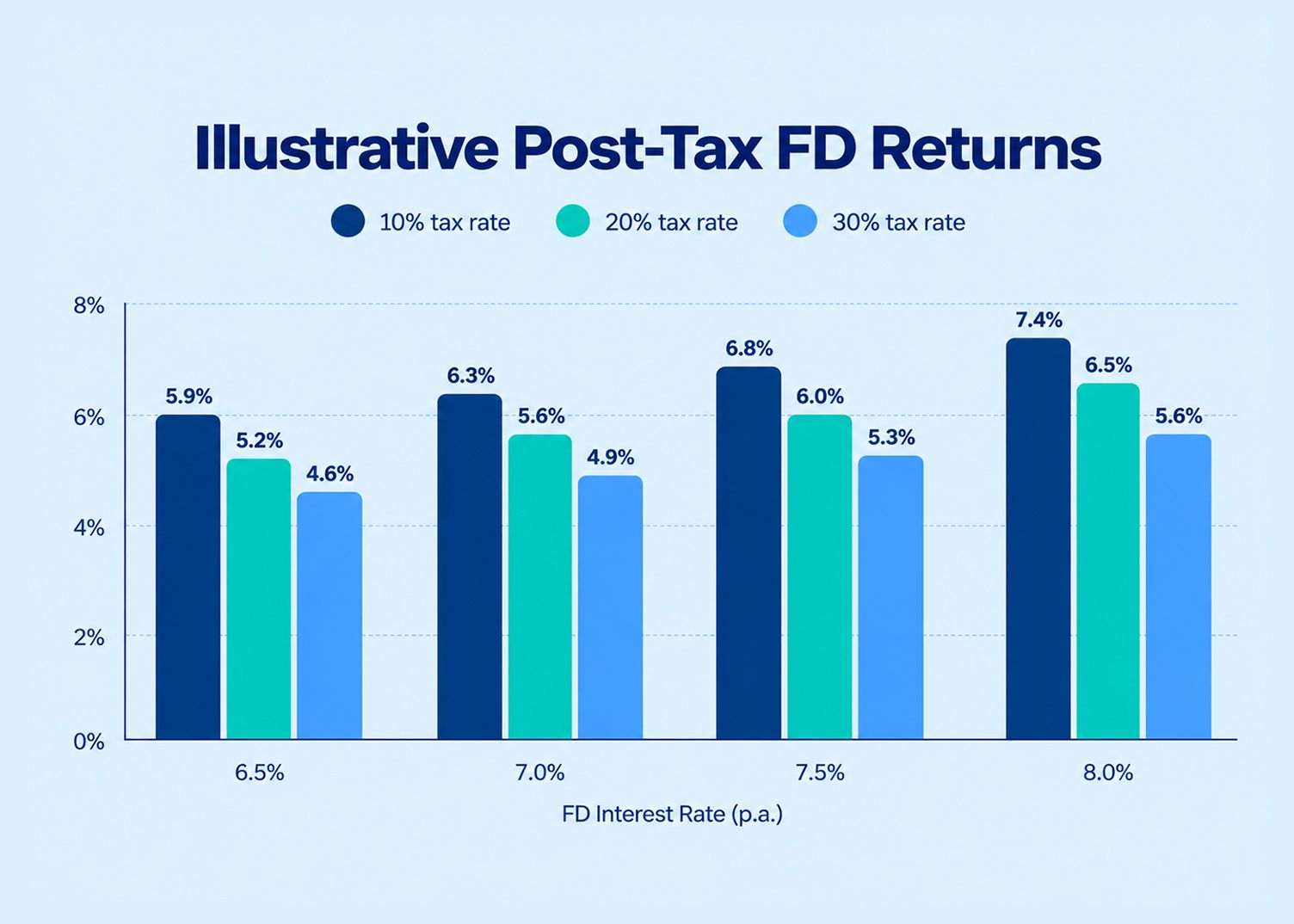
The above chart is illustrative for FY 2026-27 and assumes tax rates. It excludes the health and education cess, surcharge and deductions. The actual fixed deposit interest tax will therefore depend on your total taxable income and the selected tax regime.
How FD Interest Is Reported While Filing ITR
You can report FD interest through the Income Tax e-Filing Portal by declaring the gross interest income under Income from Other Sources.
1. Gather and verify documents: Check your AIS, Form 26AS and interest certificates from all banks to verify the interest earned and TDS deducted during the financial year.
2. Calculate gross FD interest: Calculate the gross interest by adding all the interest earned across all your FDs. The interest accrued on cumulative FDs during the financial year is also considered, even when the interest has not yet been received.
3. Select the applicable ITR form: Choose the ITR form applicable to your overall income and eligibility, such as ITR-1 or ITR-2. Go to Income from Other Sources (Schedule OS).
4. Report the FD interest: Enter the aggregate gross interest from bank deposits in the relevant interest-income field under Schedule OS. The income will form part of your total taxable income.
5. Claim TDS credit: You can also verify the TDS deducted by your bank in the TDS schedule against Form 26AS and AIS and claim the amount as credit against your final tax liability.
Conclusion
Tax on FD interest affects the overall returns you earn after tax. While your interest may not be subject to TDS, accrued interest still forms part of your taxable income and attracts tax at your applicable slab rate.
Therefore, verifying your interest income through AIS and Form 26AS, reporting the gross amount in your ITR and claiming eligible TDS credit helps you to account for your FD income accurately.
FAQs

Want to stay at the top of your finances?
Join the community of 22 lakh+ investors and learn more about Grip Invest, the latest financial knick-knacks, and shenanigans in the world of investing.
Happy Investing!
Disclaimer - Investments in debt securities/municipal debt securities/securitised debt instruments are subject to risks including delay and/ or default in payment. Read all the offer related documents carefully. The investor is requested to take into consideration all the risk factors before the commencement of trading.
This communication is prepared by Grip Broking Private Limited (bearing SEBI Registration No. INZ000312836 and NSE ID 90319) and/or its affiliate/ group company(ies) (together referred to as “Grip”) and the contents of this disclaimer are applicable to this document and any and all written or oral communication(s) made by Grip or its directors, employees, associates, representatives and agents. This communication does not constitute advice relating to investing or otherwise dealing in securities and is not an offer or solicitation for the purchase or sale of any securities. Grip does not guarantee or assure any return on investments and accepts no liability for consequences of any actions taken based on the information provided. For more details, please visit www.gripinvest.in
Registered Address - 106, II F, New Asiatic Building, H Block, Connaught Place, New Delhi 110001


