

How to Calculate Post-Tax Returns on Fixed Deposits in India



The fixed deposit interest rate does not tell you how much you will keep after deducting the tax. If you have a deposit worth INR 1 lakh with a simple interest rate of 7%, you earn a total before tax of INR 7,000. If this entire interest amount is taxed at a 20% income tax rate plus 4% cess, you will get to keep a net amount of INR 5,544, which amounts to a return of 5.544% annually.
Hence, you must understand how to arrive at the post-tax returns in fixed deposits so that you can calculate the interest you retain after tax.
What Are Post-Tax Returns On Fixed Deposits?
A 7% deposit rate tells you the interest earned before tax. Your usable income depends on how much tax that interest adds to your annual liability. Post-tax returns measure the interest left after that tax, expressed in rupees or as a percentage of your deposit.
Understanding how to calculate post-tax returns on fixed deposits starts with separating interest, tax and principal. The principal is your original investment; returning it at maturity does not make it interest income. For an ordinary resident investor, taxable deposit interest generally falls under “Income from other sources”.
The post-tax return reflects the interest remaining after accounting for the tax attributable to those earnings. It helps you compare the effective return from different deposits rather than relying solely on their advertised rates. Your actual outcome depends on your total taxable income, applicable tax regime and eligibility for rebates or deductions.
Tax deducted at source, or TDS, is a collection mechanism. It is credited against the final tax payable, rather than charged again as a separate tax. A deduction below your final liability can leave more tax to pay. Excess deduction can produce a refund after assessment. Therefore, FD returns after TDS may differ from the amount retained after final tax.
How To Calculate FD Interest Before Tax
First establish the deposit amount, annual rate, tenure and compounding frequency. Use the bank’s interest certificate to check actual earnings. An advertised rate alone does not tell you the rupee amount credited.
Simple Interest And Compounding
For simple interest, use:
Interest = Principal × Annual rate × Time in years
With an example of a deposit of INR 1,00,000 for a year at the rate of 7%, the total interest earned is INR 7,000. Thus, the total amount before tax, including the principal, is INR 1,07,000.
For a cumulative deposit, the calculation changes:
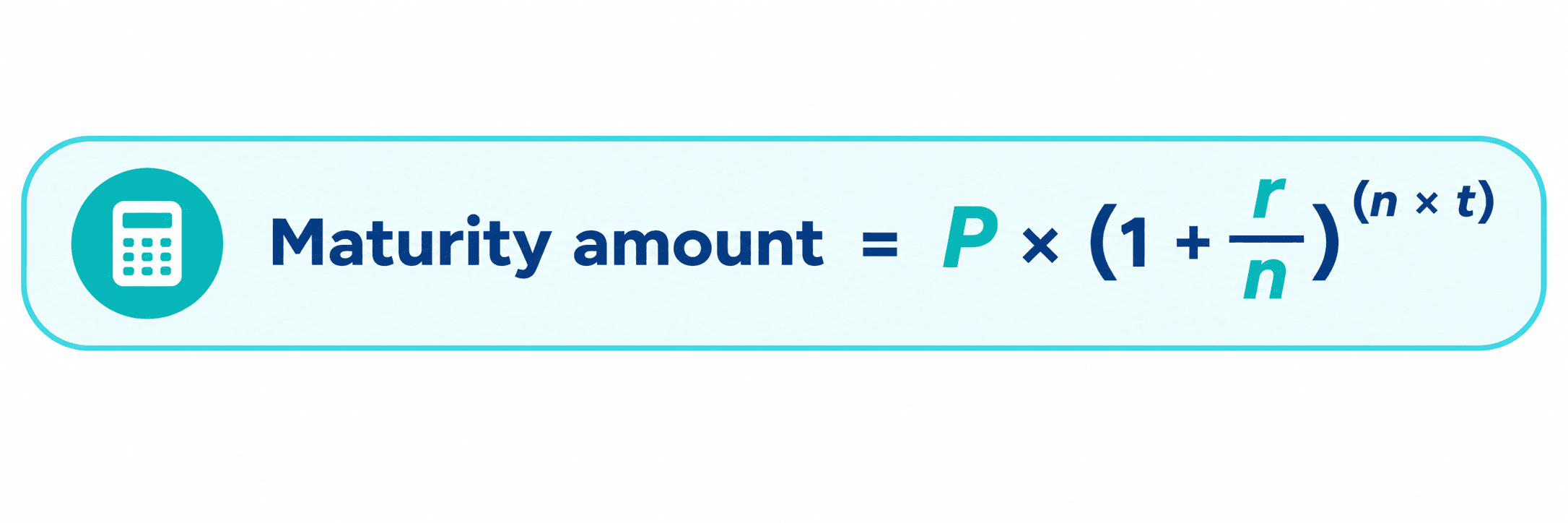
Where P is the principal amount, 'r' the decimal form of annual interest rate, 'n' the number of compounding periods in a year and 't' is the total number of years. When INR 1,00,000 is compounded quarterly at an annual rate of 7% for one year, the maturity amount is approximately INR 1,07,185.90 before tax.
The first example assumes simple interest, while the second uses quarterly compounding. Actual FD earnings depend on the bank's calculation method, compounding frequency, payout option and deposit terms. Periodic interest payouts and cumulative deposits may also have different cash-flow patterns.
How To Calculate Post-Tax FD Returns
To understand how to calculate post-tax returns on fixed deposits, apply these formulas to a one-year deposit:
- Estimated tax = Gross interest × Applicable tax rate
- Net interest = Gross interest - Tax attributable to that interest
- Annual net return (%) = Net interest ÷ Principal × 100
Worked Example With Cess
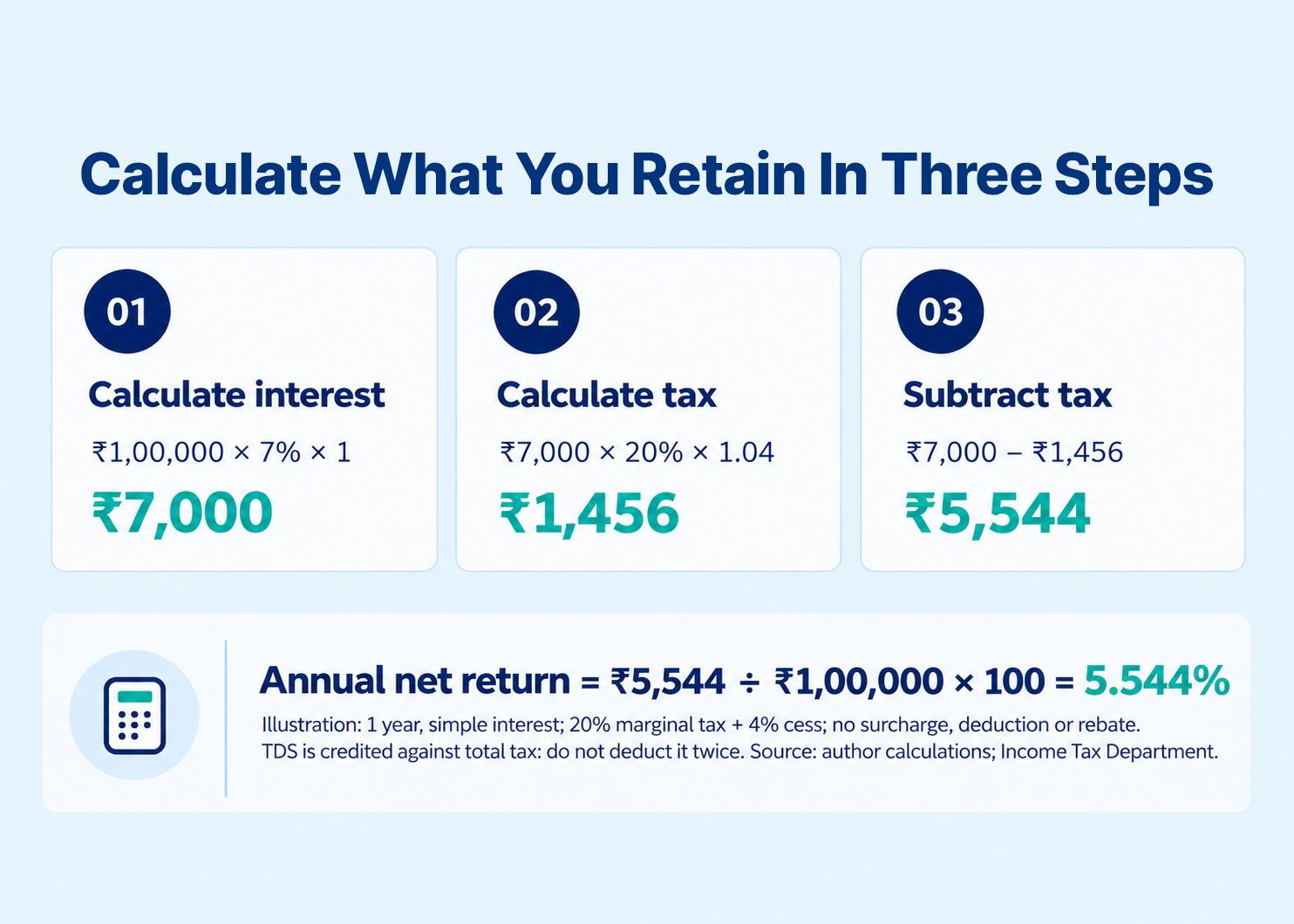
Assume INR 1,00,000 invested for one year earns simple interest at 7%. The INR 7,000 interest is fully taxable at an assumed marginal rate of 20%, with no surcharge, deduction or rebate affecting it.
- Basic tax: INR 7,000 × 20% = INR 1,400
- Health and education cess: INR 1,400 × 4% = INR 56
- Total estimated tax: INR 1,456
- Interest retained: INR 7,000 - INR 1,456 = INR 5,544
- Post-tax FD interest rate: 5.544%
In this instance, the post-tax economic value amounts to a total of INR 1,05,544, including the original principal of INR 1,00,000. However, this illustrative value is not necessarily the bank's maturity credit, as tax may have been deducted or paid separately.
While calculating the tax for FD, consider the additional tax attributable to the interest alongside your other income. The amount of tax which needs to be paid depends on your applicable tax regime, total income, deductions, rebates and other relevant tax rules. The shortcut way assumes that all the interest is being taxed with the same marginal rate but it is not a substitute for the final tax calculation on your total income.
A fixed deposit post-tax return calculator can help you estimate the amount retained under different interest-rate and tax assumptions. Check whether the calculator includes tax, cess and compounding before using its result to compare deposits.
How Does Your Tax Slab Affect FD Returns?
The marginal tax rate which is referred to in this case is the tax rate which applies to the next portion of taxable income. This means that it does not refer to the average tax rate on the overall income from the person in question. If interest spans two slabs, calculate each portion at its applicable rate.
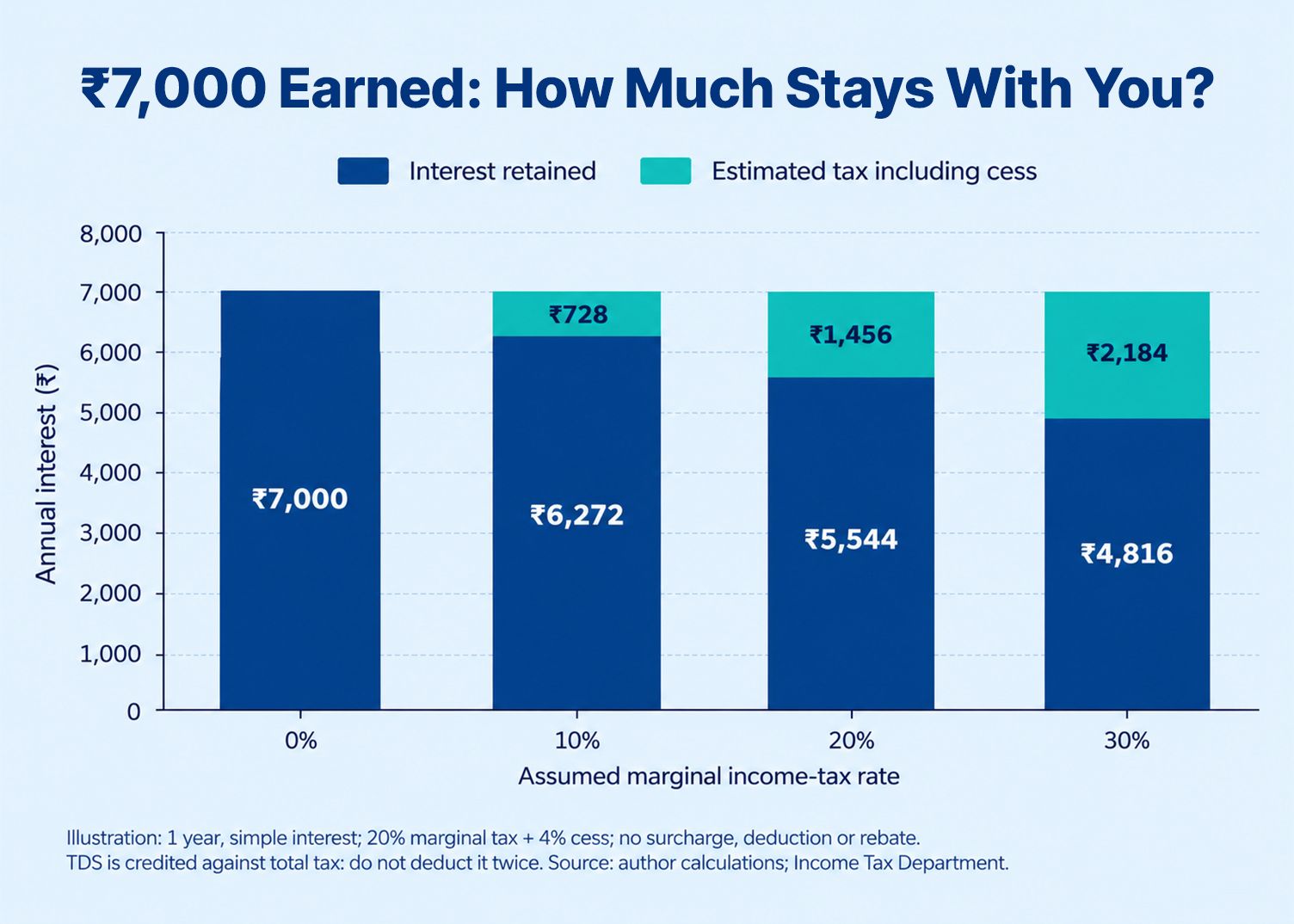
The table illustrates FD post-tax returns on INR 1 lakh earning INR 7,000 over one year. It includes 4% cess on basic tax, assumes no surcharge, and excludes deductions and rebate effects.
Assumed marginal rate | Gross interest | Estimated tax including cess | Interest retained | Net annual return |
0% | INR 7,000 | INR 0 | INR 7,000 | 7.000% |
10% | INR 7,000 | INR 728 | INR 6,272 | 6.272% |
20% | INR 7,000 | INR 1,456 | INR 5,544 | 5.544% |
30% | INR 7,000 | INR 2,184 | INR 4,816 | 4.816% |
The 0% row indicates that there is no additional tax but it does not indicate that all deposits are exempt from tax.
The relevant tax year 2026–27 runs from 1 April 2026 to 31 March 2027 under the Income-tax Act, 2025. The Act uses the term “Tax Year” rather than “Assessment Year”. Assessment Year 2026–27 relates to income earned in the preceding financial year under the Income-tax Act, 1961.
Additionally, the marginal rates in this table are illustrative assumptions, not a statement that every investor will pay tax at these rates. The Health and Education Cess is 4% of income tax plus applicable surcharge. The actual tax attributable to FD interest may differ because of the investor's total income, applicable regime, deductions, rebates and surcharge.
How To Compare FDs Using Post-Tax Returns
Compare FDs using the same principal, tenure and tax assumptions. The assumed tax rate of 20.8%, including cess, has been applied here. The two annual rates of 7% and 7.5% leave respectively amounts of INR 5,544 and INR 5,940 on INR 1 lakh. The difference makes up INR 396.
With a fixed deposit post-tax return calculator, the factors included in the calculation are cess, compounding and timing of paying taxes. Grip Invest's FD calculator can help estimate gross maturity. Calculate tax separately unless the tool explicitly includes it.
When evaluating issuer risk, withdrawal penalties and payout frequency, one cannot assume that the higher rate in advertising eliminates the credit risk or makes an unsuitable lock-in option acceptable.
Common Mistakes When Calculating Post-Tax FD Returns
An inaccurate interest estimate, an incorrect tax assumption or a missed TDS credit can distort the final calculation. Avoid these common mistakes when estimating FD returns after tax:
1. Treating no TDS as no tax: For eligible interest other than interest on securities paid by a banking company, a qualifying co-operative bank or a post office under a notified deposit scheme, the TDS threshold for Tax Year 2026–27 is INR 50,000 for non-senior citizens and INR 1,00,000 for senior citizens. These thresholds do not mean that the interest is exempt from income tax.
2. Deducting TDS twice: Account for the tax attributable to the interest once, then reconcile the TDS already credited against the final tax liability.
3. Ignoring other banks: The process of FD tax calculation must include taxable interest from deposits across all banks, not just one bank. Check the interest certificates and TDS records to avoid missing income or claiming the same credit twice.
4. Using the original rate after early closure: In this case, a customer should resort to recalculation using the revised rates and penalty conditions that the bank sets within the agreement. The resulting interest may be lower than originally estimated, reducing the post-tax return as well.
FAQs

Want to stay at the top of your finances?
Join the community of 22 lakh+ investors and learn more about Grip Invest, the latest financial knick-knacks, and shenanigans in the world of investing.
Happy Investing!
Disclaimer - Investments in debt securities/municipal debt securities/securitised debt instruments are subject to risks including delay and/ or default in payment. Read all the offer related documents carefully. The investor is requested to take into consideration all the risk factors before the commencement of trading.
This communication is prepared by Grip Broking Private Limited (bearing SEBI Registration No. INZ000312836 and NSE ID 90319) and/or its affiliate/ group company(ies) (together referred to as “Grip”) and the contents of this disclaimer are applicable to this document and any and all written or oral communication(s) made by Grip or its directors, employees, associates, representatives and agents. This communication does not constitute advice relating to investing or otherwise dealing in securities and is not an offer or solicitation for the purchase or sale of any securities. Grip does not guarantee or assure any return on investments and accepts no liability for consequences of any actions taken based on the information provided. For more details, please visit www.gripinvest.in
Registered Address - 106, II F, New Asiatic Building, H Block, Connaught Place, New Delhi 110001


