

What Happens If a Bank Fails in India? Deposit Safety and RBI Rules



Bank deposits are generally considered a safe place to keep money, but a bank's financial distress can raise concerns about access to savings and the security of fixed deposits. In India, the outcome depends on the action taken by the Reserve Bank of India (RBI), whether the bank undergoes a merger or reconstruction or enters liquidation, and the protection available under the Deposit Insurance and Credit Guarantee Corporation (DICGC).
Understanding the INR 5 lakh deposit insurance limit, the treatment of balances exceeding it and the rules governing withdrawal restrictions can help depositors assess their exposure and plan accordingly.
What Happens When A Bank Fails?
Bank failure denotes that a bank cannot fulfill its monetary commitments to its depositors. However, a failed UPI transaction or a banking-app failure does not mean bank failure in India since a technical error could disrupt transactions in an operational bank.
Instead, what happens if a bank fails depends on what action the authorities will take. They may impose restrictions on withdrawals, arrange for a merger or reconstruction, or proceed with the cancellation of the license and the liquidation of the bank. Liquidation means putting the bank out of business and using the money retrieved from its assets to pay the creditors.
Depositors will not lose all their money automatically. The eligible deposits will be covered by insurance, while a rescue scheme could allow them to keep their money even if it is more than the insurance amount. For example, after the RBI drafted a reconstruction scheme for YES Bank in March 2020, it imposed a moratorium on the bank but did not close it down immediately.
The important distinction is that financial distress, restrictions on withdrawals, reconstruction and liquidation are not interchangeable. A bank may continue operating under restrictions or undergo restructuring rather than proceed directly to liquidation. The outcome for depositors depends on the regulatory action and any approved resolution scheme.
What Happens To Your Savings And Fixed Deposits?
Savings and fixed deposits (FDs) are liabilities of the bank. Withdrawals and early termination of FDs are subject to restrictions imposed by the Reserve Bank of India (RBI) / DICGC and any other subsequent resolution schemes used by banks for handling depositors’ claims. In addition, an FD that has matured will not override the RBI’s withdrawal restrictions.
If restrictions apply, depositors may be unable to withdraw the full balance immediately, even if their FD has matured. Whether premature withdrawal is permitted, whether interest continues to accrue and when funds become accessible depend on the applicable directions, the deposit terms and the resolution arrangement. Restricted access does not, by itself, mean that the deposit has been lost.
A Hypothetical Deposit Calculation
Let us assume that Meera holds the following eligible balances with Bank A on the relevant insurance cut-off date.
- Savings account: INR 1,20,000
- FD principal: INR 4,00,000
- Accrued FD interest: INR 20,000
- Combined balance: INR 5,40,000
Assuming all accounts are held individually in the same right and capacity, with no dues to set off, the maximum insured amount is INR 5,00,000. The remaining INR 40,000 is outside insurance. Recovery depends on the applicable resolution or liquidation process. Recovery is not guaranteed.
For bank deposit safety, distinguish the account balance from the amount available. Insurance protects eligible claims within its limit; it does not guarantee uninterrupted withdrawals.
For example, if Meera needs INR 1 lakh immediately for household expenses, the fact that INR 5 lakh of her deposits is insured does not guarantee that she can withdraw INR 1 lakh while restrictions are in force. Insurance coverage and access to funds are two separate issues. She may need to use another accessible account until the applicable restrictions are lifted or the resolution process allows payment.
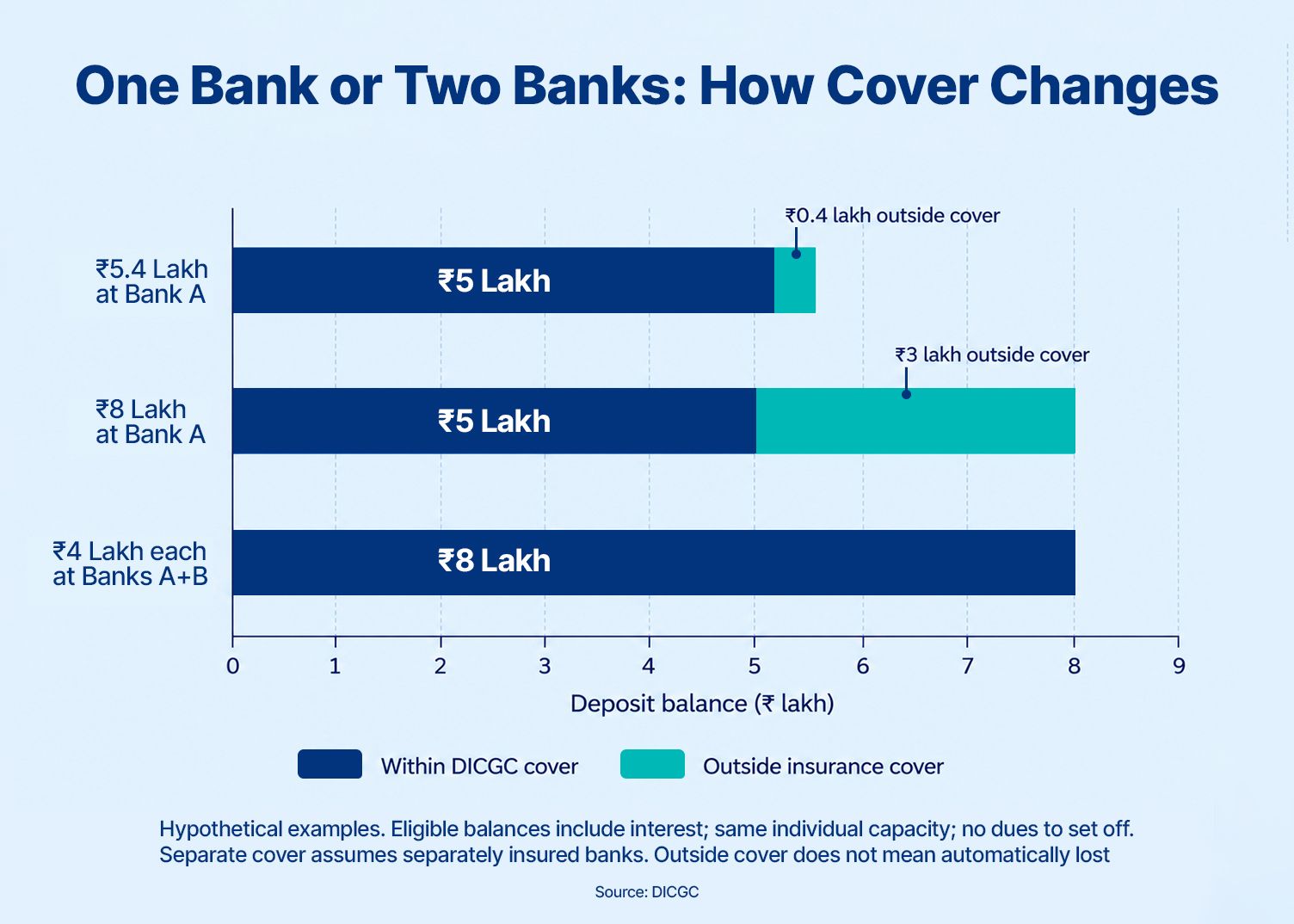
Illustrative balances, the orange segment is outside insurance, not a confirmed loss.
How Does DICGC Deposit Insurance Protect Depositors?
The Deposit Insurance and Credit Guarantee Corporation (DICGC) is RBI-owned. Its bank deposit protection covers eligible savings, current, recurring and fixed deposits at insured banks. The ceiling is INR 5 lakh per depositor, per bank, in the same right and capacity, including principal and interest. The bank pays the premium.
The limit applies to the combined eligible deposits held by a depositor across all branches of the same insured bank. It is not a separate INR 5 lakh limit for every account or branch. DICGC also considers the applicable cut-off date and any eligible dues that must be set off against deposits when calculating a claim. Depositors can check whether their bank is insured through DICGC's official list of insured banks.1
Which Payout Timeline Applies?
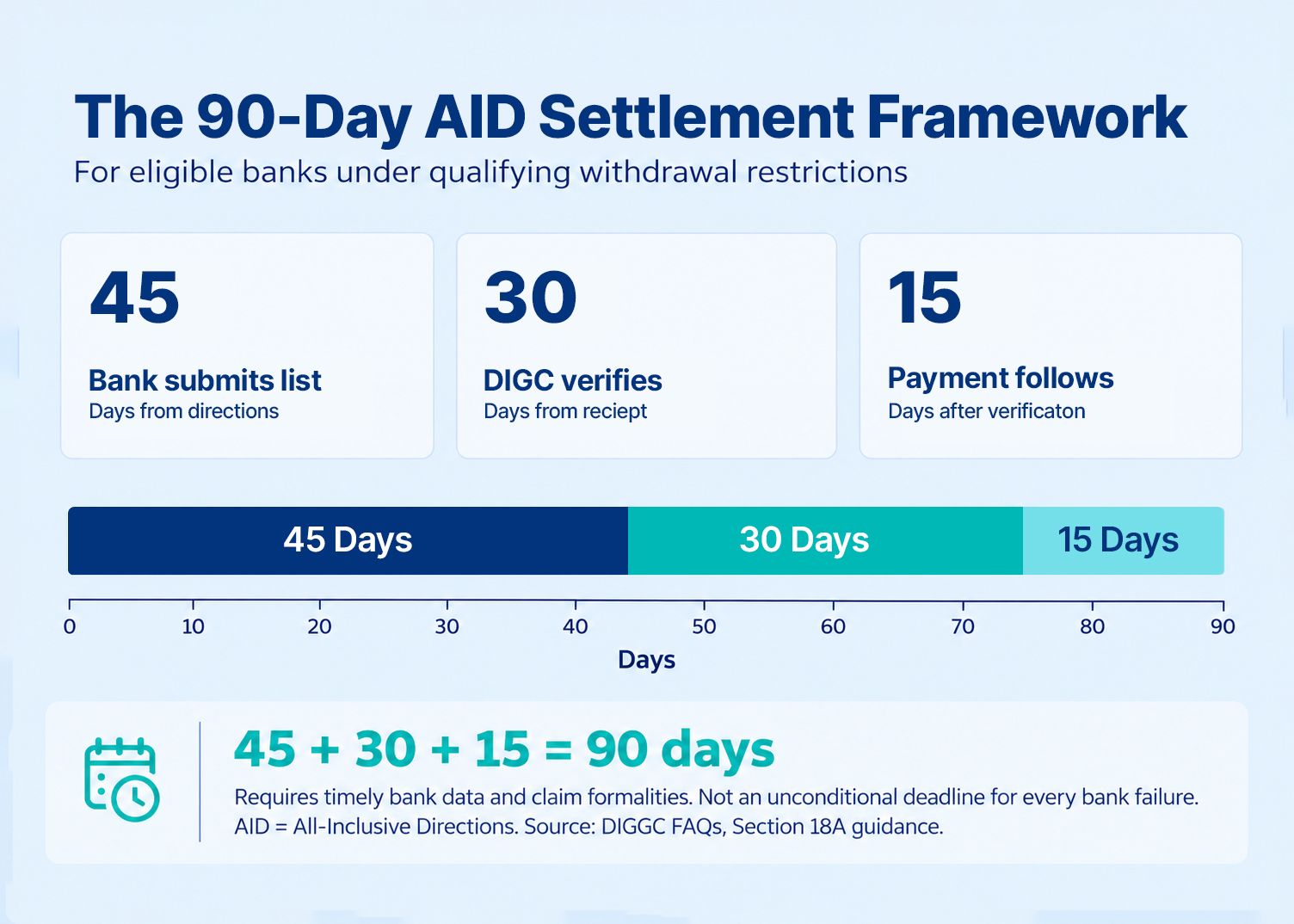
For eligible banks under RBI’s All-Inclusive Directions restricting access to deposits, Section 18A provides a 90-day settlement framework:
- Bank submits depositor details within 45 days.
- DICGC verifies claims within 30 days of receipt.
- Payment follows within 15 days after verification.
These intervals form part of the 90-day framework, subject to the statutory conditions. Delayed or missing information from the bank can affect settlement within this period. Depositors must follow the applicable claim procedure, including submitting the required willingness form and identity documents.
In case of liquidation, DICGC is liable to pay eligible claims through the liquidator within two months of receiving the claim list. The timeline does not simply begin on the date the bank experiences financial trouble.
DICGC does not insure deposits mobilised by NBFCs, corporate fixed deposits or other excluded categories merely because they are described as deposits. Make sure you know whether the issuer is an insured bank and whether the particular deposit is eligible.
Additionally, DICGC's published statistics for March 31, 2025, provide useful context. 97.60% of deposit accounts at insured banks were fully protected, while the insured-deposit ratio was 41.50% of total assessable deposits. These figures measure different things. The first refers to the proportion of accounts fully covered by insurance; the second measures insured deposits against the overall assessable deposit base. They show why a high proportion of fully protected accounts does not mean that all money deposited in the banking system is insured.
How Can Depositors Reduce Their Exposure?
Calculate the exposure rate you have per specific bank making sure to take into consideration savings account, FDs, automatic deposits, and accrued interest to be in the same capacity. Putting the money into different branches of the same bank will not increase the cover.
Plan For Interest And Access
Consider this hypothetical allocation, assuming eligible individual deposits and no other balances or deductible dues:
- INR 8 lakh at bank A: INR 5 lakh insured; INR 3 lakh outside cover.
- INR 4 lakh each at two separately insured banks: INR 8 lakh insured initially.
Leave room for interest: The INR 5 lakh deposit is now at the insurance limit. Check your balances before renewing the fixed deposit.
Keep a separate active bank account so you have another mode of payment for your necessary expenses. Plan your fixed deposit maturities for planned expenses, but do not forget that alternate maturity dates won’t give you more insurance coverage if you are faced with a bank failure.
Ensure comparisons of issuer eligibility along with interest rates and tenures. Alongside, check special-tenure FD versus regular FD as well, to understand fixed deposit structures without assuming that using longer-tenured deposits will provide you with more security.
A practical way to calculate your exposure is to prepare a bank-wise list of your eligible deposits, including principal and accrued interest. For each insured bank, compare the combined amount against the INR 5 lakh limit. Repeat this exercise when opening or renewing an FD, receiving interest or moving money between accounts.
Diversification also needs to be understood correctly. Deposits with two separately insured banks can qualify for separate insurance limits, subject to the applicable eligibility conditions. However, moving money between branches of the same bank does not create additional cover. Different accounts held in genuinely different rights and capacities may be treated separately under DICGC rules, but simply opening another account in the same capacity does not increase the limit.
Finally, consider liquidity as well as insurance. Keep enough accessible funds in another bank to cover essential expenses, such as rent, household bills and medical costs, if your primary bank restricts withdrawals. This will not increase the insurance limit, but it can reduce your dependence on a single account during a disruption.
Bank Failure Vs Bank Merger Vs Temporary Withdrawal Restrictions
The RBI rules for bank failure can produce different outcomes depending on the regulatory action taken.
- Failure: A bank is unable to meet its financial obligations. The applicable resolution or liquidation process determines how depositors' claims are handled.
- Merger: The deposits and liabilities of one bank may be transferred to another under an approved arrangement. The treatment of deposits depends on the applicable scheme.
- Temporary restrictions: Restrictions may limit withdrawals or disallow transactions as specified in the relevant order. They do not automatically mean that the bank is being liquidated.
- Reconstruction: An approved scheme may reorganise the bank through changes to its capital, management or ownership. Depositors' claims are handled under the terms of that scheme.
For instance, a hypothetical withdrawal restriction of INR 25,000 does not mean that a depositor holding INR 3 lakh has permanently lost the remaining INR 2.75 lakh. It means that access to the money is governed by the applicable restrictions.
Similarly, the INR 5 lakh insurance limit does not automatically determine how much a depositor may retain under a merger or reconstruction scheme. The treatment of deposits depends on the approved arrangement and applicable law.
Consider two hypothetical scenarios. In the first, a bank faces temporary withdrawal restrictions but remains operational. The depositor may retain the balance in the account while being unable to access it freely. In the second, a bank enters liquidation after its licence is cancelled. Eligible deposits are assessed for DICGC insurance, while recovery of amounts above the insurance limit depends on the liquidation process. These scenarios can have very different consequences for depositors.
A merger or reconstruction can also have a different outcome from liquidation. Deposits may be transferred or treated according to an approved scheme. Therefore, depositors should read the specific RBI announcement and scheme rather than assume that every distressed bank will follow the same process.
What Should You Check If Your Bank Faces Financial Trouble?
Check these details to understand what happens to money if a bank fails:
- Official Status: Understand what restrictions, reconstruction, merger, or cancellation of license is mentioned in RBI’s dated statement and bank’s notice.
- Access Rules: Find withdrawal limits, exceptions, and validity.
- Insurance: Check the position of the bank's DICGC and total eligible amounts.
- Records: Keep your statements, FD receipts, ID, and contact details ready.
- Claim Instructions: For a bank under stipulations, fill out the willingness form, provide identity proof, and share alternative bank details. Keep your acknowledgement. In case of liquidation, follow what the liquidator wants you to do.
Do not trust rumors on social media or unverified news. Read the amendments since access to bank accounts may change. For future deposits, check the FD options on Grip Invest with the consideration of issuer eligibility and liquidity requirements.
Start with the RBI's official announcements and the bank's own notices. Then check DICGC's website for insurance eligibility and applicable claim instructions. If the bank is in liquidation, consult notices issued by the appointed liquidator. Also, pay attention to the date of the announcement, the precise restrictions, any exemptions and the instructions for depositors.
Avoid making rushed financial decisions based on rumours or assuming that a bank is insolvent because its app or payment services are unavailable. A technical outage, withdrawal restriction and licence cancellation are different events. Verify the facts through official channels before deciding what action to take.
FAQs

Want to stay at the top of your finances?
Join the community of 22 lakh+ investors and learn more about Grip Invest, the latest financial knick-knacks, and shenanigans in the world of investing.
Happy Investing!
Disclaimer - Investments in debt securities/municipal debt securities/securitised debt instruments are subject to risks including delay and/ or default in payment. Read all the offer related documents carefully. The investor is requested to take into consideration all the risk factors before the commencement of trading.
This communication is prepared by Grip Broking Private Limited (bearing SEBI Registration No. INZ000312836 and NSE ID 90319) and/or its affiliate/ group company(ies) (together referred to as “Grip”) and the contents of this disclaimer are applicable to this document and any and all written or oral communication(s) made by Grip or its directors, employees, associates, representatives and agents. This communication does not constitute advice relating to investing or otherwise dealing in securities and is not an offer or solicitation for the purchase or sale of any securities. Grip does not guarantee or assure any return on investments and accepts no liability for consequences of any actions taken based on the information provided. For more details, please visit www.gripinvest.in
Registered Address - 106, II F, New Asiatic Building, H Block, Connaught Place, New Delhi 110001


