

Dhurandhar’s Fake Currency Story: De La Rue, Cash Security, And Demonetisation


Introduction: Dhurandhar Brings Fake Currency Back Into Focus
Dhurandhar is a spy drama that puts counterfeit notes on centre stage, showing how a fake-currency pipeline can be used as a tool for crime and disruption. The Dhurandhar fake currency story is set largely around Lyari in Karachi and follows intelligence-linked action as that trail unfolds.
That spillover matters because fake currency is not just a cinematic hook. It matters because trust in cash is fragile. Fake notes can hit small shops first and push banks to spend more on detection and withdrawal.
In Parliament, the government reported 2.17 lakh counterfeit notes detected in FY2024–25, with INR 500 notes the largest share; RBI-linked reporting also flags a rise in detected INR 500 fakes versus the prior year1.
In the plot of the Dhurandhar movie, there is an economic angle too, where De La Rue enters the story, and the focus shifts from on-screen counterfeits to real-world printing choices and controls.
With Dhurandhar 2 already generating buzz and early advance bookings crossing 50 Crore ahead of its release on 19th March 2026, the first film's gripping story of fake currency and national security has found a whole new audience curious about what was real.
This article focuses on the fake currency story shown in the Dhurandhar movie and examines the true story behind it in detail.
Dhurandhar And The Fake Currency Debate In India
Beyond its storyline of the Dhurandhar project in Pakistan, the movie has triggered debate around how fake currency networks are portrayed and what they imply about real-world systems. Certain scenes suggesting large-scale printing and circulation of counterfeit Indian notes led to online speculation about whether such operations could realistically bypass modern safeguards.
The controversy gained momentum as clips circulated on social media, with viewers questioning the plausibility of cross-border counterfeit pipelines and the role of foreign printing hubs shown in the film. Some commentary also linked the narrative to historical concerns around currency security, demonetisation, and past fake note seizures, even though the film itself remains a work of fiction.
What makes this discussion relevant is timing. India has seen a rise in detected counterfeit INR 500 notes in recent years, according to government and RBI-linked disclosures. This controversy sets the stage for a deeper look at how currency printing actually works, what safeguards exist, and why large-scale counterfeiting is far more complex than cinema suggests.
Who Is De La Rue? A Global Currency Printing Giant
De La Rue is a British security printer that makes banknotes and supplies security paper, plus features such as threads and holograms. It is the sole printer of Bank of England banknotes at Debden, and it has printed for Sweden’s Riksbank2,3. Historically, De La Rue’s first banknotes were produced for Mauritius, and it later supplied banknotes to Iraq in the early 2000s4.
Governments use firms like this because secure paper and inks need specialist controls. In India, it supplied materials for decades, including an exclusive colour shift security thread under a 2004 agreement that ran to 31 December 2015. However, the link turns controversial. Now, how does a lawful vendor name get pulled into a fake currency story in Dhurandhar?
Dhurandhar And Fake Currency Supply Chain Questions
Dhurandhar says the problem begins higher up in the system, with paperwork, contracts, and insiders, not with small street-level scams5,6,7. The CBI FIR from January 2023 makes a similar point. It doesn’t accuse the supplier of printing fake notes but claims that poor contract decisions and weak checks on an important security material increased unnecessary risks for India’s currency printing companies. Below is the timeline of the major incidents:
- 2004: Exclusivity agreement reported as signed for an exclusive colour shift security thread, with a five-year supply contract.
- June 2004 to 2011: The vendor’s patent trail runs later than the deal’s start, with an application in June 2004, publication in 2009 and grant in 2011.
- 2006 to 2007: Internal records reportedly flag that the vendor did not have a valid patent, yet the arrangement continues.
- 2009 to 2015: The original term reportedly ended in 2009, then extensions keep supply going, and the exclusive run is described as lasting until 31 December 2015.
- 2010: Authorities reportedly blacklisted the vendor after security and quality concerns surfaced8
- 2011: Investigators cite an INR 8.2 crore offshore-receipts angle linked to a vendor executive, described as suspicious but unproven in court.
- June 2013: A three-year extension allegedly proceeds without mandatory security clearance and required approvals.
- January 2023: The investigating agency filed an FIR focusing on conspiracy, cheating, and undue favour allegations.
Hence, when single-vendor reliance, approvals, and material security weaken, cash security turns into a blind spot.
How Fake Currency Affects The Indian Economy
Fake notes do not only cheat one person at a time. They quietly raise costs across the system, because every shop, bank, and cash handler must spend more effort to verify what should be simple.
- Sunk-cost hit to households: When a fake gets caught, the holder takes the loss, not the system.
- Inflation risk through “extra” cash: Undetected fakes can inflate money flow without matching goods and services.
- Higher cost for banks and businesses: More checks, more sorting, and more withdrawals raise operating costs.
- Fuel for organised crime: Fake currency can fund trafficking, illegal arms, and terror-linked activity.
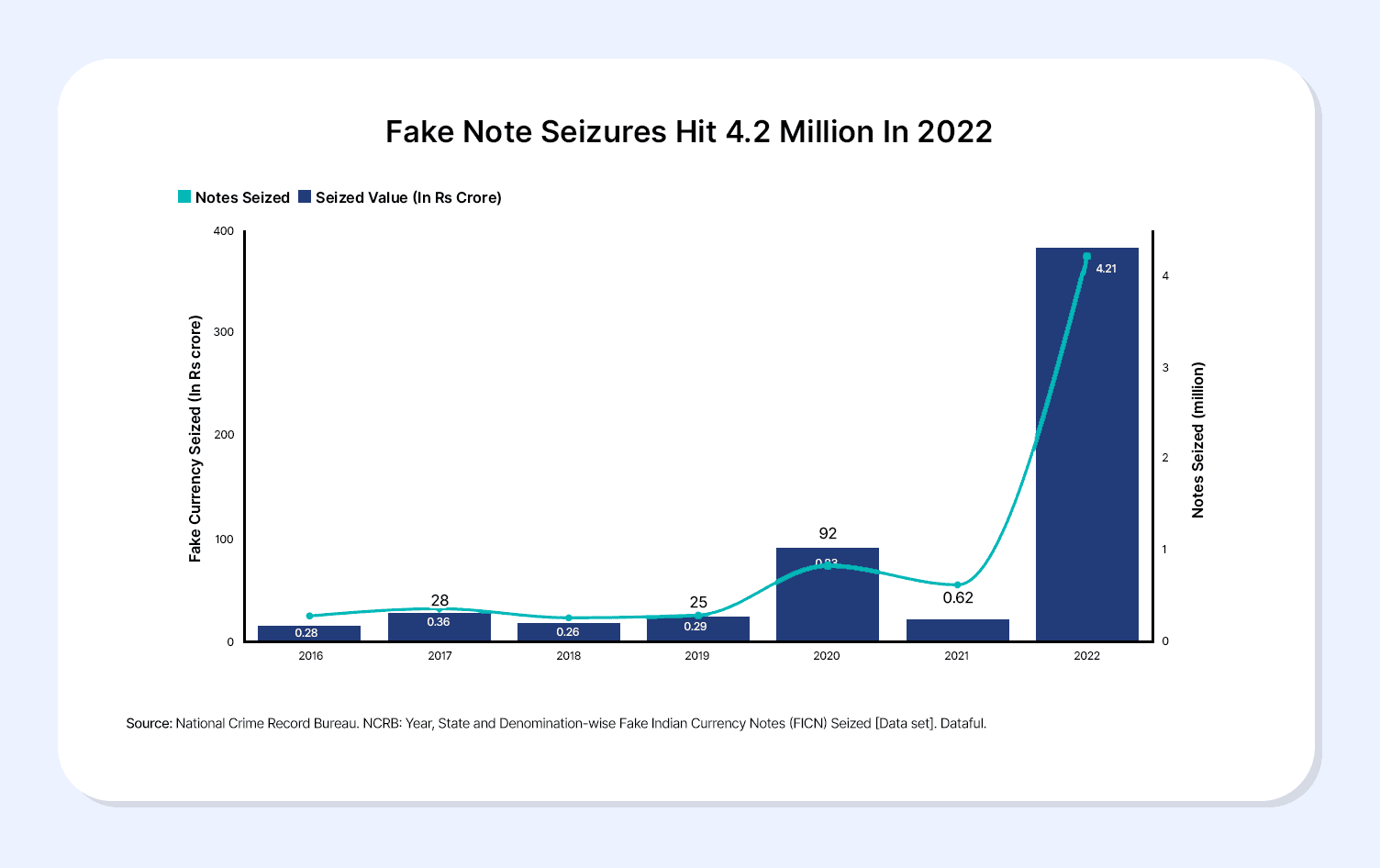
To prevent the economy from the adverse impact, it is important to track and seize the fake currency. Checkout the chart below that presents the increased number of fake note seizures:
Was Demonetisation Linked To Fake Currency Concerns?
Dhurandhar puts fake notes front and centre, so it is natural to ask whether demonetisation targeted the same risk. Official communication also put fake currency on the list of stated aims, alongside black money and terror financing.
- On 8 November 2016, the step removed legal tender status for INR 500 and INR 1,000 notes to curb Fake Indian Currency Notes (FICN)- linked terror funding9.
- Later, RBI and parliamentary replies repeated the same objective set, so counterfeit risk clearly sat inside the stated rationale10.
- Impact is harder to pin down, however, media reports cited seizures of about INR 16 crore in the year after versus about INR 51.3 crore in 201611, while RBI data for FY2016–17 showed about INR 43 crore counterfeit notes detected12.
Counterfeit management is not an India-only issue, and most countries treat it as routine currency hygiene. The US highlights security as the main purpose of redesign, while the euro area and the UK publish regular updates on counterfeits removed from circulation. That tells you why governments keep upgrading notes instead of waiting for a crisis.
Governments also keep operational details quiet for a reason. Printing plans, vendor-level choices, logistics, and timing are part of the security model, and the Supreme Court has noted the need for confidentiality and speed.
What Dhurandhar Gets Right — And Where Cinema Simplifies Reality
Dhurandhar gets the core instinct right. Fake currency is not a street trick; it is a system problem that starts with inputs, controls, and distribution networks. It also correctly hints that “near-perfect” fakes thrive when security features stay static and oversight slips.
However, cinema simplifies cause and effect. Real policy decisions bundle multiple goals, so demonetisation cannot be reduced to one motive or one villain. Investigations and allegations also move through evidence, due process and timelines, not through neat reveals. If you watch the film as a trigger to ask better questions about cash security, you take the right takeaway.
How To Spot A Fake Indian Note: A Quick Checklist
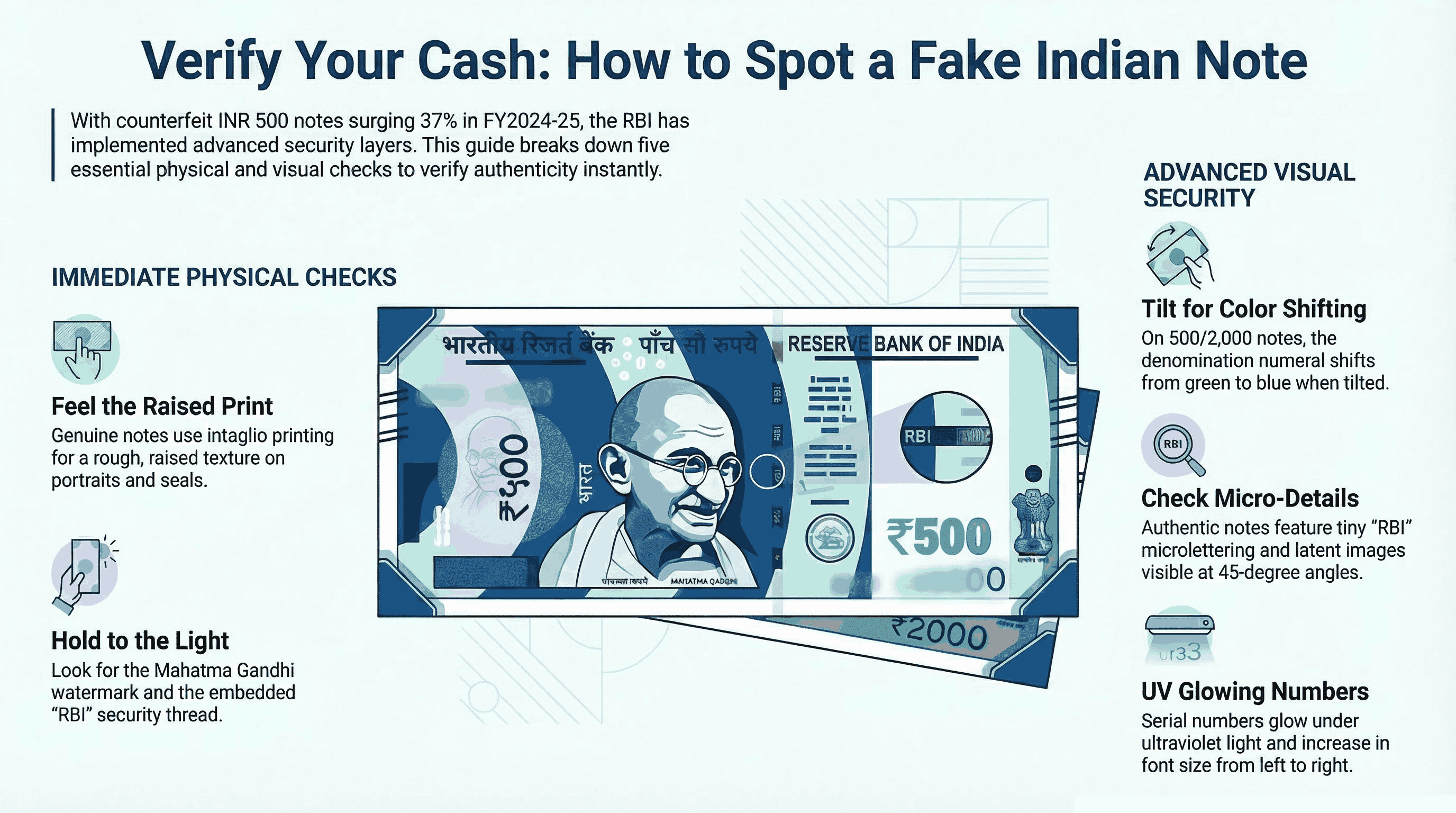
With counterfeit INR 500 notes surging 37% in FY2024-25, knowing how to identify a genuine note is more important than ever. The RBI has built multiple layers of security into every banknote, and checking even a few of these can help you spot a fake instantly.
1. Feel the note first
Genuine Indian currency is printed using intaglio printing, which gives the portrait of Gandhi, the RBI seal, and the denominational numeral a raised, rough texture you can feel with your fingertips.
Fake notes feel flat and smooth because regular printers cannot replicate this.
2. Hold it up to light
When held against light, a real note reveals a watermark of Mahatma Gandhi's portrait along with the denomination numeral. You will also see a security thread embedded in the paper that reads "bharat" (in hindi script) and "RBI" alternately.
Both are nearly impossible to fake convincingly.
3. Tilt the note
On INR 500 and INR 2,000 notes, the denominational numeral uses Optically Variable Ink (OVI), meaning it shifts between green and blue when you tilt the note.
This is one of the easiest and most reliable checks.
4. Look closely at the print
Genuine notes contain microlettering, tiny text reading "RBI" and the denomination that is only visible under a magnifying glass.
There is also a latent image of the denomination visible only at a 45-degree angle. Counterfeit notes almost always fail these two checks.
5. Check the serial number and ink
The serial number on a real note is printed in fluorescent ink that glows under ultraviolet light. The numeral panel on the right side of newer notes also increases in font size from left to right, a detail most counterfeiters miss.
What to do if you receive a fake note?
Do not try to pass it on. Hand it over to your bank branch, which is required under RBI guidelines to impound it, give you a receipt, and report it to the local police or RBI.
You will not be compensated, but you are legally protected if you surrender it in good faith.
FAQs
Q1. Is the Dhurandhar movie story real or fictional?
Dhurandhar is a fictional spy thriller inspired by real events. The Khanani Brothers and the De La Rue currency controversy it references were real, but the specific characters and plot are dramatized.
Think of it as "inspired by true events" rather than a factual retelling.
Q2. What was the 2007 Indian currency controversy?
India had outsourced its currency security paper to British firm De La Rue, and by 2007, Parliament raised alarms over near-perfect fake INR 500 and INR 1,000 notes flooding in from Pakistan via Nepal and Bangladesh.
Pakistan's ISI allegedly procured excess security paper from the same supply chain, making FICNs match up to 12 of 14 RBI security features. The scandal eventually led to De La Rue being blacklisted by the Indian government.
Q3. What are currency printing plates?
Currency printing plates are precision-engraved metal plates used to print banknotes using a high-security method called intaglio printing. They transfer ink under heavy pressure onto special currency paper, creating the raised, tactile feel you notice on real notes.
Leaking or duplicating these plates is treated as a national security threat because it allows counterfeiters to replicate nearly every physical feature of a genuine note.
Q4. How do fake notes affect the economy?
Counterfeit currency hurts the economy in two ways: if detected, the person holding fake notes suffers a direct financial loss, and if they circulate undetected, they inflate the money supply and drive up prices.
Beyond everyday harm, FICNs are directly linked to funding terrorism and organized crime in India. RBI data shows counterfeit INR 500 notes surged 37% year-on-year in FY2024-25, and that is only what gets caught in the banking system.
Reference:
1. Sansad, accessed fron: https://sansad.in/getFile/loksabhaquestions/annex/185/AU3648_nOaOGH.pdf?source=pqals
2. Bank of england, accessed from: https://www.bankofengland.co.uk/news/2019/june/boe-enters-into-contracts-to-supply-polymer-for-the-5-10-and-next-50-banknote
3. RIKS bank, accessed from: https://www.riksbank.se/en-gb/press-and-published/notices-and-press-releases/press-releases/2018/de-la-rue-becomes-the-riksbanks-new-banknote-supplier/
4. Delarue accessed from: https://www.delarue.com/about/our-history
5. Indian express, accessed from: https://indianexpress.com/article/explained/the-story-of-de-la-rue-currency-printing-firm-at-centre-of-cbis-mayaram-case-8380691/
6. The print, accessed from: https://theprint.in/india/why-ex-finance-secy-mayarams-under-cbi-lens-illegal-extensions-to-uk-firm-that-lied-about-patent/1312999/
7. Business world, accessed from: https://www.businessworld.in/article/dhurandhar-s-untold-story-chidambaram-mayaram-the-villains-the-movie-missed-583551
8. X, accessed from: https://x.com/haryannvi/status/1997925178643505300/photo/1
9. RBI, accessed from: https://www.rbi.org.in/commonman/Upload/English/PressRelease/PDFs/PR114208112016.pdf
10. Business standard, accessed from: https://www.business-standard.com/article/economy-policy/a-year-after-demonetisation-seizures-of-fake-currency-notes-see-sharp-dip-117110700717_1.html
11. India spend, accessed from: https://www.indiaspend.com/data-viz/dataviz-the-changing-nature-of-fake-currency-963436
Want to stay at the top of your finances?
Join the community of 4 lakh+ investors and learn more about Grip Invest, the latest financial knick-knacks, and shenanigans in the world of investing.
Happy Investing!
Disclaimer - Investments in debt securities/municipal debt securities/securitised debt instruments are subject to risks including delay and/ or default in payment. Read all the offer related documents carefully. The investor is requested to take into consideration all the risk factors before the commencement of trading.
This communication is prepared by Grip Broking Private Limited (bearing SEBI Registration No. INZ000312836 and NSE ID 90319) and/or its affiliate/ group company(ies) (together referred to as “Grip”) and the contents of this disclaimer are applicable to this document and any and all written or oral communication(s) made by Grip or its directors, employees, associates, representatives and agents. This communication does not constitute advice relating to investing or otherwise dealing in securities and is not an offer or solicitation for the purchase or sale of any securities. Grip does not guarantee or assure any return on investments and accepts no liability for consequences of any actions taken based on the information provided. For more details, please visit www.gripinvest.in
Registered Address - 106, II F, New Asiatic Building, H Block, Connaught Place, New Delhi 110001


