

Tax On Fixed Deposits In India 2026: How To Maximise Post-Tax Returns


Fixed deposits (FDs) have long been one of the most trusted investment options in India, especially for risk-averse investors seeking stable and guaranteed returns. However, what many overlook is that FD interest is fully taxable, which can significantly reduce your actual post-tax earnings.
Understanding the tax on fixed deposits in India including how interest is taxed, TDS deductions, and ways to save tax on FD interest is crucial to optimising your returns.
In this blog, we break down how FD taxation works in 2026, applicable tax rates, and smart strategies to maximise your post-tax FD income.
Understanding FD Taxation In India
The regulatory framework governing fixed deposit taxation follows clear principles that affect the ultimate yield investors realise.
1. Interest from FDs is fully taxable under Income from Other Sources
All interest earned from fixed deposits is classified under "Income from Other Sources" in your income tax return. This fixed deposit interest is subject to taxation according to your applicable income tax slab rate. Unlike certain investments that enjoy preferential tax treatment, FD interest receives no inherent tax advantages unless specifically structured as tax-saving instruments.
2. Applicable TDS rules (10% if PAN is provided)
Financial institutions implement TDS on fixed deposits at a standard rate of 10% under section 194A when interest earnings cross the INR 50,000 per financial year threshold1. This ensures advance tax collection directly at the source rather than waiting for the assessment year conclusion.
If you fail to provide your Permanent Account Number (PAN) to the bank, the TDS increases to 20%, effectively doubling the tax deduction.
Read: HDFC Fixed Deposit Rates 2026: Latest FD Interest and Smart Alternatives
TDS Deduction Explained
1. When And How Banks Deduct Tds
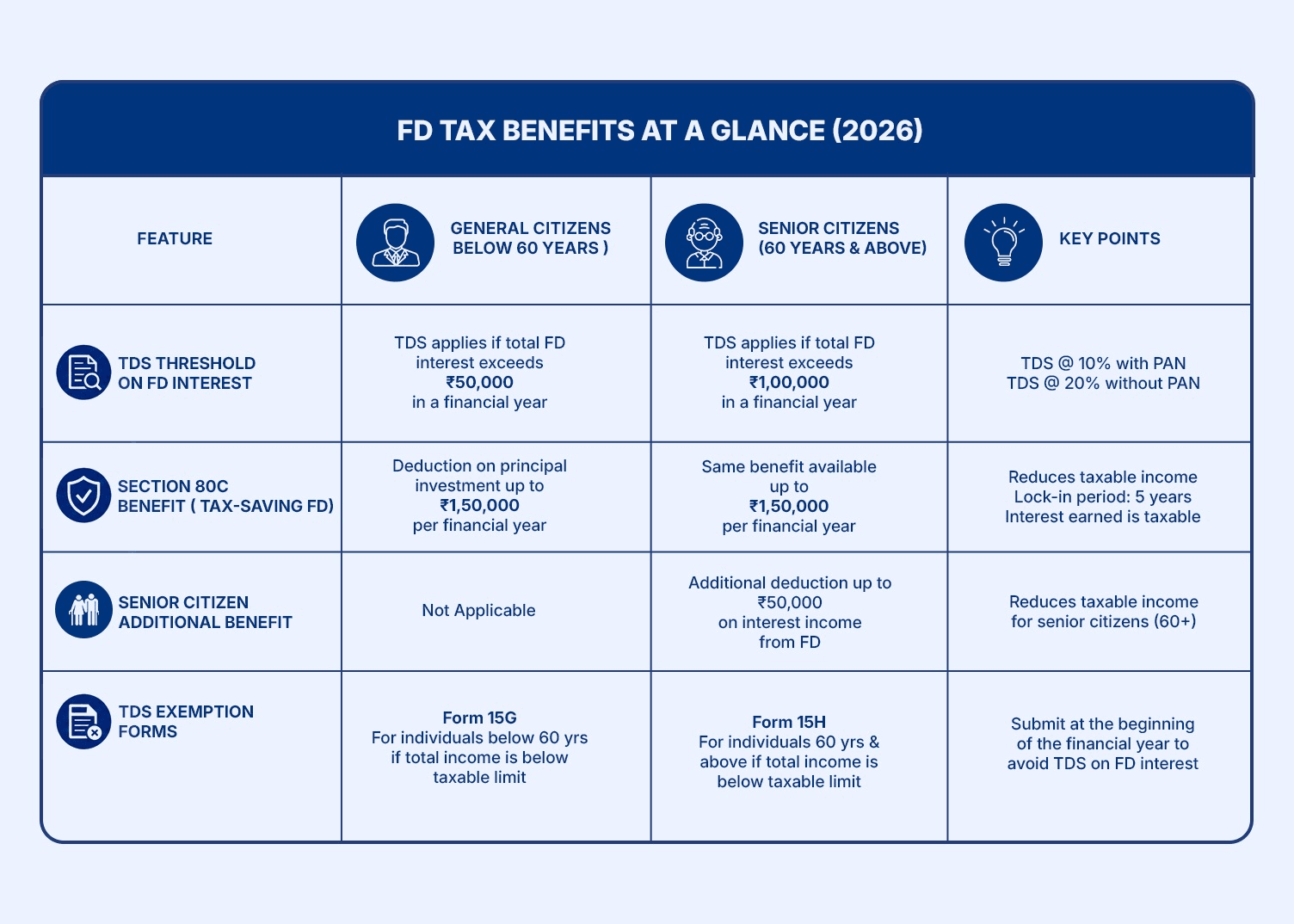
TDS on FD interest rates 2026 has to be paid to banks on your interest income if it exceeds INR 50,000 during a financial year. For senior citizens, this threshold is more generous at INR 1,00,000, providing additional tax advantages to older investors.
For most major financial institutions utilising Core Banking Solutions, this threshold applies cumulatively across all branches. However, some cooperative banks and smaller institutions may calculate these limits independently for each branch, allowing for strategic deposit distribution to minimise TDS impact.
The deduction typically occurs quarterly, with banks issuing TDS certificates (Form 26AS) that document these deductions. These certificates serve as essential documentation when filing income tax returns and claiming credit for taxes already paid.
2. Form 15g/15h Exemption For Eligible Individuals
A strategic opportunity exists for eligible investors to minimise TDS on fixed deposits through Form 15G for FD tax (for non-senior citizens) or Form 15H (for senior citizens). These declarations certify that your total income falls below the taxable threshold, making you eligible for TDS exemption.
These forms require submission at the beginning of each financial year, ideally by April 1st, and must be renewed annually. Late submissions remain valid only for subsequent interest payouts, not retroactively.
Smart Tax-Saving Strategies
Implementing deliberate strategies can substantially improve your post-tax returns from fixed deposit investments. Consider these approaches to improve your fixed deposit tax position.
1. Using 5-Year Tax-Saving FDs Under Section 80c
For investors seeking both fixed returns and tax advantages, 5-year tax-saving FDs offer a compelling option under Section 80C. These specialised deposits allow deductions up to INR 1,50,000 from your taxable income, effectively reducing your overall tax burden.
The FD tax saving options require a five-year lock-in period, during which premature withdrawals remain restricted. While this constrains liquidity, the combined benefit of interest income and tax deduction often results in better effective yields compared to regular FDs, particularly for investors in higher tax brackets.
2. Spreading FDs Across Financial Years To Reduce Tax Load
A strategic approach to fixed deposit tax exemption involves distributing your investments across different financial years to manage your taxable interest income more effectively.
Let us say you have INR 10,00,000 to invest in fixed deposits. Instead of placing the entire amount in a single FD, consider this strategic approach:
| Timing | Amount | |
| March 2025 (end of FY 2024-25) | INR 3,00,000 | First installment |
| April 2025 (start of FY 2025-26) | INR 4,00,000 | Second installment |
| February 2026 (late FY 2025-26) | INR 3,00,000 | Third installment |
The first FD's interest starts accruing at the end of FY 2024-25, with minimal interest taxable in that year. The bulk of interest gets spread across multiple subsequent financial years.
This prevents interest accumulation crossing the INR 50,000 TDS threshold in any single year.
Additionally, if interest rates are fluctuating, this approach also allows you to capitalise on rate increases over time rather than locking in your entire corpus at one rate.
Read: Risk-Adjusted Returns: The Smarter Metric Every Investor Should Know
Current TDS Rules On FD Interest
The Union Budget 2025 revised the TDS rules and income tax on FD interest4. The banks deduct TDS only if the total interest earned from fixed deposits, recurring deposits or similar instruments in a financial year exceeds the threshold limit set for your category of taxpayer, effective from 1 April 2025.
| TDS rate, PAN provided | 10%5 |
| TDS rate, if PAN is not provided | 20%6 |
1. Threshold limits
The new TDS thresholds on interest income from FDs (and similar deposits) starting FY 2025–26 are:7
| For regular citizens | 10% TDS applies if total interest exceeds INR 50,000 in a financial year |
| For senior citizens (60+ years old) | 10% TDS applies only if total interest exceeds INR 1,00,000 in a financial year |
2. Senior citizen rules
The senior citizen FD tax deducted at source on FD interest was doubled from INR 50,000 to INR 1,00,000 per financial year, in Budget 2025, providing significant relief to retirees.
Here is an example showing interest earned vs TDS deducted for regular citizens.
| Annual Interest earned | TDS deducted (%) | TDS threshold | Net interest Credited |
| 40,000 (Regular) | – | 50,000 | 40,000 |
| 55,000 (Regular) | 5,500 (10%) | 50,000 | 49,500 |
| 1,00,000 (Senior) | – | 1,00,000 | 1,00,000 |
| 1,20,000 (Senior) | 12,000 (10%) | 1,00,000 | 1,08,000 |
FD Income Tax Exemptions And Deductions Available
1. Tax Burden Reduction
Many Tax-saving provisions allow people to reduce their tax burden and can help them save taxes by allowing tax deductions from their taxable income. Each taxpayer of the financial year can reduce their total tax liability due to an income member.
Tax-saving fixed deposits fall under Section 80C. They allow you to deduct the principal amount invested in a tax-saving FD up to INR 1,50,000 per financial year. Therefore, the amount of tax you pay will be directly affected by the FDs you invest in. However, the interest earned on tax-saving fixed deposits will be subject to income tax.
2. Senior Citizen Tax Benefit
Senior citizens (60 plus) receive more favourable tax treatment than others do. As a result, senior citizens can offset up to INR 50,000 against their interest income from fixed deposits. This benefit from fixed deposits will be of significant assistance to seniors who depend on fixed deposit interest.
3. TDS Exemption
Form 15G on FD is required for taxpayers under the age of 60 to be able to avoid TDS on fixed deposits when their projected total annual income falls below the threshold for taxability. Similarly, Form 15H is for individuals over age 60. Both of these must be submitted to your FD bank at the beginning of the financial year. By using fixed deposits with the appropriate tax deduction methods based on projected income and submitting the required forms, you can receive higher returns than you would without these benefits.
Key Differences: Tax-Saving FD vs Normal FD
If you are seeking the best possible saving sources as per your budget and time limit, here is fixed deposit comparison. It will give an insight about what will serve best in your favour.
Feature | Normal FD | Tax-Saving FD |
Tax benefit under Section 80C | Not available | The section 80c FD benefits are available up to INR 1.5 lakh |
Lock-in period | Flexible | Fixed at 5 years |
Premature withdrawal | Allowed with a penalty | Not allowed |
Interest payout | Cumulative and non-cumulative | Cumulative only |
Interest taxation | Fully taxable | Fully taxable |
Suitable for | Liquidity and income | Tax planning |
Which FD Should You Pick?
The type of fixed deposit depends on your tax status, liquidity requirements, age, and risk tolerance, since each FD serves a different purpose in finance. These are general but significant considerations to keep in mind when selecting normal FD vs 5 year FD that fit your budget.
1. For Tax Benefits
If saving tax is your main objective, a tax-saving FD would be a more appropriate option. It enables you to claim deductions under the FD option for 80c, making it effective for those earning a salary or self-employed professionals who do not fully use their 80C limit. The tax deduction on FDs has been raised to 1.5 lakh per financial year, and tax-saving FDs are among the safest 80c eligible FD schemes-qualified FD plans available.
2. For Short-Term Cash Flow
A normal FD will suit the investors who require money or wish to keep their money as a short-term deposit. Its flexibility in tenure and early withdrawal option make it the best choice for emergency funds or short-term money planning. This is the place where the FD interest rate difference between fds is not considered significant relative to liquidity.
3. For Senior Citizens
The elderly tend to use conventional FDs due to higher interest rates and spot payments. This is vital, as it allows one to access the money when needed. Tax-saving FDs are not the best options because they are too committed to lock-in. Compared with 5-year FDs, normal FDs tend to be more flexible, benefiting senior citizens.
4. For Low-Risk Long-Term Goals (Including Corporate FDs)
Investors with a low-risk profile and long-term objectives may find a mix of tax-saving FDs and corporate FDs effective. The corporate FDs offered by Grip offer the chance to earn higher returns than regular bank FDs while retaining the safety of investment-grade. The returns on these corporate FDs range from 8% to 10%, compared with 6 to 7% offered by bank FDs, and they provide the option for cumulative or non-cumulative interest payouts. They are also controlled and covered with security measures, and hence they suit investors who want to increase returns without substantially raising risk. With the best 80c FD options 2025 to best options for 2026, Grip is giving potential FD options for all category investors.
5-Year Tax-Saving FD
A 5-year tax-saving FD is available only to eligible resident individuals and Hindu Undivided Families (HUFs). It is not available to companies, partnership firms, or non-resident Indians (NRIs), although eligibility may vary depending on the bank's policies and applicable regulations.
Before investing, remember that:
- The deduction under Section 80C is available only under the old tax regime.
- The deposit must remain invested for a mandatory lock-in period of five years.
- Premature withdrawals are generally not permitted during the lock-in period.
Understanding these conditions can help you determine whether a tax-saving FD aligns with both your tax planning and liquidity needs.
How It Compares With Other Section 80C Investments?
The 5-year tax-saving FD is just one investment that falls within Section 80C and provides tax savings. This form of investment guarantees returns, but there are other investments that provide higher growth, increased liquidity, or more tax benefits. These aspects have been explained below to help you understand what works best for you as an investor.
1. Public Provident Fund (PPF)
Public Provident Fund is a savings scheme by the government, and the period is fixed at 15 years. PPF provides tax-free interest along with tax-free maturity value and can be used for wealth creation through investments. However, since the lock-in period is longer, investors looking for liquidity may find it difficult.
2. Equity-Linked Savings Scheme (ELSS)
The Equity-Linked Savings Scheme (ELSS) is another popular tax-saving option, which is a mutual fund investing mostly in equities. ELSS has the shortest lock-in period among major Section 80C options, which is three years. This scheme provides potential for high returns along with increased risks.
3. National Savings Certificate (NSC)
Another government-guaranteed investment, NSC, has a tenure of five years. It is a good investment instrument due to its assured returns and the low risk involved. Unlike a 5 Year Tax-Saving FD, it is a compounding plan and is eligible under Section 80C till maturity, but not in the last year.
4. Employees Provident Fund (EPF)
It is a retirement savings plan for salaried individuals. Both the deposits and interest are exempt from taxes based on existing laws. The EPF is perfect for creating your retirement corpus, but cannot be opted for by all investors.
5. Sukanya Samriddhi Yojana (SSY)
SSY is a financial plan for a girl child. The SSY has good returns guaranteed by the government, with good taxation benefits. But only parents or legal guardians of an eligible girl child can avail of the same.
| Investment | Lock-in | Risk | Liquidity | Return Potential | Tax Treatment |
| 5 Year Tax-Saving FD | 5 years | Low | Low | Fixed | Investment eligible under Section 80C; interest taxable |
| PPF | 15 years | Very Low | Partial withdrawals after specified years | Moderate | Exempt-Exempt-Exempt (EEE) |
| ELSS | 3 years | High | Moderate after lock-in | High (market-linked) | Investment eligible under Section 80C; LTCG tax applicable beyond limits |
| NSC | 5 years | Low | Low | Fixed | Investment eligible under Section 80C; interest taxable, with reinvestment benefits until maturity |
| EPF | Until retirement (with certain withdrawal provisions) | Very Low | Limited | Moderate | Tax benefits are subject to the prevailing rules |
| Sukanya Samriddhi Yojana | Up to maturity or eligible withdrawal | Very Low | Limited | Moderate to High | Exempt-Exempt-Exempt (EEE) |
Cumulative FD Vs Non-Cumulative FD: Key Differences
While the most prominent difference between cumulative and non-cumulative fixed deposit is how the FD interest tax India is treated in each option, there are several other factors that an investor should consider while making a decision:
| Basis of Comparison | Cumulative Fixed Deposit | Non-Cumulative Fixed Deposit |
| Interest Payout | Interest is not paid periodically under a cumulative fixed deposit. It is received at maturity along with the principal. | Interest earned under a non-cumulative deposit is paid at regular intervals such as monthly, quarterly, or annually. |
| Compounding | Under a cumulative fixed deposit, interest is reinvested and compounded over the fixed deposit tenure. | There is no compounding benefit in a non-cumulative fixed deposit, as interest is paid out rather than reinvested. |
| Maturity Value | Cumulative fixed deposits have a higher maturity value due to compounding. | Non-cumulative fixed deposits have a lower maturity value than cumulative fixed deposits at the same interest rate. |
| Cash Flow | Cumulative fixed deposits do not have a regular cash flow, as interest is not paid during the deposit period. | Non-cumulative fixed deposits provide a steady, predictable cash flow as interest is paid out periodically. |
| Tax Timing | As per cumulative FD tax rules, tax is levied each year when interest is accrued, and it is paid when the interest is paid out. Therefore, tax is paid on the lump-sum amount at maturity. | Non cumulative FD tax is levied on the interest payout. As the interest is paid annually, it is also taxed annually. |
| Best Suited For | Cumulative fixed deposits are suitable for investors focused on long-term savings and wealth accumulation. | For investors seeking a fixed return or regular income from their investments, non-cumulative fixed deposits are a great option. |
Taxation On Cumulative And Non-Cumulative Fd Interest
Interest earned on fixed deposits is taxable under “Income from Other Sources” in India. It is taxed regardless of the FD type and according to the investor’s applicable income tax slab. Under it, TDS on fixed deposit interest is calculated and deducted depending on the interest earned during a financial year.
In a cumulative fixed deposit, although the interest is received only at maturity, it is considered taxable every year as it accrues. This can result in higher tax liability in the year of maturity if not planned properly.
In a non-cumulative fixed deposit, interest is taxed in the year it is received, spreading the tax liability across years.
Let’s understand it with the help of an example:
Suppose you invest INR 5,00,000 in a fixed deposit with a 5-year tenure at an interest rate of 7.5% per annum. Assuming you fall under the 30% income tax slab:
If you have invested in a cumulative fixed deposit (in INR ):
| Year | Opening Balance | Interest @ 7.5% | Closing Balance | TDS @ 10% | Tax @ 30% |
| 1 | 5,00,000 | 37,500 | 5,37,500 | 0 | 11,250 |
| 2 | 5,37,500 | 40,313 | 5,77,813 | 4,031 | 12,094 |
| 3 | 5,77,813 | 43,336 | 6,21,149 | 4,334 | 13,001 |
| 4 | 6,21,149 | 46,586 | 6,67,735 | 4,659 | 13,976 |
| 5 | 6,67,735 | 50,080 | 7,17,815 | 5,008 | 15,024 |
If you have invested in a non-cumulative fixed deposit (in INR ):
| Year | Opening Balance | Interest @ 7.5% | Tax @ 30% | Net Interest |
| 1 | 5,00,000 | 37,500 | 11,250 | 26,250 |
| 2 | 5,00,000 | 37,500 | 11,250 | 26,250 |
| 3 | 5,00,000 | 37,500 | 11,250 | 26,250 |
| 4 | 5,00,000 | 37,500 | 11,250 | 26,250 |
| 5 | 5,00,000 | 37,500 | 11,250 | 26,250 |
What Is A Joint FD?
A Joint Fixed Deposit is an FD account opened in the names of two or more individuals. Banks generally allow multiple holders, with one person designated as the primary or first holder.3
Joint FDs are commonly opened by:
- Husband and wife
- Parents and children
- Siblings
- Business partners
Many people assume that because multiple names appear on the FD, the interest income is automatically shared equally for tax purposes. However, taxation works differently.
How Is Joint FD Interest Taxed?
Under Indian income tax laws, FD interest is taxable under the head "Income from Other Sources."
The key principle is:
The person who contributes the funds for creating the FD is generally liable to pay tax on the interest earned.
The ownership of the money matters more than the number of names mentioned on the FD account.4
Example 1: Single Contributor
Suppose:The entire
- Raj invests INR 10 lakh in a Joint FD.
- His wife Priya is added as the second holder.
- The FD generates INR 75,000 annual interest.
Even though Priya's name appears on the FD, Raj contributed the entire amount. Therefore:
- Taxable Interest for Raj = INR 75,000
- Taxable Interest for Priya = INR 0
Raj must report the full interest income in his Income Tax Return (ITR).
Example 2: Equal Contribution
Suppose:
- Raj contributes INR 5 lakh.
- Priya contributes INR 5 lakh.
- Total FD amount = INR10 lakh.
- Annual interest earned = INR 80,000.
In this case:
- Raj reports INR 40,000.
- Priya reports INR 40,000.
Since both contributed equally, the interest income is divided proportionately.
TDS Rules On Joint FD In 2026
Tax Deducted at Source (TDS) remains one of the most misunderstood areas of joint FD taxation.
As per current FD TDS rules:
- Banks deduct TDS when interest crosses the prescribed threshold.
- TDS is generally linked to the PAN of the first holder.
- The first holder receives the TDS credit in Form 26AS and AIS.
Example
Assume:
- Joint FD earns INR 1,20,000 interest.
- Bank deducts TDS of INR 12,000.
- Raj is the first holder.
- Raj and Priya contributed equally.
Actual taxable income:
- Raj = INR 60,000
- Priya = INR 60,000
However, TDS may appear entirely under Raj's PAN.
In such situations, proper disclosure should be made while filing returns so that the income and TDS credit are appropriately adjusted.
Can Form 15G Or Form 15H Be Submitted?
Yes. Eligible investors can submit:
This helps avoid TDS deduction if total taxable income remains below the applicable tax limits.
Joint FD Between Family Members
Joint FDs among family members are extremely common, but they can trigger additional tax considerations.
Husband and Wife Joint FD
If a husband gifts money to his wife and she invests it in a Joint FD, the clubbing provisions under the Income Tax Act may apply.
This means the interest income may still be taxable in the husband's hands, even though the FD includes the wife's name.6
Parent And Child Joint FD
If parents invest their own funds and add a child as a joint holder:
- Parents remain liable for tax.
- Child generally has no tax liability unless they contribute funds.
Senior Citizen and Child Joint FD
Many families add children as joint holders for operational convenience. However, tax treatment still depends on who contributed the funds.
The presence of a child's name alone does not transfer ownership or tax responsibility.
Joint FD vs Individual FD: Tax Difference
Many investors wonder whether opening a Joint FD provides any special tax advantage.
The answer is: Not necessarily.
Individual FD
- Tax liability is straightforward.
- Entire interest belongs to one person.
- Easy reporting in ITR.
Joint FD
- Requires tracking of actual contributions.
- TDS may appear under one PAN.
- Additional documentation may be needed.
- Useful for succession planning and operational convenience.
Quick Comparison:
Feature | Individual FD | Joint FD |
| Ownership | Single | Multiple |
| Tax Reporting | Simple | Contribution-based |
| TDS Credit | Single PAN | Usually first holder PAN |
| Succession Benefits | Limited | Better |
| Documentation | Minimal | Moderate
|
Alternative Tax-Efficient Investments
While fixed deposits offer stability, exploring complementary options can enhance your overall portfolio's tax efficiency.
Bonds and fixed-income instruments on Grip may offer better post-tax efficiency.
For investors seeking alternatives to traditional fixed-income interest tax structures, there are many fixed-income opportunities in instruments such as corporate bonds, invoice discounting, debt mutual funds and lease financing offered by Grip Invest that often provide higher nominal yields than bank fixed deposits.
Strategic allocation across these instruments, alongside traditional fixed deposits, can improve the tax efficiency of your overall fixed-income portfolio.
Conclusion
Improving post-tax returns from fixed deposits requires deliberate planning and awareness of the tax framework. By understanding the tax on fixed deposit mechanics and implementing appropriate strategies such as tax-saving FDs, strategic timing, and form submission, investors can significantly enhance their effective yields. Investors can also use an FD interest tax calculator to understand how much tax their investment will incur.
Visit Grip Invest today to explore smarter ways to grow your savings.
FAQs On FD Tax
1. How is FD interest taxed in India?
FD interest is fully taxable under "Income from Other Sources" at your applicable income tax slab rate, regardless of whether you withdraw or reinvest the interest.
2. What is the TDS rate on fixed deposit interest?
The standard TDS on FD interest rates 2026 is 10% when interest exceeds INR 50,000 annually (INR 1,00,000 for senior citizens). This rate doubles to 20% if PAN details are not provided to the bank.
3. Is there any FD that offers tax-free interest?
No FD offers completely tax-free interest. However, 5-year tax-saving FDs provide tax deductions under Section 80C, effectively reducing your overall tax liability, though the interest itself remains taxable.
References:
1. Clear tax, accessed from: https://cleartax.in/s/tds-on-fd-interest
Want to stay at the top of your finances?
Join the community of 4 lakh+ investors and learn more about Grip Invest, the latest financial knick-knacks, and shenanigans in the world of investing.
Happy Investing!
Disclaimer - Investments in debt securities/municipal debt securities/securitised debt instruments are subject to risks including delay and/ or default in payment. Read all the offer related documents carefully. The investor is requested to take into consideration all the risk factors before the commencement of trading.
This communication is prepared by Grip Broking Private Limited (bearing SEBI Registration No. INZ000312836 and NSE ID 90319) and/or its affiliate/ group company(ies) (together referred to as “Grip”) and the contents of this disclaimer are applicable to this document and any and all written or oral communication(s) made by Grip or its directors, employees, associates, representatives and agents. This communication does not constitute advice relating to investing or otherwise dealing in securities and is not an offer or solicitation for the purchase or sale of any securities. Grip does not guarantee or assure any return on investments and accepts no liability for consequences of any actions taken based on the information provided. For more details, please visit www.gripinvest.in
Registered Address - 106, II F, New Asiatic Building, H Block, Connaught Place, New Delhi 110001


