

Debt Mutual Funds Vs Fixed Deposits: Returns, Taxation And Risks Compared



Debt Mutual Funds Vs Fixed Deposits: What Is The Difference?
Debt mutual funds vs fixed deposits (FDs) is a common low-risk instrument comparison. A bank FD pays interest at a predetermined rate. A debt mutual fund invests in fixed-income instruments and provides market-dependent returns.
However, the debt mutual funds vs FD comparison goes beyond returns. Investors should also consider risks, liquidity, tenure and taxation before choosing between them.
How Do Debt Mutual Funds And Fixed Deposits Work?
Both fixed deposit vs debt funds are debt instruments, but they work differently.
Debt Mutual Funds
Debt mutual funds collect money (as SIPs or lumpsum) from investors and use it to buy different debt securities. For example, a liquid fund scheme invested in the following as of 30 September 2026:1
Debt Instrument | Portfolio Allocation |
|---|---|
Commercial paper | 51.37% |
Certificates of deposit | 34.72% |
Treasury bills | 12.43% |
Other investments and cash | 1.48% |
These instruments have different maturity periods, risks and ways of earning income. The fund manager buys and sells them or holds them until maturity. The money received is then invested again.
Debt mutual funds earn returns in three ways:
- Interest income: The fund earns interest or receives more money at maturity than it paid for the securities.
- Changes in market prices: When market interest rates rise, existing bond prices generally fall. When rates fall, bond prices generally rise.
- Gains or losses from selling: The fund makes a gain or loss when it sells securities for more or less than their purchase price.
The above changing values affect the fund’s Net Asset Value (NAV), which is the value of one unit after expenses and liabilities. This rise/fall of NAV determines the investor’s returns. Suppose one buys a debt fund unit for INR 100. Over one year, the fund earns INR 7 in interest.
However, the value of its investments falls by INR 3, and fund expenses are INR 0.50. So, the unit's value increases to INR 103.50. Your actual return is 3.5%.
Fixed Deposits
In an FD, one deposits funds with a financial institution for a chosen period at an agreed interest rate and payout interval as per the terms during the time of investment.
For example, if you invest INR 1 lakh in a one-year bank FD at 6.25% simple annual interest, you earn INR 6,250 pre-tax at maturity.
Banks commonly offer FDs. Moreover, companies and RBI-regulated non-banking financial companies (NBFCs) also offer corporate fixed deposits. They may offer higher interest rates and eligible FDs provide credit ratings to better assess the repayment risk. Through Grip Invest, compare selected corporate FD options, complete KYC and book an FD online. You do not need to open a new bank account with the issuer.
Debt Mutual Funds Vs Fixed Deposits: Key Differences
The following shows the main differences between debt funds vs fixed deposits one needs to know before deciding the investment.
| Factor | Bank Fixed Deposits |
| Meaning | Money deposited with a bank for a fixed period at an agreed interest rate. |
| Returns and interest rates | Interest rate is fixed when booked. |
| Capital protection and risks | Eligible deposits have DICGC insurance up to INR 5 lakh per depositor per bank. Bank default risk remains. |
| Investment tenure | Fixed tenure |
| Minimum investment | Some bank FDs start at INR 1,000. The minimum varies by bank. |
| Liquidity | Early withdrawal may attract penalties or reduced interest. |
| Taxation | Interest taxed at applicable income-tax slab rates. |
| Income payout options | Interest paid regularly or at maturity. |
Taxation On Debt Mutual Funds Vs Fixed Deposits
FD and debt mutual fund taxation differs based on how returns are earned and when they are taxed. Here is the tax framework of the instruments under FY 2026-27.
FD Taxation
- FD interest is added to your taxable income and taxed at your applicable income-tax slab rate.
- Interest is generally taxable each year, even if the FD pays it at maturity.
- Banks generally deduct 10% (20% without PAN) TDS- Tax Deducted at Source when annual interest crosses the applicable limit (INR 50,000 for ?60 years or INR 1,00,000 for 60+).3,4 This amount is adjusted against your final tax liability when you file your income-tax return.
Debt Mutual Fund Taxation
For FY 2026-27, debt funds are generally considered as specified funds. The category generally includes those investing over 65% in debt and money-market instruments.5
- Units bought from 1 April 2023: Gains from specified debt funds are taxed at slab rates, regardless of the holding period, under Section 50AA (now Section 76).
- Units bought before 1 April 2023: Qualifying long-term gains after 24 months are generally taxed at 12.5% without indexation. Short-term gains are as per the tax slab.
Assume INR 1 lakh invested in each of the instruments for 1 year: 6.5% bank FD and a debt fund with 6.5% return. The debt fund is a specified fund purchased after 1 April 2023 and fully redeemed after one year. Plus, he/she falls under the 30% slab, and 4% cess on the tax.
Particulars | Bank FD | Debt Mutual Fund |
|---|---|---|
Initial investment | INR 1,00,000 | INR 1,00,000 |
Assumed gross return | 6.5% | 6.5% |
Value after one year | INR 1,06,500 | INR 1,06,500 |
Taxable amount | INR 6,500 (interest) | INR 6,500 (capital gains) |
Tax at 30% plus 4% cess | INR 2,028 | INR 2,028 |
Final amount after tax | INR 1,04,472 | INR 1,04,472 |
Both investments give the same post-tax return in this example because they face the same tax rate. However, FD earnings are taxed as interest income, while debt fund earnings are taxed as capital gains.
Debt Fund vs FD: Which is Better?
The choice of investment depends on the goal, investment period and risk level. Suppose the goal is school fees next year, an FD with a matching maturity can help or to park emergency funds, liquid or overnight funds that allow easy withdrawals (usually T+1 days) can be considered.
However, understand how these investments behave before choosing.
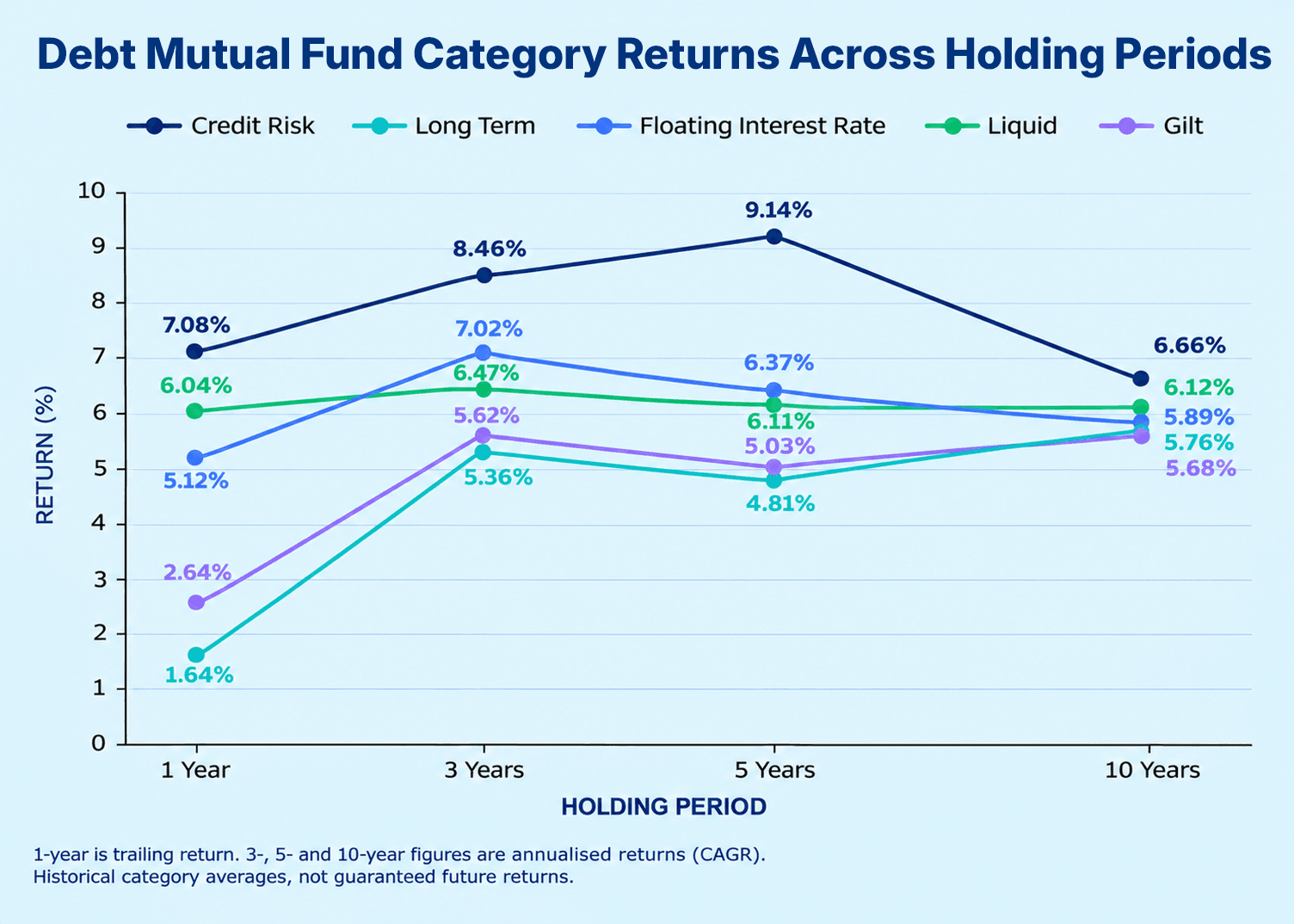
Debt fund returns change across investment periods. Consider the following historical category-average returns as of 19 November 2026.
Source: Value Research Online6
Liquid funds gave higher returns in short term vs floating interest rate funds long term. It shows performance changes with category and time period. However, past returns do not guarantee future returns. Investors must also check the fund's risks and suitable holding period.
FD rates also differ. RBI data shows that over two-thirds of outstanding bank term deposits had interest rates below 7% in June 2026. However, other FD options offer rates above 7%.7
Compare Grip’s curated list of corporate FDs offering up to 10% pre-tax IRR to help you achieve your goal faster!
FAQs

Want to stay at the top of your finances?
Join the community of 22 lakh+ investors and learn more about Grip Invest, the latest financial knick-knacks, and shenanigans in the world of investing.
Happy Investing!
Disclaimer - Investments in debt securities/municipal debt securities/securitised debt instruments are subject to risks including delay and/ or default in payment. Read all the offer related documents carefully. The investor is requested to take into consideration all the risk factors before the commencement of trading.
This communication is prepared by Grip Broking Private Limited (bearing SEBI Registration No. INZ000312836 and NSE ID 90319) and/or its affiliate/ group company(ies) (together referred to as “Grip”) and the contents of this disclaimer are applicable to this document and any and all written or oral communication(s) made by Grip or its directors, employees, associates, representatives and agents. This communication does not constitute advice relating to investing or otherwise dealing in securities and is not an offer or solicitation for the purchase or sale of any securities. Grip does not guarantee or assure any return on investments and accepts no liability for consequences of any actions taken based on the information provided. For more details, please visit www.gripinvest.in
Registered Address - 106, II F, New Asiatic Building, H Block, Connaught Place, New Delhi 110001


